Municipal Water Supply Pipe Material Comparison: Ductile Iron, HDPE, PVC, Stainless Steel, and Steel–Nylon Composite Pipes

As global urbanization continues, the construction, rehabilitation, and modernization of municipal water supply networks are becoming increasingly important components of infrastructure investment.
For municipal engineering companies, water utilities, EPC contractors, and pipeline procurement professionals, selecting the right water supply pipe is no longer simply a matter of comparing material prices.
It is a long-term engineering decision involving water safety, structural reliability, corrosion resistance, hydraulic efficiency, installation costs, and lifecycle performance.
Common materials used in municipal water supply systems include:
-
Ductile Iron Pipes (DIP)
-
High-Density Polyethylene Pipes (HDPE)
-
Polyvinyl Chloride Pipes (PVC)
-
Carbon Steel Pipes
-
Stainless Steel Pipes
-
Fiberglass Reinforced Plastic Pipes (FRP/GRP)
-
Steel–Nylon Composite Pipes
Each material offers specific advantages and limitations.
In high-pressure, large-diameter, corrosive, or continuously operated water transmission systems, conventional materials may not always provide the optimal balance between mechanical strength, corrosion resistance, and long-term maintenance costs.
As a result, engineered composite piping solutions that combine metallic structural strength with non-metallic protective layers are attracting greater attention.
This article compares major municipal water supply pipe materials and explains how steel–nylon composite pipes can provide additional value in selected water infrastructure applications.
1. Why Is Municipal Water Supply Pipe Selection Becoming More Important?
Municipal water pipelines are often designed to operate for several decades.
Once a major transmission pipeline is installed, repairing or replacing it can be significantly more expensive than the original pipe purchase.
In densely populated urban areas, pipeline failures may also result in road excavation, traffic disruption, water service interruptions, and substantial indirect economic losses.
1.1 Aging Infrastructure and Corrosion
Traditional metallic pipelines may experience several deterioration mechanisms during long-term service, including:
-
External corrosion caused by soil and groundwater
-
Internal corrosion associated with dissolved oxygen and aggressive ions
-
Accumulation of corrosion products and deposits
-
Joint deterioration and leakage
-
Damage caused by pressure fluctuations and water hammer
However, properly lined and externally protected ductile iron and steel pipes can also achieve long service lives.
Pipeline durability depends not only on the base material but also on protective coatings, installation quality, environmental conditions, and operating practices.
1.2 Increasing Pressure and Transmission Requirements
Urban expansion, industrial parks, mountainous cities, and regional water transmission projects create additional demands on pipeline pressure ratings and structural performance.
Municipal water supply pipes must often accommodate:
-
Pump start-up and shutdown pressure fluctuations
-
Water hammer caused by rapid valve closure
-
Static pressure resulting from elevation differences
-
Soil and traffic loads
-
Temperature changes and long-term fatigue
These conditions encourage engineers to consider piping systems that combine mechanical strength with effective corrosion protection.
1.3 Greater Attention to Lifecycle Costs
Modern water infrastructure procurement increasingly evaluates long-term ownership costs rather than initial purchasing prices alone.
A pipe with a low purchase price may become expensive if it requires frequent repairs, replacement, or maintenance.
Consequently, durability, reliability, and maintenance efficiency have become important considerations in municipal pipe material selection.
2. Comparison of Common Municipal Water Supply Pipe Materials
2.1 Ductile Iron Pipes: Proven Structural Strength with Corrosion Protection Requirements
Ductile iron pipes have been widely used in municipal water distribution and transmission networks for decades.
Key advantages:
-
High mechanical strength
-
Good ring stiffness
-
Mature jointing and fitting systems
-
Suitable for many buried pipeline applications
-
Extensive experience in municipal water infrastructure
Main limitations:
-
Susceptible to corrosion without appropriate protection
-
May require additional external protection in aggressive soils
-
Localized corrosion can develop if internal linings are damaged
-
Relatively heavy, requiring suitable lifting and handling equipment
Ductile iron remains an established choice for conventional municipal water supply networks.
However, projects involving coastal groundwater, highly corrosive soils, or aggressive water chemistry require careful consideration of internal linings and external corrosion protection.
2.2 HDPE Pipes: Excellent Corrosion Resistance and Flexibility
High-density polyethylene pipes are widely used in municipal water supply, drainage, and distribution applications.
Key advantages:
-
Resistant to conventional electrochemical rusting
-
Good flexibility and ability to accommodate some ground movement
-
Heat-fused joints can create continuous piping systems
-
Relatively lightweight
-
Suitable for certain trenchless installation methods
Main limitations:
-
Lower elastic modulus compared with metallic pipes
-
Long-term pressure capability depends on material grade, temperature, and design life
-
Creep and deformation require consideration
-
Large-diameter, high-pressure applications may require thicker walls
-
Installation and fusion joint quality are critical
HDPE is particularly suitable for applications requiring flexibility and corrosion resistance.
However, in high-pressure, large-diameter transmission pipelines, engineers should also evaluate pipe wall thickness, available internal diameter, and structural requirements.
2.3 PVC Pipes: Cost-Effective for Conventional Water Distribution
PVC-U and PVC-O pipes are commonly used in water supply applications.
Key advantages:
-
Competitive initial material costs
-
Smooth internal surfaces
-
Good resistance to many water-related corrosive conditions
-
Lightweight construction
-
Established product standards and fitting systems
Main limitations:
-
Impact resistance varies significantly between PVC material types
-
Careful handling is required to prevent mechanical damage
-
Operating temperature and pressure limits must be respected
-
Ground movement and joint displacement require proper design
PVC-U and PVC-O should not be treated as identical materials.
PVC-O pipes, manufactured using molecular orientation technology, can provide different mechanical strength and impact performance characteristics.
Therefore, PVC pipe selection should consider the specific material grade, pressure rating, and installation conditions.
2.4 Stainless Steel Pipes: Strong Corrosion Performance at a Higher Initial Cost
Stainless steel pipes, particularly grades 304 and 316L, are used in water treatment facilities, pumping stations, equipment connections, and specialized water supply installations.
Key advantages:
-
Good mechanical properties
-
Smooth internal surfaces
-
Suitable for many clean-water and equipment-piping applications
-
Established manufacturing and welding technologies
Main limitations:
-
Relatively high initial investment
-
Susceptibility to chloride-induced pitting and crevice corrosion under certain conditions
-
Higher welding and installation quality requirements
-
Material and fabrication costs can increase significantly for large diameters
In chloride-rich water environments, stainless steel does not automatically guarantee complete corrosion resistance.
Although 316L generally offers better chloride corrosion resistance than 304, its suitability must still be evaluated according to chloride concentration, temperature, and operating conditions.
2.5 FRP/GRP Pipes: Lightweight Solutions for Selected Large-Diameter Applications
Fiberglass reinforced plastic pipes offer non-metallic corrosion resistance and are used in raw water transmission, seawater systems, and certain large-diameter water infrastructure projects.
Key advantages:
-
Relatively lightweight
-
Smooth internal surfaces
-
Resistance to many corrosive environments, depending on the resin system
-
Available for large-diameter pipeline applications
Main limitations:
-
Structural properties depend heavily on product design and manufacturing quality
-
Bedding and backfilling quality can significantly affect long-term performance
-
Local impact damage must be considered during handling and installation
-
Joint sealing and installation precision require careful control
When comparing FRP with metallic or composite pipes, engineers should evaluate ring stiffness, operating pressure, surge pressure, external loads, and installation conditions.
2.6 Steel–Nylon Composite Pipes: Combining Steel Strength with Polymer Protection
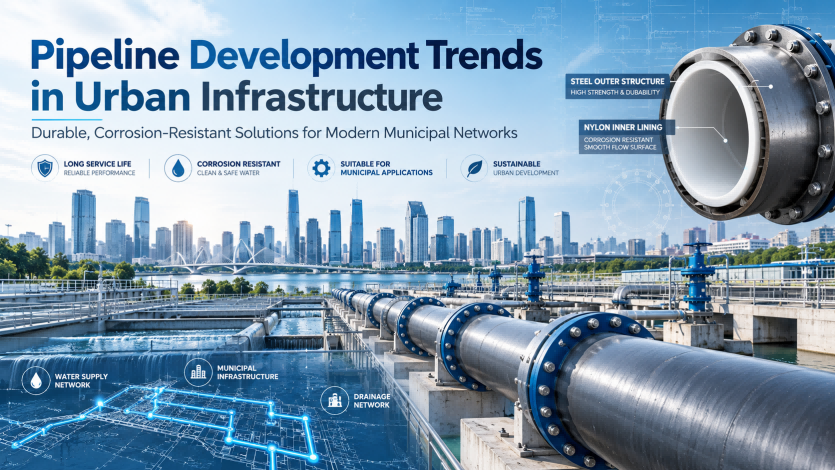
Steel–nylon composite pipes integrate the structural load-bearing capability of steel with the functional benefits of a nylon lining.
Their fundamental design principle is straightforward:
The steel structure provides mechanical support and pressure-bearing capability, while the nylon lining reduces direct contact between the transported fluid and the steel substrate.
Compared with conventional unlined carbon steel pipes, properly engineered steel–nylon composite pipes can offer potential advantages in internal corrosion control, surface smoothness, and abrasion resistance.
Compared with certain all-plastic piping systems, the steel component provides higher structural stiffness and mechanical support.
Key advantages include:
-
Combined benefits of steel and nylon materials
-
Reduced direct exposure of steel to compatible transported fluids
-
Smooth internal lining that supports hydraulic performance
-
Customizable designs for different diameters and pressure requirements
-
Potential suitability for water transmission systems requiring both structural strength and corrosion protection
-
Flanged connections for integration with pumps, valves, and other equipment
It is important to recognize that composite construction does not automatically eliminate corrosion risks associated with external steel surfaces, pipe ends, or flanges.
Actual performance depends on lining integrity, bonding quality, external protection, joint design, and operating conditions.
For potable water applications, all water-contact materials and the finished piping system must satisfy applicable drinking-water safety requirements and project-specific certifications.
3. Municipal Water Supply Pipe Material Comparison Table
The following table provides a qualitative comparison of general engineering characteristics.
Actual performance depends on specific product grades, manufacturing processes, pressure classes, and design conditions.
| Comparison Factor | Ductile Iron | HDPE | PVC | FRP/GRP | Steel–Nylon Composite |
|---|---|---|---|---|---|
| Structural strength | High | Design-dependent | Grade-dependent | Design-dependent | Steel-based structural support |
| Internal corrosion resistance | Depends on lining | Good | Good | Depends on resin | Depends on nylon lining integrity |
| External corrosion resistance | Requires protection | Good | Good | Good | Steel exterior requires protection |
| Flexibility | Relatively low | High | Low to moderate | Design-dependent | Generally low |
| Internal surface smoothness | Lining-dependent | Good | Good | Good | Smooth nylon lining |
| High-pressure applications | Established | Rating-dependent | Rating-dependent | Special design may be required | Can be engineered for specified pressures |
| Large-diameter applications | Established | Available in selected sizes | Available in selected sizes | Established | Depends on manufacturing capability |
| Joint systems | Push-on, flanged, etc. | Butt fusion, electrofusion, etc. | Socket joints, etc. | Couplings, flanges, etc. | Flanged connections |
| Major maintenance considerations | Corrosion and joints | Fusion joints and deformation | Joints and external damage | Joints and structural damage | Lining, flanges, pipe ends, and external coating |
No single pipe material is ideal for every municipal water supply project.
HDPE provides flexibility and corrosion resistance. PVC offers economic advantages in many conventional applications. Ductile iron provides proven mechanical strength and established installation systems.
FRP can be effective in selected large-diameter applications.
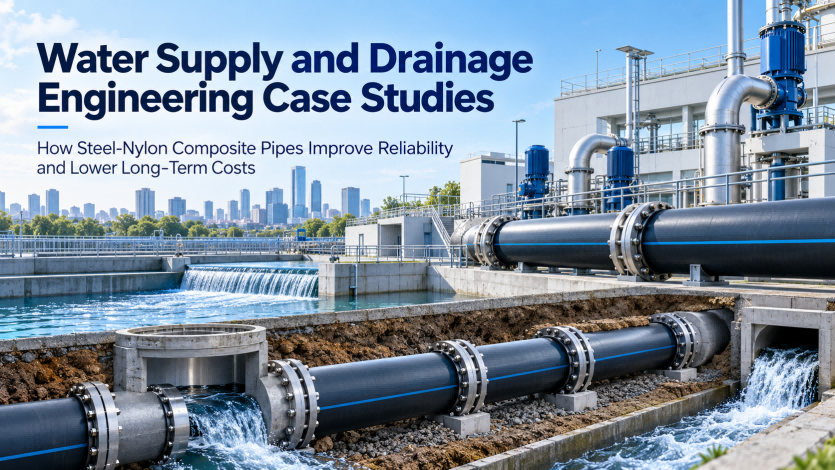
Steel–nylon composite pipes provide an additional option when projects require a combination of metallic structural performance and polymer-based internal corrosion protection.
4. Why Consider Steel–Nylon Composite Pipes for Water Infrastructure?
4.1 Steel-Based Structural Strength for Demanding Applications
Large municipal water transmission pipelines must accommodate continuous operating pressure, elevation changes, installation loads, and transient pressure fluctuations.
In steel–nylon composite pipes, the steel component can provide the primary structural support and pressure-bearing capability.
For projects requiring both stiffness and internal corrosion protection, this functional combination can provide engineering value.
Our company can evaluate steel–nylon composite pipe configurations for different diameters and pressure requirements, including applications with nominal pressure requirements in the approximate range of 1.0–4.0 MPa, subject to product design and verification.
Actual pressure ratings and temperature limits must be confirmed through product-specific technical documentation, design calculations, and testing.
4.2 Nylon Linings Help Reduce Internal Corrosion Risks
Traditional steel pipes may experience internal corrosion associated with dissolved oxygen, aggressive ions, and localized water chemistry.
Steel–nylon composite pipes use a polymer lining to separate the transported fluid from the steel substrate.
For fluids demonstrated to be compatible with the nylon material, this arrangement can help reduce internal corrosion risks caused by direct steel exposure.
Potential application areas include:
-
Coastal water infrastructure
-
Raw water transmission
-
Industrial park water supply
-
Reclaimed water transportation
-
Selected high-mineral-content water systems
For disinfected potable water, however, long-term compatibility with residual chlorine, chloramines, and other disinfectants must be evaluated.
Short-term chemical resistance results should not be used as a substitute for long-term performance verification.
4.3 Smooth Internal Surfaces Support Hydraulic Efficiency
Hydraulic efficiency is an important consideration in water transmission systems.
Pipe friction losses depend on flow rate, effective internal diameter, pipe length, flow velocity, and internal surface characteristics.
Steel–nylon composite pipes feature relatively smooth nylon internal surfaces.
Under suitable operating conditions, these surfaces can help control roughness and reduce internal diameter changes associated with corrosion.
This is particularly relevant to long-distance, high-flow water transmission projects.
However, hydraulic performance should always be compared using equivalent flow rates, actual internal diameters, and verified roughness values.
Steel–nylon composite pipes should not automatically be assumed to have lower pumping energy requirements than HDPE, PVC, or FRP systems.
4.4 Abrasion Resistance for Selected Raw Water Applications
Not all municipal water infrastructure systems transport fully treated drinking water.
Raw water pipelines may carry sand, suspended solids, or other abrasive particles.
Under these conditions, internal abrasion and corrosion can occur simultaneously.
Properly tested reinforced nylon materials may offer abrasion-resistant characteristics that support selected raw water transmission applications.
Areas requiring particular attention include:
-
Pump discharge sections
-
Elbows and bends
-
Diameter transitions
-
High-velocity pipeline segments
Actual abrasion resistance depends on particle hardness, particle size, solids concentration, fluid velocity, and impact angle.
4.5 Flanged Connections Support Installation and Maintenance
Pipeline connection methods directly affect installation efficiency, particularly in pumping stations, valve chambers, water treatment facilities, and pipeline rehabilitation projects.
Our steel–nylon composite piping solutions can incorporate purpose-designed flanged connections.
For suitable product configurations, integrated flange designs can reduce certain field connection operations and facilitate installation.
Potential benefits include:
-
Reduced need for selected on-site welding operations
-
Factory-prefabricated pipe sections
-
Convenient connection to pumps and valves
-
Easier removal of individual pipe sections during maintenance
-
Compatibility with modular installation approaches
Flanged joints must still be properly designed and installed according to operating pressure, gasket materials, bolt preload, and sealing requirements.
5. Which Pipe Material Is Best for Different Municipal Water Supply Applications?
Scenario 1: Urban Main Water Transmission Networks
Main requirements: Structural strength, long-term pressure resistance, reliability, and leakage control.
Common options include:
-
Ductile iron pipes
-
Steel pipes
-
Technically qualified steel–nylon composite pipes
Ductile iron remains a well-established solution for many conventional transmission networks.
However, when a project involves internal corrosion concerns combined with higher structural requirements, steel–nylon composite pipes may be considered during technical evaluation.
Scenario 2: Coastal Municipal Water Supply Systems
Main challenges: Salinity, corrosive groundwater, and aggressive soil conditions.
Potential material choices include HDPE, PVC, appropriately protected ductile iron, and steel–nylon composite pipes.
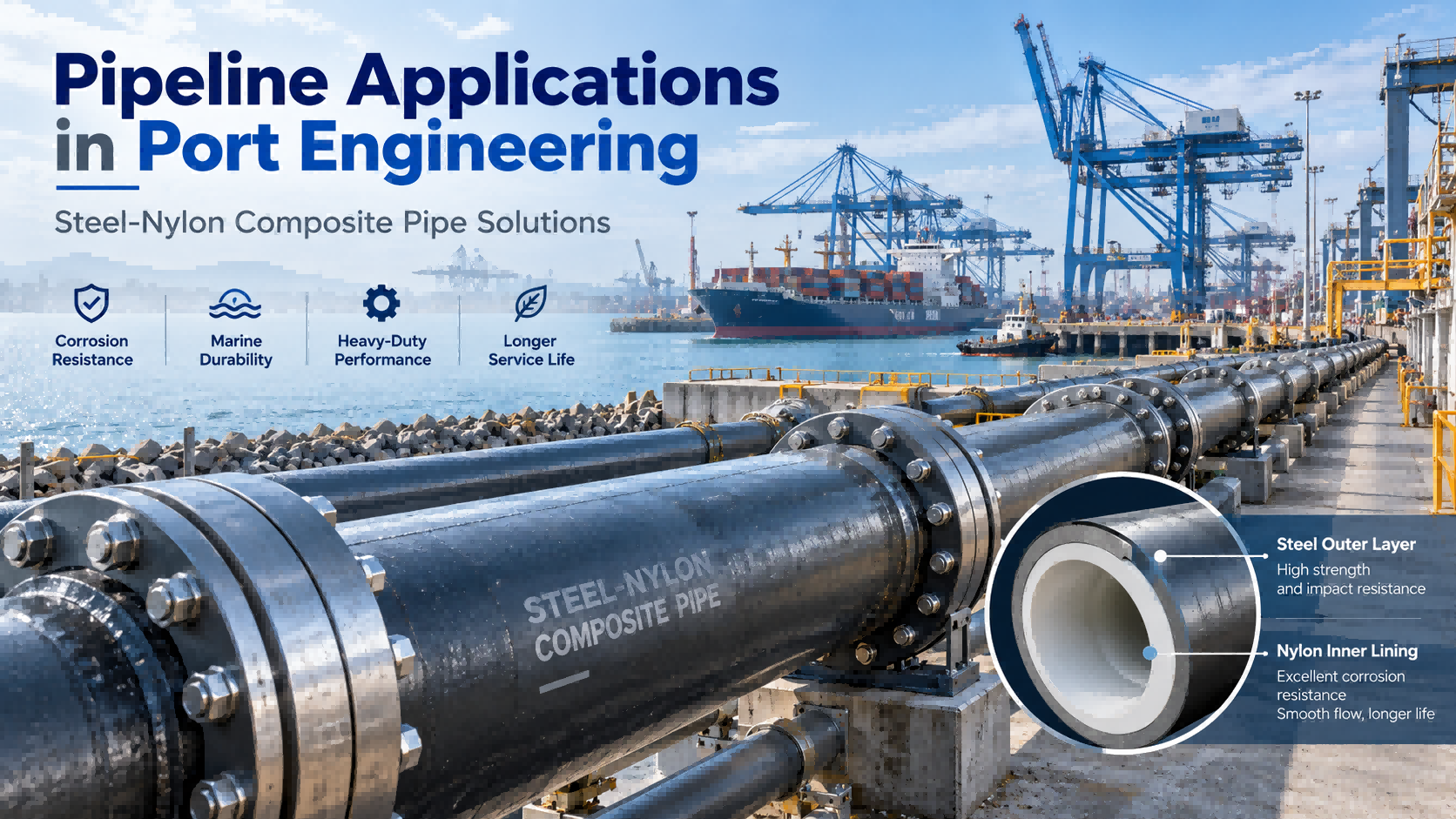
The nylon lining in steel–nylon composite pipes can help manage internal corrosion associated with compatible transported water.
Nevertheless, because the pipe includes steel structural components, reliable external corrosion protection remains essential.
Special attention should be paid to flanges, joints, buried connections, and exposed steel surfaces.
Scenario 3: Large-Diameter, Long-Distance Water Transmission
Main requirements: High flow capacity, stable pressure performance, installation reliability, and long-term economic efficiency.
Potential materials include steel, ductile iron, FRP, HDPE, and appropriately engineered composite piping systems.
Steel–nylon composite pipes may offer value when projects require:
-
High structural stiffness
-
Non-metallic internal protection
-
Reduced internal corrosion exposure
-
Lower maintenance requirements under validated operating conditions
For very large diameters, additional engineering verification is required for structural stability, manufacturing tolerances, transportation, and installation.
Scenario 4: Rehabilitation of Aging Municipal Water Pipelines
Main requirements: Reduced excavation, shorter service interruptions, and controlled project costs.
Depending on the rehabilitation method, engineers may choose HDPE, ductile iron, steel, composite pipes, or trenchless rehabilitation technologies.
Steel–nylon composite pipes can be considered for localized replacement sections, especially near pumping stations, valve connections, or other demanding pipeline locations.
However, HDPE may offer greater installation advantages for certain long-distance trenchless applications requiring substantial pipe flexibility.
Composite piping therefore does not need to replace an entire municipal network to deliver value.
It can be evaluated for critical sections where specific structural and corrosion-protection requirements exist.
Scenario 5: Reclaimed Water and Industrial Water Supply
Reclaimed water and industrial utility water may have chemical compositions that differ from conventional drinking water.
Some systems contain elevated mineral concentrations, aggressive ions, or suspended solids.
Steel–nylon composite pipes may be suitable candidates for technical evaluation in these environments.
Material compatibility, pressure capacity, lining durability, and abrasion resistance should be examined before final selection.
6. Beyond Purchase Price: Understanding the Lifecycle Cost of Water Supply Pipes
Municipal pipeline projects are frequently evaluated over periods of 20, 30, or more years.
The actual cost of a pipeline system includes much more than the initial purchase price.
A simplified lifecycle cost model is:
LCC = Initial Material Cost + Installation Cost + Operating Energy Cost + Maintenance Cost + Service Interruption Cost + Replacement Cost − Residual Value
For a rigorous economic comparison, future expenses should be discounted to their present value using a consistent discount rate.
6.1 Initial Material Costs
These include pipes, fittings, connection components, and transportation.
HDPE and PVC may have competitive initial costs in selected conventional applications.
However, comparisons should be based on equivalent design pressure, usable internal diameter, and installation requirements.
6.2 Installation Costs
Installation expenses include excavation, trench preparation, lifting, joining, inspection, backfilling, and surface restoration.
Heavier metallic pipes may require more lifting equipment.
Flexible pipes, on the other hand, still require appropriate bedding, backfilling, and deformation control.
For suitable applications, factory-prefabricated flanged steel–nylon composite pipe sections may reduce some field installation operations.
6.3 Operating Energy Costs
Hydraulic losses can significantly influence pumping energy consumption in long-term water transmission systems.
Comparisons should use the same flow rate, effective internal diameter, and operating period.
Pipe material names alone cannot determine energy efficiency.
6.4 Maintenance and Repair Costs
Maintenance expenses include inspection, corrosion protection repairs, leakage correction, fitting replacement, and labor.
For systems exposed to aggressive environments, pipe material selection and protective design may influence long-term maintenance requirements.
6.5 Service Interruptions and Replacement Costs
In densely populated areas, water supply interruptions and road reconstruction can generate substantial indirect costs.
If a verified steel–nylon composite solution reduces internal corrosion or abrasion-related failures in a particular application, it may lower the associated maintenance burden.
However, any claimed economic advantage should be demonstrated using project-specific lifecycle cost calculations.
The objective of engineering procurement should not simply be to purchase the cheapest pipe, but to identify the most reliable and cost-effective solution over the intended operating life.
7. Drinking Water Safety and Regulatory Compliance
An important distinction must be made between potable water applications and non-potable water transmission.
7.1 Potable Water Supply
Drinking-water pipelines must satisfy not only mechanical and durability requirements but also applicable health and safety requirements for water-contact materials.
In markets such as the United States, NSF/ANSI/CAN 61 is an important standard for evaluating the health effects of materials and products in contact with drinking water.
Relevant water-contact components may include:
-
Internal pipe linings
-
Gaskets and sealing materials
-
Coatings
-
Fittings and other components
Other countries and regions may apply different regulations, certification systems, or approval requirements.
For steel–nylon composite pipes intended for potable water service, all applicable testing and product approval requirements must be completed before use.
7.2 Raw Water, Reclaimed Water, and Industrial Water
Non-potable water systems may have different regulatory and technical requirements.
In these applications, material selection may focus more heavily on water chemistry, corrosion resistance, mechanical performance, and project-specific engineering standards.
Industrial material test reports should not be presented as equivalent to potable water safety certification.
8. Key Technical Parameters for Steel–Nylon Composite Pipe Selection
Before selecting a pipe material, engineering companies and procurement teams should provide the following information.
8.1 Transported Fluid
Identify whether the pipeline carries drinking water, raw water, reclaimed water, or industrial utility water.
Water quality analysis is recommended.
8.2 Pipe Diameter
Specify nominal diameter, required flow rate, actual internal diameter, and allowable flow velocity.
8.3 Operating Pressure
Define normal operating pressure, maximum sustained pressure, transient surge pressure, and hydrostatic test pressure.
8.4 Operating Temperature
Confirm normal temperature, maximum short-term temperature, and minimum environmental temperature.
8.5 Installation Conditions
Specify whether the pipeline will be buried, aboveground, installed inside a pipe gallery, located in a pumping station, or placed underwater.
8.6 Corrosion Conditions
Provide information on water chemistry, soil resistivity, groundwater conditions, and required corrosion protection.
8.7 Connection Requirements
Confirm compatibility with existing valves, pumps, pipeline connections, flange dimensions, and sealing specifications.
8.8 Design Life and Applicable Standards
Define the expected operating life, relevant product standards, independent testing requirements, and acceptance criteria.
These parameters help determine whether steel–nylon composite pipes are technically appropriate and whether specialized designs are necessary.
9. Our Steel–Nylon Composite Pipe Solutions
As a manufacturer specializing in reinforced nylon pipes and steel–nylon composite piping systems, we focus on developing solutions that combine structural reliability, corrosion resistance, abrasion resistance, and long-term economic value.
For municipal raw water transmission, industrial water supply, reclaimed water systems, and other suitable water infrastructure applications, we provide technical discussions and project-specific product selection support.
Our key areas of expertise include:
9.1 Steel and Reinforced Nylon Composite Structures
By combining metallic load-bearing structures with polymer functional layers, our piping solutions are designed to address demanding structural and internal corrosion protection requirements.
9.2 Corrosion and Abrasion Resistance
We evaluate application requirements according to fluid compatibility, abrasive conditions, pressure, and structural design considerations.
9.3 Large-Diameter and Customized Pipe Solutions
We support technical evaluation of large-diameter pipes, non-standard dimensions, and customized fittings based on project requirements and verified manufacturing capabilities.
9.4 Flanged Connections and Matching Fittings
Our steel–nylon composite piping systems can incorporate compatible flange connections and fittings to support equipment integration and project installation.
9.5 Long-Term Operational Value
We emphasize not only the initial purchase price but also durability, maintenance requirements, failure risks, and total lifecycle costs.
Our objective is not to replace every conventional pipeline material.
Instead, we aim to help engineering companies, water infrastructure developers, and industrial customers identify suitable composite piping solutions for projects where their combined material characteristics provide practical advantages.
10. Conclusion: The Future of Municipal Water Supply Pipes Depends on Overall Performance
Municipal water supply pipe selection is evolving beyond simple comparisons of purchase price and mechanical strength.
Today, engineers must evaluate drinking water safety, structural reliability, corrosion resistance, hydraulic performance, installation efficiency, and long-term operating costs.
Ductile iron remains an established choice for many water distribution systems.
HDPE offers flexibility and corrosion resistance.
PVC provides economic value in conventional water supply applications.
FRP and steel pipes offer advantages in selected large-diameter transmission projects.
At the same time, steel–nylon composite pipes combine metallic structural support with polymer-based internal protection, creating an additional option for water transmission applications that require both pressure-bearing performance and corrosion resistance.
For coastal infrastructure, aggressive water environments, large-diameter pipelines, and selected aging network rehabilitation projects, properly evaluated steel–nylon composite pipes may provide meaningful engineering benefits.
Ultimately, a successful pipeline material selection should answer three important questions:
-
Can the material meet the project's mechanical, operational, and regulatory requirements?
-
Can the pipeline maintain reliable performance under its intended service conditions?
-
Can the system control maintenance and operating costs throughout its design life?
These considerations form the foundation of modern municipal water infrastructure planning.
Looking for Corrosion-Resistant Water Transmission Pipes?
If you are planning a municipal raw water transmission project, industrial water supply system, reclaimed water pipeline, or another demanding piping application, our engineering team can help evaluate your technical requirements.
Provide us with your pipe diameter, operating pressure, transported fluid, temperature range, and installation conditions.
We can discuss the technical suitability of our steel–nylon composite pipes, including potential customized configurations and connection solutions.
Choosing the right pipeline material is more than a purchasing decision. It is an investment in the long-term reliability and performance of your infrastructure.
Contact us today to discuss your next water transmission project.
Large-Diameter Water Supply Pipe Selection: How to Balance Pressure Resistance, Corrosion Protection, and Lifecycle Costs
Corrosion-Resistant Piping Solutions for Coastal Areas: How Steel–Nylon Composite Pipes Address High Salinity, Humidity, and Harsh Corrosive Environments