How to Extend the Service Life of Municipal Water Supply and Drainage Pipelines to 50 Years: An Engineering Guide

As urbanization continues worldwide, municipal water supply networks, wastewater collection systems, and stormwater drainage infrastructure are facing increasingly serious challenges associated with aging pipelines.
In many cities, underground pipelines have been operating for decades. Corrosion, leakage at pipe joints, internal scaling, structural deterioration, and rising maintenance costs are gradually affecting the reliability of urban infrastructure.
For municipal infrastructure owners, engineering consultants, and EPC contractors, one important question is receiving increasing attention:
How can municipal water supply and drainage pipelines maintain safe, reliable, and efficient operation for 50 years while minimizing maintenance, replacement, and downtime costs?
The answer involves more than simply selecting a durable pipe material. It requires a comprehensive approach that considers pipeline design, structural protection, connection technology, installation quality, and long-term asset management.
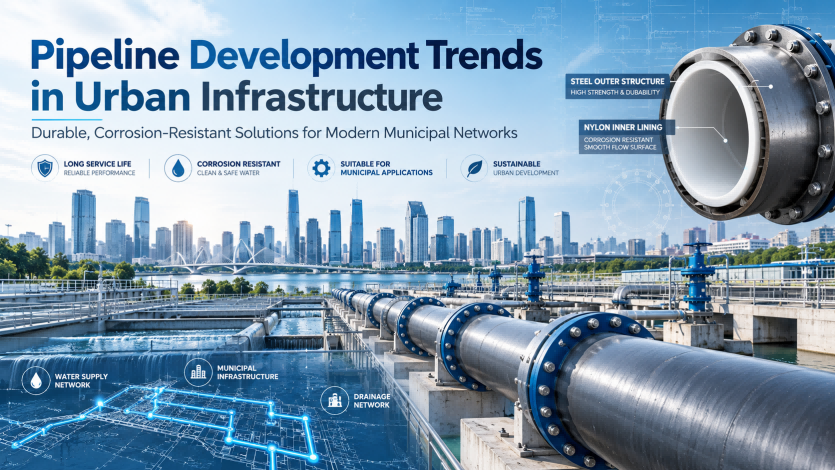
In this context, steel-nylon composite pipes, which combine the structural strength of steel with the corrosion resistance and wear resistance of reinforced nylon, offer a promising material solution for certain municipal water supply and drainage applications.
1. Why Should Municipal Water Pipelines Be Designed for a 50-Year Service Life?
1.1 Underground Pipeline Replacement Costs Are Much Higher Than Pipe Procurement Costs
For aboveground industrial pipelines, localized damage can often be repaired through scheduled shutdowns and maintenance.
However, replacing underground municipal pipelines is considerably more complicated.
Typical replacement activities may involve:
-
Road excavation and traffic restrictions
-
Protection of underground gas, power, and communication utilities
-
Temporary water supply or wastewater diversion
-
Excavation support, dewatering, and road restoration
-
Labor, equipment, and construction management expenses
-
Disruption to residential and commercial activities
Therefore, the actual cost of a pipeline extends far beyond its initial purchase price.
Consider a municipal water transmission pipeline that requires two major replacements over a 50-year planning period.
Even if the original pipe material is relatively inexpensive, accumulated construction, maintenance, and replacement costs may eventually exceed those of a more durable pipeline system.
Modern municipal infrastructure requires more than low-cost pipes. It requires long-term reliability, manageable maintenance requirements, and favorable lifecycle economics.
1.2 A 50-Year Service Life Is an Engineering Objective, Not an Automatic Guarantee
A 50-year design service life does not mean that every pipeline will operate for 50 years under all conditions.
Actual service life depends on several factors:
-
Chemical properties of the transported medium
-
Operating pressure and pressure fluctuations
-
Internal and external corrosion environments
-
Pipe materials and structural design
-
Joint, sealing, and fitting quality
-
Installation and construction quality
-
Long-term inspection and maintenance practices
From an engineering perspective, a 50-year service life should be considered a performance objective that must be supported by appropriate design, material verification, and asset management.
The ISO 24516 series addresses the management of water supply and wastewater assets, while the American Water Works Association (AWWA) promotes lifecycle-based approaches to water infrastructure planning and management.
These principles emphasize that extending pipeline service life begins during the initial design stage.
2. Six Major Factors Affecting the Service Life of Municipal Water Pipelines
2.1 Internal Pipe Corrosion
Internal corrosion is one of the major causes of deterioration in conventional metallic water supply and drainage pipelines.
Municipal water distribution systems may be exposed to dissolved oxygen, chloride ions, and disinfectants.
Wastewater pipelines may encounter organic substances, sulfides, and industrial effluents with fluctuating chemical compositions.
These conditions can contribute to:
-
Localized corrosion of metallic pipe walls
-
Accumulation of corrosion products and deposits
-
Reduction in the effective flow area
-
Pipe wall thinning and increased leakage risks
In some sewer systems, hydrogen sulfide can also contribute to microbiologically influenced sulfuric acid formation, accelerating the deterioration of certain concrete and metallic structures.
Consequently, selecting a pipe lining material with suitable chemical resistance is an important strategy for extending pipeline service life.
2.2 External Corrosion in Underground Environments
Underground pipelines are exposed not only to the transported medium but also to surrounding soil conditions.
Typical environmental factors include:
-
Soil moisture
-
Salt content and chloride concentration
-
Soil pH
-
Stray electrical currents
-
Electrochemical differences between soil layers
For pipelines with steel load-bearing structures, external corrosion may still occur if protective measures are insufficient.
Therefore, even when corrosion-resistant internal linings are used, the external steel surface requires appropriate protection.
Depending on project conditions, this may include protective coatings, cathodic protection where necessary, and strict quality control during field installation.
2.3 Increasing Internal Surface Roughness
During operation, scaling, corrosion deposits, and biofilm accumulation can gradually change a pipeline's hydraulic performance.
For pressurized water distribution systems, the Hazen-Williams equation illustrates how internal roughness affects frictional head loss under otherwise comparable conditions.
For municipal transmission pipelines operating continuously over long distances, increasing internal roughness may lead to higher pumping energy consumption.
Steel-nylon composite pipes feature a relatively smooth reinforced nylon internal surface that separates the transported fluid from the steel load-bearing structure.
This design can help reduce the risk of internal surface deterioration caused by metallic corrosion.
However, a smooth lining does not completely prevent biofilm formation or sediment accumulation. Actual hydraulic performance should be evaluated through appropriate testing and operational data.
2.4 Pressure Fluctuations and Water Hammer
Municipal water supply networks frequently experience operating conditions such as:
-
Pump startup and shutdown
-
Rapid valve closure
-
Sudden changes in flow rate
-
Pressure fluctuations during peak demand
These events can generate water hammer, causing transient pressures to exceed normal operating levels.
If pipe strength, joint design, and surge protection are inadequate, repeated pressure fluctuations may increase fatigue and leakage risks.
Pipeline selection must therefore consider more than normal working pressure.
Important design parameters include:
-
Maximum transient pressure
-
Negative pressure and vacuum conditions
-
Pressure cycle frequency
-
Axial restraint requirements
-
Load-bearing capacity of flanges and sealing systems
2.5 Joint Aging and Leakage
Long-term pipeline reliability depends not only on the pipe body but also on its connections.
Flanges, socket joints, gaskets, valves, and transitions between different pipe materials may become potential leakage points.
In underground networks, joint failures can cause prolonged water leakage, soil erosion, and even road settlement.
Reliable joint design and installation are therefore essential for achieving a long service life.
2.6 Ground Settlement and External Loads
Underground municipal pipelines must withstand a combination of external loads, including:
-
Soil cover pressure
-
Vehicle traffic loads
-
Groundwater uplift forces
-
Differential ground settlement
-
Construction-related loading
Insufficient structural strength, improper bedding, or inadequate joint movement allowance can lead to pipeline damage.
Although corrosion resistance is important, it cannot replace comprehensive structural engineering.
3. Seven Key Strategies for Extending Municipal Pipeline Service Life to 50 Years
Strategy 1: Select Pipe Materials Based on Actual Operating Conditions, Not Price Alone
Different pipeline materials offer different advantages and limitations.
A technical comparison should consider corrosion resistance, mechanical strength, hydraulic performance, installation conditions, and long-term maintenance requirements.
| Pipe Material | Main Advantages | Long-Term Considerations |
|---|---|---|
| Ductile Iron Pipe | High strength and established municipal applications | Requires attention to internal and external corrosion protection and joint maintenance |
| HDPE Pipe | Resistance to many corrosive media and good flexibility | Temperature, pressure, creep behavior, and installation conditions |
| PVC Pipe | Smooth internal surface and relatively lightweight | Impact resistance, temperature limitations, and pressure suitability |
| FRP Pipe | Resistance to many corrosive media and lightweight construction | Installation quality, impact damage, and long-term structural performance |
| Steel Pipe | High structural strength and engineering versatility | Internal and external corrosion protection and maintenance requirements |
| Steel-Nylon Composite Pipe | Combines steel structural support with corrosion-resistant and wear-resistant nylon lining | Requires verification of long-term lining performance, external corrosion protection, interface integrity, and joint reliability |
For projects involving complex corrosive environments, relatively high pressure, or difficult maintenance conditions, steel-nylon composite pipes deserve consideration as a potential engineering solution.
However, the final material selection should be based on project specifications, validated performance data, and lifecycle cost analysis.
Strategy 2: Use Corrosion-Resistant Internal Lining Materials
Reinforced nylon offers useful wear resistance and chemical resistance under suitable operating conditions.
When properly formulated, manufactured, and validated, reinforced nylon linings can provide internal protection in selected water treatment, industrial wastewater, and corrosive fluid transportation systems.
The primary engineering advantage of steel-nylon composite pipes lies in their composite structure:
The steel component provides mechanical support, while the validated nylon lining provides the fluid-contact surface and internal corrosion protection.
This arrangement helps reduce direct exposure of the steel structure to corrosive media, potentially lowering the risk of internal corrosion-related failures.
However, nylon is not universally resistant to all chemicals.
Strong acids, concentrated oxidizing agents, certain disinfectants, and prolonged high-temperature exposure may require additional chemical compatibility and aging tests.
Material suitability must always be verified for the actual operating conditions.
Strategy 3: Maintain Stable Hydraulic Performance Over Time
Hydraulic head loss in municipal pipelines is affected by several factors:
-
Internal pipe diameter
-
Flow velocity and volume
-
Internal surface condition
-
Fittings and local flow resistance
-
Pipeline configuration
For long-distance pumping systems, even relatively small changes in frictional resistance can contribute to significant energy consumption over many years.
The relatively smooth internal surface of reinforced nylon provides an opportunity to maintain favorable hydraulic performance.
When evaluating steel-nylon composite pipes, engineers should focus on:
-
Actual internal diameter rather than nominal diameter alone
-
Initial internal surface roughness
-
Long-term scaling and wear behavior
-
Local resistance at flanges, elbows, and tees
-
Effective hydraulic capacity after extended operation
For new municipal projects, hydraulic modeling software such as EPANET can be used to compare pipeline materials, diameters, and operating conditions.
Strategy 4: Improve Structural and Joint Reliability
In municipal water infrastructure, connection design directly affects installation efficiency and leakage risks.
Our steel-nylon composite pipes can be supplied with engineered flange connections, including integrally formed flange solutions where supported by the applicable product design and manufacturing process.
Potential advantages include:
-
Standardized pipeline assembly
-
Convenient connections to valves, pumps, and equipment
-
Reduced need for certain on-site hot work
-
Easier localized maintenance and pipe replacement
-
Suitability for selected municipal rehabilitation projects with limited installation space
In environments where open-flame operations are restricted, appropriately designed mechanical flange connections may help reduce on-site welding requirements.
However, long-term flange sealing performance still depends on gasket selection, bolt preload, flange rigidity, installation quality, and operating loads.
Underground flange connections also require suitable external corrosion protection and consideration of inspection accessibility.
A high-quality pipe body must be combined with a reliable connection system to create a durable underground pipeline network.
Strategy 5: Optimize Pressure, Surge, and Buried Pipeline Design
Municipal pressure pipelines must be designed for normal operating pressure, maximum transient pressure, and appropriate engineering safety margins.
Our steel-nylon composite pipe product range includes designs associated with pressure classes from 1.0 to 4.0 MPa, depending on the product specification.
However, this range does not mean that every pipe diameter, temperature, and fluid application can achieve the same pressure rating.
Project-specific evaluations should include:
-
Influence of temperature on long-term material properties
-
Structural interaction between nylon lining and steel components
-
Internal pressure, external pressure, and vacuum conditions
-
Thrust forces at elbows, tees, and pipeline ends
-
Foundation support and differential settlement
-
Allowable joint movement and restraint requirements
A reliable design must ensure that the pipe body, fittings, joints, and support structures meet the overall project requirements.
Strategy 6: Establish a Traceable Manufacturing Quality Control System
When a pipeline project targets 50 years of service, manufacturing consistency becomes particularly important.
For steel-nylon composite pipes, the quality assurance process should consider:
-
Raw material quality and batch traceability
-
Nylon lining thickness and uniformity
-
Dimensions and weld quality of the steel load-bearing structure
-
Integrity of the lining-to-structure interface
-
Hydrostatic pressure and leakage testing
-
Flange dimensions and sealing surface quality
-
External protective coating quality
-
Pressure cycling, aging, and abrasion testing where required
For long-life infrastructure projects, accelerated aging studies, long-term material testing, and field performance data should be used together to evaluate service life.
A successful short-term factory pressure test alone cannot establish a 50-year service life.
Strategy 7: Move from Reactive Repairs to Predictive Maintenance
Even highly durable pipeline materials require systematic asset management.
For water supply networks, pressure monitoring, flow balance analysis, leakage detection, and failure records can help identify high-risk sections.
For wastewater systems, CCTV inspections, cleaning records, infiltration assessments, and structural condition surveys can provide information about pipeline deterioration.
With digital asset management systems, municipal operators can prioritize maintenance based on risk rather than waiting for serious pipeline failures.
This approach can reduce emergency repairs and improve the efficiency of infrastructure investment.
4. Why Are Steel-Nylon Composite Pipes Worth Considering for Long-Life Municipal Water Infrastructure?
The fundamental concept behind steel-nylon composite pipes is to combine the advantages of different materials within one engineered pipeline structure.
4.1 Steel Provides Mechanical Strength and Structural Support
Compared with single-material polymer pipes, appropriately designed steel load-bearing structures can provide high structural stiffness and mechanical load capacity.
This may offer advantages in applications involving:
-
Large-diameter pressure pipelines
-
Pump station connections
-
Pipeline sections exposed to significant mechanical loads
-
Projects requiring customized structural designs
4.2 Reinforced Nylon Provides Internal Corrosion Protection
When chemical compatibility requirements are satisfied, reinforced nylon linings can prevent direct contact between the transported fluid and the steel interior.
This design can help reduce internal metallic corrosion, corrosion deposit accumulation, and certain wear-related risks.
For municipal projects involving challenging water chemistry or specific industrial wastewater conditions, this protective function may be particularly valuable.
4.3 Suitable for Applications Involving Both Corrosion and Abrasion
Clean drinking water and sand-containing wastewater create very different operating conditions.
In systems transporting certain particle-containing wastewater streams, highly mineralized industrial effluents, or fluids causing abrasive wear, reinforced nylon may offer additional performance benefits.
However, severe slurry abrasion or high-velocity particle impact requires careful evaluation.
Important parameters include particle hardness, particle size, flow velocity, impact angle, and actual abrasion testing results.
4.4 Supports Large-Diameter and Customized Pipeline Projects
Municipal water transmission mains, industrial park drainage networks, and large pumping station projects frequently require large-diameter pipelines.
Our company has experience in manufacturing and customizing large-diameter steel-nylon composite pipes.
Depending on project requirements, we can evaluate:
-
Pipe diameter
-
Design pressure
-
Wall thickness
-
Flange configuration
-
Customized fittings
-
Special installation requirements
For non-standard dimensions or complex installation spaces, project-specific engineering and manufacturing feasibility assessments can be provided.
4.5 Potential to Reduce Long-Term Total Cost of Ownership
The value of steel-nylon composite pipes extends beyond material properties.
When corrosion resistance, structural performance, and long-term reliability are validated for a particular application, reduced maintenance frequency and lower replacement risks may improve lifecycle economics.
A higher initial investment can potentially be offset by lower operating and maintenance expenses.
However, these benefits should be demonstrated through project-specific performance data and lifecycle cost models rather than assumed.
5. A 50-Year Total Cost of Ownership Analysis: Why Initial Purchase Price Is Not Enough
Total Cost of Ownership (TCO) is an important evaluation method for long-term municipal infrastructure investments.
A simplified lifecycle cost model can be expressed as:
50-Year Lifecycle Cost (Present Value) = Initial Investment + Present Value of Maintenance Costs + Present Value of Replacement Costs + Present Value of Failure-Related Losses + Present Value of Other Operating Costs
These cost components include:
-
Initial investment: Pipe materials, fittings, transportation, and installation
-
Maintenance costs: Inspection, cleaning, repair, and routine servicing
-
Replacement costs: Removal, reinstallation, excavation, and surface restoration
-
Failure-related losses: Water interruptions, wastewater discharge incidents, and associated indirect impacts
-
Operating costs: Pumping energy and other ongoing expenditures
Illustrative Economic Comparison
The following example uses hypothetical cost indices to demonstrate lifecycle cost evaluation.
It does not represent actual market pricing or verified service-life performance for any specific pipe material.
| Cost Component | Conventional Pipe Solution A | Steel-Nylon Composite Pipe Solution B |
|---|---|---|
| Initial Investment | 100 | 125 |
| Annual Maintenance Cost | 3 | 1.5 |
| Complete Replacement in Year 25 | 100 | 0 |
| Evaluation Period | 50 Years | 50 Years |
| Discount Rate | 5% | 5% |
| 50-Year Lifecycle Cost (Present Value) | Approx. 184.3 | Approx. 152.4 |
Under these assumptions, Solution B requires an initial investment that is 25% higher.
However, its 50-year lifecycle cost in present-value terms is approximately 17.3% lower.
This illustrates an important principle: a pipeline with a higher initial purchase and installation cost may deliver better long-term economic value if it reliably reduces maintenance and replacement expenses.
The calculation assumes that Solution B can operate throughout the 50-year evaluation period without complete replacement and that the projected maintenance costs are achieved.
Actual results will vary depending on operating conditions, material performance, project costs, service life, and discount rates.
For real infrastructure investments, sensitivity analyses should be conducted using alternative service-life and maintenance scenarios.
This helps prevent overly optimistic assumptions from distorting investment decisions.
6. How Should Different Municipal Water and Drainage Systems Approach Pipeline Life Extension?
Application 1: Municipal Water Transmission Pipelines
Key requirements include:
-
Long-term pressure resistance
-
Low leakage risk
-
Stable hydraulic performance
-
Drinking water contact safety
-
Reliable joints and structural design
Steel-nylon composite pipes may be evaluated as candidate materials for appropriate pressure pipeline applications.
However, where drinking water is transported, the complete water-contact system—including lining materials, gaskets, and related components—must be assessed against applicable health and safety requirements.
For example, projects in North American markets may require verification against NSF/ANSI/CAN 61 or other applicable standards.
Corrosion resistance in industrial service does not automatically establish suitability or approval for drinking water applications.
Application 2: Municipal Wastewater Collection Systems
Important performance requirements include:
-
Resistance to wastewater-related corrosion
-
Tolerance to abrasion from suspended solids
-
Reliable joint sealing
-
Resistance to external pressure and groundwater loads
-
Reduced blockage and leakage risks
For wastewater pumping mains, pump station discharge lines, and selected applications involving combined corrosion and abrasion, properly validated steel-nylon composite pipes may offer a useful alternative.
For conventional gravity sewers, engineers should also compare structural designs, installation convenience, and overall construction costs among available pipe materials.
Application 3: Stormwater Drainage and Flood Control Systems
During heavy rainfall, stormwater pipelines may experience high flow rates while transporting sand, gravel, and other solid particles.
For pumped stormwater discharge sections, abrasion-prone elbows, and specialized connection points, wear-resistant composite piping may be worth evaluating.
However, for extensive gravity drainage networks, conventional reinforced concrete, HDPE, FRP, and other established pipe systems should also be compared based on technical and economic performance.
Application 4: Rehabilitation of Aging Municipal Pipelines
Not every aging pipeline network requires complete replacement.
Municipal infrastructure operators can first conduct condition and risk assessments to identify critical sections, such as:
-
Pipelines with repeated leakage repairs
-
Metallic pipe sections affected by severe internal corrosion
-
Pump discharge areas with significant pressure fluctuations
-
Elbows and bends exposed to accelerated abrasion
-
High-corrosion zones associated with industrial wastewater discharge
Targeted replacement, in-situ rehabilitation, and phased renewal can help reduce upfront investment and traffic disruption.
Steel-nylon composite pipes may be considered for selected replacement sections where combined corrosion resistance, wear resistance, and mechanical strength are important.
However, replacing individual sections does not automatically extend the remaining service life of an entire aging network to 50 years.
Unreplaced sections must still be evaluated independently.
7. How Can Steel-Nylon Composite Pipes Be Evaluated Against a 50-Year Design Service Life?
For municipal projects targeting long-term service, we recommend a structured engineering verification process.
Stage 1: Collect Actual Operating Data
The first step is to understand the pipeline's real operating conditions.
Required information should include:
-
Pipe diameter
-
Flow rate
-
Fluid composition
-
Operating temperature
-
Normal working pressure
-
Maximum transient pressure
-
Soil and groundwater conditions
-
Installation environment
Stage 2: Evaluate Material and Structural Suitability
Engineers should assess the chemical compatibility and long-term aging behavior of the reinforced nylon lining.
At the same time, the steel structure, external corrosion protection, and connection system must be evaluated for the intended operating environment.
Stage 3: Conduct Testing and Pilot Installation Where Necessary
Depending on project requirements, the verification program may include:
-
Hydrostatic pressure testing
-
Leakage testing
-
Abrasion testing
-
Temperature cycling
-
Chemical compatibility testing
-
Material aging studies
-
Trial pipeline installation
Pilot sections can provide valuable information before a new material is deployed across an entire municipal network.
Stage 4: Establish Long-Term Performance Indicators
After installation, operators should monitor indicators such as:
-
Leakage frequency
-
Maintenance expenses
-
Pressure loss
-
Flow capacity
-
Joint condition
-
Pipeline structural changes
These measurements can support performance evaluation and future maintenance planning.
Stage 5: Conduct Service-Life Assessment
Long-term testing, field performance records, and engineering risk analysis should be combined to establish appropriate inspection intervals and estimate service life.
For major municipal projects, manufacturers, engineering consultants, and asset owners should work together to define product acceptance criteria and long-term performance evaluation procedures.
8. From Pipe Manufacturer to Long-Term Engineering Solutions Partner
As municipal water infrastructure evolves, the role of a pipe supplier should extend beyond offering a product specification and a quotation.
Understanding actual operating conditions is essential.
As a manufacturer specializing in reinforced MC nylon pipes and steel-nylon composite pipes, we are committed to providing application-oriented solutions based on fluid properties, operating pressure, temperature, pipeline dimensions, and installation requirements.
Our primary technical capabilities include:
-
Reinforced nylon lining structures for selected corrosive and abrasive applications
-
Steel-nylon composite pipes combining mechanical strength with internal corrosion protection
-
Large-diameter and non-standard pipeline customization
-
Flanged connections and matching pipe fittings
-
Engineering material selection support for complex transportation systems
-
Technical coordination, manufacturing quality control, and project delivery support
For overseas EPC contractors, municipal infrastructure developers, and engineering consultants, our goal is to support technical material selection at an early project stage.
By evaluating material suitability and total lifecycle costs before procurement, project stakeholders can reduce the risk of later design changes, premature failures, and avoidable maintenance expenses.
9. The Future of Municipal Pipelines: From 50-Year Design Life to Long-Term Infrastructure Value
The future of municipal water infrastructure will increasingly focus on three key priorities.
9.1 Long-Term Reliability
Pipelines must do more than pass initial acceptance tests.
They must maintain predictable performance under challenging operating conditions over extended periods.
9.2 Lower Maintenance Requirements
Reducing unplanned repairs, road excavation, and service interruptions will remain a major objective for municipal infrastructure operators.
9.3 Greater Lifecycle Value
Pipeline procurement decisions are gradually shifting from an emphasis on initial purchase price toward a broader assessment of:
-
Material performance
-
Installation methods
-
Operating energy consumption
-
Maintenance expenses
-
Replacement risks
-
Long-term infrastructure reliability
Steel-nylon composite pipe technology represents one approach to addressing these requirements.
By combining steel's mechanical support with reinforced nylon's internal protective properties, it offers an alternative material option for selected demanding municipal pipeline applications.
Nevertheless, advanced pipe materials cannot replace sound engineering design, comprehensive quality assurance, or systematic maintenance management.
Conclusion: Achieving a 50-Year Municipal Pipeline Service Life Requires a Reliable System, Not Just a Durable Material
Extending the service life of municipal water supply and drainage pipelines to 50 years is not simply a matter of selecting a material advertised as having a longer lifespan.
An effective strategy begins at the engineering design stage and integrates:
-
Suitable materials for the transported fluid
-
Reliable structural and joint design
-
Optimized hydraulic performance
-
Strict manufacturing and installation quality control
-
Long-term condition monitoring and asset management
For pipeline systems facing combined challenges involving corrosion, abrasion, pressure resistance, and high maintenance costs, steel-nylon composite pipes deserve serious consideration as a potential material solution.
Their ultimate value must be demonstrated through operating conditions, engineering testing, and lifecycle cost analysis.
Looking for a Long-Term Pipeline Solution for Your Municipal Infrastructure Project?
Are you planning a municipal water transmission system, wastewater pumping main, industrial park drainage network, or aging pipeline rehabilitation project?
Contact our engineering team to explore suitable steel-nylon composite piping solutions.
Share your required pipe diameter, transported medium, operating pressure, temperature, and project specifications.
Our team can assist with evaluating material suitability, connection design, and customized manufacturing options.
Build more reliable municipal pipeline systems. Reduce lifecycle maintenance risks. Invest in long-term infrastructure performance.
Seawater Pipeline Material Selection Guide: How to Choose Corrosion-Resistant, Wear-Resistant, and Long-Lasting Industrial Pipes