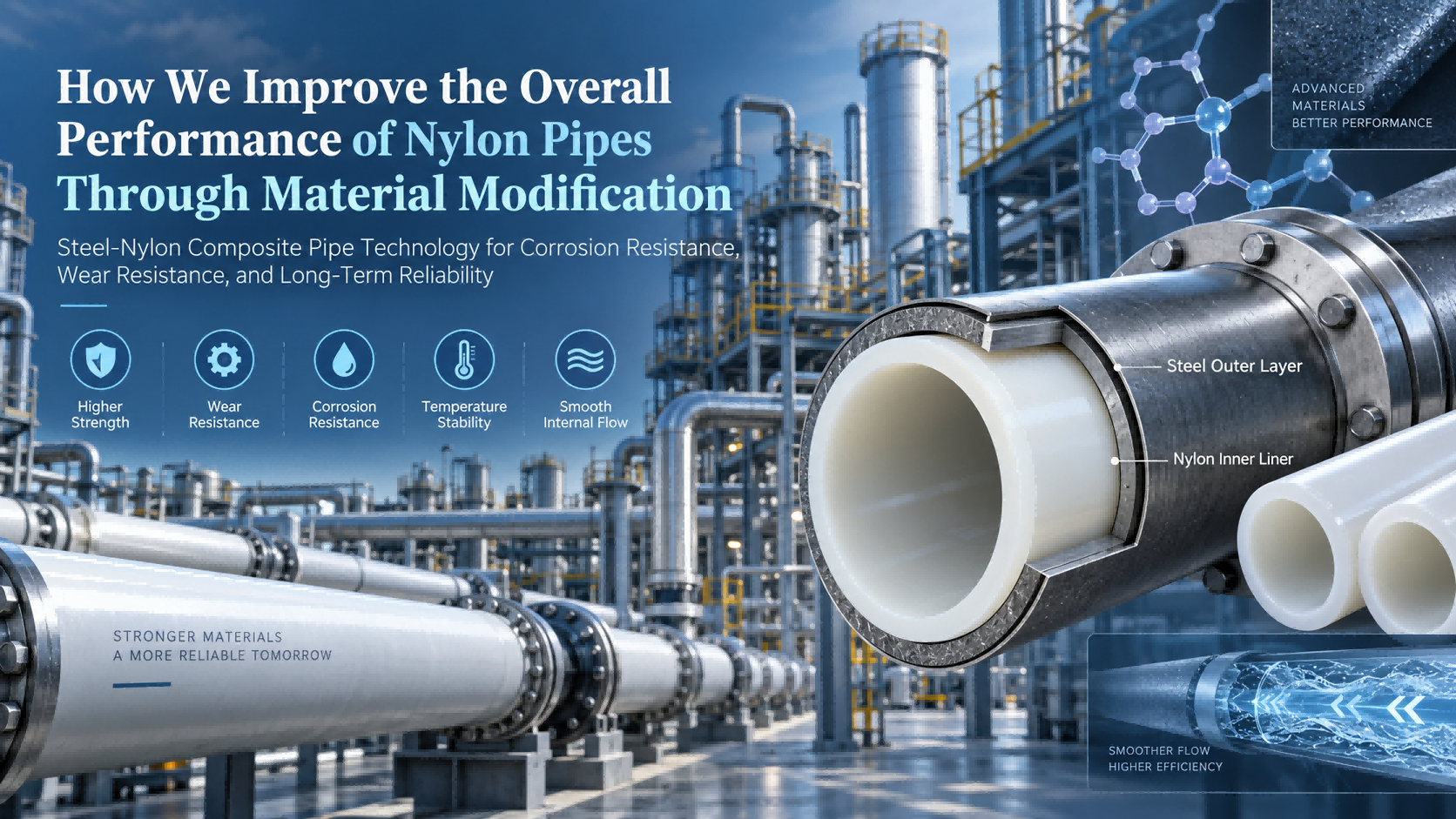
How We Improve the Overall Performance of Nylon Pipes Through Material Modification
In industrial piping, material performance is never determined by a single property.
A pipe material may offer excellent corrosion resistance but lack sufficient mechanical strength for long-term loading. Another material may provide high strength but suffer rapid wear under abrasive slurry service. A material may also perform well under laboratory conditions but deteriorate much faster when exposed to high temperatures, low temperatures, pressure fluctuations, and complex chemical media in actual industrial operations.
This is why simply selecting a “nylon material” is not enough for industrial-grade piping systems.
The real challenge is how to systematically modify nylon for specific operating conditions while achieving the right balance among mechanical strength, toughness, wear resistance, corrosion resistance, temperature adaptability, dimensional stability, and long-term reliability.
This is particularly important for steel-nylon composite pipes.
Our R&D approach is not focused on maximizing one isolated material property. Instead, we combine material modification, structural engineering, and manufacturing process control so that the nylon inner layer can effectively provide corrosion resistance, wear resistance, and media isolation, while the steel structure delivers mechanical strength and pressure-bearing capability.
The result is a composite piping system designed for demanding industrial environments.
1. Why Does Nylon for Industrial Piping Require Targeted Modification?
Nylon is an engineering polymer known for its favorable mechanical properties, wear resistance, and chemical stability.
However, there is a major difference between producing ordinary plastic components and manufacturing industrial pressure piping.
For conventional mechanical components, engineers may focus primarily on strength, wear resistance, or processability.
Industrial piping systems, on the other hand, must withstand far more complex long-term operating conditions, including:
-
Continuous media transportation
-
Sustained internal pressure
-
Repeated temperature fluctuations
-
Abrasive slurry erosion
-
High-salinity or alkaline environments
-
Pressure fluctuations caused by pump start-up and shutdown
-
Pipeline vibration and localized impact
-
Dimensional stability challenges in large-diameter pipes
-
Continuous operation over many years
For this reason, industrial piping materials cannot be optimized around only one performance indicator.
If rigidity is increased excessively, the material may become brittle.
If flexibility is emphasized too heavily, load-bearing capacity and dimensional stability may decline.
If large quantities of wear-resistant fillers are introduced, material uniformity and processing performance may be affected.
And if development focuses only on short-term laboratory results, the material may not maintain consistent performance in large-scale pipe production and long-term service.
Therefore, in our approach, material modification is not simply the addition of one additive.
It is the development of a balanced performance system specifically designed for industrial piping applications.
2. The Core Objective of Material Modification: Balanced Performance Rather Than One Maximum Property
For industrial piping applications, we typically evaluate several major performance dimensions:
| Performance Area | Importance for Industrial Piping |
|---|---|
| Mechanical strength | Resists loads, impacts, and operating stresses |
| Toughness | Reduces the risk of brittle cracking and impact failure |
| Wear resistance | Handles slurry, salt mud, solids, and abrasive particles |
| Corrosion resistance | Isolates corrosive media from the steel structure |
| Temperature stability | Supports operation across a wider temperature range |
| Dimensional stability | Helps maintain liner thickness, connection accuracy, and large-diameter consistency |
| Surface properties | Helps reduce deposition, scaling, and flow resistance |
| Long-term stability | Reduces performance degradation during extended operation |
These properties are not independent of one another.
A mature engineering material must achieve an appropriate balance among them.
3. Step One: Balancing Mechanical Strength and Toughness
One of the first challenges in industrial piping materials is achieving the correct relationship between strength and toughness.
If mechanical strength is insufficient, long-term stress, temperature fluctuations, and external loads may cause deformation.
However, excessively increasing rigidity may make a material more susceptible to brittle failure, particularly under low-temperature or impact conditions.
One important objective of nylon modification is therefore to optimize the internal material structure so that good mechanical performance can be maintained without sacrificing impact resistance.
This approach may involve several areas.
Optimizing the Polymer Structure
By controlling the polymerization process, molecular characteristics, and internal structure of the nylon matrix, it is possible to establish a more stable mechanical foundation for subsequent modification.
Improving Toughness
Industrial pipes can experience mechanical impact during transportation and installation, as well as stress concentration caused by pump operation and temperature changes.
The material therefore cannot be designed around hardness alone.
A properly engineered toughening system can help reduce the risk of brittle cracking.
Maintaining the Balance Between Strength and Toughness
For industrial piping, the most important objective is not achieving the highest laboratory value for one parameter.
The real objective is maintaining stable overall performance under actual service temperatures and long-term loading.
This is one of the fundamental differences between engineering-grade piping materials and ordinary plastic products.
4. Step Two: Enhancing Wear Resistance for Abrasive Media Transportation
In many chemical, mining, oilfield, and salt-processing applications, corrosion is only part of the problem.
Some of the most demanding operating conditions involve:
Corrosion and abrasion occurring simultaneously.
Typical media may include:
-
Salt mud
-
Mineral slurry
-
Suspensions containing solid particles
-
Sand-containing produced fluids
-
Industrial wastewater containing solid impurities
-
High-velocity process slurries
When solid particles travel through a pipeline at high velocity, they continuously impact and abrade the inner surface.
Traditional metallic piping may therefore experience both electrochemical corrosion and mechanical wear.
Some corrosion-resistant linings may successfully isolate the metallic structure from aggressive media but may not offer sufficient long-term abrasion resistance.
For this reason, friction, abrasion, and surface characteristics are important parts of our nylon material development.
The objectives of material modification include:
-
Improving surface wear resistance
-
Optimizing friction characteristics
-
Reducing material loss caused by long-term particle erosion
-
Maintaining a relatively smooth internal surface
-
Reducing the risk of localized wear-through
These characteristics become particularly important around elbows, tees, reducers, pump discharge sections, and areas upstream and downstream of valves.
Such locations often experience concentrated erosion rather than uniform wear.
Therefore, developing a truly wear-resistant piping system requires more than selecting a wear-resistant material.
Engineers must also consider flow patterns, velocity, particle size, solids concentration, and local piping geometry.
5. Step Three: Improving Stability in Complex Chemical Environments
Industrial corrosion resistance cannot simply be described as “this material is corrosion-resistant.”
The effect of a chemical medium on a piping material usually depends on several interacting factors:
Chemical Type × Concentration × Temperature × Pressure × Exposure Time
The same chemical can behave very differently toward a material when its concentration or temperature changes.
For this reason, our nylon material development focuses not only on generic corrosion resistance but also on long-term stability under targeted industrial operating conditions.
One important design principle of steel-nylon composite pipe is:
The transported medium primarily contacts the functional nylon layer rather than the pressure-bearing steel structure.
This allows the two primary functions of the pipeline to be separated.
The steel structure mainly provides:
Mechanical support and pressure-bearing capability.
The nylon inner layer primarily provides:
Corrosion resistance, wear resistance, media isolation, and a smooth internal conveying surface.
Compared with requiring a single material to perform every function, this composite structure allows individual material properties to be used more effectively against different pipeline failure mechanisms.
6. Step Four: Improving Material Stability Under Temperature Changes
Temperature is one of the most frequently underestimated factors in pipeline material selection.
A material may perform very well at room temperature, while changes in temperature can significantly affect its:
-
Strength
-
Rigidity
-
Toughness
-
Dimensions
-
Creep behavior
-
Chemical stability
Industrial piping materials therefore cannot be evaluated solely according to room-temperature test results.
Through optimization of the material formulation, stabilization system, and manufacturing process, the overall performance of nylon can be improved under changing temperature conditions.
For industrial projects, one question is especially important:
How much performance can the material retain at its long-term operating temperature?
This is more meaningful than asking only:
What is the maximum temperature the material can withstand for a short period?
For continuously operating industrial plants, long-term stability is often considerably more important than short-term peak performance.
7. Step Five: Improving Dimensional Stability for Large-Diameter Pipe Manufacturing
For small plastic components, minor dimensional variations may not cause serious problems.
But when pipe diameters increase from several hundred millimeters to one meter or more, even relatively small variations in material shrinkage, temperature distribution, or molding uniformity can become significant.
Large-diameter nylon and steel-nylon composite pipes therefore place much greater demands on material stability.
Material modification must work together with manufacturing process control to address issues such as:
-
Shrinkage control
-
Uniform wall thickness
-
Liner concentricity
-
Internal stress control
-
Large-size molding stability
-
Cooling consistency
-
Long-term dimensional stability
This is also why manufacturing a large-diameter composite pipe is not simply a matter of scaling up a smaller product.
As pipe diameter increases, requirements for materials, equipment, temperature control, and production processes become increasingly demanding.
8. Step Six: Optimizing the Nylon Inner Surface to Reduce Scaling and Flow Resistance
Pipeline failure does not always occur because of leakage.
Some pipes remain structurally intact but gradually lose conveying capacity because of severe internal scaling and deposition.
As deposits continue to accumulate:
The effective flow area decreases.
Pressure loss increases.
Pumping energy consumption rises.
Eventually, the pipeline may require shutdown, mechanical cleaning, or complete replacement.
For this reason, we also pay close attention to the surface characteristics of the nylon material.
The nylon inner layer of a steel-nylon composite pipe can provide a relatively smooth and uniform conveying surface, helping reduce conditions that encourage impurities to adhere and accumulate.
This can be particularly valuable in systems prone to:
-
Salt deposition
-
Crystallization
-
Sedimentation
-
Solid-containing media transportation
For industrial operators, an important question is therefore not simply:
How much does the pipe cost today?
A more meaningful question is:
How much effective conveying capacity will the pipeline still maintain after years of operation?
9. Material Performance Is Only the First Advantage — The Steel-Nylon Composite Structure Is the Second
Even after modification, every individual material has its own performance limitations.
For this reason, we do not attempt to make nylon perform every structural function in a pipeline.
Steel-nylon composite pipe follows a clearer functional division.
External Steel Structure
The steel structure primarily handles:
-
Internal pressure
-
External mechanical loads
-
Pipeline rigidity
-
Flange and structural connections
-
Mechanical strength required for industrial installation
Internal Nylon Functional Layer
The nylon layer primarily provides:
-
Corrosion resistance
-
Wear resistance
-
Isolation of the transported medium
-
A smooth internal surface
-
Reduced risk of scaling and deposition
The design philosophy can therefore be summarized as:
Steel provides strength; nylon provides protection.
This is one of the fundamental advantages of composite piping design.
Rather than forcing one material to solve every engineering problem, different materials are assigned the functions they are best suited to perform.
10. Why Must Material Modification Be Integrated With the Manufacturing Process?
Developing the material formulation does not automatically guarantee that the final pipe will achieve the expected performance.
For industrial piping, another critical question must be answered:
Can the material properties achieved in development be consistently reproduced in every pipe during mass production?
This depends heavily on manufacturing process control.
Key factors may include:
-
Raw material consistency
-
Formulation accuracy
-
Polymerization process control
-
Temperature control
-
Molding conditions
-
Nylon liner thickness control
-
Cooling rate
-
Internal stress management
-
Dimensional inspection
-
Pressure testing
-
Finished-product traceability
Variations at any of these stages can affect final product performance.
For this reason, we believe a mature industrial pipeline development system should form a complete closed loop:
Material Design → Process Development → Prototype Testing → Engineering Validation → Mass Production → Field Performance Feedback → Further Optimization
The more engineering projects a material experiences, the deeper our understanding of its actual performance becomes.
Laboratory testing tells us:
What a material should theoretically be capable of doing.
Long-term industrial operation tells us:
What that material can actually withstand in real service.
11. Why We Do Not Believe in a “Universal Pipe Material”
One common misconception in industrial piping is that there should be one material capable of handling every medium, temperature, and pressure.
In reality, this does not reflect sound engineering practice.
Every material has an appropriate operating envelope.
Steel-nylon composite pipe is no exception.
Proper material selection should consider factors including:
-
Transported medium
-
Chemical concentration
-
pH
-
Operating temperature
-
Design pressure
-
Flow velocity
-
Solids concentration
-
Particle size
-
Pipe diameter
-
Installation environment
-
Required service life
For example, some strongly oxidizing chemicals, certain high-concentration acids, or operating conditions beyond the material's recommended long-term temperature range require individual compatibility evaluation.
A decision should never be based solely on a general statement such as “corrosion resistant.”
A professional piping supplier should not tell customers:
“Our pipe can transport everything.”
Instead, the supplier should help answer a much more important engineering question:
“Is this material genuinely suitable for your specific medium, concentration, temperature, pressure, and operating conditions?”
12. The Ultimate Purpose of Material Modification Is to Reduce Pipeline Lifecycle Cost
For industrial users, improvements in material performance must ultimately translate into economic value.
The real cost of a pipeline is not simply its purchase price.
A more complete evaluation should consider:
Pipeline Lifecycle Cost =
Initial procurement cost
-
Installation cost
-
Production downtime losses
-
Cleaning cost
-
Corrosion protection and maintenance cost
-
Leakage repair cost
-
Replacement cost
-
Safety and environmental risk cost
A low-cost pipeline that requires frequent:
-
Leak repairs
-
Cleaning
-
Replacement
-
Shutdowns
-
Corrosion maintenance
may ultimately cost significantly more over its service life than a pipeline with a higher initial purchase price but a longer and more stable operating period.
Therefore, the ultimate purpose of our material modification work is not to produce an impressive set of laboratory data.
The objective is much more practical:
To help pipelines operate longer and more reliably in real industrial environments while reducing maintenance frequency and unplanned shutdowns.
13. From “Manufacturing a Pipe” to “Engineering a Material System”
Industrial pipeline materials are undergoing an important change in engineering philosophy.
Traditionally, pipeline selection often focused on a simple question:
Steel, stainless steel, PE, FRP, or nylon — which material should we choose?
A more advanced approach is:
What kind of material system does this operating environment actually require?
When an industrial piping system must simultaneously deal with:
-
Corrosion
-
Abrasion
-
Pressure
-
Temperature
-
Impact
-
Scaling
-
Long-term continuous operation
it becomes increasingly difficult for a single material to solve every problem effectively.
Steel-nylon composite piping offers a different approach.
We improve the functional performance of the nylon layer through material modification.
We use the steel structure to provide reliable pressure-bearing and mechanical capability.
We integrate the advantages of different materials through composite structural design.
The objective is to achieve a better overall performance profile for demanding industrial applications.
Conclusion: The Value of Material Modification Must Ultimately Be Proven in Industrial Service
For industrial piping, meaningful material innovation is not about improving one laboratory parameter.
It is about answering practical engineering questions:
Can the pipeline resist corrosion over long periods?
Can it withstand abrasive particle erosion?
Will its properties remain stable when temperatures change?
Can it remain reliable under sustained pressure?
Can large-diameter products maintain manufacturing consistency?
Will the pipeline still provide efficient flow after years of operation?
These are the reasons we continue to develop modified nylon materials and optimize steel-nylon composite pipe structures.
From material formulation and large-diameter forming technology to pressure-bearing steel structures, nylon functional layers, and flanged connections, our focus is not on any single isolated parameter.
We focus on the long-term performance of the entire piping system under real industrial operating conditions.
For chemical processing, oil and gas fields, salt chemicals, soda ash production, chlor-alkali plants, slurry transportation, and other industrial applications where corrosion and abrasion may occur simultaneously, pipeline material selection is gradually moving beyond a simple comparison of initial purchase prices.
The decision is increasingly based on:
Material compatibility, operational reliability, and total lifecycle cost.
Material modification is therefore an important technical foundation for improving the overall performance of steel-nylon composite pipes and expanding their application in increasingly demanding industrial environments.
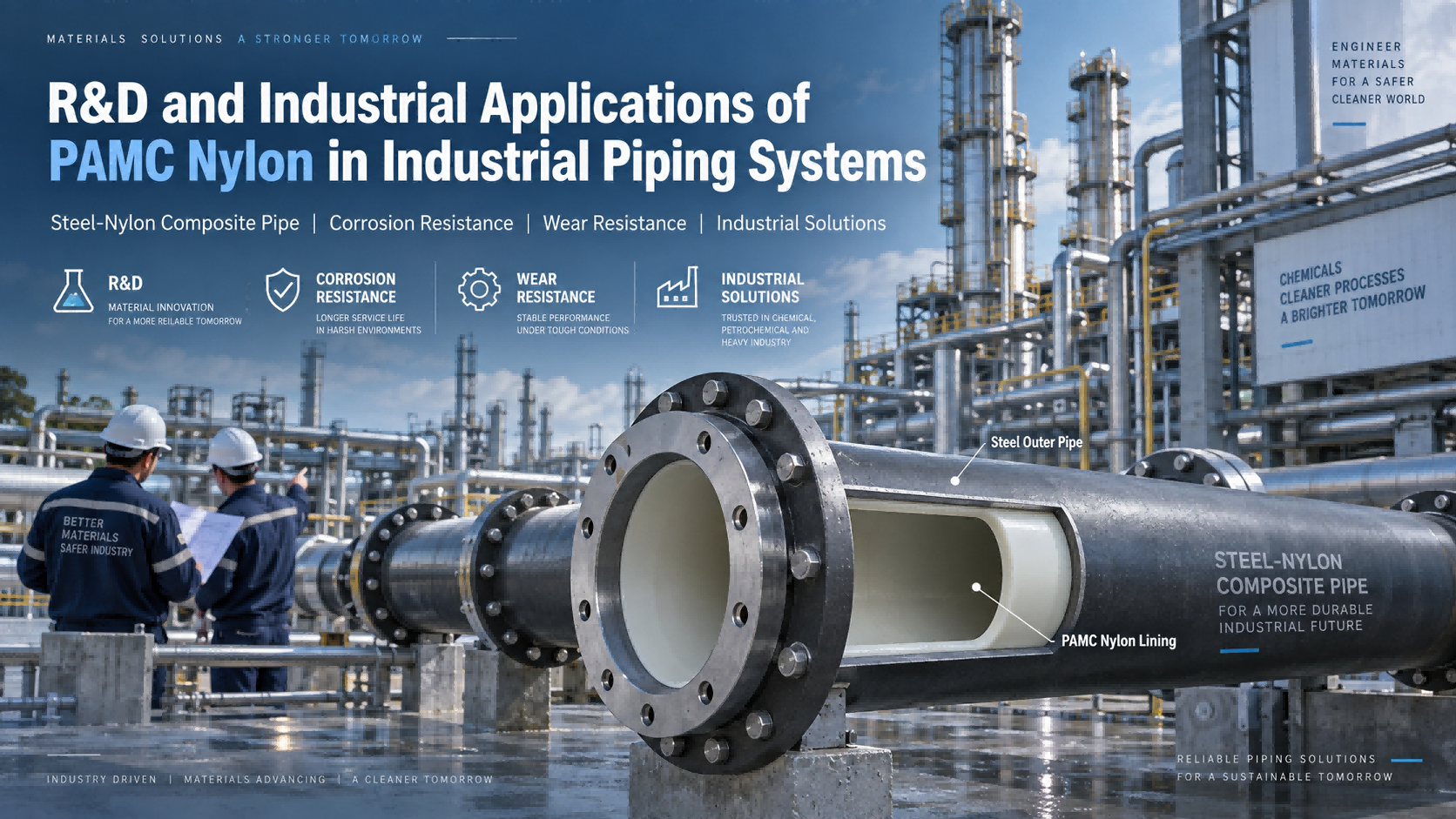
R&D and Industrial Applications of PAMC Nylon in Industrial Piping Systems