Oil & Gas Field Pipeline Maintenance Is Shifting from Periodic Repair to Long-Life Design

Oil and gas field pipeline systems are undergoing an important transformation.
In the past, the maintenance logic for many oilfield pipelines could be summarized as:
Corrosion → Inspection → Repair → Replacement.
When localized corrosion, perforation, or leakage occurred, emergency repairs were carried out. When corrosion reached a certain level, damaged sections were replaced. Periodic inspection and maintenance were then used to keep the overall pipeline network in operation.
This approach may have been economically acceptable during the early stages of oilfield development.
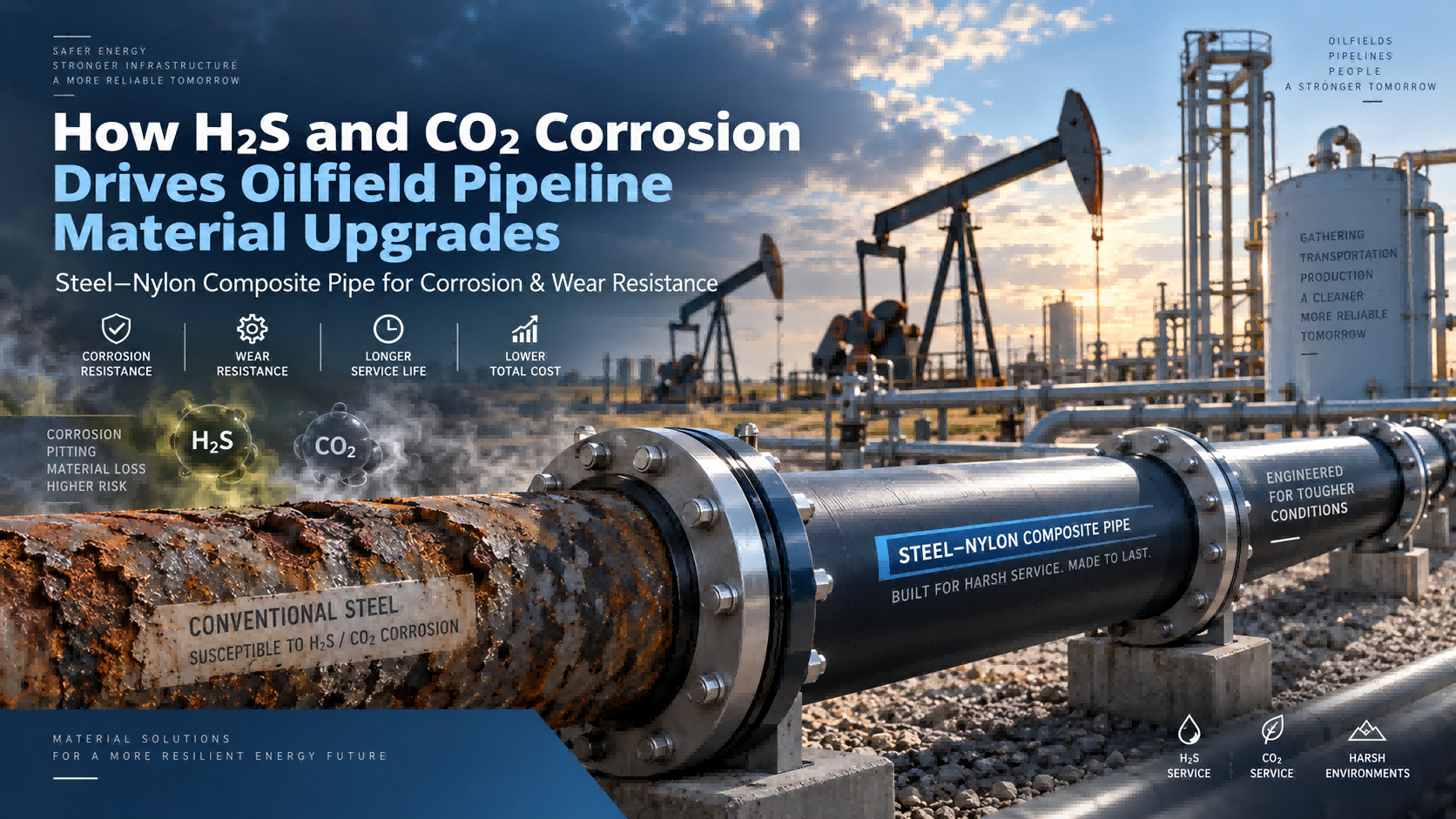
However, as oilfields enter high-water-cut production stages and pipelines face increasingly complex conditions involving highly mineralized produced water, CO₂/H₂S corrosion, sand erosion, scaling, and multiple aggressive media, more operators are recognizing an important fact:
What truly determines pipeline economics is not the initial purchase price, but how many times the pipeline must be repaired, how often production must be interrupted, and how many replacements are required over 10 years or even longer.
As a result, oil and gas pipeline management is gradually shifting away from traditional periodic maintenance toward:
Long-Life Pipeline Design.
The fundamental change behind this transition is that pipeline material selection is moving from simply “meeting current transportation requirements” toward “reducing future failure probability from the design stage.”
For steel–nylon composite pipes, this shift is particularly important because it highlights their long-term value in oil and gas gathering, produced-water transportation, water-injection systems, and other highly corrosive services.
1. Why Is the Traditional Periodic Maintenance Model Becoming Increasingly Difficult to Sustain?
Oil and gas field pipelines differ significantly from ordinary industrial pipelines.
They are often exposed not to a single corrosion factor, but to a continuously changing and highly complex transportation environment.
Typical operating conditions may involve:
-
High-water-cut crude oil;
-
Highly mineralized produced water;
-
Corrosive ions such as Cl⁻;
-
CO₂ corrosion;
-
H₂S-containing environments;
-
Sand and solid particles;
-
Microbiologically influenced corrosion;
-
Temperature fluctuations;
-
Changes in flow velocity;
-
Localized erosion;
-
Internal scaling.
This means that conventional carbon-steel pipelines are often exposed to several failure mechanisms simultaneously rather than only one.
For example, corrosion gradually reduces the pipe wall thickness, while entrained sand particles accelerate localized wear.
Scaling reduces the effective internal diameter and may also create conditions for under-deposit corrosion.
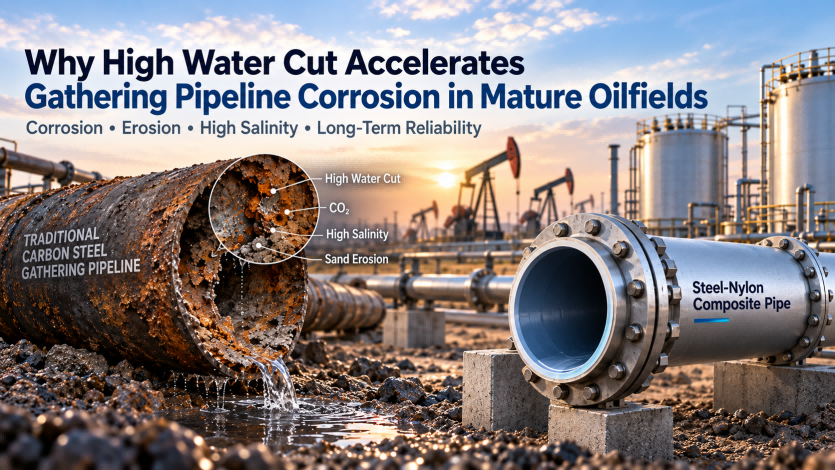
As water cut increases, the protective effect of the oil phase on the pipe wall decreases, allowing salts, acid gases, and other contaminants in the aqueous phase to remain in direct contact with the metal surface.
The result can be a combination of:
Corrosion + Erosion + Scaling + Localized Attack.
This is one reason why some pipelines can still experience unpredictable localized leakage even when routine inspection and maintenance programs are in place.
2. Periodic Maintenance Addresses Failure; Long-Life Design Addresses the Source of Failure
These are fundamentally different engineering approaches.
The traditional maintenance model asks:
When does the pipeline need to be repaired?
Long-life design asks a different question:
Why does the pipeline fail, and can that failure mechanism be reduced through material and system design from the beginning?
Consider a carbon-steel pipeline transporting highly mineralized produced water.
If the dominant failure mechanism is internal corrosion, increasing the frequency of repair does not eliminate the fundamental problem:
The transported medium continues to remain in direct contact with the metal wall.
A more advanced design strategy is therefore not simply to repair the pipeline more frequently, but to ask:
Can the corrosive medium be prevented from directly contacting the pressure-bearing steel structure?
This is precisely the engineering logic behind steel–nylon composite pipe.
Through a combination of:
Steel Structure + Nylon Functional Layer
these two materials can perform different functions within one pipeline system.
The steel layer is responsible for:
-
Pressure resistance;
-
Structural rigidity;
-
Mechanical strength for large industrial pipelines.
The nylon inner layer is responsible for:
-
Isolating corrosive media;
-
Providing wear resistance;
-
Reducing direct contact between the medium and the steel structure;
-
Improving the condition of the internal surface;
-
Reducing the tendency for deposits and scale to adhere.
This is not simply a matter of “adding another material inside a steel pipe.”
It is a functional redesign in which different materials are assigned different engineering responsibilities.
3. What Oil & Gas Pipeline Design Really Needs to Address Is the Failure Mechanism
Long-life pipeline design does not simply mean using a thicker pipe wall.
The real principle is:
Failure Mechanism-Based Design
Suppose the primary problem in an oilfield pipeline is internal corrosion.
If the solution is merely to increase the thickness of the steel wall, the underlying logic is essentially:
Provide more metal for corrosion to consume.
The corrosion mechanism itself remains unchanged.
If a corrosion-resistant inner layer is used to isolate the transported medium, the design philosophy changes to:
Reduce the conditions that allow corrosion to occur in the first place.
The difference between these two strategies is fundamental.
Traditional Approach
Corrosion
↓
Wall thinning
↓
Inspection
↓
Repair
↓
Continued corrosion
↓
Repair again
Long-Life Design Approach
Analyze the causes of corrosion
↓
Select a medium-resistant material
↓
Create an isolation layer between the medium and structural steel
↓
Reduce corrosion exposure
↓
Lower the probability of failure
↓
Extend maintenance intervals
Therefore, competition among future oilfield pipeline materials will increasingly move beyond the question:
Which material has the lowest purchase price?
Instead, the more important question will be:
Which pipeline system can reduce the number of repairs required over the next ten years?
4. High-Water-Cut Oilfields Are Accelerating This Transition
As oilfields enter the middle and later stages of development, high water cut becomes a major characteristic of many mature fields.
When the proportion of water in produced fluids continues to increase, the operating environment of the entire gathering and transportation system changes significantly.
A pipeline that was originally used primarily to transport crude oil gradually becomes a pipeline that continuously transports large quantities of saline produced water.
At this point, the internal corrosion pressure on conventional carbon steel increases substantially.
Particular attention should be paid to locations such as:
-
Elbows;
-
Tees;
-
Upstream and downstream sections of valves;
-
Reducers;
-
Pump discharge sections;
-
Locations with sudden changes in flow velocity.
Localized corrosion and erosion can become more severe at these points.
For mature oilfields, therefore, one important direction for upgrading gathering systems is no longer simply to “repair faster,” but to:
Make the pipeline itself more resistant to corrosion and wear.
5. Why Is the Steel–Nylon Composite Structure Well Suited to Long-Life Design?
The value of steel–nylon composite pipe should not be understood simply as that of a “corrosion-resistant pipe.”
Its greater engineering value lies in its ability to address several requirements that often conflict with one another in industrial pipeline systems.
5.1 Steel Provides Structural and Mechanical Strength
Oil and gas pipelines must often withstand internal pressure, installation loads, support loads, and complex field conditions.
The steel structure provides stable:
-
Hoop strength;
-
Axial strength;
-
Pipe rigidity;
-
Flange connection strength;
-
Installation stability.
For higher-pressure or large-diameter pipeline applications, steel remains a highly mature structural material.
5.2 The Nylon Inner Layer Provides Corrosion Resistance
When corrosive media are in direct contact with carbon steel, corrosion control often depends on measures such as:
-
Corrosion allowance;
-
Corrosion inhibitors;
-
Internal coatings;
-
Inspection;
-
Periodic repair.
With a steel–nylon composite structure, however, the nylon layer can be used to isolate the internal medium from the steel structure.
The key design philosophy is:
Let steel handle the pressure, and let nylon handle contact with the medium.
From the perspective of functional material design, this is often more rational than requiring one material to satisfy every performance requirement simultaneously.
6. Wear Resistance Is Equally Important for Oilfield Pipelines
Not all oil and gas pipeline failures are caused purely by chemical corrosion.
Many pipeline systems also contain:
-
Sand;
-
Solid particles;
-
Corrosion products;
-
Crystalline deposits;
-
Suspended solids.
When these particles move at high velocity, they can continuously impact the pipe wall and create:
Erosion-Corrosion.
This is especially important at elbows, tees, and reducers, where changes in flow direction and turbulence can intensify localized erosion.
Therefore, “corrosion resistant” does not automatically mean “long life.”
Pipeline materials used for complex oilfield services should ideally address both:
Corrosion Resistance + Wear Resistance.
With a wear-resistant nylon inner layer, steel–nylon composite pipe can provide a more comprehensive protection strategy for applications where corrosion and abrasion occur simultaneously.
7. A Smooth Internal Surface Is Also Part of Long-Life Design
Pipeline service-life problems are not limited to leakage.
Another common challenge is:
Scaling and deposition.
Produced-water, injection-water, and highly mineralized-water systems may experience long-term accumulation of:
-
Salt deposits;
-
Corrosion products;
-
Suspended solids;
-
Reduced effective internal diameter;
-
Increased pressure loss.
Deposits tend to adhere more easily to rough internal surfaces.
The relatively smooth internal surface of steel–nylon composite pipe can help reduce conditions that promote adhesion and deposit accumulation.
From a lifecycle perspective, this means that the objective of pipeline design is not merely:
Avoid leakage.
It is also to:
Maintain stable hydraulic performance over the long term.
8. Long-Life Design Is Not Only About Longer Service Life—It Is About Fewer Maintenance Events
A common mistake in pipeline material selection is to compare only:
Price per meter.
In reality, the economic performance of an oilfield pipeline should be evaluated using:
Total Cost of Ownership (TCO)
A more complete cost model should include:
TCO = Initial Purchase Cost + Installation Cost + Inspection Cost + Maintenance Cost + Replacement Cost + Production Losses + Labor Cost + Safety-Risk Cost
Suppose Material A has a lower initial purchase price but requires:
-
Repeated excavation;
-
Multiple emergency repairs;
-
Frequent replacement;
-
Repeated production shutdowns.
Material B may require a higher initial investment but significantly reduce the number of maintenance interventions.
Over a 10-year, 15-year, or even longer operating period:
Material B may ultimately have the lower real cost.
This is the economic logic behind long-life pipeline design.
9. Reducing Hot-Work Maintenance Is Another Important Value in Oil & Gas Pipeline Upgrades
Pipeline repair in an oil and gas field usually involves much more than simply “replacing a section of pipe.”
In many cases, it also involves:
-
Production shutdown;
-
Draining and depressurization;
-
Cleaning;
-
Gas testing;
-
Hot-work permits;
-
Welding;
-
Safety supervision;
-
Restarting production.
Especially in areas containing hydrocarbons, H₂S, or other flammable and hazardous media, hot work creates additional safety-management requirements.
Therefore:
Avoiding even one pipeline repair can create value far greater than the cost of the pipe section itself.
Steel–nylon composite pipes with flange connections can reduce the need for field welding and provide practical installation advantages in many retrofit and partial-replacement projects.
They can be especially useful for:
-
Aging pipeline upgrades;
-
Pump discharge sections;
-
Valve upstream and downstream sections;
-
High-corrosion elbows;
-
Gathering branches;
-
Pilot sections.
10. Pipeline Design Is Moving from Single Performance Indicators to System Reliability
In the past, pipeline selection often focused on a few basic parameters:
-
Pressure;
-
Temperature;
-
Wall thickness;
-
Unit price.
Modern oil and gas operations increasingly focus on:
Reliability.
The events that have the greatest impact on production are often not normal operating conditions, but unexpected shutdowns.
Therefore, future pipeline material evaluation is likely to place increasing emphasis on the following shift:
| Traditional Evaluation | Long-Life Design Evaluation |
|---|---|
| Price per meter | Total lifecycle cost |
| Initial wall thickness | Long-term remaining life |
| Corrosion resistance alone | Combined corrosion and wear performance |
| Meets pressure requirements | Long-term pressure stability |
| Can it be installed? | How easily can it be maintained? |
| Initial investment | 10–20 year total cost |
| Periodic replacement | Reduced replacement frequency |
| Repair after failure | Prevention at the design stage |
In other words:
Pipeline procurement is gradually changing from “buying materials” to “buying reliability.”
11. Which Oil & Gas Pipelines Should Be Prioritized for Long-Life Materials?
Not every pipeline requires the same material grade.
A more rational strategy is:
Risk-Based Material Selection.
Priority should be given to high-risk locations.
1. High-Water-Cut Crude Oil Gathering Pipelines
Priority should be given to controlling internal corrosion and localized erosion.
2. Highly Mineralized Produced-Water Pipelines
Special attention should be paid to chloride ions, salts, and corrosive aqueous environments.
3. Oilfield Water-Injection Pipelines
These pipelines often operate continuously and require high reliability and effective internal corrosion control.
4. Elbows, Tees, and Reducers
Changes in flow conditions make these locations more vulnerable to erosion-corrosion.
5. Pump Discharge Sections
These locations can experience significant changes in flow velocity and pressure and deserve special attention.
6. Pipeline Sections Upstream and Downstream of Valves
Complex local flow patterns can make these sections typical high-wear locations.
7. Local Upgrades of Aging Pipeline Networks
It may not be necessary to replace an entire pipeline network at once. High-failure sections can be upgraded first.
This approach allows oilfield operators to verify the performance of long-life pipeline materials with a relatively limited initial investment.
12. Starting with a 100–500 Meter Pilot Section Can Be a Practical Upgrade Path
For large oil and gas projects, changing the material system of an entire pipeline network often requires extensive technical validation.
A more practical path can be:
Step 1: Identify High-Failure Pipeline Sections
Locate the sections with the highest corrosion, leakage, or replacement frequency.
Step 2: Establish Historical Maintenance Data
Record:
-
Number of repairs;
-
Actual service life;
-
Corrosion rate;
-
Production downtime;
-
Maintenance cost.
Step 3: Install a 100–500 Meter Pilot Section
Use steel–nylon composite pipe for actual field-service validation.
Step 4: Perform Periodic Inspection
Compare:
-
Wall-thickness changes;
-
Internal surface condition;
-
Scaling and deposits;
-
Pressure-drop changes;
-
Leakage performance.
Step 5: Calculate ROI
Translate the test results into:
Maintenance Cost Saved per Kilometer.
Step 6: Gradually Expand the Application
Pilot section
↓
Local high-wear sections
↓
Branch pipelines
↓
Station piping
↓
Main transportation system
This staged upgrade path is often easier for project owners to accept than replacing an entire system at once.
13. The Value of Steel–Nylon Composite Pipe Is Not “Zero Maintenance Forever”
No industrial pipeline should be described as completely maintenance-free.
A more professional engineering objective is:
Reduce corrosion exposure, lower failure probability, extend inspection intervals, reduce the number of repairs, and improve the reliability of the entire pipeline network throughout its lifecycle.
This is the real problem that steel–nylon composite pipe is intended to address.
Its core advantages should not be reduced to a single performance parameter. Instead, they come from the combination of:
Structural strength of steel
Corrosion resistance of nylon
Wear resistance of nylon
Smooth internal surface
Flanged connections
Together, these characteristics can create a pipeline system better suited to complex industrial media.
Depending on specific engineering requirements, steel–nylon composite pipe can be designed for different pressure classes and large-diameter applications, providing additional material options for oil and gas gathering, produced-water, and water-injection systems.
14. The Future Competition Is About the 10-Year Operating Cost per Kilometer of Pipeline
Consider two pipelines.
The first has a lower initial purchase cost but experiences, over ten years:
-
Five repairs;
-
Two major replacement campaigns;
-
Multiple production shutdowns.
The second requires a somewhat higher initial investment but remains stable over ten years with only routine inspection and maintenance.
The real question is no longer:
Which pipeline is cheaper to purchase?
It becomes:
Which pipeline costs less to operate over 10 years?
This will increasingly become one of the most important criteria for future industrial pipeline material selection.
15. The Shift from Periodic Maintenance to Long-Life Design Is Ultimately an Upgrade in Engineering Philosophy
Traditional industrial pipeline management has largely followed the model:
Find the problem → Fix the problem.
The future increasingly emphasizes:
Predict the problem → Prevent the problem.
This transformation is especially important for oil and gas fields.
As:
-
Oilfields enter high-water-cut stages;
-
Aging pipeline networks continue to expand;
-
Corrosion environments become more complex;
-
Safety requirements increase;
-
Labor costs rise;
-
Production-loss costs increase;
frequent repair becomes increasingly difficult to justify as the most economical solution.
A more rational future pipeline strategy should therefore be:
Design for Longer Life.
Design for Lower Maintenance.
Design for Reliability.
Steel–nylon composite pipe is one category of composite pipeline that fits this engineering philosophy.
It is not simply a combination of steel and nylon. It is an attempt to solve one of the long-standing contradictions in industrial pipeline design:
How can a pipeline retain the structural strength of steel while minimizing direct attack on the pressure-bearing structure by corrosive and abrasive media?
As oilfield pipeline investment decisions shift from asking “How much does the pipeline cost to buy?” toward asking “How many times will this pipeline need maintenance over the next ten years?”, the competitive rules of pipeline materials will change as well.
The best oil and gas pipeline system of the future may not necessarily be the one with the lowest initial price.
It will be the system that delivers:
Fewer failures, fewer repairs, fewer shutdowns, and more stable operation throughout its lifecycle.
That is the real meaning of long-life pipeline design.
What New Requirements Does High-Salinity Produced Water Place on Pipeline Materials?