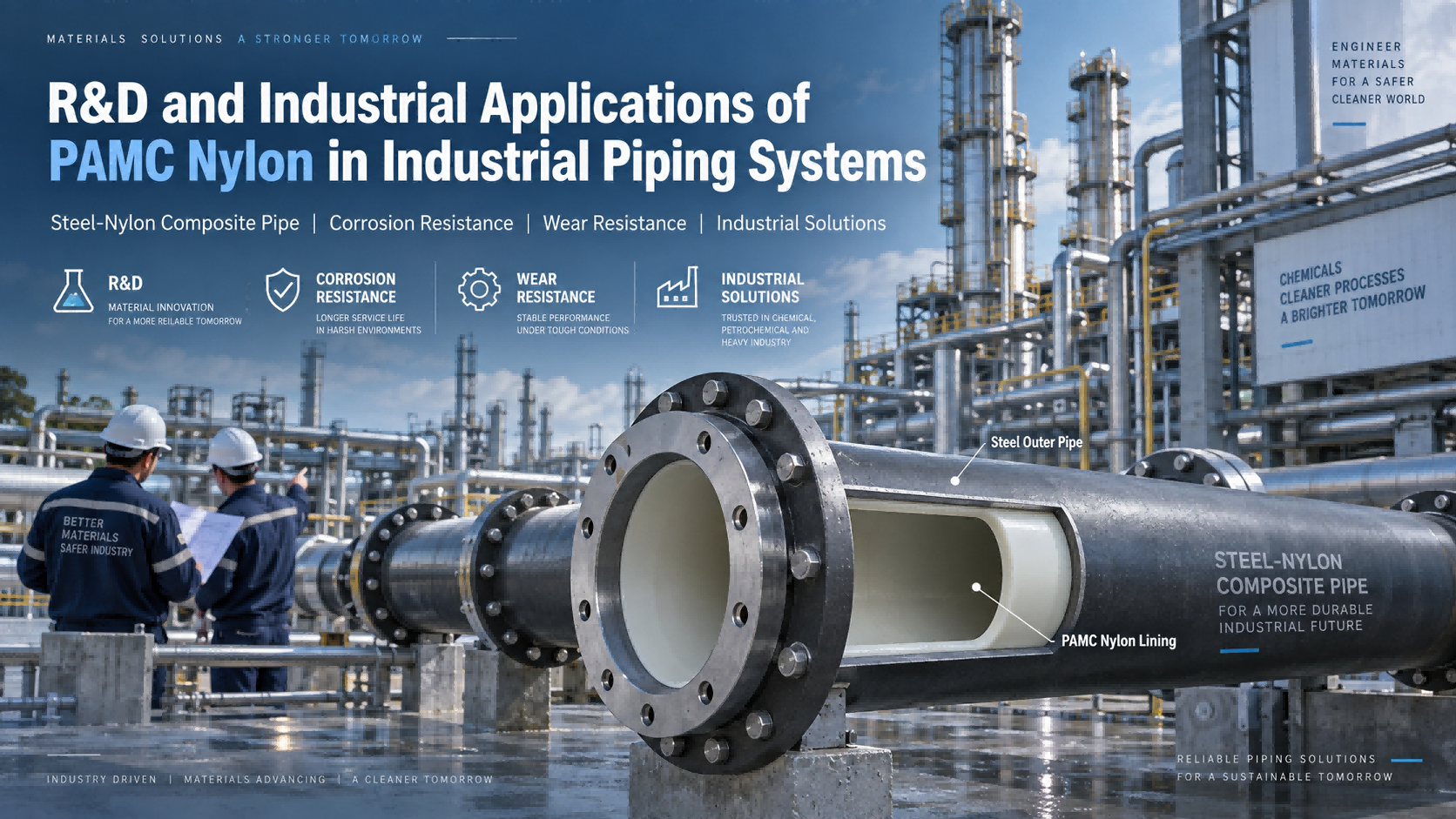
R&D and Industrial Applications of PAMC Nylon in Industrial Piping Systems
The development of industrial piping materials has always revolved around several fundamental engineering questions:
How can corrosion be controlled? How can wear be reduced? How can pipelines withstand pressure? How can service life be extended? And how can maintenance requirements be minimized?
Traditional carbon steel pipe offers excellent mechanical strength and pressure resistance, but it is vulnerable to corrosion, wall thinning, perforation, and leakage when exposed to aggressive media.
Stainless steel improves corrosion resistance, but it comes with higher material costs and can still suffer localized corrosion under certain chloride-containing conditions.
Non-metallic materials such as PE, PVC, and FRP offer good corrosion resistance, but each has limitations involving temperature, pressure, structural rigidity, large-diameter manufacturing, or demanding industrial operating conditions.
As a result, one trend in modern industrial piping is becoming increasingly clear:
It is becoming more difficult for a single material to solve every engineering problem. Composite material systems are therefore becoming an important direction for industrial pipeline development.
PAMC nylon materials and the resulting steel-nylon composite pipe systems have evolved within this engineering context.
By combining the corrosion resistance, wear resistance, low-friction characteristics, and smooth internal surface of nylon with the mechanical strength, rigidity, and pressure-bearing capability of steel, a pipeline structure can be created that balances corrosion protection with structural performance.
For oil and gas, chemical processing, salt chemicals, soda ash, chlor-alkali, mining, slurry transportation, and other applications where corrosion and wear occur simultaneously, this material combination can provide significant engineering value.
1. Why Does the Industrial Piping Industry Need Advanced Nylon Materials?
An industrial pipeline is far more than a simple container used to transport fluids.
Under actual industrial operating conditions, a pipeline may simultaneously be exposed to:
-
Chemical corrosion
-
Electrochemical corrosion
-
Solid-particle erosion
-
Slurry abrasion
-
Temperature fluctuations
-
Internal pressure
-
Water hammer
-
External mechanical loads
-
Installation stress
-
Continuous long-term operation
This means that improving only one material property is often not enough to solve pipeline reliability problems.
For example, one material may provide excellent corrosion resistance but insufficient wear resistance. Another may offer high mechanical strength but remain vulnerable to specific corrosive media.
Materials intended for complex industrial services must therefore achieve a balance among multiple performance requirements.
This is one of the fundamental reasons behind the development of PAMC nylon materials for industrial pipeline applications.
2. What Is PAMC Nylon?
PAMC nylon can be understood as an engineered nylon material system developed and optimized for demanding industrial applications.
Compared with conventional plastic piping materials, its development is not focused solely on corrosion resistance. Instead, greater attention is given to the comprehensive performance required by industrial piping systems, including:
Corrosion resistance, wear resistance, mechanical properties, dimensional stability, temperature adaptability, and long-term operational reliability.
Through continuous improvements in material formulation, polymerization processes, molding technology, and structural design, nylon can be adapted more effectively for industrial fluid transportation.
For industrial piping applications, the importance of PAMC nylon is not simply that it can replace another plastic material.
Its greater value lies in its ability to function as a high-performance functional layer within a composite piping structure.
In steel-nylon composite pipe systems, PAMC nylon can provide the critical functions of:
-
Media isolation
-
Internal corrosion resistance
-
Wear resistance
-
Smooth flow surfaces
while the steel structure provides mechanical strength and pressure resistance.
3. Corrosion Resistance Is One of the Primary Drivers Behind PAMC Nylon Development
Corrosion is one of the most common causes of industrial pipeline failure.
The risk becomes particularly significant when transporting:
-
High-salinity fluids
-
Chloride-containing media
-
Alkaline solutions
-
Certain weak acidic media
-
Industrial wastewater
-
Oilfield produced fluids
-
High-mineralization water
-
Brine
-
Chemical mother liquor
When conventional carbon steel pipe is directly exposed to these fluids over long operating periods, corrosion can lead to wall thinning, localized attack, perforation, and ultimately leakage.
Traditional solutions generally include:
-
Upgrading the steel grade
-
Using stainless steel
-
Applying anti-corrosion coatings
-
Using rubber-lined or plastic-lined steel
-
Replacing metallic pipe with FRP, PE, or other non-metallic materials
However, every solution has its own application limits.
One important objective in the development of PAMC nylon is therefore to minimize direct contact between the transported medium and the structural steel.
In a steel-nylon composite pipe, the functional structure can be simplified as:
Process Medium → PAMC Nylon Functional Layer → Steel Structural Layer
The transported medium primarily contacts the nylon layer instead of directly contacting the steel.
This fundamentally changes the approach to internal pipeline corrosion protection.
Rather than relying only on a more corrosion-resistant metal, the system uses a dedicated non-metallic functional layer to isolate aggressive media from the structural steel.
4. Wear Resistance Is Another Important Engineering Advantage of PAMC Nylon
Many industrial fluids are not clean liquids.
Typical examples include:
-
Mineral slurry
-
Salt mud
-
Lime slurry
-
Phosphate slurry
-
Sand-containing oilfield produced fluids
-
Industrial solid-liquid mixtures
-
High-concentration slurry
-
Wastewater containing suspended solids
When these media flow through pipelines at relatively high velocity, solid particles continuously impact and abrade the internal pipe surface.
Wear is often particularly severe at:
Elbows, tees, reducers, pump discharge sections, and other areas where the flow direction changes.
In these applications, the real challenge is often not chemical corrosion alone.
Instead, several degradation mechanisms may act simultaneously:
Corrosion + Erosion + Abrasion
This combination is one of the major reasons why the actual service life of some industrial pipelines can be significantly shorter than expected.
One important advantage of PAMC nylon is therefore its ability to combine corrosion resistance with wear resistance.
This combination is particularly valuable in slurry transportation and particle-containing industrial fluid systems.
5. Why Are Low Friction and a Smooth Internal Surface Important?
Another long-term challenge in industrial piping systems is:
Scaling and deposition.
When a pipe surface becomes rough because of corrosion or surface deterioration, deposits can attach more easily to the internal wall.
Over time, the process may develop as follows:
Internal corrosion → Increased surface roughness → Greater deposition → Reduced effective flow area → Increased hydraulic resistance → Lower transportation efficiency
Eventually, the pipeline may require:
-
Mechanical cleaning
-
Chemical descaling
-
Flushing
-
Maintenance shutdown
-
Pipeline replacement
PAMC nylon provides a relatively smooth internal surface.
When it serves as the media-contact layer of the pipeline, it can help reduce hydraulic resistance while creating less favorable conditions for deposit adhesion.
This can be particularly valuable in systems transporting:
-
Brine
-
Chemical mother liquor
-
Industrial wastewater
-
Slurry
-
Desulfurization fluids
-
High-mineralization water
-
Oilfield produced water
From a lifecycle perspective, internal surface characteristics are therefore important not only for corrosion protection but also for:
Energy consumption, flow efficiency, maintenance frequency, and long-term system performance.
6. Why Did PAMC Nylon Develop Toward a Steel-Nylon Composite Structure?
Nylon offers many useful functional properties.
However, industrial pipeline systems must also meet another critical requirement:
Structural strength.
This becomes especially important in:
-
Large-diameter pipelines
-
Higher-pressure systems
-
Long-distance pipelines
-
Pipe-rack installations
-
Long-span piping sections
-
Complex industrial installation environments
A pipeline must not only resist corrosion but also maintain sufficient:
-
Hoop strength
-
Axial strength
-
Rigidity
-
Pressure-bearing capability
-
External load resistance
This naturally leads to a composite engineering concept:
Let steel provide structural strength, while nylon manages the transported medium.
This is the fundamental design logic behind steel-nylon composite pipe.
The steel structure provides the mechanical framework and pressure-bearing capability, while the PAMC nylon layer provides corrosion resistance, wear resistance, and isolation from aggressive process media.
The result is a system that utilizes the strengths of both material classes.
7. What Is the Structural Value of Steel-Nylon Composite Pipe?
Conventional steel pipe and steel-nylon composite pipe represent two different engineering philosophies.
In conventional steel pipe:
Steel = Structural Material + Media-Contact Material
In steel-nylon composite pipe:
Steel = Structural Load-Bearing Layer
PAMC Nylon = Functional Protective Layer
This difference may appear simple, but it can fundamentally change the failure mechanism of the piping system.
One of the major concerns with conventional steel pipe is that continuous internal corrosion not only damages the media-contact surface but also gradually reduces the structural wall thickness.
In other words, deterioration of corrosion resistance and deterioration of mechanical strength occur simultaneously.
In a composite pipe structure, the nylon layer acts as the primary barrier between the aggressive medium and the steel structure.
By reducing direct exposure of the steel to corrosive fluids, the system can help protect the structural layer from internal corrosion.
8. How Is PAMC Nylon Applied to Large-Diameter Industrial Pipelines?
Good laboratory material properties do not automatically translate into successful industrial pipeline products.
Large-scale industrial manufacturing introduces another set of technical challenges, including:
-
Large-diameter molding
-
Uniform wall thickness
-
Temperature-field control
-
Shrinkage management
-
Interface stability
-
Flange structure design
-
Batch consistency
-
Stable pressure ratings
-
Finished-product inspection
As pipe diameter increases from DN100 to DN500, DN1000, DN1600, and beyond, manufacturing difficulty increases significantly.
For this reason, the technical barriers associated with large-diameter steel-nylon composite pipe are not limited to material formulation itself.
A mature manufacturing capability requires the integration of:
Material Technology + Manufacturing Equipment + Forming Process + Structural Design + Quality Control
This is also why major industrial projects increasingly evaluate the manufacturing capability of a composite pipe supplier rather than looking only at the name of the material.
9. Where Can PAMC Steel-Nylon Composite Pipe Be Applied?
The engineering value of PAMC nylon becomes most meaningful when evaluated against specific process media and operating conditions.
9.1 Oilfield Gathering and Transportation Systems
As mature oilfields enter high-water-cut production stages, pipeline systems may be exposed simultaneously to:
-
Water
-
Dissolved salts
-
CO₂
-
H₂S
-
Suspended solids
-
Sand
-
Corrosive components
These factors can combine to create:
Corrosion + Erosion + Deposition
within gathering and transportation pipelines.
Steel-nylon composite pipe combines a steel load-bearing structure with a nylon functional layer that isolates aggressive process fluids.
It can therefore provide an alternative material solution for gathering pipelines, station process piping, and selected high-corrosion pipeline sections.
9.2 Oilfield Produced Water and Water Injection Systems
Oilfield water systems frequently contain high levels of dissolved salts and minerals.
High salinity and high chloride concentrations can significantly increase the corrosion risk of metallic piping.
When suspended particles are also present, abrasive wear can further accelerate pipeline deterioration.
The combination of corrosion resistance and wear resistance offered by PAMC nylon can therefore be particularly valuable in these environments.
9.3 Soda Ash Industry
Soda ash production involves the transportation of a wide range of challenging process media, including:
-
Mother liquor
-
Brine
-
Salt mud
-
Process wastewater
These fluids can create multiple pipeline problems involving corrosion, scaling, deposition, and particle erosion.
For this reason, soda ash production represents a typical application environment for corrosion-resistant and wear-resistant composite piping systems.
9.4 Chlor-Alkali Industry
The chlor-alkali industry requires extensive transportation of alkaline process media.
For pipelines carrying caustic soda, brine, and related process fluids, key engineering parameters include:
-
Chemical compatibility
-
Concentration
-
Temperature
-
Pressure
-
Long-term operational stability
Within appropriate chemical compatibility limits, steel-nylon composite pipe can combine the structural strength of steel with the corrosion resistance of a nylon internal layer.
9.5 Salt Chemical Industry
High-concentration brine and chloride-rich environments can be highly challenging for conventional carbon steel piping.
Corrosion, scaling, and maintenance problems may occur during long-term operation.
A PAMC nylon functional layer helps reduce direct contact between salt-containing process fluids and the structural steel.
As a result, steel-nylon composite pipe can be considered for suitable brine and salt-chemical process applications.
9.6 Phosphate Chemical and Slurry Transportation
One of the biggest challenges in slurry transportation is abrasion.
The problem is particularly severe in components such as:
-
Elbows
-
Tees
-
Reducers
-
Pump discharge sections
Local turbulence and changes in flow direction can intensify erosion and abrasive wear.
Pipeline materials used in such systems must therefore provide not only corrosion resistance but also sufficient wear resistance.
PAMC nylon can offer useful performance characteristics for solid-liquid mixed media and slurry transportation.
10. How Does PAMC Steel-Nylon Composite Pipe Compare with Conventional Materials?
Industrial piping material selection should not be based on the question:
“Which material is the best?”
A better question is:
“Which material is most suitable for the specific operating conditions?”
Carbon Steel Pipe
Advantages:
-
High mechanical strength
-
Mature manufacturing technology
-
Relatively economical initial cost
Limitations:
-
Service life can be significantly affected in corrosive environments
Stainless Steel Pipe
Advantages:
-
High strength
-
Good corrosion resistance in many chemical environments
Limitations:
-
Relatively high material cost
-
Localized corrosion must still be evaluated in certain chloride-rich environments
PE / HDPE Pipe
Advantages:
-
Good corrosion resistance
-
Lightweight
-
Convenient installation in many applications
Limitations:
-
High-temperature, high-pressure, large-diameter, and high-rigidity services require careful engineering evaluation
FRP Pipe
Advantages:
-
Good corrosion resistance
-
Relatively lightweight
Limitations:
-
Long-term structural reliability, connection design, mechanical impact, and complex loading conditions must be evaluated according to the specific project
Steel-Nylon Composite Pipe
Its principal advantage comes from combining two different materials:
Steel provides structural strength, while PAMC nylon provides corrosion and wear resistance.
This makes the composite structure particularly attractive for industrial conditions where:
Pressure + Corrosion + Wear
occur simultaneously.
11. Why Is Flanged Connection Important for Industrial Projects?
Industrial pipeline materials must solve more than just service-life problems.
They must also solve:
Installation and maintenance problems.
Many oil, gas, chemical, mining, and industrial facilities have strict requirements involving:
-
Hazardous-area management
-
Explosion prevention
-
Restricted shutdown periods
-
Existing pipeline modification
-
Congested equipment layouts
-
Limited installation space
If extensive field welding is required, project construction can become more complicated.
Steel-nylon composite pipe with flanged connections can be connected directly to:
-
Pumps
-
Valves
-
Process equipment
-
Storage tanks
-
Pipe fittings
This is especially useful in the rehabilitation of existing industrial piping systems.
In many cases, an entire pipeline does not need to be replaced at once.
Instead, operators can prioritize frequently failing sections such as:
-
Elbows
-
Tees
-
Pump discharge sections
-
Pipe sections upstream and downstream of valves
-
Highly corrosive sections
-
High-wear sections
This targeted replacement strategy can reduce the complexity and investment required for an initial pipeline upgrade.
12. Why Must PAMC Nylon R&D Be Closely Connected with Engineering Applications?
The biggest difference between laboratory materials and industrial materials is simple:
Laboratories focus on material properties. Industrial projects focus on system reliability.
A material may perform exceptionally well in laboratory testing, but its industrial value remains limited if it cannot be consistently manufactured into:
-
DN500 pipe
-
DN1000 pipe
-
DN1600 pipe
-
Larger-diameter pipe
or if it cannot reliably achieve different pressure ratings.
PAMC nylon material development therefore needs to be integrated with several capabilities.
Material Development
Study formulation, polymerization, material properties, and chemical compatibility.
Structural Design
Optimize the steel structure, nylon functional layer, connection systems, and flange configurations.
Manufacturing Technology
Achieve stable forming and dimensional consistency for large-diameter pipes and fittings.
Inspection and Testing
Establish a complete quality-control system from incoming raw materials to finished products.
Engineering Validation
Use long-term field application data to continuously improve product design and manufacturing processes.
A truly mature industrial material is therefore not simply “developed” in a laboratory.
It is continuously optimized through:
R&D + Manufacturing + Testing + Engineering Application
13. From PAMC Nylon Pipe to Steel-Nylon Composite Pipe: Material Innovation or System Innovation?
From a broader technological perspective, this development represents more than a simple material upgrade.
It reflects a change in the engineering philosophy of industrial piping.
Traditional thinking often focuses on:
Finding a more corrosion-resistant single material.
Modern engineering increasingly asks:
How can different materials be used for the functions they perform best?
For example, steel can provide:
-
Mechanical strength
-
Pressure resistance
-
Structural stability
PAMC nylon can provide:
-
Corrosion resistance
-
Wear resistance
-
Isolation between the process medium and structural steel
-
Improved internal flow-surface characteristics
This functional division of materials is one of the most important advantages of composite pipeline technology.
14. Future Development Directions for PAMC Nylon in Industrial Piping
As industrial pipeline requirements become increasingly demanding, PAMC nylon and steel-nylon composite piping technologies are likely to continue developing in several directions.
14.1 More Complex Process Media
Future material development will increasingly evaluate long-term performance under combinations of:
Concentration × Temperature × Pressure × Flow Velocity
rather than simply asking whether a material is resistant to a specific chemical.
14.2 Higher Pressure Ratings
As composite piping gains wider acceptance in oil and gas, chemical, mining, and industrial applications, demand for higher pressure capabilities is likely to increase.
This will place greater emphasis on structural design, manufacturing consistency, and quality assurance.
14.3 Larger Diameters
More chemical plants, mining operations, industrial water systems, and large-scale fluid transport projects require pipeline diameters of DN1000 and above.
Stable large-diameter manufacturing capability will therefore become an increasingly important competitive advantage for composite pipeline manufacturers.
14.4 Improved External Corrosion Protection
Steel-nylon composite pipe primarily addresses corrosion caused by internal process media.
However, external steel structures can also be exposed to aggressive environments such as:
-
Marine conditions
-
Coastal environments
-
Salt spray
-
High-humidity chemical plants
As a result, future industrial composite piping systems may evolve from:
“Internal Corrosion Protection Products”
toward:
“Integrated Internal and External Corrosion Protection Systems.”
14.5 Digital Quality Management
In the future, individual industrial pipes may increasingly have complete digital manufacturing records covering:
-
Raw material batches
-
Manufacturing parameters
-
Dimensional inspection
-
Pressure testing
-
Final inspection
-
Project information
-
Installation location
This can significantly improve traceability throughout the service life of industrial piping systems.
15. The Procurement Logic for Industrial Pipelines Is Changing
In the past, one of the first questions asked during pipeline procurement was often:
“How much does it cost per meter?”
But as chemical plants, oilfields, mining companies, and other industrial operators become more aware of maintenance costs and production losses, procurement priorities are changing.
Modern projects increasingly consider:
-
Pipeline service life
-
Leakage risk
-
Maintenance frequency
-
Shutdown duration
-
Installation cost
-
Cleaning cost
-
Replacement cost
-
Total lifecycle cost
A pipeline material with a higher initial purchase price may still produce a lower long-term cost if it can reduce maintenance, replacement, leakage, and production shutdowns.
This is one of the reasons why high-performance composite piping systems are receiving increasing attention.
16. Why Do We Continue to Develop PAMC Steel-Nylon Composite Pipe?
Our objective is not simply to manufacture another type of industrial pipe.
We focus on several persistent problems faced by industrial operators:
Corrosion, wear, scaling, leakage, and frequent maintenance.
For this reason, we continue to develop and optimize:
-
PAMC nylon materials
-
Steel-nylon composite structures
-
Large-diameter manufacturing technology
-
Stable pressure-rating manufacturing
-
Quality-control systems
-
Industrial application solutions
Our products are designed primarily for applications in:
-
Oil and gas
-
Chemical processing
-
Chlor-alkali
-
Soda ash
-
Salt chemicals
-
Phosphate chemicals
-
Mining
-
Power generation
-
Industrial water systems
especially where corrosion and wear represent significant pipeline challenges.
Our steel-nylon composite pipe systems combine:
Steel Structural Strength + PAMC Nylon Corrosion and Wear Resistance + Flanged Connections
to create an integrated industrial piping solution.
For projects where pressure, corrosion, and wear exist simultaneously, this structure provides an alternative engineering option to conventional single-material piping systems.
Conclusion: True Material Innovation Must Ultimately Solve Engineering Problems
The value of an industrial material cannot be measured by a single impressive laboratory parameter.
A successful industrial material must answer much more practical questions:
Can it operate reliably for a long period?
Can it be manufactured consistently?
Can it withstand real industrial operating conditions?
Can it reduce leakage and maintenance?
Can it lower lifecycle costs for the entire project?
The evolution of PAMC nylon from material research into industrial pipeline applications is essentially a continuous process of solving these engineering challenges.
The development of steel-nylon composite pipe further demonstrates an important principle:
The future of industrial piping may not depend on finding one “universal material,” but on combining different materials so that each performs the function it is best suited to provide.
For highly corrosive, highly abrasive, large-diameter, and continuously operated industrial piping systems, steel-nylon composite pipe offers an engineering solution worth evaluating by design teams, plant operators, maintenance engineers, and procurement professionals.
If your project is experiencing pipeline corrosion, abrasion, frequent leakage, or insufficient service life, the suitability of steel-nylon composite pipe can be evaluated based on the transported medium, concentration, operating temperature, pressure, pipe diameter, flow velocity, and site environment.
How We Improve the Overall Performance of Nylon Pipes Through Material Modification
Core Directions for the Continuous Technological Advancement of Steel–Nylon Composite Pipes