Power Plant Circulating Water Pipe Selection: Balancing Corrosion, Scaling, Pressure, and Life-Cycle Cost
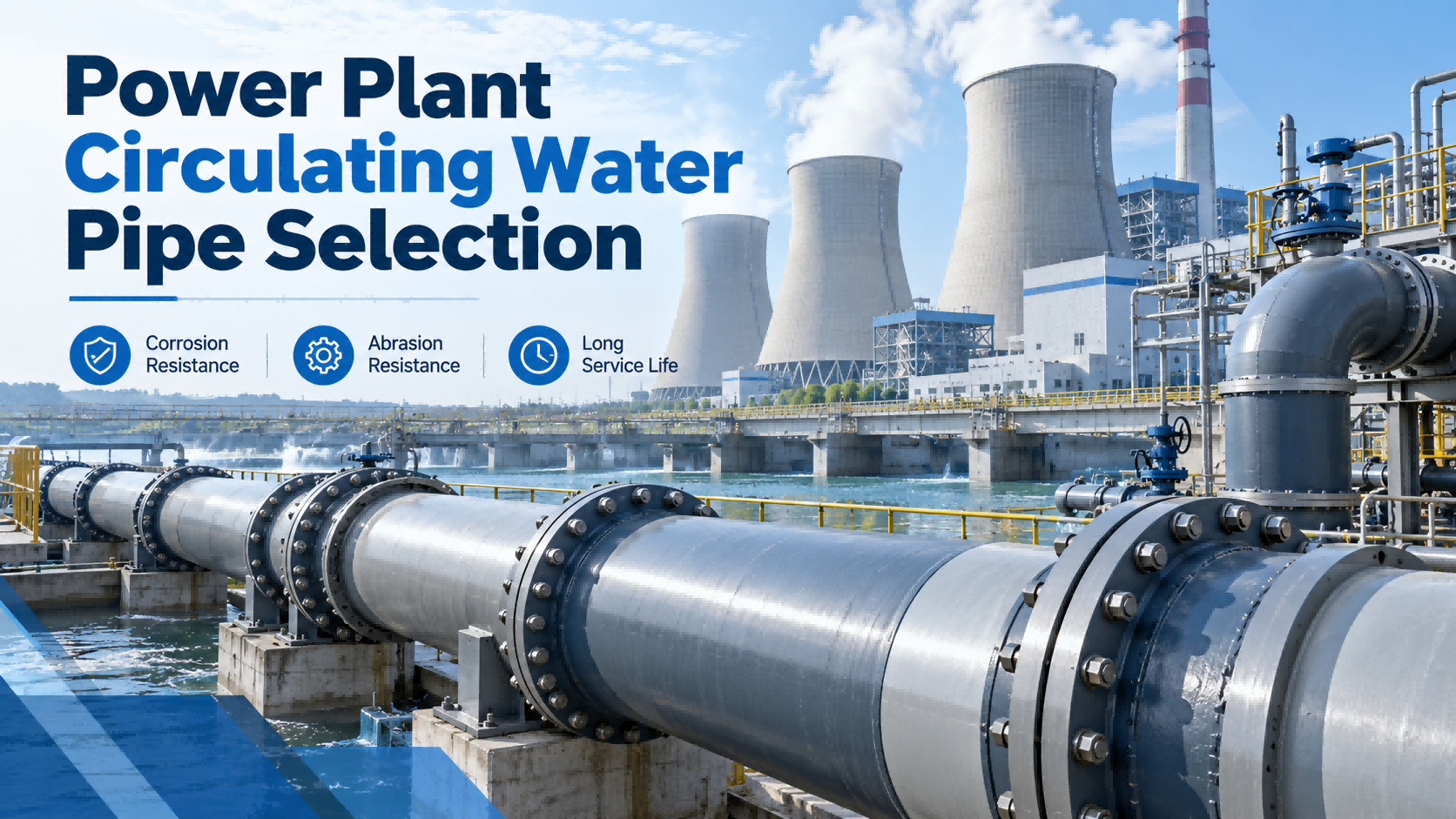
In thermal power plants, gas-fired power plants, nuclear auxiliary systems, and large industrial captive power stations, the circulating cooling water system is one of the most critical utility systems.
At first glance, circulating water pipelines appear to carry nothing more than water. From an engineering materials perspective, however, the operating conditions are far more complex.
Circulating water may contain:
-
Chloride ions and other dissolved salts;
-
Dissolved oxygen;
-
Suspended solids and sediment;
-
Microorganisms;
-
Water-treatment chemicals;
-
Corrosion products;
-
Carbonates and other scale-forming substances.
At the same time, circulating water systems are typically characterized by high flow rates, large pipe diameters, continuous operation, and high shutdown costs.
Therefore, selecting piping for a power plant circulating water system should not simply be a question of:
“Which pipe has the lowest purchase price?”
A more appropriate question is:
Which piping solution provides the best balance among corrosion resistance, abrasion resistance, scaling control, pressure capability, large-diameter manufacturing, and long-term maintenance cost?
This is also why an increasing number of large industrial projects are reassessing conventional carbon steel, FRP, HDPE, stainless steel, and composite piping solutions.
1. Why Is Power Plant Circulating Water Piping More Difficult to Select Than Ordinary Water Piping?
The major difference between a circulating water pipeline and a conventional municipal water pipeline is that the operating environment is highly complex.
Many pipeline failures are not caused by one single factor. Instead, several degradation mechanisms often act together.
For example:
Corrosion → increased internal surface roughness → more deposits → changes in local flow conditions → accelerated under-deposit corrosion.
Another example is:
Sediment erosion → localized damage to protective coatings → exposure of the steel substrate → accelerated local corrosion → further wall thinning.
In practice, power plant circulating water pipelines are exposed to the combined effects of:
corrosion + abrasion + scaling + hydraulic losses + pressure fluctuations + long-term continuous operation.
This explains why some materials that perform well in ordinary water service may behave very differently when used in large-scale power plant circulating water systems.
2. Six Key Parameters for Circulating Water Pipe Selection
2.1 Water Corrosivity
The first step is to analyze the circulating water chemistry, including:
-
Chloride concentration;
-
Total dissolved solids (TDS);
-
pH;
-
Hardness;
-
Alkalinity;
-
Dissolved oxygen;
-
Sulfates;
-
Water-treatment chemicals;
-
Make-up water source.
If seawater, high-salinity water, industrial reclaimed water, or highly concentrated circulating water is used, the corrosion risk can increase significantly.
For conventional carbon steel, long-term operation may result in:
-
General corrosion;
-
Pitting corrosion;
-
Under-deposit corrosion;
-
Corrosion around weld areas;
-
Localized wall thinning.
Therefore, simply increasing the wall thickness of a steel pipe does not fundamentally eliminate the corrosion problem.
2.2 Suspended Solids in Circulating Water
Circulating water in a power plant is not always perfectly clean.
Especially when the source water includes:
-
River water;
-
Lake water;
-
Seawater;
-
Industrial reclaimed water,
the system may contain:
-
Sediment;
-
Rust particles;
-
Scale particles;
-
Biological deposits;
-
Other suspended solids.
Under high-flow conditions, these particles can continuously erode the internal pipe surface, particularly at elbows, tees, reducers, and pump discharge sections.
Therefore, circulating water piping must provide not only corrosion resistance, but also adequate erosion and abrasion resistance.
2.3 Pipeline Design Pressure
Although most large circulating water systems are not classified as extremely high-pressure systems, significant pressure fluctuations can occur because of:
-
High flow rates;
-
Large diameters;
-
Pump start-up and shutdown;
-
Valve operation;
-
Water hammer;
-
Elevation differences.
Therefore, the selected material must provide sufficient:
structural strength and pressure-bearing capability.
This is one of the major differences between large industrial circulating water pipelines and ordinary low-pressure drainage systems.
2.4 Pipe Diameter
One of the defining characteristics of power plant circulating water systems is the use of:
large-diameter pipelines.
In large projects, DN800, DN1000, DN1200, DN1600, and even larger diameters may be required.
As the pipe diameter increases, material selection becomes more complicated.
Engineers must consider:
-
Ring stiffness;
-
Vacuum stability;
-
Pressure resistance;
-
Pipe self-weight;
-
Support spacing;
-
Flange strength;
-
Transportation;
-
Lifting;
-
Installation.
Therefore, large-diameter circulating water piping is no longer simply a matter of selecting a corrosion-resistant material. It becomes a comprehensive structural engineering challenge.
2.5 Scaling and Internal Surface Roughness
During long-term operation, deposits may gradually accumulate on the internal surface of circulating water pipelines, including:
-
Carbonate scale;
-
Corrosion products;
-
Biofilm;
-
Sediment.
As the pipe wall becomes rougher, hydraulic resistance increases.
For a large circulating water system, even a small increase in pressure loss per unit length can lead to significantly higher pumping energy consumption over several kilometers of pipeline and continuous year-round operation.
Therefore, pipe evaluation should not focus only on:
“Will the pipe corrode?”
It should also consider:
“What will the internal pipe surface look like after many years of operation?”
2.6 Total Life-Cycle Cost
The most expensive part of a circulating water pipeline is often not the initial purchase.
Long-term costs may include:
-
Corrosion protection;
-
Leak repairs;
-
Replacement;
-
Shutdowns;
-
Lifting operations;
-
Welding;
-
Scaffolding;
-
Labor;
-
Production losses.
For this reason, large power plants are increasingly shifting their evaluation criteria from:
CAPEX — initial investment
to:
TCO — Total Cost of Ownership.
3. Comparison of Common Power Plant Circulating Water Pipe Materials
Common piping solutions include:
| Pipe Material | Corrosion Resistance | Abrasion Resistance | Pressure Capability | Large-Diameter Capability | Main Engineering Concerns |
|---|---|---|---|---|---|
| Carbon Steel | Moderate | Good | High | Excellent | Corrosion and coating maintenance |
| Stainless Steel | Good | Good | High | Good | Chloride pitting and cost |
| FRP | Excellent | Moderate | Moderate | Excellent | Impact resistance, joints, long-term structural stability |
| HDPE | Excellent | Good | Condition-dependent | Good | Large-diameter stiffness, temperature, pressure |
| Rubber-Lined Steel | Good | Good | High | Good | Lining aging and localized separation |
| Steel-Nylon Composite Pipe | Excellent | Excellent | High | Excellent | Structural design, manufacturing quality, connection reliability |
Every material has its own suitable operating range.
A proper engineering selection should not simply attempt to identify one universally “best” material.
Instead, engineers should determine which material is most suitable for a specific combination of:
water chemistry + pipe diameter + pressure + temperature + velocity + required service life.
4. Why Do Conventional Carbon Steel Circulating Water Pipes Often Enter a Repetitive Maintenance Cycle?
Carbon steel has several clear advantages:
-
High structural strength;
-
Mature manufacturing technology;
-
Excellent large-diameter capability;
-
Well-established welding and installation systems.
For these reasons, large power plant circulating water systems have traditionally used significant quantities of steel pipe.
The main challenge is corrosion.
Circulating water may contain:
-
Chloride ions;
-
Dissolved oxygen;
-
Microorganisms;
-
Water-treatment chemicals,
all of which may contribute to the gradual degradation of steel pipelines.
In engineering practice, a common solution is:
Steel Pipe + Protective Coating
However, a coating is essentially a separate protective barrier.
If it is damaged during transportation, welding, installation, or long-term operation, the following failure process may begin:
Coating damage → steel substrate exposure → localized corrosion → wall thinning → leakage
Over time, many aging circulating water systems gradually enter a repetitive cycle of:
repair → operation → new leakage → further repair.
5. Why Is Corrosion Resistance Alone Not Enough?
This is one of the most frequently overlooked issues in circulating water piping design.
Some plastic and FRP materials offer excellent inherent corrosion resistance.
However, large industrial circulating water pipelines must also answer several additional engineering questions.
Can the pipe withstand long-term internal pressure?
As pipe diameter increases, circumferential stress caused by internal pressure also becomes increasingly important.
Design must consider:
-
Operating pressure;
-
Design pressure;
-
Water hammer pressure;
-
Temperature;
-
Long-term fatigue.
Can the pipe withstand external loads?
Buried pipelines may also be exposed to:
-
Soil pressure;
-
Surface loads;
-
Ground settlement;
-
Groundwater buoyancy.
Can the pipe withstand impact during installation?
Large pipes are difficult to transport and install without exposure to:
-
Lifting;
-
Collision;
-
Localized impact.
Therefore, material toughness is also an important consideration.
Are the joints reliable?
Many industrial piping failures do not occur in straight pipe sections.
They occur at:
-
Flanges;
-
Elbows;
-
Tees;
-
Reducers;
-
Joints.
Therefore:
The reliability of the connection system is just as important as the pipe material itself.
6. Why Are Steel-Nylon Composite Pipes Suitable for Large Circulating Water Systems?
The engineering concept behind a steel-nylon composite pipe is not simply to add a plastic layer inside a steel pipe.
Its core design principle is:
The steel structure carries pressure and mechanical loads, while the reinforced nylon layer provides corrosion and abrasion resistance on the media-contact surface.
This represents a typical combination of:
Structural Material + Functional Material
6.1 Steel Provides Structural and Pressure-Bearing Strength
One of the greatest advantages of steel is its:
strength and rigidity.
Therefore, in large-diameter circulating water systems with significant design pressure, the steel structure can withstand:
-
Internal pressure;
-
External loads;
-
Pipeline weight;
-
Installation loads.
This avoids the need for some single-material non-metallic pipes to continuously increase wall thickness as pipe diameter and pressure requirements rise.
7. Reinforced Nylon Inner Layer Helps Address Corrosion
Inside a steel-nylon composite pipe, the transported medium primarily contacts the reinforced nylon layer rather than the structural steel.
This can significantly reduce common steel-pipe corrosion mechanisms such as:
-
Electrochemical corrosion;
-
Pitting;
-
Under-deposit corrosion;
-
Rusting and internal wall degradation.
For applications involving:
-
High-salinity circulating water;
-
Industrial reclaimed water;
-
Chloride-containing cooling water;
-
Certain corrosive industrial circulating water systems,
this composite structure can provide substantial engineering value.
8. Beyond Corrosion Resistance: Abrasion Resistance Matters
Sediment, deposits, and suspended solids in power plant circulating water can continuously erode the inside of pipelines.
Erosion is often particularly severe at:
-
Elbows;
-
Tees;
-
Pump discharge sections;
-
Reducers.
Reinforced nylon has good abrasion resistance, enabling steel-nylon composite piping to address both:
corrosion + erosion
within one piping structure.
This is especially important for power plants with complex or variable circulating water quality.
9. A Smoother Internal Surface Helps Maintain Long-Term Hydraulic Efficiency
The longer a pipeline operates, the more important its hydraulic performance becomes.
As traditional steel pipes corrode, their internal surfaces may gradually develop:
-
Rust;
-
Pitting;
-
Corrosion deposits;
-
Scale and sediment.
These factors increase internal roughness.
A reinforced nylon inner layer, by contrast, can maintain a relatively smooth flow surface.
For circulating water systems, this can help:
limit the growth of hydraulic resistance during long-term operation.
In large circulating water pumping systems that operate 24 hours a day, differences in internal surface condition can gradually translate into differences in pumping efficiency and long-term energy consumption.
10. Large-Diameter Capability Is an Important Advantage of Steel-Nylon Composite Pipe
Power plant circulating water systems frequently require large-diameter piping.
This is also where material selection becomes particularly challenging.
At smaller diameters, many pipe materials may satisfy the operating requirements.
However, once the project enters the range of:
DN800, DN1000, DN1200, DN1600, or even larger diameters,
engineering complexity increases significantly.
The advantage of a steel-nylon composite structure is that the steel component provides the required:
-
Rigidity;
-
Strength;
-
Resistance to deformation.
At the same time, the nylon layer provides protection against corrosion and abrasion on the media-contact surface.
For extra-large-diameter circulating water systems, this combination provides significant engineering flexibility.
11. Flanged Connections Are Important in Power Plant Circulating Water Systems
Large industrial piping systems must solve not only the problem of the pipe body itself, but also:
how the pipeline will be connected reliably.
Flanged connections are particularly common in:
-
Pump houses;
-
Valve areas;
-
Heat exchanger interfaces;
-
Maintenance sections;
-
Pipe rack installations.
Steel-nylon composite pipes can use flange structures compatible with conventional industrial equipment systems.
A properly designed integrated composite flange connection can help reduce potential problems associated with conventional lined piping, including:
-
Media penetration at connection interfaces;
-
Exposure of metallic end faces;
-
Localized corrosion.
Therefore, in composite piping design:
Corrosion resistance of the straight pipe is only the first step. Corrosion resistance and integrity at the connection points are among the key factors determining long-term system reliability.
12. Circulating Water Pipelines Should Be Compared by TCO, Not Just Price per Meter
Suppose Pipe A is 20% less expensive initially.
However, over ten years of operation, it requires:
-
Three localized repairs;
-
One major replacement;
-
Multiple shutdowns;
-
Reapplication of corrosion protection;
-
Welding work;
-
Heavy lifting operations.
Pipe B may have a higher initial cost, but significantly reduces maintenance frequency.
Which option is actually less expensive?
The answer cannot be determined by:
initial purchase price
alone.
Instead, the project should calculate:
Pipeline TCO
TCO =
Initial pipe cost
-
Installation cost
-
Corrosion protection cost
-
Energy cost
-
Maintenance cost
-
Replacement cost
-
Shutdown losses
For a large power plant, the final factor—
Downtime Cost
—can sometimes be even more important than the pipe purchase cost itself.
13. Which Circulating Water Applications Are Particularly Suitable for Evaluating Steel-Nylon Composite Pipe?
The following operating conditions are especially suitable for a technical and economic comparison.
High-Salinity Circulating Water
For example:
-
Coastal power plants;
-
Seawater cooling systems;
-
High-salinity industrial water systems.
Industrial Reclaimed Water
As industrial water conservation becomes increasingly important, more power plants are using reclaimed or reused industrial water.
This water can be chemically more complex than conventional freshwater.
Circulating Water with High Suspended Solids
If the water contains:
-
Sediment;
-
Solid particles;
-
Corrosion products,
the pipeline must provide both corrosion resistance and abrasion resistance.
Large-Diameter Circulating Water Mains
Especially for:
DN800 and above
and even:
DN1200–DN2000
large circulating water systems.
Aging Steel Pipeline Upgrade Projects
For existing circulating water systems suffering from:
-
Frequent leakage;
-
Repeated repair welding;
-
Severe corrosion;
-
Failed protective coatings,
simply replacing the existing pipes with the same type of steel pipe may not solve the underlying problem.
In such situations, a new material evaluation should be conducted from both technical and economic perspectives.
14. How Should Power Plants Make the Final Circulating Water Pipe Selection?
A complete material selection process should include at least the following steps.
Step 1: Analyze Water Quality
Confirm key parameters such as:
-
pH;
-
Chloride concentration;
-
TDS;
-
Hardness;
-
Suspended solids;
-
Chemical additives.
Step 2: Confirm Design Parameters
Including:
-
DN;
-
Operating pressure;
-
Design pressure;
-
Operating temperature;
-
Design temperature;
-
Flow velocity.
Step 3: Identify Corrosion and Abrasion Mechanisms
Determine whether the main failure mechanism is:
corrosion,
abrasion,
or:
a combination of corrosion and abrasion.
Step 4: Compare Candidate Materials
At minimum, the evaluation should consider:
-
Carbon Steel;
-
Stainless Steel;
-
FRP;
-
HDPE;
-
Rubber-Lined Steel;
-
Steel-Nylon Composite Pipe.
Step 5: Calculate 20-Year Life-Cycle Cost
Instead of comparing only:
$/meter,
compare:
$/service life
or even:
$/m³ of transported water.
This provides a much more realistic assessment of the economic performance of circulating water piping.
15. Our Steel-Nylon Composite Pipe Solution
For large industrial circulating water systems and other applications involving corrosive or abrasive media, we focus on the development and manufacturing of reinforced nylon and steel-nylon composite piping systems.
The steel-nylon composite structure combines:
Steel Strength
with:
Nylon Corrosion and Abrasion Resistance.
The design objective is to address a long-standing challenge in industrial piping:
Metallic materials provide high strength but are vulnerable to corrosion, while some non-metallic materials provide excellent corrosion resistance but may face additional engineering challenges under large-diameter, high-pressure, and complex mechanical loading conditions.
By using a composite structure, each material can perform the function it is best suited for.
Our piping products can be designed with different diameters, pressure classes, and connection structures according to specific project requirements, making them suitable for large industrial water systems and the transportation of complex corrosive and abrasive media.
During the project selection stage, we recommend that customers provide:
-
Transported medium;
-
Water quality analysis;
-
Operating temperature;
-
Operating pressure;
-
Pipe diameter;
-
Flow velocity;
-
Existing pipeline material;
-
Current major failure problems.
A targeted material evaluation can then be performed instead of simply repeating traditional material-selection practices.
16. Conclusion: The Future of Power Plant Circulating Water Piping Is About Longer Stable Operating Life, Not the Lowest Initial Price
A clear change is taking place in power plant circulating water system design.
The traditional material selection question was:
Which pipe has the lowest purchase cost?
Increasingly, modern projects are asking:
Which piping solution can maintain reliable operation with lower maintenance costs over the next 10, 20, or even more years?
For circulating water systems, corrosion is only one part of the challenge.
The actual engineering problem includes:
corrosion
abrasion
scaling
pressure
large-diameter structural stability
maintenance cost
shutdown losses
acting together.
The value of steel-nylon composite pipe lies in its ability to combine:
Steel Structure for Pressure-Bearing Strength + Reinforced Nylon for Corrosion and Abrasion Resistance
within one integrated piping system.
For large power plant circulating water mains, high-salinity cooling water, industrial reclaimed water, and retrofit projects where conventional steel pipelines require frequent corrosion repairs, steel-nylon composite pipe deserves serious consideration alongside carbon steel, FRP, HDPE, stainless steel, and other conventional solutions.
A well-engineered circulating water pipe selection should not ask:
“Which material is the cheapest?”
It should ask:
“Which piping system can provide safe, stable, and efficient operation at the lowest overall cost throughout its entire design life?”
That is the central principle of modern power plant circulating water pipeline material selection.
Recommended Piping for Power Plant FGD Systems: How to Select Pipe Materials When Corrosion, Abrasion, and Scaling Occur Together
How to Reduce Maintenance Costs in High-Abrasion Slurry Pipelines