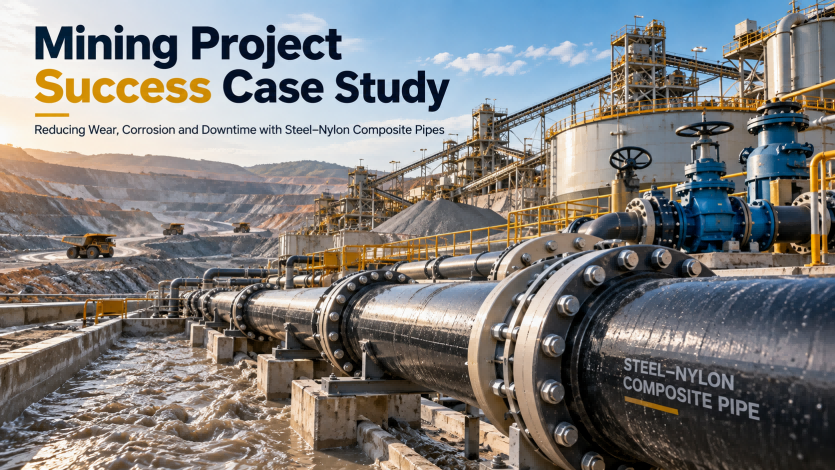
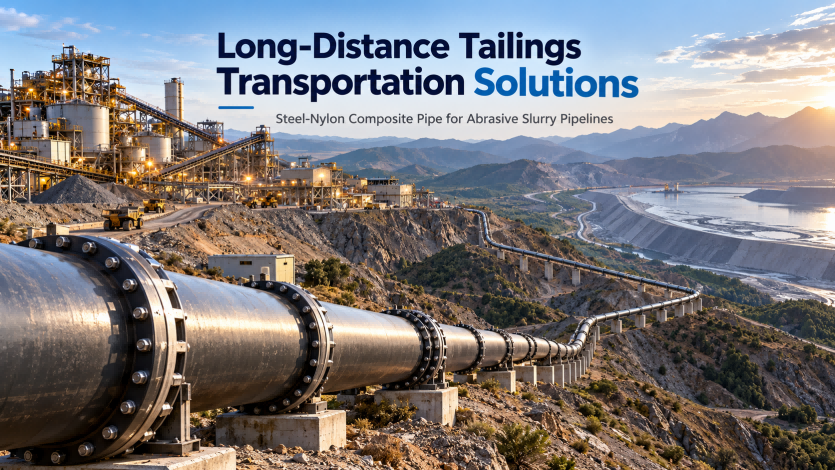
Recommended Piping for Power Plant FGD Systems: How to Select Pipe Materials When Corrosion, Abrasion, and Scaling Occur Together
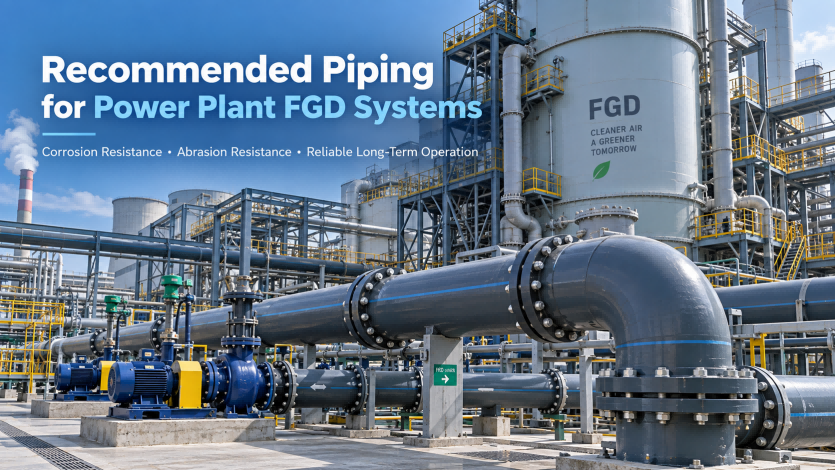
In a power plant wet flue gas desulfurization system, pipelines may appear to be simple components connecting the absorber tower, slurry pumps, limestone preparation system, and gypsum dewatering system. In practice, however, piping reliability can have a major impact on the long-term stability and maintenance requirements of the entire FGD system.
This is especially true in limestone-gypsum Wet Flue Gas Desulfurization (WFGD) systems.
The fluids transported through these pipelines are far more challenging than ordinary water. Depending on the process location, they may contain suspended solids, chlorides, sulfates, sulfites, limestone particles, gypsum crystals, and other corrosive or abrasive constituents.
As a result, FGD pipelines may need to withstand several degradation mechanisms at the same time:
-
Corrosion
-
Abrasive wear
-
Slurry erosion
-
Scaling and solids deposition
-
Continuous friction from suspended particles
-
Severe local erosion at elbows, tees, and pump discharge sections
-
Pressure and temperature fluctuations during start-up and shutdown
-
Humid, saline, and chemically aggressive environments
Therefore, the key question in FGD piping selection is not simply:
“Which pipe is corrosion resistant?”
The more important engineering question is:
Which piping system can provide an appropriate balance of corrosion resistance, abrasion resistance, pressure capability, structural reliability, and long-term operating cost?
For many low- to moderate-temperature slurry, wastewater, and combined corrosion-abrasion services, steel-nylon composite pipe is an alternative that deserves serious engineering evaluation.
1. Why Are FGD Systems So Demanding on Pipeline Materials?
A wet FGD system is essentially a complex gas-liquid-solid reaction and material handling system.
A typical limestone-gypsum WFGD process may include:
Limestone slurry preparation
↓
Slurry transportation
↓
Absorber circulation and spraying
↓
SO₂ absorption and oxidation
↓
Gypsum slurry discharge
↓
Gypsum dewatering
↓
FGD wastewater treatment
Different sections of the system experience very different operating conditions.
Limestone Slurry Pipelines
The primary concern is continuous abrasion from suspended solid particles.
As slurry velocity increases, wall wear can become more severe, particularly at:
-
Elbows
-
Tees
-
Reducers
-
Valves
-
Pump discharge sections
Absorber Recirculation Slurry Pipelines
These are often among the highest-flow piping systems in an FGD plant.
The transported slurry may simultaneously contain:
-
Suspended solids
-
Corrosive ions
-
High circulating flow rates
-
Chemically active constituents
Because these systems often operate continuously, the piping material must provide both corrosion and abrasion resistance.
Gypsum Slurry Pipelines
Gypsum crystals moving through the pipeline continuously interact with the pipe wall.
When deposits accumulate inside the pipeline, the remaining flow area may become smaller, producing local high-velocity zones and potentially accelerating erosion.
FGD Wastewater Pipelines
FGD wastewater can have complex chemistry.
Its composition varies depending on factors such as:
-
Coal source
-
Make-up water quality
-
Chloride accumulation
-
FGD operating conditions
-
Wastewater treatment strategy
High chloride and dissolved salt concentrations can create challenging corrosion conditions for certain metallic materials.
This is why:
It is difficult for one conventional piping material to be the optimum choice for every part of an FGD system.
A more rational approach is to select materials according to the actual process conditions of each piping section, including fluid chemistry, temperature, pressure, solids concentration, particle size, and flow velocity.
2. Five Common Failure Mechanisms in FGD Piping
2.1 Corrosion
When ordinary carbon steel is directly exposed to corrosive slurry or wastewater, protective linings or coatings are normally required.
Without adequate protection, long-term service may result in:
-
General corrosion
-
Localized corrosion
-
Pitting
-
Corrosion near weld areas
-
Wall thinning
-
Perforation
-
Leakage
Once leakage occurs, the consequences extend beyond replacing a section of pipe.
A failure may also result in:
-
Production interruptions
-
Emergency maintenance
-
Environmental concerns
-
Higher labor costs
-
Unplanned FGD shutdowns
2.2 Slurry Abrasion
FGD slurry contains limestone particles, gypsum crystals, and other suspended solids that can continuously abrade the internal surface of the piping system.
If slurry is treated as if it were ordinary liquid and the solid phase is ignored during material selection, premature failure can result.
The most vulnerable locations often include:
-
Pump discharge lines
-
90-degree elbows
-
Tees
-
Reducers
-
Valve sections
-
Other areas with severe turbulence
At these locations, changes in flow direction or velocity can significantly increase local erosion.
3. Many FGD Pipelines Fail Because of Combined Corrosion and Abrasion
This is one of the most important factors to understand when selecting materials for FGD slurry service.
Evaluating corrosion resistance alone is often insufficient.
Consider a pipe protected by an internal anticorrosion lining.
If the lining has inadequate abrasion resistance, suspended particles may gradually damage its surface.
Once a local area of the protective layer is compromised, the structural steel underneath may become directly exposed to the process fluid.
A typical degradation process may then develop:
Abrasion → Lining Damage → Steel Exposure → Accelerated Corrosion → Local Wall Thinning → Leakage
Therefore, for FGD slurry systems, an appropriate piping material should ideally be evaluated for both:
Corrosion Resistance + Abrasion Resistance
This combined requirement is one reason composite piping systems are receiving increasing attention in challenging industrial applications.
4. Scaling and Deposition Should Not Be Ignored
FGD slurry can contain large quantities of calcium salts and suspended solids.
If the internal pipe surface is rough, or if significant internal steps, weld irregularities, or dead zones exist, solid particles may be more likely to accumulate.
Over time, these deposits can lead to:
-
Reduced effective flow area
-
Increased hydraulic resistance
-
Higher pump energy consumption
-
Reduced flow capacity
-
Local blockage
-
More frequent cleaning and maintenance
Therefore, FGD piping design should consider not only whether the pipe will corrode but also:
Whether the internal surface can help maintain stable hydraulic performance during long-term operation.
A relatively smooth internal surface can be beneficial in reducing particle attachment and flow resistance.
5. Comparison of Common Pipe Materials for Power Plant FGD Systems
Common materials used or considered in FGD piping systems include:
-
Rubber-lined steel pipe
-
FRP/GRP pipe
-
Stainless steel pipe
-
HDPE pipe
-
Other lined steel pipe systems
-
Steel-nylon composite pipe
Each material has its own advantages and limitations.
| Pipe Material | Corrosion Resistance | Abrasion Resistance | Pressure Capability | Impact Resistance | Large-Diameter Capability | Key Considerations |
|---|---|---|---|---|---|---|
| Carbon Steel | Relatively low without protection | Moderate | High | High | High | Normally requires corrosion protection |
| Rubber-Lined Steel | Good in suitable service | Good | High | Relatively high | High | Lining aging, debonding, and local damage should be considered |
| FRP/GRP | Good for many chemical environments | Depends on resin and laminate design | Moderate | Relatively lower | Good | Impact, joints, and long-term structural performance require evaluation |
| HDPE | Good in many environments | Good | Temperature- and diameter-dependent | Good | Good | Pressure capability at elevated temperatures requires careful design |
| Stainless Steel | Good in many environments | Good | High | High | High | Localized corrosion in high-chloride service and material cost must be evaluated |
| Steel-Nylon Composite Pipe | Advantageous in suitable corrosive environments | Good | Relatively high | Good | High | Chemical compatibility, temperature, and service conditions must be verified |
Therefore, engineering material selection should not simply ask:
“Which pipe material is the best?”
A better question is:
“Which material is most suitable for this specific pipeline and its actual operating conditions?”
6. Why Consider Steel-Nylon Composite Pipe for FGD Applications?
Steel-nylon composite pipe uses a composite structural concept.
The basic engineering principle is:
The steel structure provides mechanical strength and pressure resistance, while the reinforced nylon layer isolates the transported medium from the steel and provides a wear-resistant internal flow surface.
This allows the system to combine selected advantages of metallic and polymer materials.
For industrial services involving both corrosion and abrasion, this composite structure can offer significant engineering value.
6.1 Steel Provides Mechanical Strength and Pressure Resistance
FGD pipelines must do more than resist corrosion.
They may also need to withstand:
-
Normal operating pressure
-
Pressure fluctuations during pump start-up and shutdown
-
Pipeline support loads
-
Structural requirements in large diameters
-
Transportation loads
-
Installation loads
-
Potential hydraulic transients
For some all-polymer piping systems, stiffness and pressure capability can become increasingly important considerations as diameter, temperature, and pressure increase.
Steel-nylon composite pipe uses a steel structural layer to provide mechanical support.
This makes it particularly worth evaluating where three requirements exist simultaneously:
Corrosion Resistance + Abrasion Resistance + Pressure Capability
For example, our steel-nylon composite pipe system can be engineered for industrial projects with pressure classes of approximately 1.0–4.0 MPa, depending on pipe diameter, temperature, design conditions, and project requirements.
Large-diameter configurations are also available for industrial piping applications.
7. Nylon Internal Layer Helps Isolate the Process Medium from the Steel Structure
One fundamental weakness of unprotected carbon steel piping is direct contact between the corrosive medium and the metallic pressure-bearing structure.
Steel-nylon composite pipe introduces a nylon layer between the conveyed medium and the structural steel.
Instead of continuously attempting to manage corrosion after it occurs, the design philosophy is to:
Reduce direct contact between the corrosive process medium and the pressure-bearing steel structure.
For suitable slurry, brine, industrial wastewater, and process-water applications, this configuration can help reduce the risk of internal steel corrosion.
However, polymer compatibility must always be evaluated according to actual operating conditions.
For FGD applications, the assessment should consider:
-
pH
-
Chloride concentration
-
Temperature
-
Solids concentration
-
Chemical composition
-
Operating pressure
-
Cleaning chemicals, if applicable
No polymer material should be assumed to be universally compatible with every FGD fluid without reviewing the actual service conditions.
8. Abrasion Resistance Is Especially Important for FGD Slurry Pipelines
A distinguishing feature of FGD systems is that many process streams are both corrosive and abrasive.
Typical examples include:
-
Limestone slurry
-
Gypsum slurry
-
Certain FGD wastewater streams
-
Slurry recycle systems
Reinforced nylon offers useful abrasion and impact-resistant characteristics, making it a material worth evaluating for solid-liquid two-phase flow.
For pipelines that continuously transport suspended particles, this means material selection can move beyond simple corrosion protection toward a more integrated strategy:
Corrosion Resistance + Abrasion Resistance
This is particularly relevant in sections experiencing continuous solids transport.
9. A Smooth Internal Surface Can Help Reduce Hydraulic Resistance and Deposition
The long-term energy efficiency of a piping system depends on more than pump efficiency.
The condition of the internal pipe surface also matters.
If corrosion products, deposits, and surface degradation significantly increase internal roughness over time, hydraulic resistance may rise.
The operating sequence can become:
Increasing Surface Roughness
↓
Increasing Pressure Loss
↓
Higher Pumping Requirement
↓
Higher Energy Consumption
↓
Reduced System Efficiency
A nylon internal surface can maintain a relatively smooth flow passage when used under suitable service conditions.
For long-term slurry and industrial water transportation, this can help avoid the progressive roughening associated with internal metallic corrosion.
10. Flanged Connections Can Simplify Industrial Installation
FGD systems are usually located in equipment-dense areas of a power plant.
During shutdown maintenance and retrofit projects, the available construction window may be limited.
Pipeline connection design therefore becomes an important consideration.
Our steel-nylon composite piping system can be designed with flanged connections according to project requirements, allowing connection to:
-
Pumps
-
Valves
-
Process equipment
-
Existing steel pipelines
-
Other flanged piping components
For certain retrofit projects, flanged installation can also reduce the amount of field welding required.
This can be particularly useful for facilities seeking to reduce hot-work activities in operating plant areas.
11. Where Can Steel-Nylon Composite Pipe Be Evaluated in an FGD System?
Not every area of an FGD system should use the same piping material.
Steel-nylon composite pipe is generally more relevant for low- to moderate-temperature liquid and solid-liquid two-phase transportation applications, subject to project-specific engineering evaluation.
Potential applications include:
11.1 Limestone Slurry Pipelines
Primary concerns:
Abrasion + Deposition
Special attention should be paid to:
-
Elbows
-
Tees
-
Pump discharge sections
-
High-velocity areas
11.2 Gypsum Slurry Pipelines
Primary concerns:
Crystal Abrasion + Corrosive Environment
The material should be evaluated for both wear and chemical resistance.
11.3 FGD Wastewater Pipelines
Primary concerns:
High Salinity + Chlorides + Complex Water Chemistry
Material compatibility should be confirmed using actual wastewater chemistry and operating temperature.
11.4 Process Water and Circulating Water Systems
Where the water contains significant dissolved salts or where conventional steel pipelines have experienced repeated internal corrosion, composite piping may help reduce direct contact between the process water and structural steel.
11.5 Drainage and Slurry Recovery Pipelines
When solids are continuously present, abrasion resistance can have a direct influence on maintenance intervals and service life.
12. Which Areas Should Be Prioritized During FGD Pipeline Upgrades?
An existing power plant does not necessarily need to replace every FGD pipeline at the same time.
A more practical strategy is often to start with the sections that experience the highest failure frequency.
These commonly include:
Pump Discharge Sections
High velocity and severe turbulence can make pump discharge sections particularly vulnerable to erosion.
90-Degree Elbows
When particles change direction, they continuously impact the outer radius of the elbow.
In many slurry piping systems, elbows are among the first components to experience localized wall loss.
Tees
Flow splitting and directional changes can create complex turbulence and localized wear.
Reducers
Changes in flow velocity may result in local erosion.
High-Velocity Straight Pipe Sections
When slurry velocity remains high for extended periods, even straight pipe can experience significant abrasion.
Therefore, older FGD systems can adopt a:
High-Risk-Section-First Upgrade Strategy
rather than replacing the entire piping network in a single project.
13. Eight Parameters to Confirm Before Selecting FGD Piping
Before determining the pipe material, it is advisable to provide the piping supplier with at least the following information.
1. Transported Medium
Is the pipeline transporting:
-
Limestone slurry?
-
Gypsum slurry?
-
FGD wastewater?
-
Process water?
-
Circulating water?
2. pH Range
Different pH levels create different chemical environments.
3. Chloride Concentration
This can be a critical parameter in FGD material selection.
4. Solids Concentration
Higher solids content generally increases the importance of abrasion evaluation.
5. Particle Size
Coarse and fine particles can produce different wear mechanisms.
6. Flow Velocity
Slurry velocity can significantly affect abrasion rate.
7. Operating Temperature
The mechanical properties and long-term performance of polymer materials are temperature-dependent.
8. Working and Design Pressure
Pipe design should account for:
-
Normal operating pressure
-
Design pressure
-
Pump start-up conditions
-
Hydraulic transients
-
Potential water hammer
These parameters should be considered together rather than independently.
14. FGD Pipe Selection Is Shifting from Purchase Price to Total Cost of Ownership
In many industrial projects, piping materials were traditionally compared mainly on:
Initial cost per meter.
For a continuously operating power plant, however, this approach can be misleading.
A more complete evaluation considers:
Total Cost of Ownership — TCO
A simplified model is:
TCO = Initial Pipe Cost + Installation Cost + Maintenance Cost + Replacement Cost + Downtime Loss + Energy Cost
Consider two piping options.
Pipe A has a lower purchase price but requires major maintenance every three to five years.
Pipe B has a higher initial investment but significantly reduces maintenance requirements.
Over a 10- or 20-year operating period, the economic result can be completely different.
For a large power plant, the cost associated with one unplanned shutdown may exceed the purchase cost of a significant section of piping.
As a result, future FGD piping decisions are increasingly likely to focus on:
Extending stable operating periods while reducing lifetime maintenance requirements.
15. The Goal of Steel-Nylon Composite Pipe Is Not to Replace Every Material
In practical industrial engineering, using one material throughout an entire FGD system is rarely the best solution.
Different process areas should use materials selected specifically for their operating environment.
For example:
High-temperature flue gas sections should be designed according to high-temperature gas chemistry and thermal requirements.
Internal absorber components should be selected according to absorber design, process chemistry, and operating conditions.
However, for many:
-
Slurry transportation lines
-
Industrial wastewater pipelines
-
Brine pipelines
-
Circulating water systems
-
Pipelines experiencing simultaneous corrosion and abrasion
steel-nylon composite piping can be a valuable alternative for engineering evaluation.
It is intended to address a common materials challenge:
Metallic pipe provides high structural strength but may be vulnerable to corrosion.
Some non-metallic materials provide excellent corrosion resistance but may face additional stiffness or pressure design considerations in demanding services.
Steel-nylon composite pipe combines:
Structural Strength of Steel
Corrosion, Abrasion, and Low-Friction Characteristics of Nylon
to provide a composite piping solution for challenging industrial transportation systems.
16. For Aging Power Plants, Phased Pipeline Upgrades May Be More Practical
Many FGD systems that have operated for more than ten years are now entering a period of concentrated pipeline aging.
Replacing the entire piping system at once can involve:
-
High capital expenditure
-
Long shutdown periods
-
Significant construction work
-
Increased operational disruption
A phased upgrade strategy may therefore be more practical.
Step 1: Build a Pipeline Failure Map
Record:
-
Number of leaks
-
Wall-thinning locations
-
Elbow service life
-
Maintenance frequency
-
Existing pipe materials
-
Historical replacement areas
Step 2: Identify High-Failure Sections
In many systems, a relatively small percentage of pipeline sections may account for a large proportion of maintenance activity.
Step 3: Install a 100–500 Meter Trial Section
When evaluating a new piping material, a trial section can first be installed under representative operating conditions.
Step 4: Monitor Long-Term Performance
Monitor:
-
Abrasion
-
Corrosion
-
Pressure behavior
-
Flow performance
-
Maintenance frequency
-
Leakage history
Step 5: Expand Application Gradually
If the trial section performs satisfactorily under actual operating conditions, the new material can then be considered for wider application.
This approach can significantly reduce the risk associated with large-scale material replacement.
17. Future Trends in Power Plant FGD Piping
As power plants place greater emphasis on reliability, maintenance cost, and lifecycle management, FGD pipeline material strategies are also changing.
Several trends are becoming increasingly important.
Trend 1: From Corrosion Resistance to Corrosion + Abrasion Resistance
FGD slurry piping requires consideration of multiple simultaneous failure mechanisms.
Trend 2: From Low Initial Cost to Low TCO
Maintenance costs, replacement frequency, energy consumption, and downtime losses are receiving greater attention.
Trend 3: Increasing Use of Composite Materials
Combining the advantages of different materials is becoming an important strategy for demanding industrial services.
Trend 4: Growing Demand for Large-Diameter Composite Pipe
Large FGD, circulating water, process water, and industrial water systems increasingly require large-diameter piping.
Our steel-nylon composite piping system can be engineered and manufactured for large-diameter industrial pipeline projects, providing another material option for power generation, chemical processing, mining, and water-handling applications.
Trend 5: More Localized Upgrades in Aging Systems
Rather than replacing entire piping networks, many facilities are increasingly likely to prioritize:
-
Elbows
-
Tees
-
Pump discharge sections
-
High-velocity sections
-
Frequently leaking areas
This can help concentrate capital expenditure on the sections responsible for the highest maintenance risk.
Conclusion: FGD Piping Should Be Selected for Long-Term Reliable Operation
Selecting piping for a power plant FGD system is not simply a matter of comparing material purchase prices.
The more important questions are:
Can the pipe withstand the actual corrosive environment?
Can it resist continuous slurry abrasion?
Can it satisfy the required pressure and structural conditions?
Can it reduce leakage and maintenance frequency?
Can it help reduce unplanned shutdowns?
What will the total cost be over 10, 15, or 20 years of operation?
For limestone slurry, gypsum slurry, FGD wastewater, and other applications where corrosion and abrasion may occur simultaneously, steel-nylon composite pipe provides an alternative material strategy worth evaluating.
By combining:
Steel Structural Strength + Reinforced Nylon Corrosion Resistance + Abrasion-Resistant Flow Surface + Industrial Flanged Connections
the composite structure is designed to address mechanical strength, corrosion, abrasion, installation, and long-term maintenance requirements within one piping system.
For power plants planning a new FGD system, technical retrofit, or replacement of aging pipelines, material decisions should not be based solely on the initial pipe price.
Instead, the evaluation should include:
-
Fluid chemistry
-
Temperature
-
Pressure
-
Flow velocity
-
Solids concentration
-
Particle size
-
Installation requirements
-
Maintenance history
-
Total lifecycle cost
A successful FGD pipeline is not simply one that can be installed successfully. It is one that continues to operate reliably, safely, and with low maintenance requirements over the long term.
Engineering Selection Information
If you are evaluating a new or replacement FGD pipeline, the following information is useful for preliminary material assessment:
Medium + Operating Temperature + Working Pressure + Pipe Diameter + Solids Concentration + Particle Size + Flow Velocity + pH + Chloride Concentration + Existing Pipeline Failure History
Based on these parameters, engineers can further evaluate whether steel-nylon composite pipe is suitable for limestone slurry, gypsum slurry, FGD wastewater, circulating water, or other related services and determine an appropriate pipe diameter, pressure class, connection method, and structural configuration.
Applications of Wear-Resistant Pipes in Thermal Power Plants: Reducing Abrasion, Corrosion, and Downtime in Slurry Transport Systems
Power Plant Circulating Water Pipe Selection: Balancing Corrosion, Scaling, Pressure, and Life-Cycle Cost