What New Requirements Does High-Salinity Produced Water Place on Pipeline Materials?

As oilfields mature and water cut continues to increase, produced-water treatment, reinjection, and transportation systems are becoming increasingly important parts of oilfield infrastructure.
This is particularly true for produced water with high salinity and high chloride concentrations.
Under these conditions, pipelines are no longer simply transporting “water.” Instead, they must withstand a complex combination of:
-
Corrosion
-
Scaling
-
Erosion
-
Pressure fluctuations
-
Complex ionic compositions
-
Suspended solids
-
Long-term operating stresses
Some pipeline materials that perform reliably in conventional industrial water systems may experience significantly shorter service lives once exposed to highly saline oilfield produced water.
As a result, the key question in pipeline material selection is changing from:
“Can this pipe transport the fluid?”
to:
“Can this pipeline transport the fluid reliably for many years under a complex corrosive environment?”
This shift is creating a new set of requirements for the next generation of oilfield pipeline materials.
1. Why Is High-Salinity Produced Water More Challenging Than Ordinary Water?
Oilfield produced water is very different from ordinary industrial wastewater.
Depending on the reservoir, production process, and treatment system, it may contain:
-
High concentrations of Cl⁻
-
Na⁺, Ca²⁺, Mg²⁺, and other dissolved salts
-
Dissolved CO₂
-
H₂S in certain oilfield environments
-
Suspended solids
-
Sand particles
-
Crude oil and emulsified oil
-
Corrosion products
-
Water-treatment chemicals
-
Microorganisms and their metabolic products
At the same time, factors such as:
-
Temperature
-
Pressure
-
Flow velocity
-
pH
-
Total dissolved solids
-
Water chemistry
may vary between wells, production blocks, and different stages of field development.
This means that high-salinity produced-water pipelines are usually not exposed to just one corrosion mechanism.
Instead:
Multiple corrosion and degradation mechanisms can occur simultaneously.
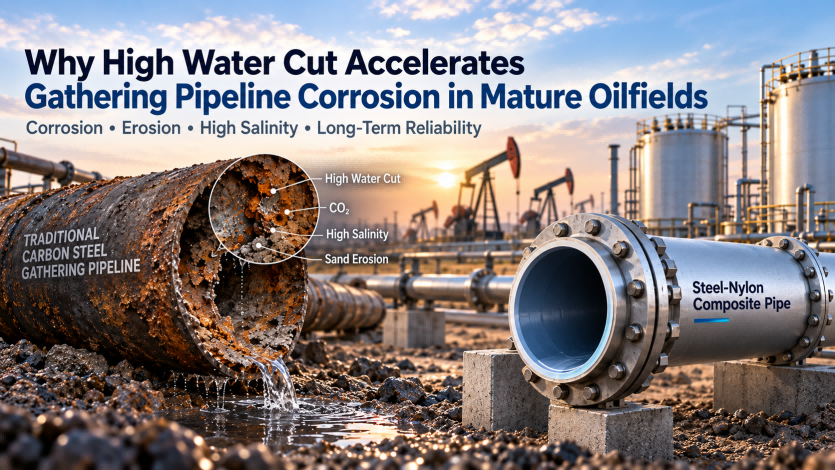
For example, chloride ions may contribute to localized corrosion, dissolved CO₂ may create a more corrosive aqueous environment, suspended solids may cause erosion, while deposits and scale may create conditions for under-deposit corrosion.
Therefore, evaluating a pipeline material based on a single “corrosion resistance” parameter is usually not sufficient.
2. Requirement No. 1: Resistance to Chloride-Induced Corrosion
Chloride ions are among the most important factors to consider in high-salinity produced-water systems.
When conventional carbon steel is continuously exposed to saline water, various forms of deterioration may occur, including:
-
General corrosion
-
Localized corrosion
-
Pitting
-
Wall-thickness reduction
-
Corrosion around welded areas
-
Perforation
-
Leakage
One of the most serious problems is that failure is often not caused by uniform wall thinning across the entire pipeline.
Instead:
Localized corrosion can progress much faster than the average corrosion rate.
Most of the pipeline may still retain sufficient wall thickness while a single deep corrosion pit eventually penetrates the pipe wall and causes leakage.
For this reason, an important material-selection strategy for high-salinity produced water is to minimize direct contact between the corrosive fluid and the primary metallic pressure-bearing structure.
This is one of the fundamental engineering principles behind composite piping systems.
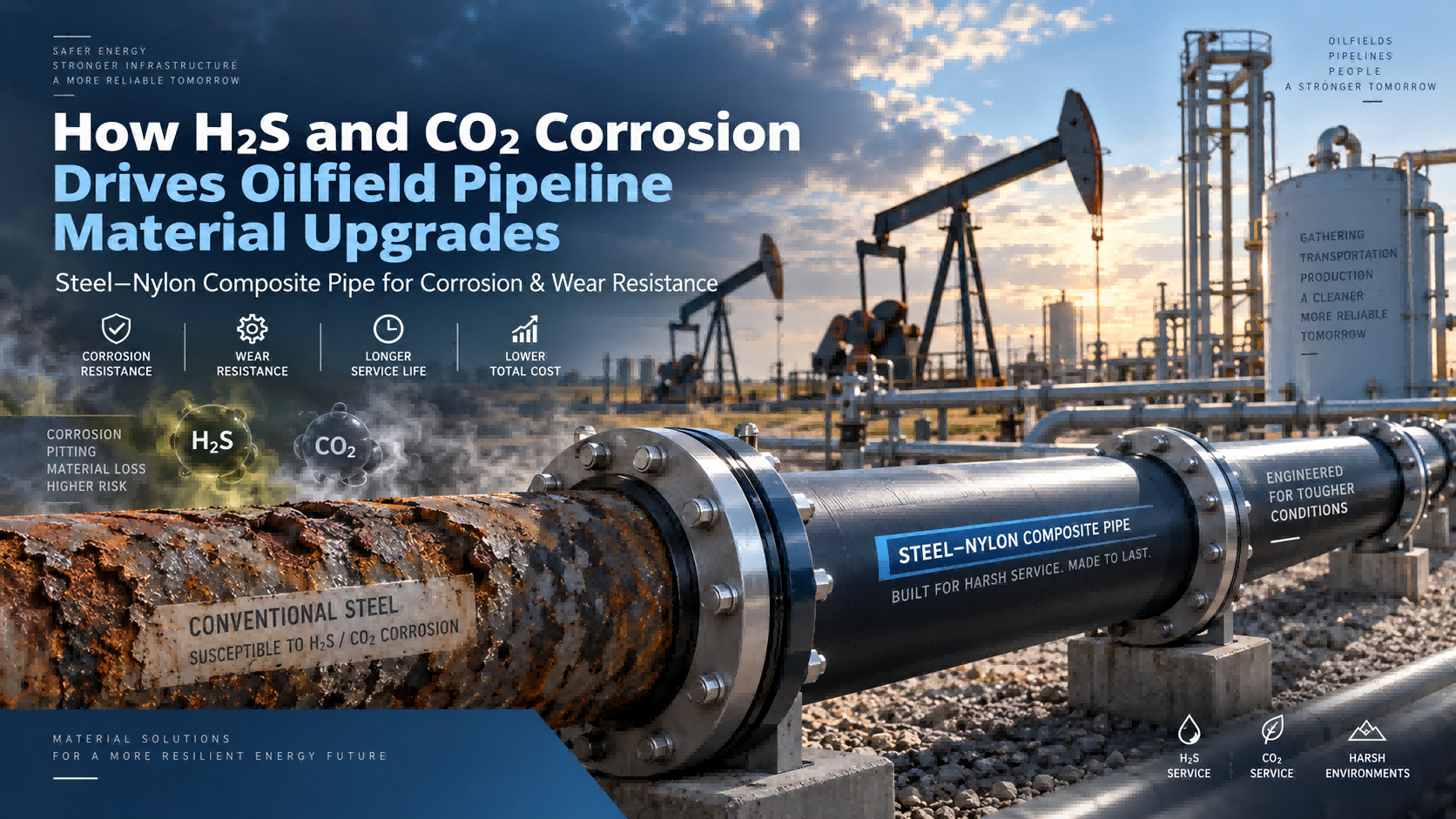
3. Requirement No. 2: Resistance to Complex CO₂ and H₂S Corrosion Environments
High salinity is not the only challenge in many oilfield produced-water systems.
The fluid may also contain:
CO₂, H₂S, and other corrosive components.
When CO₂ dissolves in water, it can create a corrosive aqueous environment that accelerates corrosion of conventional carbon steel.
In sour oil and gas fields where H₂S may also be present, material selection becomes even more complex.
Engineers may need to consider:
-
H₂S concentration
-
Partial pressure
-
Temperature
-
Operating pressure
-
pH
-
Chloride concentration
-
Material stress level
and other relevant service parameters.
For this reason, one increasingly important design principle for high-salinity produced-water pipelines is:
Preventing the corrosive fluid from directly contacting the primary metallic pressure-bearing layer.
Steel-nylon composite pipes are based on this concept.
Their structure can be simplified as:
Steel Structural Layer + Nylon Functional Inner Layer
The steel structure primarily provides:
-
Pressure resistance
-
Rigidity
-
Mechanical strength
-
External mechanical protection
The nylon inner layer primarily provides:
-
Isolation between the fluid and the steel
-
Protection against direct internal corrosion
-
A relatively smooth internal surface
-
Improved performance under combined corrosion and wear conditions
Instead of requiring a single material to solve every engineering problem, the composite structure allows different materials to perform different functions.
4. Requirement No. 3: Corrosion Resistance Alone Is Not Enough — Erosion Resistance Also Matters
Produced-water systems are sometimes treated purely as corrosion systems.
In reality, many oilfield pipelines are exposed to both corrosion and erosion.
This is especially important at locations such as:
-
Elbows
-
Tees
-
Reducers
-
Upstream and downstream of valves
-
Pump discharge sections
-
High-velocity sections
When produced water carries sand, corrosion products, scale particles, or other suspended solids, the internal pipe surface can be continuously subjected to mechanical impact and abrasion.
The result may be a combined mechanism involving:
Corrosion + Abrasion + Erosion
This is why some oilfield pipeline failures cannot be explained by chemical corrosion alone.
If a pipe material is chemically resistant but has poor wear resistance, localized failure can still occur rapidly in high-velocity fluids containing suspended solids.
Nylon offers good wear resistance, making steel-nylon composite pipe a potential solution for produced-water environments where both corrosion and mechanical wear must be considered.
5. Requirement No. 4: Reduced Scaling and Deposit-Related Problems
Another major challenge in high-salinity produced-water systems is:
Scaling and deposition.
Typical deposits may include compounds or materials associated with:
-
CaCO₃
-
BaSO₄
-
SrSO₄
-
CaSO₄
-
Iron corrosion products
-
Oil sludge
When significant deposits accumulate on the internal pipe wall, several problems can follow.
Reduced Effective Flow Area
Deposits gradually reduce the internal cross-sectional area of the pipe, increasing hydraulic resistance.
Higher Pumping Energy Consumption
More pressure may be required to maintain the same flow rate.
Under-Deposit Corrosion
Localized chemical and electrochemical conditions beneath deposits may accelerate corrosion.
Increased Cleaning and Maintenance
More frequent pigging, flushing, mechanical cleaning, or maintenance may be required.
For this reason, modern produced-water systems increasingly emphasize:
Internal surface smoothness and low roughness.
Steel-nylon composite pipes use a nylon inner surface that can provide a relatively smooth flow path.
However, it is important to clarify:
A smooth pipe surface does not mean that scaling can never occur.
Scale formation is still influenced by water chemistry, temperature, pressure, ionic saturation, and operating conditions.
Nevertheless, a smoother internal surface can reduce favorable conditions for deposit adhesion and contribute to improved long-term hydraulic performance.
6. Requirement No. 5: Reliable Pressure-Bearing Capability
Not all oilfield produced-water pipelines operate at low pressure.
Applications may include:
-
Produced-water transportation
-
Water-treatment plant piping
-
Transfer pipelines
-
Water reinjection systems
-
Booster pump discharge pipelines
Pressure capability therefore remains an important material-selection criterion.
This is also one of the factors that must be carefully considered when using certain non-metallic materials to solve high-salinity corrosion problems.
Although non-metallic materials can eliminate conventional electrochemical corrosion of steel, their structural performance must still be evaluated under:
-
Higher pressures
-
Higher temperatures
-
Large diameters
-
External loads
-
Complex mechanical conditions
Steel-nylon composite pipes use the steel structure as the primary mechanical and pressure-bearing component.
This enables engineers to combine:
Corrosion Resistance + Mechanical Strength + Pressure Capability
within one composite pipeline system.
Depending on pipe diameter, wall thickness, design temperature, medium, and engineering requirements, our steel-nylon composite pipes can be manufactured for pressure classes of approximately:
1.0–4.0 MPa
Final selection should always be confirmed according to the actual project design conditions.
7. Requirement No. 6: Adaptability to Temperature Variations
Oilfield pipelines frequently experience more challenging temperatures than conventional industrial water systems.
For example, pipelines in cold regions may face extremely low winter temperatures, while fluids close to wellheads or process equipment may be transported at significantly elevated temperatures.
Pipeline material selection therefore needs to consider:
-
Low-temperature toughness
-
Strength retention at elevated temperature
-
Thermal expansion
-
Long-term thermal aging
-
Thermal expansion compatibility between different material layers
This is why pipeline materials should not be evaluated solely according to a single advertised “maximum temperature.”
The more important question is:
Can the entire pipeline system remain stable under the actual design temperature, operating pressure, and long-term service conditions?
Our reinforced nylon and steel-nylon composite pipe products can be designed for various applications within an approximate temperature range of:
-36°C to 160°C
Specific operating conditions should always be evaluated according to the actual fluid composition, pressure, temperature, and project requirements.
8. Requirement No. 7: Capability for Large-Diameter Produced-Water Pipelines
As mature oilfields enter high-water-cut production stages, the total volume of produced water often increases significantly.
This creates demand for:
-
Higher treatment capacity
-
Greater water transportation volumes
-
Larger pipe diameters
-
Longer transportation distances
Therefore, a produced-water pipeline material cannot be evaluated only based on its suitability for DN100 or DN200 pipelines.
Major transfer lines and large processing facilities may require:
DN500, DN800, DN1000, or even larger pipelines.
At these diameters, factors such as:
-
Pipe roundness
-
Structural rigidity
-
Wall stability
-
Joint reliability
-
Manufacturing consistency
-
Transportation
-
Installation capability
become increasingly important.
We have developed large-diameter manufacturing capabilities for reinforced nylon and steel-nylon composite pipes, including production experience with pipes up to approximately DN1600, as well as development capabilities for even larger diameters.
For major oilfield produced-water projects:
The ability to manufacture large-diameter corrosion-resistant pipelines consistently is itself an important supplier capability.
9. Requirement No. 8: Pipeline Joints Must Be Part of the Reliability Strategy
Many industrial pipeline leaks do not occur in straight pipe sections.
They often occur at:
-
Connections
-
Flanges
-
Elbows
-
Tees
-
Valve connections
-
Equipment interfaces
Therefore, high-salinity produced-water systems should not evaluate only the straight pipe material.
The entire system should be considered:
Pipe + Fittings + Joints + Valve Connections
Steel-nylon composite pipes can be designed with flange connections.
For oilfield station modifications and replacement of aging pipelines, flange connections can provide an important engineering advantage:
They can reduce the need for field welding or heat-fusion operations.
This is especially valuable in oilfields, chemical facilities, and hazardous areas where hot-work permits and safety controls can make welding operations complicated and costly.
Flanged connections can also simplify integration with:
-
Valves
-
Pumps
-
Existing steel piping systems
-
Replacement sections
-
Future maintenance
As a result, competition among future oilfield pipeline systems will increasingly move beyond pipe material alone.
It will also become a competition in:
Overall Connection and System Reliability
10. Why Does Traditional Carbon Steel Face Increasing Challenges in High-Salinity Produced Water?
Carbon steel is not inherently a poor pipeline material.
In fact, it offers several major advantages:
-
High mechanical strength
-
Mature manufacturing technology
-
Good weldability
-
Established engineering standards
-
Competitive initial cost
For these reasons, carbon steel has remained one of the most widely used industrial piping materials.
The problem arises when:
Highly saline produced water directly contacts the internal carbon-steel surface for extended periods.
In such environments, internal corrosion may become one of the primary factors limiting pipeline service life.
Traditional corrosion-control strategies may include:
-
Increased corrosion allowance
-
Corrosion inhibitors
-
Internal coatings
-
Routine inspection
-
Repair welding
-
Partial pipe replacement
All of these approaches can be useful.
However, if the fundamental pipe-material system remains unchanged, operators may still need to manage corrosion throughout the entire operating life of the asset.
This is one reason why more projects are evaluating:
Composite Pipeline Materials
11. Why Can Steel-Nylon Composite Pipe Be Considered for High-Salinity Produced Water?
The concept behind steel-nylon composite pipe is not simply to “put a plastic layer inside a steel pipe.”
Its engineering principle is:
Different materials perform different functions.
Steel Structural Layer
The steel layer provides:
Strength
including:
-
Mechanical strength
-
Pressure resistance
-
Structural rigidity
-
External mechanical protection
Nylon Functional Layer
The nylon layer provides:
Corrosion and Wear Protection
including:
-
Isolation of corrosive fluids from the steel structure
-
Reduced direct internal corrosion
-
Wear resistance
-
Smooth internal surface
-
Improved long-term hydraulic performance
The design philosophy can therefore be summarized as:
Steel for Strength + Nylon for Corrosion Resistance
In other words:
Steel handles the structural requirements, while nylon handles the fluid-contact environment.
12. How Does Steel-Nylon Composite Pipe Compare with Other Materials?
Every pipeline material has its own strengths and limitations.
There is no single material that is ideal for every produced-water application.
| Pipe Material | Corrosion Resistance | Mechanical Strength | Wear Resistance | High-Temperature Capability | Large-Diameter Capability | Main Consideration |
|---|---|---|---|---|---|---|
| Carbon Steel | Relatively Low | High | Medium | High | High | Internal corrosion |
| Stainless Steel | Relatively High | High | Medium | High | High | Chloride-related localized corrosion and cost |
| HDPE | High | Relatively Low | Good | Limited | Good | Temperature and pressure limits |
| FRP | High | Medium | Depends on structure | Medium | High | Joint and structural design |
| Rubber-Lined Steel | Relatively High | High | Good | Medium | High | Liner life and interface stability |
| Steel-Nylon Composite Pipe | Relatively High | High | High | Broad range | High | Correct chemical and service-condition matching |
The correct engineering question is therefore not:
“Which pipe material is the best?”
Instead, it should be:
“Which pipeline material is best suited to this specific operating condition?”
13. What Parameters Should Be Confirmed Before Selecting a Produced-Water Pipeline?
For a real oilfield produced-water project, we recommend confirming at least the following parameters before selecting the pipeline material.
Fluid Parameters
-
Total dissolved solids / salinity
-
Chloride concentration
-
pH
-
Ca²⁺ concentration
-
Mg²⁺ concentration
-
HCO₃⁻ concentration
-
SO₄²⁻ concentration
-
CO₂ concentration or partial pressure
-
H₂S concentration or partial pressure
-
Oil content
-
Sand content
-
Solid particle size
Operating Parameters
-
Normal operating temperature
-
Maximum design temperature
-
Normal operating pressure
-
Design pressure
-
Flow velocity
-
Nominal diameter
-
Required design life
Engineering Conditions
-
Buried or aboveground
-
Indoor or outdoor
-
Potential vacuum conditions
-
Vibration
-
Frequency of disassembly
-
Hot-work restrictions
-
Existing pipeline replacement or new construction
Only after these conditions are understood can engineers conduct meaningful pipeline material selection.
14. Produced-Water Pipeline Procurement Is Moving from Initial Price to TCO
Traditionally, some pipeline purchasing decisions have focused heavily on:
$/meter
or the initial cost per unit length.
However, for produced-water pipelines, a more meaningful metric is increasingly:
Total Cost of Ownership — TCO
TCO should include more than the purchase price.
A simplified model can be expressed as:
TCO = Pipe Purchase + Installation + Corrosion Protection + Maintenance + Chemicals + Inspection + Shutdown Losses + Pipe Replacement + Leakage Risk
Consider a pipeline with a low initial purchase price.
If it requires:
-
Frequent leak repairs
-
Repeated shutdowns
-
Regular elbow replacement
-
Partial line replacement
-
Continuous use of corrosion inhibitors
then the lowest-cost pipe at the procurement stage may not be the lowest-cost pipeline over the life of the project.
Conversely, a material with a somewhat higher initial investment may produce a lower lifecycle cost if it significantly reduces maintenance and replacement frequency.
Therefore:
Material selection for high-salinity produced-water systems is increasingly shifting from a CapEx-only approach toward a lifecycle-cost approach.
15. What Are the Future Trends in Pipeline Materials for High-Salinity Produced Water?
From an engineering perspective, several major trends are likely to shape future produced-water pipeline systems.
1. From Corrosion Resistance Alone to Combined Corrosion and Wear Resistance
Real operating environments rarely involve only one degradation mechanism.
Pipeline materials will increasingly need to address both chemical corrosion and mechanical wear.
2. From Pipe Purchase Price to Pipeline Service Life
Operators are increasingly asking:
How long can this pipeline operate reliably?
rather than simply:
How much does the pipe cost?
3. From Single Materials to Composite Material Systems
Steel, polymers, rubber, and FRP each offer different advantages.
Composite structures can combine:
Mechanical Performance + Chemical Resistance + Wear Resistance
within one engineered system.
4. From Straight Pipe to Complete Piping Systems
A reliable pipeline solution must increasingly include:
-
Straight pipes
-
Elbows
-
Tees
-
Reducers
-
Pump discharge sections
-
Upstream and downstream valve sections
-
Connection systems
5. From Repair-Oriented Maintenance to Low-Maintenance Pipeline Systems
Many oilfield operators no longer want to ask:
“How do we repair the pipeline more efficiently?”
Instead, the strategic question is becoming:
“How can we reduce the need for pipeline repairs in the first place?”
16. Our Steel-Nylon Composite Pipeline Solutions
We specialize in the development and manufacturing of reinforced nylon pipes and steel-nylon composite pipes for demanding industrial applications.
Our products are designed to address common industrial pipeline challenges such as:
-
Corrosion
-
Wear
-
Scaling
-
Frequent maintenance
-
Short replacement cycles
For high-salinity oilfield produced-water systems, we can provide solutions including:
-
Steel-nylon composite straight pipes
-
Corrosion-resistant elbows
-
Tees
-
Reducers
-
Pump discharge pipe sections
-
Upstream and downstream valve pipe sections
-
Partial replacement solutions for aging pipelines
-
100–500 m trial pipeline sections
-
Large-diameter water transportation pipelines
For projects where customers are not yet ready to implement a new material across an entire pipeline network, we particularly recommend beginning with the highest-failure locations.
For example:
Pump Outlet → Elbow → Valve Section → High-Failure Pipeline → Trial Section
A trial section can be used to evaluate actual field performance before expanding the solution to a larger pipeline network.
This approach can significantly reduce the technical and commercial risk associated with introducing a new pipeline material.
Conclusion: High-Salinity Produced Water Is Redefining Oilfield Pipeline Material Requirements
As oilfields enter mature, high-water-cut production stages, produced water can no longer be treated as a secondary operational issue.
It is increasingly becoming a critical infrastructure challenge affecting:
Operating Costs, Pipeline Reliability, Production Continuity, and Long-Term Asset Performance
High salinity, chloride ions, CO₂, H₂S, suspended solids, temperature, pressure, scaling, and erosion can interact with one another, making conventional single-material solutions increasingly difficult to optimize.
Future pipeline materials for high-salinity produced water will need to provide a more balanced combination of:
Corrosion Resistance
Wear Resistance
Pressure Capability
Temperature Resistance
Hydraulic Performance
Joint Reliability
Large-Diameter Manufacturing Capability
Low Maintenance
Lifecycle Cost Efficiency
The value of steel-nylon composite pipe is therefore not simply that it replaces steel or replaces a conventional non-metallic pipe.
Its engineering advantage comes from combining:
Steel Strength + Nylon Protection
Steel provides the structural strength and pressure-bearing capability.
Nylon provides the fluid-contact layer for corrosion isolation, wear resistance, and a smooth internal surface.
For demanding produced-water applications where corrosion, abrasion, pressure, and long-term reliability must all be considered simultaneously, this composite-material approach provides an alternative solution for modern oilfield pipeline systems.
If you are planning a project involving:
-
High-salinity produced water
-
Oilfield wastewater transportation
-
Water reinjection
-
Produced-water treatment
-
Oil and gas gathering pipelines
you can provide us with the following operating information:
Fluid Composition + Temperature + Pressure + Pipe Diameter + Flow Rate + Installation Environment
Based on these parameters, we can evaluate whether steel-nylon composite pipe is suitable for your application and provide a project-specific pipeline material recommendation.
Why Oilfield Water Injection Systems Are Paying More Attention to Internal Corrosion