How to Reduce Hot Work Risks in Chemical Plants: From Better Hot Work Management to Reducing the Need for Hot Work

In chemical plants, welding, cutting, and other hot work activities are often unavoidable during construction, maintenance, revamping, and pipeline replacement projects.
However, chemical plants are fundamentally different from ordinary industrial environments. Flammable and explosive materials, corrosive chemicals, combustible gases, complex piping networks, and continuously operating process units may all exist within the same production area.
Even with strict permit procedures, isolation, gas testing, supervision, and emergency precautions, hot work remains one of the higher-risk activities that chemical plants must carefully control.
This raises an important question:
Is stricter hot work management the only way to reduce hot work risks?
A more fundamental approach is emerging:
Instead of focusing only on how to make hot work safer, chemical plants should also consider how pipeline design and material selection can reduce the need for hot work in the first place.
For pipelines transporting corrosive chemicals, alkalis, brine, slurry, industrial wastewater, and other demanding process media, piping systems that use flanged connections, reduce field welding, and provide corrosion resistance, wear resistance, and reliable pressure capability can offer significant advantages.
Steel-nylon composite pipe is particularly relevant to this approach.
1. Why Is Hot Work a Major Risk in Chemical Plant Pipeline Projects?
Pipeline construction in chemical plants is fundamentally different from ordinary water supply or general industrial piping work.
In a conventional industrial environment, welding may simply be one step in the installation process.
Inside a chemical plant, however, hot work may involve several overlapping hazards.
Complex Process Media
Chemical plants may contain:
-
Flammable liquids
-
Combustible gases
-
Corrosive chemicals
-
Toxic or hazardous media
-
High-temperature fluids
-
Concentrated chemicals
-
Process residues
-
Residual materials in trenches, equipment, pipelines, or pipe racks
The situation can become even more complicated in plants that have been operating for many years.
A pipeline being shut down does not necessarily mean that the surrounding environment is completely free of risk.
Depending on applicable regulations, plant procedures, and site conditions, hot work may therefore require:
-
Process isolation
-
Pipeline draining
-
Purging
-
Gas testing
-
Permit approval
-
Dedicated supervision
-
Emergency preparation
All these activities increase the organizational complexity, safety burden, and indirect cost of pipeline maintenance.
2. Why Can Aging Chemical Pipelines Create More Hot Work?
For many chemical plants, the greatest hot work challenge does not occur during initial construction.
It develops gradually during long-term operation.
A typical cycle looks like this:
Corrosion → Wall Thinning → Leakage → Pipe Replacement → Welding Repair → Further Corrosion → Another Repair
In other words, a major source of hot work may not be the original installation but repeated maintenance throughout the pipeline's service life.
For example, when conventional carbon steel pipelines operate in corrosive environments, they may gradually develop:
-
Pitting corrosion
-
General corrosion
-
Weld-area corrosion
-
Erosion-corrosion
-
Wall thinning
-
Perforation
-
Localized leakage
Once these failures occur, plant operators may have to repeatedly cut out damaged sections and weld in replacements.
Therefore, one of the most effective long-term ways to reduce hot work risk is:
Reduce the frequency of pipeline failures and repairs.
If a more suitable piping material can extend the maintenance interval from frequent repairs to long-term stable operation, the benefit goes far beyond the cost of replacing pipe.
It can also reduce the number of future high-risk maintenance interventions.
3. Hot Work Risk Reduction Should Begin at the Pipeline Design Stage
Traditional hot work management mainly asks:
What precautions must be taken before hot work begins?
A more advanced engineering approach asks an earlier question:
Which welding activities can be eliminated from the site altogether?
This means hot work risk reduction should begin during pipeline design and material selection.
Engineering teams should consider:
-
Can flanged connections be used?
-
Can field welding be reduced?
-
Can more components be prefabricated in the factory?
-
Can corrosion-related maintenance frequency be reduced?
-
Can individual pipe sections be replaced more easily?
-
Can plant shutdown time be shortened?
These questions are changing the way industrial piping materials are evaluated.
Historically, engineers might mainly consider:
Corrosion Resistance + Pressure Rating + Purchase Price
Today, an increasing number of projects also evaluate:
Installation Method + Construction Safety + Maintainability + Shutdown Losses + Lifecycle Cost
4. Strategy One: Reduce Field Welding
Where technically appropriate, reducing the number of field welds is one of the most direct ways to decrease hot work requirements.
Steel-nylon composite piping systems can be designed with flanged connections.
Pipe sections and fittings can be manufactured and prefabricated under controlled factory conditions before being delivered to the site.
Installation can then be completed using flanges, fasteners, and suitable sealing systems.
Compared with conventional metallic piping systems that depend heavily on field welding, this approach can reduce welding operations at the chemical plant.
The benefits go beyond easier installation.
They are also directly related to risk reduction.
Traditional Welded Pipeline Installation May Involve:
Pipe cutting
↓
Bevel preparation
↓
Alignment
↓
Welding
↓
Weld inspection
↓
Coating repair
↓
Quality verification
With a prefabricated flanged piping system, more of the manufacturing process can be transferred from the chemical plant to a controlled factory environment.
This reflects an important risk-control principle:
If complex fabrication work can be completed safely and consistently in a factory, there is often value in minimizing the amount that must be performed inside an operating chemical plant.
5. Strategy Two: Reduce Corrosion to Minimize Future Maintenance Hot Work
Reducing welding during initial installation is only one part of the solution.
For chemical plants, the more important question is:
How many times will this pipeline need to be repaired over the next ten years?
Consider two piping systems.
Pipeline A
The initial purchase price is relatively low, but corrosion and leakage occur repeatedly after several years of service.
The plant must frequently cut out and replace damaged sections.
Pipeline B
The initial cost may be different, but the internal surface provides improved corrosion and wear resistance, significantly reducing maintenance frequency.
If only the purchase price is considered, Pipeline A may appear more attractive.
However, the result may change significantly when the following costs are included:
-
Maintenance labor
-
Hot work preparation
-
Safety management
-
Production shutdowns
-
Leakage control
-
Pipeline replacement
-
Spare parts inventory
-
Environmental risks
This is one reason why industrial pipeline procurement is gradually shifting from:
Purchase Price
to:
Total Cost of Ownership (TCO)
6. Why Steel-Nylon Composite Pipe Is Suitable for Certain Corrosive Chemical Applications
Steel-nylon composite pipe is not simply a conventional steel pipe with an ordinary plastic layer inside.
Its engineering principle is based on combining a steel structural layer with a high-performance nylon functional layer.
The basic concept can be summarized as:
Steel provides structural strength and pressure capability, while nylon provides the medium-contacting surface with corrosion and wear resistance.
This combination can provide important advantages in demanding chemical pipeline applications.
6.1 Separating the Process Medium from the Steel Structure
In conventional carbon steel pipelines carrying brine, alkaline solutions, industrial wastewater, and certain corrosive media, the process fluid is directly exposed to the steel surface.
Over time, corrosion may result in:
-
Wall thinning
-
Pitting
-
Perforation
-
Leakage
-
Weld-area deterioration
Steel-nylon composite pipe uses a nylon functional layer to separate the transported medium from the steel structural layer.
This helps reduce direct chemical attack on the steel.
6.2 Addressing Both Corrosion and Wear
Many chemical pipelines are not exposed to corrosion alone.
Typical examples include:
-
Salt slurry
-
Chemical slurry
-
Fluids containing solid particles
-
Industrial wastewater
-
Mother liquor
-
Crystallized or particle-containing fluids
These applications may involve a combination of:
Corrosion + Erosion + Abrasion
This combined mechanism is one reason some traditional pipeline materials fail sooner than expected.
By using a reinforced nylon inner layer with corrosion-resistant and wear-resistant properties, steel-nylon composite pipe can be particularly valuable in these demanding service conditions.
6.3 Smooth Inner Surface Helps Reduce Scaling and Deposits
After long-term operation, chemical pipelines may also experience:
-
Scaling
-
Sedimentation
-
Reduced internal flow area
-
Increased pressure loss
-
More frequent cleaning requirements
The relatively smooth nylon inner surface can help reduce adhesion and deposit formation under suitable operating conditions.
This may further reduce cleaning and maintenance requirements.
7. Strategy Three: Use Flanged Connections to Improve Maintainability
Even a well-designed industrial piping system may eventually require maintenance.
Therefore, a good piping system should not only be durable.
It should also answer another important question:
If maintenance is eventually required, how easily can the affected component be replaced?
Because steel-nylon composite piping systems can use flanged connections, engineers can design systems with replaceable sections such as:
-
Straight pipe modules
-
Elbows
-
Tees
-
Reducers
-
Valve upstream and downstream sections
-
Pump discharge sections
This is particularly important for chemical plants.
Rather than treating an entire pipeline as one continuous welded system, selected components can be designed as replaceable modules.
If one high-wear section eventually reaches the end of its service life, it may be possible to isolate and replace that section without cutting and welding large portions of the pipeline.
8. The Entire Pipeline Does Not Always Need to Be Replaced
One of the biggest challenges in brownfield chemical plant upgrades is cost.
Replacing an entire piping network at once may require a significant investment and a long shutdown period.
A phased upgrade strategy can therefore be more practical.
Chemical plants can first identify the following areas.
Category 1: High-Corrosion Areas
Pipe sections with repeated leakage or significant wall thickness reduction.
Category 2: High-Wear Areas
Elbows, reducers, pump discharge lines, and high-velocity sections.
Category 3: High Hot Work Risk Areas
Pipelines close to process units, storage tanks, flammable-material equipment, or congested pipe racks.
Category 4: High-Maintenance-Cost Areas
Sections that repeatedly require repair every year and continuously consume maintenance resources.
These areas can then be prioritized for replacement with corrosion-resistant, wear-resistant, flanged piping systems.
This approach is often easier to implement than replacing every pipeline in the plant at once.
9. Wear-Prone Fittings Can Be an Ideal Starting Point
Flow conditions are not identical throughout a pipeline system.
Certain components are often exposed to much more severe erosion and wear than straight pipe.
Typical examples include:
-
Elbows
-
Tees
-
Reducers
-
Pump outlet sections
-
Valve upstream and downstream sections
These areas may experience:
-
Sudden changes in flow direction
-
Local increases in velocity
-
Increased turbulence
-
Particle impact
-
Pressure fluctuations
As a result, they may deteriorate significantly faster than straight pipe sections.
For chemical plants that are not ready to upgrade an entire pipeline, improving these high-risk components first can be an effective strategy.
For example:
Existing Pipeline + Steel-Nylon Composite Wear-Resistant Elbows
or:
Existing Pipeline + 100–500 m Trial Section
can provide a practical way to verify performance before expanding the material across a larger system.
10. Strategy Four: Increase Factory Prefabrication and Reduce Site Complexity
Another major challenge in chemical plant revamping projects is the limited shutdown window.
Traditional field welding may require several coordinated procedures.
If installation exceeds the scheduled maintenance window, restarting the production unit may be delayed.
For this reason, industrial piping projects increasingly emphasize:
Factory Prefabrication + Site Assembly
Steel-nylon composite pipes can be manufactured according to project requirements, including:
-
Pipe diameter
-
Pipe length
-
Flanged ends
-
Elbows
-
Tees
-
Reducers
-
Special pipe sections
More fabrication work can therefore be completed before the piping system reaches the chemical plant.
Site activities can focus more heavily on installation, connection, inspection, and commissioning.
For large chemical plant revamping projects, this can help reduce on-site complexity and shorten installation schedules.
11. Reducing Hot Work Does Not Mean Ignoring Engineering Safety
One point must be made clear:
No piping system should be described as completely risk-free simply because it uses flanged connections.
Even when welding is reduced, the piping system must still be professionally designed according to factors such as:
-
Process medium
-
Design pressure
-
Design temperature
-
Flange rating
-
Gasket and sealing materials
-
Pipe supports
-
Pipeline stress
-
Installation environment
-
Plant safety requirements
If welding, cutting, or other hot work is still required elsewhere in the project, all applicable regulations, project specifications, and plant safety procedures must still be followed.
Therefore, the real meaning of reducing hot work is:
Use appropriate materials, prefabrication, and connection methods to eliminate avoidable field welding while still meeting all engineering and safety requirements.
That is the more practical engineering approach.
12. Why Should Chemical Plants Consider Steel-Nylon Composite Pipe?
For suitable chemical media and operating conditions, the value of steel-nylon composite pipe goes beyond being simply a "corrosion-resistant pipe."
It addresses several related problems simultaneously.
| Chemical Plant Challenge | Steel-Nylon Composite Pipe Approach |
|---|---|
| Pipeline corrosion | Nylon inner layer separates corrosive media from the steel structure |
| Pipeline wear | Reinforced nylon provides improved wear resistance |
| Complex field welding | Flanged connections can reduce field welding requirements |
| Frequent maintenance | Corrosion and wear resistance can extend maintenance intervals |
| Difficult replacement of vulnerable sections | Elbows, tees, and pipe sections can be designed as replaceable modules |
| Limited shutdown window | Factory prefabrication combined with site assembly |
| Pressure requirements for larger pipelines | Steel structural layer provides mechanical strength and pressure support |
| High lifecycle cost | Reduced repair, replacement, and shutdown frequency can improve TCO |
This is why pipeline evaluation should not focus only on:
"How much does this pipe cost per meter?"
A more valuable question is:
"Over the entire service life, how many repairs, shutdowns, replacements, and high-risk maintenance operations can this piping system help reduce?"
13. The Future of Chemical Piping: From Corrosion Resistance to Low-Maintenance Systems
For decades, one of the primary objectives of industrial pipeline material development was straightforward:
Solve the corrosion problem.
Today, expectations are becoming more demanding.
Chemical companies increasingly want piping systems that are:
-
Corrosion-resistant
-
Wear-resistant
-
Pressure-capable
-
Easier to install
-
Less dependent on field fabrication
-
Easier to maintain
-
Faster to replace
-
Less disruptive to production
-
More economical over the complete lifecycle
Therefore, future competition in chemical piping will likely be based not on one material property, but on a combination of:
Corrosion Resistance + Wear Resistance + Pressure Capability + Installation Safety + Maintainability + Lifecycle Cost
Steel-nylon composite pipe sits at the intersection of these requirements.
It combines the structural characteristics of steel with the functional properties of nylon while supporting flanged connection and modular piping design.
14. How Can Chemical Plants Develop a Hot Work Risk Reduction Strategy?
For chemical plants planning brownfield pipeline upgrades, maintenance projects, or new process installations, the following approach can help identify opportunities to reduce hot work requirements.
Step 1: Review Pipeline Leakage and Maintenance Records from the Past 3–5 Years
Identify the pipelines that repeatedly require repair.
Step 2: Identify High-Corrosion and High-Wear Locations
Pay particular attention to:
-
Elbows
-
Tees
-
Reducers
-
Pump discharge sections
-
Valve upstream and downstream sections
Step 3: Review How Many Hot Work Activities These Locations Generate
Many plants may discover that a relatively small number of problematic pipe sections account for a disproportionately large share of recurring maintenance work.
Step 4: Re-Evaluate Pipeline Materials
Do not compare materials based only on initial purchase cost.
Evaluate:
-
Expected service life
-
Corrosion resistance
-
Wear resistance
-
Maintenance frequency
-
Replacement requirements
-
Shutdown impact
-
Total lifecycle cost
Step 5: Evaluate Flanged Connections and Factory Prefabrication
Whenever technically appropriate, move more fabrication activities from the chemical plant to a controlled manufacturing environment.
Step 6: Begin with a Trial Section
For a new piping material, a plant can initially select a representative high-corrosion or high-wear section for field validation.
A 100–500 m trial section may provide a practical way to evaluate operating performance before larger-scale implementation.
Conclusion: Advanced Safety Management Begins by Reducing High-Risk Work at the Source
Reducing hot work risk in chemical plants will always require strong permit systems, gas testing, isolation, supervision, and site safety management.
But from a long-term engineering perspective, simply managing each hot work activity more carefully is not enough.
A more fundamental question should be asked:
Why does the plant need to perform so much hot work in the first place?
If repeated hot work is being driven by pipeline corrosion, perforation, leakage, and frequent replacement, then the long-term solution should begin with the pipeline material, connection method, and system design.
By using corrosion-resistant and wear-resistant steel-nylon composite piping systems with factory-prefabricated sections and flanged connections, chemical plants can reduce field welding requirements in suitable applications while also reducing the frequency of corrosion-related maintenance.
The industry is therefore gradually moving from:
Manage Hot Work Better
to:
Reduce the Need for Hot Work
The goal is not simply to make each hot work operation safer.
It is to eliminate avoidable hot work through better engineering decisions.
For modern chemical plants, this represents more than a pipeline material upgrade. It is also an evolution in process safety, maintenance strategy, plant reliability, and total lifecycle cost management.
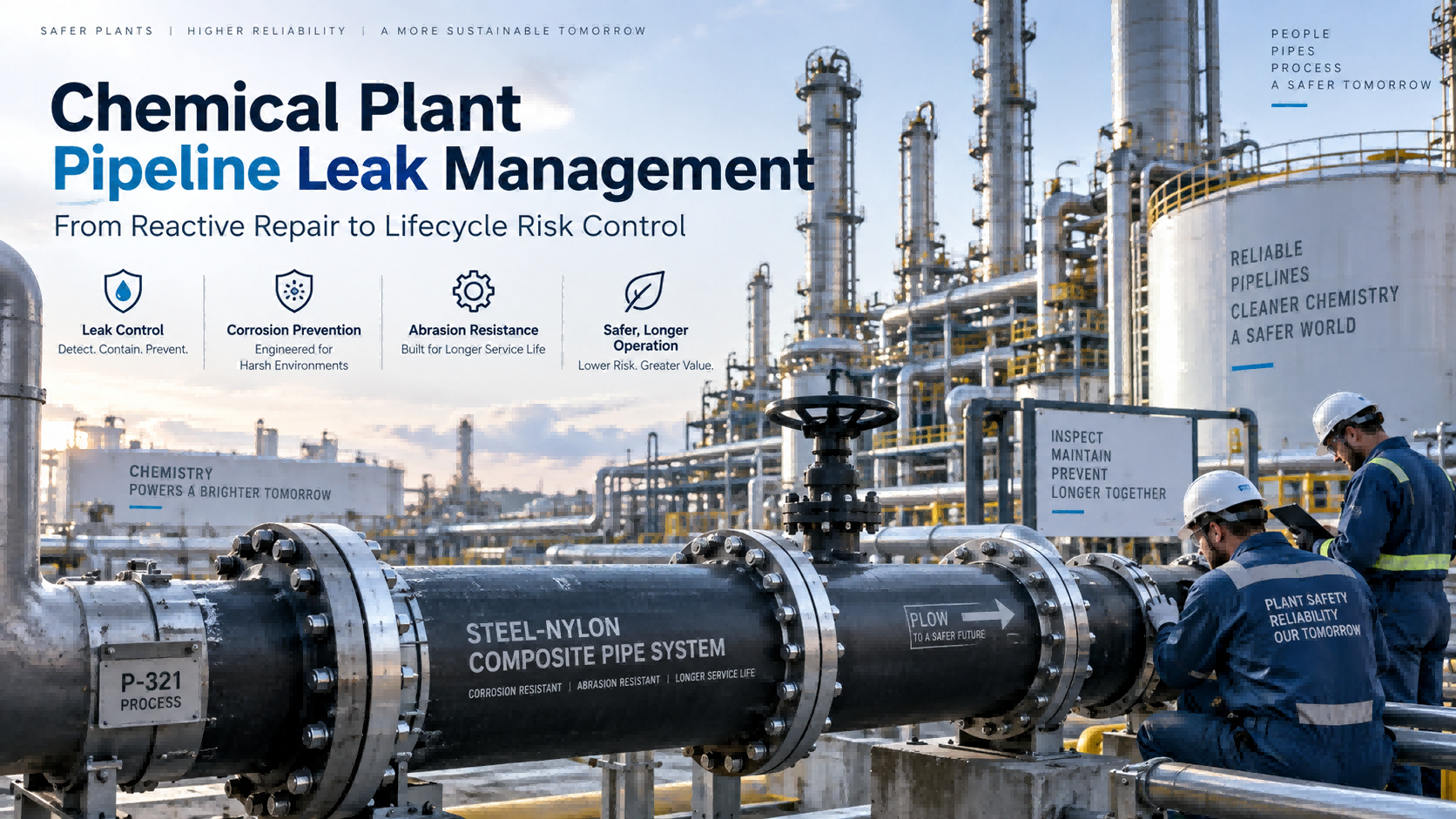
Chemical Plant Pipeline Leak Management: From Reactive Repair to Lifecycle Risk Control