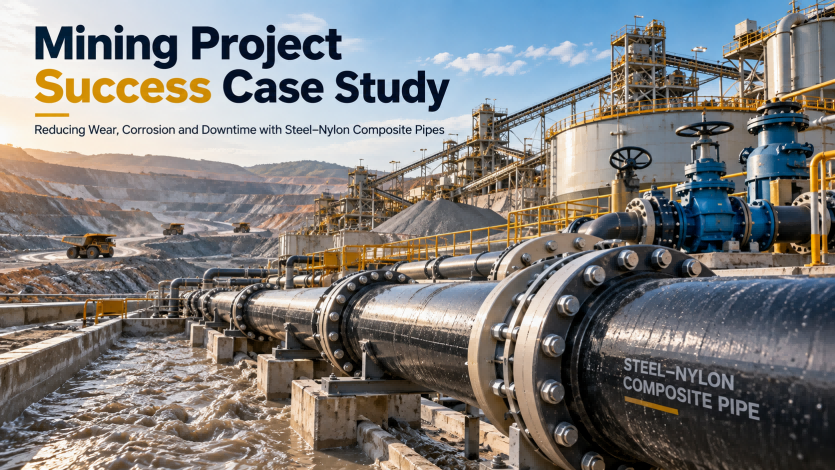
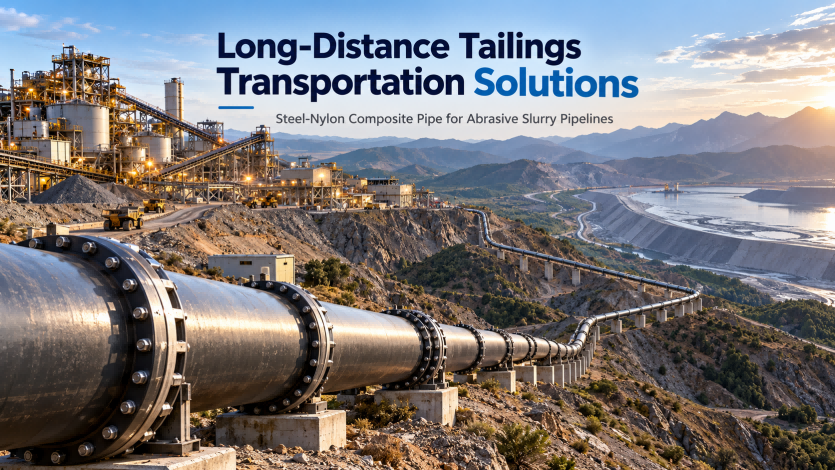
How to Reduce Maintenance Costs in High-Abrasion Slurry Pipelines
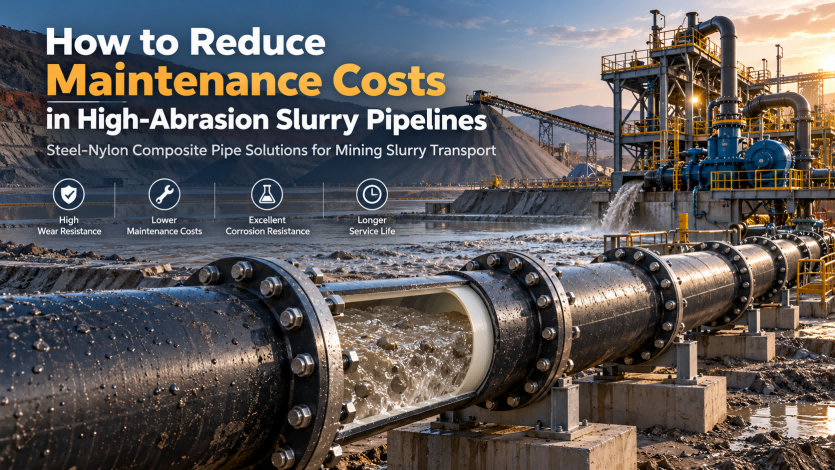
In mining operations, slurry pipelines are often not the most expensive assets, yet they can become one of the most critical factors affecting the continuous operation of the entire production system.
In iron ore, copper, gold, tailings, concentrate, and mine backfill applications, large volumes of solid particles continuously impact and abrade the inner surface of pipelines at high velocity. As slurry concentration increases, particle size becomes larger, flow velocity rises, or conveying distances become longer, pipeline wear can accelerate significantly.
At the beginning of a project, many mining companies focus on one simple question:
“How much does the pipe cost per meter?”
After several years of operation, however, the more important questions often become:
-
How often does the pipeline need to be replaced?
-
Why do elbows wear through so frequently?
-
How much spare pipe and fittings must be kept in inventory?
-
How much slurry is lost during a pipeline failure?
-
How much production is lost during shutdown and repair?
-
What are the labor and equipment costs associated with pipe replacement?
-
Which pipeline material should be selected when abrasion and corrosion occur simultaneously?
For high-abrasion slurry systems, therefore, reducing costs is not simply about purchasing cheaper pipes.
The real objective is:
To extend pipeline service life, reduce leakage, minimize replacement frequency, and reduce unplanned shutdowns—thereby lowering the total lifecycle cost of the slurry transportation system.
This is becoming an increasingly important consideration in modern mining pipeline design.
1. Why Do High-Abrasion Slurries Wear Pipelines So Quickly?
Slurry is fundamentally different from clean water or other ordinary liquids.
It contains large quantities of mineral particles, sand, tailings, and other solids moving together with the carrier fluid.
These solid particles continuously:
-
impact the pipe wall,
-
slide across the inner surface,
-
cut the material,
-
and create abrasive wear.
The problem becomes particularly severe in applications involving:
-
High-solids slurry
-
Coarse-particle slurry
-
High-velocity transportation
-
Long-distance slurry pipelines
-
High-head pumping systems
-
High-pressure slurry transportation
-
High-sand-content tailings
-
Iron ore slurry
-
Copper concentrate slurry
-
Gold mine tailings
-
Mine backfill slurry
The particles inside the slurry effectively behave like millions of small abrasive tools.
As operating time increases, the pipe wall gradually becomes thinner.
Eventually, the typical failure sequence may become:
Wall thinning → Localized wear-through → Leakage → Shutdown → Pipe replacement
When this cycle occurs repeatedly, pipeline maintenance costs can rise rapidly.
2. Six Key Factors That Determine Slurry Pipeline Wear
The service life of a slurry pipeline is not determined by one parameter alone.
Instead, it is the result of multiple operating and material factors acting together.
2.1 Solids Concentration
In general, the higher the concentration of solid particles in the slurry, the greater the frequency of particle contact and impact against the pipe wall.
High-solids slurry therefore places significantly greater demands on pipeline abrasion resistance.
This becomes especially important as mining operations increase plant throughput.
Many mines increase slurry concentration and transportation capacity to improve productivity.
As a result:
A pipeline material that performed adequately under the original operating conditions may wear much faster after production capacity is increased.
2.2 Particle Size
Fine particles and coarse particles do not produce exactly the same wear mechanisms.
Larger particles generally carry greater impact energy.
When coarse particles strike elbows, tees, reducers, or other flow-direction changes at high velocity, severe localized erosion may occur.
For this reason, slurry pipeline design should consider not only average particle size, but also:
-
Maximum particle size
-
Particle-size distribution
-
Particle shape
-
Mineral hardness
2.3 Slurry Velocity
Flow velocity is one of the most important factors affecting slurry pipeline wear.
If velocity is too low, solid particles may settle inside the pipeline and eventually cause deposition or blockage.
If velocity is too high, however, abrasion can increase significantly.
The goal of slurry pipeline design is therefore to achieve a balance:
Maintain sufficient velocity to prevent solids deposition while avoiding unnecessarily high velocities that accelerate pipe wear.
This is why different slurry systems should not simply use one universal velocity standard.
2.4 Pipeline Layout
Wear in straight pipe sections is often relatively uniform.
However, certain components typically experience much more severe abrasion, including:
-
Elbows
-
Tees
-
Pump discharge sections
-
Reducers
-
Areas near valves
-
Sections with significant elevation changes
Elbows are particularly vulnerable.
When slurry changes direction at high velocity, large quantities of particles are driven toward the outside wall of the bend.
This can result in severe localized erosion.
In many mining operations, pipeline failure does not begin along the entire pipeline.
Instead:
A small number of elbows or fittings may fail first.
2.5 Mineral Hardness
Different minerals have significantly different abrasive characteristics.
Slurries containing large amounts of hard mineral particles can create severe abrasive wear.
Therefore, simply knowing that the transported medium is “slurry” is not sufficient for proper material selection.
A more detailed analysis should include:
-
Mineral composition
-
Mohs hardness
-
Particle morphology
-
Solids concentration
-
Particle-size range
2.6 Corrosive Conditions
Many slurry pipelines experience:
Abrasion + Corrosion
The slurry may contain:
-
Salts
-
Acidic compounds
-
Alkaline compounds
-
Chlorides
-
Other corrosive components
Under these conditions, conventional metallic pipelines may experience corrosion-abrasion synergy.
Corrosion first attacks and weakens the metal surface.
Slurry particles then remove the corroded layer.
Fresh metal is exposed and corrosion begins again.
The process repeats continuously:
Corrosion → Abrasion → New metal exposure → Corrosion again → Further abrasion
This combined mechanism can significantly accelerate wall-thickness loss.
3. Why Can the “Cheaper Pipe” Become the More Expensive Solution?
One of the most common mistakes in mining pipeline procurement is comparing materials only according to their price per meter.
Consider two different pipeline solutions:
| Solution | Initial Cost | Replacement Frequency | Maintenance Cost | Shutdown Risk |
|---|---|---|---|---|
| Conventional Pipeline | Lower | Higher | Higher | Higher |
| Long-Life Wear-Resistant Pipeline | Higher | Lower | Lower | Lower |
If only the initial purchase price is considered, the first option may appear more economical.
However, the real cost of a mining slurry pipeline includes:
Total Cost = Pipe Purchase + Installation + Maintenance + Replacement + Downtime + Slurry Loss + Spare Parts Inventory + Labor
This is why modern industrial projects increasingly focus on:
Total Cost of Ownership (TCO)
For mines operating continuously 24 hours a day, production losses caused by downtime can sometimes exceed the purchase cost of the pipeline itself.
Therefore:
The objective of slurry pipeline selection should not be the lowest purchase price, but the lowest lifecycle cost.
4. Where Do Slurry Pipeline Maintenance Costs Really Come From?
Many companies consider only the cost of replacing damaged pipe when calculating maintenance expenses.
In reality, a single slurry pipeline failure may generate several different categories of cost.
4.1 Pipe and Fitting Costs
These may include:
-
Replacement pipes
-
Elbows
-
Tees
-
Flanges
-
Gaskets
-
Valve-related components
4.2 Installation and Repair Costs
Replacing slurry pipelines may require:
-
Maintenance technicians
-
Lifting equipment
-
Cutting equipment
-
Welding equipment
-
Installation tools
-
Safety supervision
If the pipeline is located in difficult terrain or along a long-distance mining route, repair costs may become even higher.
4.3 Production Downtime
This is often one of the most underestimated costs.
When a slurry pipeline suddenly leaks, the typical process may involve:
Stopping the slurry pump
↓
Draining the pipeline
↓
Locating the worn section
↓
Removing the damaged pipe
↓
Installing a replacement section
↓
Pressure testing
↓
Restarting production
The entire process may require several hours or considerably longer.
For a large mining operation:
The production loss per hour may be far greater than the price of the damaged pipe itself.
4.4 Environmental Cleanup Costs
Slurry leakage can lead to:
-
Ground contamination
-
Equipment contamination
-
Cleanup expenses
-
Slurry recovery costs
-
Environmental management risks
Reducing leakage therefore means more than lowering maintenance costs.
It also helps reduce environmental and operational risks.
5. The First Way to Reduce Maintenance Costs: Extend Wear Life
The most direct way to improve the economics of a slurry transportation system is to:
Reduce the rate of pipe-wall wear.
Improving the abrasion resistance of the pipeline can extend replacement intervals.
For example, if one material must be replaced frequently while another significantly extends the maintenance interval, the long-term economic difference can become substantial.
Assume a pipeline is expected to operate for 10 years.
If the original pipe must be replaced every two years, multiple shutdowns and replacement cycles will occur.
If an upgraded material significantly extends the service interval, the total number of:
-
Purchases
-
Installations
-
Shutdowns
-
Maintenance operations
can all be reduced.
This is where wear-resistant pipeline materials generate their real economic value.
6. Why Steel-Nylon Composite Pipe Is Suitable for High-Abrasion Slurry Transportation
In complex slurry systems, it is difficult for a single material to simultaneously provide:
Abrasion Resistance + Corrosion Resistance + Pressure Capacity + Structural Strength
The engineering principle behind steel-nylon composite pipe is to allow different materials to perform different functions.
The structure can generally be understood as:
The steel structural layer provides mechanical strength and pressure-bearing capability.
Meanwhile:
The reinforced nylon functional layer provides abrasion resistance, corrosion resistance, and separates the transported medium from the steel structure.
This combination offers important advantages in slurry transportation.
7. Advantage 1: Reinforced Nylon Inner Layer Helps Reduce Slurry Wear
Reinforced nylon provides strong resistance to abrasive wear.
During slurry transportation, the medium primarily contacts the nylon functional layer instead of directly attacking the steel structure.
This can help reduce problems commonly associated with conventional steel pipelines, including:
-
Progressive wall thinning
-
Corrosion pits
-
Localized perforation
-
Combined corrosion and abrasion
For abrasive media such as:
-
Iron ore slurry
-
Copper slurry
-
Tailings
-
Mine backfill slurry
this combination of materials can provide significant engineering value.
8. Advantage 2: Addressing Both Corrosion and Abrasion
One of the most challenging problems in slurry transportation is not abrasion alone.
It is:
Corrosion + Abrasion
Increasing the hardness of a metallic pipe does not necessarily eliminate corrosion problems.
On the other hand, using a conventional plastic pipe may introduce limitations related to pressure capacity or structural rigidity in certain applications.
The value of a steel-nylon composite structure is that:
The outer steel structure provides strength and pressure resistance,
while:
the reinforced nylon inner functional layer isolates corrosive media and resists abrasive wear.
This makes the structure particularly suitable for complicated industrial transportation conditions.
9. Advantage 3: Suitable for Higher-Pressure Slurry Systems
Slurry transportation systems often need to overcome:
-
Friction losses
-
Elevation differences
-
Long conveying distances
-
Pumping pressure
Pressure-bearing capability is therefore an important design requirement.
Some non-metallic pipeline materials may have limitations in high-pressure, large-diameter, or mechanically demanding installations.
Steel-nylon composite pipe uses the steel structure to provide mechanical support and can therefore combine:
Abrasion Resistance + Pressure-Bearing Capability
Depending on project requirements, pipeline systems can be designed for pressure classes in the range of approximately 1.0–4.0 MPa.
The final pressure rating should always be verified according to:
-
Nominal diameter
-
Operating temperature
-
Transported medium
-
Pipeline support system
-
Pressure fluctuations
-
Water hammer
-
Required safety factors
10. Advantage 4: Suitable for Large-Diameter Slurry Transportation
Modern mining operations continue to increase in scale.
As mineral-processing capacity grows, slurry pipeline systems are increasingly moving toward:
Higher Flow Rates + Larger Diameters + Longer Conveying Distances
Many projects therefore require:
DN500
DN800
DN1000
DN1200
or even larger pipelines.
Steel-nylon composite construction can combine an abrasion- and corrosion-resistant inner layer with the structural rigidity provided by steel.
For large-scale mining projects, this structural advantage can be particularly important.
11. The Second Way to Reduce Maintenance Costs: Upgrade High-Wear Areas First
Wear does not occur at exactly the same rate throughout an entire slurry pipeline.
In many projects, the more economical strategy is:
Identify the Most Severe Wear Locations and Upgrade Them First
Typical high-wear locations include:
Elbows
Particles strike the outside wall of the bend as the slurry changes direction.
Tees
Changes in flow direction and turbulence can cause localized erosion.
Pump Discharge Sections
Velocity, pressure, and turbulence can make these areas particularly vulnerable.
Reducers
Increasing flow velocity can accelerate local wear.
High-Elevation-Difference Sections
Changes in flow conditions can increase erosion in certain locations.
For existing mines, this means the entire pipeline does not necessarily need to be replaced immediately.
A more practical strategy may be:
Upgrade vulnerable elbows, tees, and critical pipe sections first.
Once operating data confirms the performance of the new material, its use can gradually be expanded to other sections of the pipeline.
12. A 100–500 Meter Trial Section Can Reduce Material-Replacement Risk
When large mining operators evaluate a new pipeline material, laboratory data alone may not be sufficient.
A more reliable approach is to establish an actual operating trial section.
For example:
Select a 100–500 meter high-wear pipeline section
and install the new pipeline material.
During operation, monitor:
-
Wall-thickness changes
-
Wear rate
-
Leakage
-
Flange-joint condition
-
Pipeline vibration
-
Pressure changes
-
Actual service life
After six months, twelve months, or a longer operating period, the results can be directly compared with those of the original pipeline.
This allows mine operators to determine:
Whether the new material is actually suitable for their specific slurry conditions.
For large-scale pipeline replacement projects, this can be an effective way to reduce technical and investment risk.
13. The Third Way to Reduce Maintenance Costs: Optimize Elbow Design
In many mining operations, a large proportion of pipeline maintenance is concentrated around a relatively small number of elbows.
Therefore, in addition to upgrading materials, the pipeline geometry itself can also be optimized.
Increase Bend Radius
A larger bend radius can reduce sudden changes in particle direction and lower impact intensity.
Optimize Flow Velocity
Avoid unnecessary localized high velocities.
Improve Pipeline Layout
Reduce unnecessary sharp changes in direction.
Improve Wear-Resistant Structure
Use more wear-resistant materials or optimized structures in high-impact zones.
Combining material optimization with hydraulic and mechanical design is often more effective than simply increasing wall thickness.
14. The Fourth Way to Reduce Maintenance Costs: Establish Wall-Thickness Monitoring
A mature slurry pipeline maintenance strategy should not wait until a pipe leaks before taking action.
A better approach is:
Predictive Maintenance
Critical areas can be inspected regularly, including:
-
Elbows
-
Tees
-
Pump outlets
-
High-velocity sections
-
Key long-distance pipeline sections
A wall-thickness trend can then be established.
For example:
| Inspection Time | Wall Thickness | Wear Loss |
|---|---|---|
| Initial | 12 mm | — |
| 6 Months | 11.4 mm | 0.6 mm |
| 12 Months | 10.8 mm | 1.2 mm |
| 18 Months | 10.2 mm | 1.8 mm |
These data can be used to estimate:
Remaining service life.
Maintenance can then shift from:
Emergency Repair
to:
Planned Maintenance
For large mining operations, this change in maintenance strategy can significantly reduce operational risk.
15. Do Not Compare Only Material Prices—Compare Annualized Pipeline Costs
A more useful metric for slurry pipeline procurement is:
Annualized Pipeline Cost
In simple terms:
Annualized Cost = Total Lifecycle Cost ÷ Effective Service Life
For example, one material may have a lower initial purchase price but require frequent replacement.
Another material may cost more initially but provide a longer service life and fewer maintenance shutdowns.
In that case:
The second option may have a lower annualized cost.
Mining pipeline procurement should therefore move beyond a CAPEX-only perspective and consider:
CAPEX + OPEX + Downtime
In other words:
Purchase Cost + Operating and Maintenance Cost + Production Losses
16. How Should Steel Pipe, HDPE, FRP, and Steel-Nylon Composite Pipe Be Compared?
Every pipeline material has its own suitable application range.
No single material is ideal for every slurry condition.
| Pipeline Material | Abrasion Resistance | Corrosion Resistance | Pressure Capability | Large-Diameter Rigidity | Typical Characteristics |
|---|---|---|---|---|---|
| Conventional Steel Pipe | Medium | Relatively Low | High | High | Strong structure, but corrosion-abrasion requires attention |
| HDPE | Good | Good | Medium | Medium | Good corrosion resistance and flexibility |
| FRP | Medium | Good | Medium | Good | Good corrosion resistance; impact and complex wear conditions require careful evaluation |
| Rubber-Lined Steel Pipe | Good | Good | High | High | Good abrasion resistance; liner condition requires monitoring |
| Steel-Nylon Composite Pipe | Good | Good | High | High | Combines abrasion resistance, corrosion resistance, structural strength, and pressure capability |
Actual material selection should also consider:
-
Slurry concentration
-
Particle size
-
Chemical composition
-
Operating pressure
-
Temperature
-
Pipe diameter
-
Conveying distance
-
Pipeline layout
-
Installation conditions
17. Which Slurry Applications Should Consider Steel-Nylon Composite Pipe?
Steel-nylon composite pipe can be evaluated for the following types of mining projects:
1. Iron Ore Slurry Transportation
High-solids slurry transportation places significant demands on abrasion resistance.
2. Copper Slurry Transportation
Long-distance concentrate and tailings pipelines may need to withstand both corrosion and abrasion.
3. Gold Mine Tailings
Continuous erosion by tailings particles can lead to rapid wear in conventional pipelines.
4. Mine Backfill Systems
High-density backfill slurry requires both strong abrasion resistance and reliable pressure capacity.
5. Long-Distance Tailings Transportation
As transportation distance increases, maintenance complexity and shutdown costs also increase.
6. High-Pressure Slurry Systems
These systems require both structural strength and long-term abrasion resistance.
18. What Parameters Should Be Collected Before a Slurry Pipeline Upgrade?
Before selecting a steel-nylon composite pipe system, the following information should be collected.
Medium Parameters
-
Slurry type
-
Solids concentration
-
Particle size
-
Maximum particle size
-
Mineral hardness
-
pH value
-
Corrosive components
Operating Parameters
-
Working pressure
-
Design pressure
-
Operating temperature
-
Flow velocity
-
Conveying capacity
Pipeline Parameters
-
Nominal diameter
-
Pipeline length
-
Number of elbows
-
Elevation difference
-
Number of pumping stations
Current Operating Problems
-
Existing pipe material
-
Average service life
-
Most severely worn sections
-
Annual repair frequency
-
Typical shutdown duration
-
Maintenance costs
These data help engineers determine whether the problem is primarily related to:
-
Material selection
-
Excessive flow velocity
-
Pipeline geometry
-
Or a combination of several factors
19. The Real Competitive Advantage of a Slurry Pipeline Is “Less Maintenance”
Modern mining operations are increasingly focusing on one important performance indicator:
Maintenance-Free Operating Interval
For large mines, production continuity itself creates significant economic value.
If a slurry pipeline can:
Operate longer
↓
Reduce wear-through failures
↓
Reduce leakage
↓
Reduce emergency maintenance
↓
Reduce downtime
↓
Reduce spare-parts inventory
↓
Lower lifecycle costs
then even if its initial purchase price is not the lowest, it may still provide the more economical long-term solution.
20. Moving from “Replacing Pipes” to “Designing a Longer-Life Slurry System”
The traditional slurry pipeline maintenance model is often:
Wear → Leakage → Replacement
Modern mining operations are increasingly shifting toward:
Material Selection → Wear Prediction → Structural Optimization → Condition Monitoring → Long-Life Design
Steel-nylon composite pipe should therefore not be viewed simply as another pipeline material.
It can be considered part of a broader:
Long-term slurry transportation solution for high-abrasion, high-corrosion, high-pressure operating environments.
By using the steel structure to provide mechanical strength and pressure resistance, and the reinforced nylon functional layer to provide abrasion and corrosion resistance, this composite structure can help reduce frequent pipeline replacement in demanding mining applications.
Conclusion: The Key to Reducing Slurry Transportation Costs Is Not Buying a Cheaper Pipe—It Is Reducing the Next Maintenance Event
For high-abrasion slurry transportation systems, the most expensive component is often not the pipe itself.
The real costs come from:
Frequent maintenance, unexpected leakage, and unplanned production shutdowns.
Mining companies evaluating pipeline upgrades should therefore move beyond simple purchase-price comparisons and consider:
Service Life + Maintenance Frequency + Downtime Losses + Total Lifecycle Cost
For slurry systems involving combinations of:
High Abrasion + Corrosion + High Pressure + Large Diameter + Long-Distance Transportation
steel-nylon composite pipe provides an engineering solution worth evaluating.
By upgrading wear-resistant materials, optimizing critical high-wear areas, and improving overall pipeline design, mining operators can work toward:
Longer pipeline service life, fewer maintenance events, lower shutdown risk, and lower long-term transportation costs.
For iron ore, copper, gold, tailings, and mine backfill projects, the most important question is no longer simply:
“How much does this pipeline cost?”
The better question is:
“How much will this slurry pipeline cost over the next 10 years?”
That is the core principle behind reducing maintenance costs in high-abrasion slurry transportation systems.
Power Plant Circulating Water Pipe Selection: Balancing Corrosion, Scaling, Pressure, and Life-Cycle Cost
How to Select Pipes for Mine Backfill Systems: Balancing Abrasion Resistance, Pressure Capacity, and Long-Term Reliability