
Corrosion Protection Solutions for Salt Chemical Industry Pipelines: A Systematic Approach from Material Selection to Lifecycle Reliability
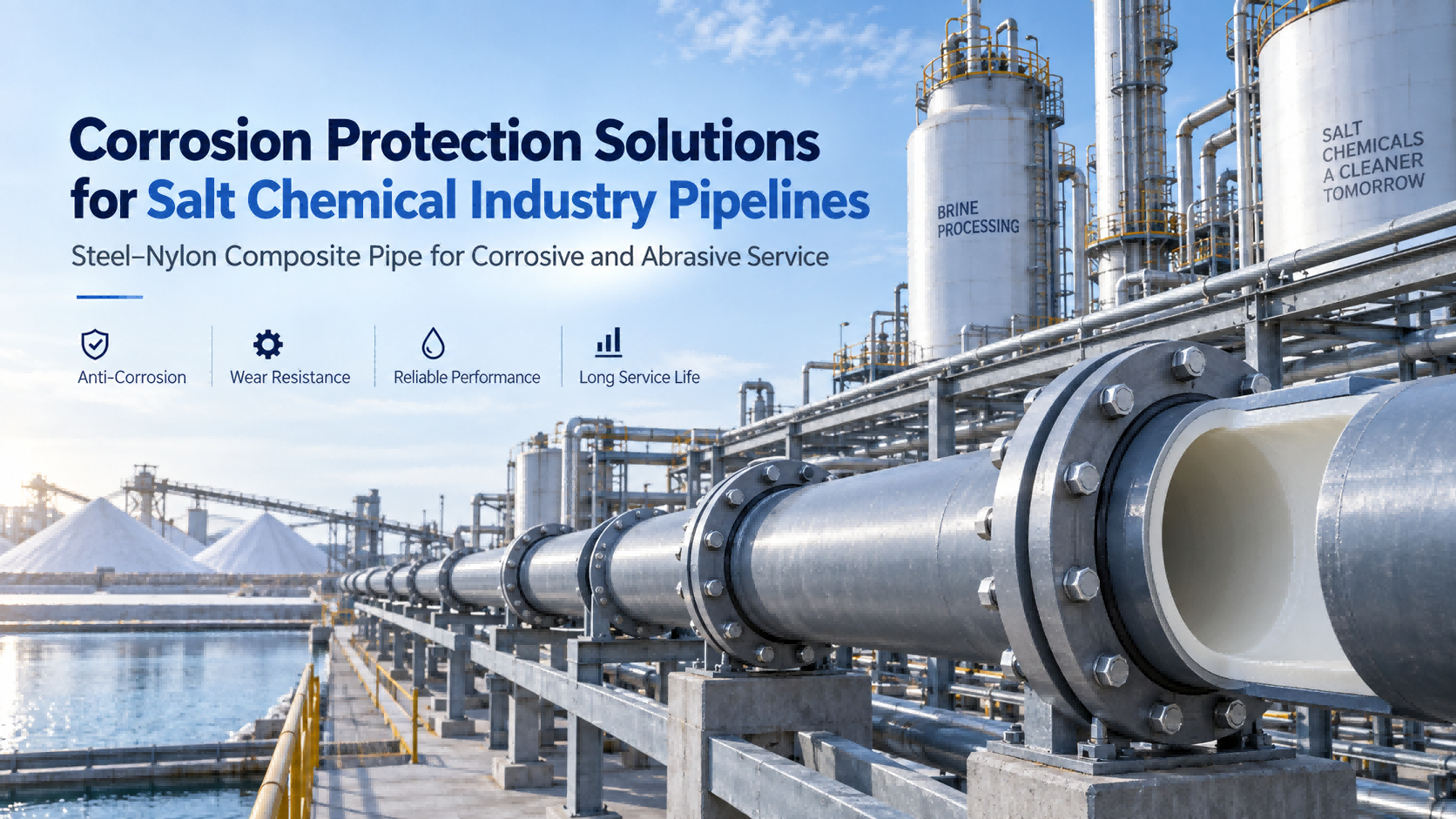
The salt chemical industry may appear to revolve around “salt,” but from the perspective of industrial piping, it represents a highly complex corrosion environment.
High concentrations of chloride ions, brine, alkaline solutions, mother liquor, salt sludge, crystalline particles, and varying temperature and pressure conditions often exist within the same production system. In many cases, pipeline failures are not caused by insufficient pressure resistance, but by the combined effects of corrosion, erosion, scaling, abrasion, and leakage at connection points over long-term operation.
Therefore, corrosion protection for salt chemical pipelines can no longer be understood simply as “adding a protective coating to steel pipe.”
A truly reliable solution requires a comprehensive evaluation of the conveyed medium, pipe structure, material system, connection method, and total lifecycle cost.
For chlor-alkali, soda ash, brine treatment, and other salt chemical applications, steel–nylon composite pipe is increasingly becoming a piping solution worthy of serious engineering consideration.
1. Why Are Salt Chemical Pipelines Particularly Vulnerable to Corrosion?
Corrosion conditions in salt chemical plants are significantly more demanding than those found in ordinary industrial water systems.
One of the most important factors is the high concentration of dissolved ions.
Brine, mother liquor, and certain process wastewater streams may contain high concentrations of Cl⁻, Na⁺, CO₃²⁻, OH⁻, and other ionic species. These media can accelerate electrochemical corrosion of conventional carbon steel while also creating localized corrosion risks for certain metallic materials.
In chloride-rich environments in particular, simply upgrading to a higher-grade metal does not necessarily eliminate corrosion risks.
Many salt chemical pipelines must also deal with several additional challenges simultaneously.
For example:
-
Salt sludge, crystals, and suspended solids can continuously erode the pipe wall.
-
Temperature fluctuations may create thermal stress in both the pipe material and connection system.
-
Long-term transport of concentrated alkaline solutions places additional demands on material compatibility.
-
Frequent start-stop cycles may produce pressure fluctuations and vacuum conditions.
-
Outdoor pipe racks must withstand UV exposure, atmospheric corrosion, weathering, and long-term structural loads.
Salt chemical pipelines should therefore be regarded as a typical multi-factor coupled operating environment.
Solving corrosion alone does not necessarily solve the overall service-life problem of the piping system.
2. Common Failure Modes in Salt Chemical Pipelines
Pipeline failure in salt chemical plants is rarely caused by a single factor.
2.1 Internal Corrosion of Carbon Steel Pipe
Carbon steel has long been widely used in industrial piping because of its mature manufacturing technology, high mechanical strength, and relatively low initial cost.
However, in brine, mother liquor, and corrosive wastewater environments, carbon steel may suffer continuous internal corrosion.
Over time, this can lead to:
-
Progressive wall-thickness loss
-
Localized pitting
-
Corrosion perforation
-
Failures near welded joints
-
Internal scaling and deposits
If the pipeline requires periodic replacement, the real cost extends far beyond the purchase price of the pipe itself.
Additional expenses may include:
-
Maintenance labor
-
Production shutdown losses
-
Scaffolding
-
Lifting and dismantling
-
Welding
-
Reapplication of corrosion protection
-
Inspection
-
Safety management during maintenance
For continuously operating chemical plants, these indirect costs can eventually exceed the original material cost.
2.2 Stainless Steel Does Not Mean “Completely Corrosion-Free”
304 and 316L stainless steel are widely used in chemical processing systems and offer strong corrosion resistance in many environments.
However, in high-chloride service, engineers still need to evaluate the risks of:
-
Pitting corrosion
-
Crevice corrosion
-
Localized corrosion near welds
-
Corrosion under deposits
Areas around weld seams, flange sealing surfaces, stagnant zones, and deposits can become particularly vulnerable when chloride concentrations are high.
Another issue is cost.
As pipeline diameter increases, the material cost of high-grade stainless steel rises significantly.
For DN300, DN500, or even larger salt chemical process pipelines, continuously increasing the alloy grade may not always provide the most economical corrosion-control strategy.
2.3 Long-Term Stability of Lined Pipe Systems
Rubber-lined steel pipe, plastic-lined steel pipe, and other lined piping systems are commonly used in chemical processing applications.
Their basic design philosophy is reasonable:
The steel structure provides mechanical strength, while the lining isolates the corrosive medium from the metal substrate.
The critical issue, however, is whether the lining can remain mechanically and chemically stable throughout long-term service.
Depending on material, manufacturing method, installation quality, temperature cycling, vacuum conditions, and chemical exposure, some conventional lining systems may face risks such as:
-
Blistering
-
Local separation
-
Delamination
-
Lining collapse under vacuum
-
Mechanical damage
-
Permeation-related deterioration
Once the protective layer is locally damaged, the corrosive medium may reach the steel structure beneath it.
Therefore, the real question for composite piping is not simply:
“Does the pipe have a corrosion-resistant lining?”
The more important question is:
Can the corrosion-resistant layer remain structurally stable and intact throughout long-term industrial operation?
3. What Factors Should Be Considered When Selecting Salt Chemical Pipelines?
Many purchasing decisions are still based primarily on the price per meter of pipe.
For continuously operating salt chemical plants, this approach can significantly underestimate long-term operating costs.
A more reliable selection method should evaluate several factors simultaneously.
| Evaluation Factor | Key Engineering Question |
|---|---|
| Corrosion Resistance | Can the material withstand brine, alkaline solutions, mother liquor, and actual ion concentrations? |
| Abrasion Resistance | Are salt sludge, crystals, slurry, or suspended solids present? |
| Pressure Capacity | What are the operating pressure, design pressure, and pressure fluctuations? |
| Temperature Range | What are the normal and maximum operating temperatures? |
| Structural Stability | Is the pipeline large-diameter, long-span, or installed on outdoor pipe racks? |
| Internal Surface Properties | Is the pipe susceptible to scaling, deposition, or flow restriction? |
| Connection Method | Does installation require welding, hot work, or complicated field fabrication? |
| Maintenance Frequency | How frequently will inspection, repair, or replacement be required? |
| Lifecycle Cost | What is the combined cost of material, installation, maintenance, and shutdowns? |
This means salt chemical pipeline selection should move beyond the question of:
“Which pipe should we purchase?”
Instead, the better question is:
“Which piping system can minimize operating and maintenance costs over the next 10 years or longer?”
4. Why Is Steel–Nylon Composite Pipe Suitable for Salt Chemical Applications?
The fundamental design philosophy of steel–nylon composite pipe is to combine the mechanical advantages of steel with the corrosion and abrasion resistance of engineering nylon.
In simple terms:
Steel provides structural strength, while the nylon functional layer handles direct contact with the conveyed medium.
This creates a fundamentally different performance profile compared with conventional single-material metallic or non-metallic piping.
4.1 Isolating the Steel Structure from Corrosive Media
The major weakness of conventional steel pipe in high-salinity environments is direct contact between the steel and the corrosive fluid.
Steel–nylon composite pipe uses a nylon functional layer as the fluid-contact surface, effectively isolating the conveyed medium from the internal steel structure.
For applications involving:
-
Brine
-
Mother liquor
-
Certain strongly alkaline media
-
Salt chemical wastewater
this structural concept can significantly reduce the risk associated with direct internal corrosion of metallic pipe walls.
4.2 Combining Corrosion Resistance and Abrasion Resistance
Many salt chemical process streams are not clean liquids.
Examples include:
-
Salt sludge
-
Crystalline particles
-
Slurries
-
Suspended solids
-
Process by-products
These materials can create significant erosion and abrasion inside pipelines.
If a pipe material provides excellent corrosion resistance but insufficient wear resistance, its actual service life may still be limited.
Engineering nylon offers both corrosion resistance and strong abrasion resistance.
Steel–nylon composite pipe is therefore particularly suitable for applications where engineers need to address:
Corrosion + Erosion + Abrasion
at the same time.
This is an important distinction between a structural composite pipe and a conventional anti-corrosion coating system.
5. Why Does a Smooth Inner Surface Matter in Salt Chemical Processing?
Scaling is another major issue that is often underestimated during pipeline selection.
After several years of operation, the primary problem may no longer be corrosion perforation.
Instead, deposits can gradually accumulate on the internal pipe wall, reducing the effective flow area.
As the internal diameter decreases, the system may experience:
-
Higher pressure losses
-
Reduced flow capacity
-
Increased pumping energy consumption
-
More frequent cleaning requirements
-
Higher risk of blockage
-
Reduced process efficiency
In severe cases, mechanical cleaning or partial pipeline replacement may become necessary.
Steel–nylon composite pipe provides a relatively smooth internal flow surface, helping reduce the tendency of certain process media to adhere to and accumulate on the pipe wall.
For brine, mother liquor, and other media with scaling potential, this characteristic affects not only pipeline service life but also the long-term hydraulic efficiency of the entire system.
From a lifecycle perspective:
Reducing scaling is itself an important way to reduce operating costs.
6. Why Can Steel–Nylon Composite Pipe Be More Suitable Than Single-Material Non-Metallic Pipe for Large Industrial Projects?
Fully non-metallic pipes offer significant corrosion-resistance advantages.
However, as pressure, temperature, and diameter increase, engineering concerns gradually extend beyond corrosion resistance to overall structural performance.
Large salt chemical plants commonly involve:
-
Large-diameter pipelines
-
Long-distance transport systems
-
Outdoor pipe racks
-
Relatively high operating pressures
-
Long unsupported spans
-
Complex support structures
Under these conditions, the pipeline must provide more than corrosion resistance.
It must also maintain adequate:
-
Rigidity
-
Hoop strength
-
Axial stability
-
Structural integrity
-
Connection reliability
Steel–nylon composite pipe uses the steel structure to provide mechanical support while the nylon functional layer provides the required corrosion- and wear-resistant fluid interface.
Our steel–nylon composite pipes can be engineered for pressure classes of approximately 1.0–4.0 MPa, with manufacturing capability extending to diameters above DN2000, depending on project requirements.
This makes the product suitable for large-scale industrial transportation systems in industries such as:
-
Salt chemicals
-
Soda ash
-
Chlor-alkali
-
Oil and gas
-
Mining
-
Industrial water treatment
Steel–nylon composite pipe should therefore not be viewed simply as a “corrosion-resistant pipe.”
A more accurate description is:
A structurally reinforced corrosion-resistant composite piping system for demanding industrial environments.
7. Why Are Integral Flange Connections Important in Salt Chemical Projects?
In many industrial piping systems, failures do not occur in straight pipe sections.
Instead, problems often develop around:
-
Welds
-
Flanges
-
Elbows
-
Tees
-
Reducers
-
Valve connections
-
Equipment interfaces
Traditional steel pipeline installation frequently requires:
-
Cutting
-
Beveling
-
Welding
-
Weld inspection
-
Surface preparation
-
Repair of anti-corrosion coatings
In chemical plants, field welding also introduces additional hot-work controls and safety-management requirements.
Our steel–nylon composite pipe adopts an integral flange connection design, which can significantly reduce the need for field welding.
For certain chemical plant installation and retrofit projects, this can provide several practical benefits:
-
Shorter installation time
-
Reduced field welding
-
Less hot work
-
Easier connection to valves and equipment
-
Simplified dismantling during maintenance
-
Greater convenience for partial pipeline replacement
These advantages are especially important when upgrading existing salt chemical plants where production interruptions and hot-work permits must be minimized.
In many retrofit projects, installation simplicity can be just as important as the purchase price of the piping material.
8. Should Every Process Section in a Salt Chemical Plant Use the Same Pipe Material?
Usually not.
A single salt chemical facility may contain dozens of different process fluids and operating conditions.
For example:
Raw Brine Systems
The main concern may be chloride-related corrosion.
Salt Sludge Pipelines
Abrasion, particle impact, deposition, and blockage may become more important.
Mother Liquor Systems
Corrosion, crystallization, scaling, and erosion may occur simultaneously.
Strong Alkali Pipelines
Material compatibility must be evaluated against alkali concentration and operating temperature.
Wastewater Systems
Chemical composition may vary significantly over time, creating unpredictable corrosion conditions.
The more rational selection method is therefore:
Medium composition × Concentration × Temperature × Pressure × Solids content × Flow velocity × Diameter
rather than specifying a single material for every pipeline throughout an entire plant.
This also reflects the broader development of industrial piping from simple product procurement toward engineered transportation solutions.
9. Salt Chemical Pipeline Corrosion Control Is Shifting from “Repair” to “Prevention”
For many years, some industrial facilities followed a reactive maintenance model:
Pipe corrodes → Leakage occurs → Production stops → Pipe is repaired or replaced → Operation resumes
This approach may have been acceptable when labor, downtime, and safety-management costs were lower.
Modern salt chemical plants, however, increasingly prioritize:
-
Continuous plant availability
-
Process safety
-
Environmental protection
-
Maintenance efficiency
-
Labor costs
-
Long-term reliability
As a result, the objective of pipeline management is changing.
Companies are no longer asking only:
“How much does this pipe cost per meter?”
They are increasingly asking:
“How many times will this pipeline need to be repaired over the next 10 years?”
These two questions represent fundamentally different procurement strategies.
A lower-priced pipe may appear economical at the purchasing stage, but if it requires repeated replacement, the plant must also absorb costs associated with:
-
Replacement materials
-
Labor
-
Lifting equipment
-
Scaffolding
-
Production shutdowns
-
Safety permits
-
Process-fluid cleaning
-
Waste disposal
-
Potential environmental incidents
For salt chemical plants, the more appropriate investment objective is therefore:
Lowest Total Cost of Ownership
In other words:
The goal should be the lowest lifecycle cost—not simply the lowest initial purchase price.
10. Which Salt Chemical Pipelines Should Consider Steel–Nylon Composite Pipe?
Steel–nylon composite pipe deserves particular consideration in applications involving:
-
High-salinity and high-chloride media
-
Soda ash mother liquor systems
-
Brine transportation
-
Salt sludge transportation
-
Certain chlor-alkali brine and alkaline process systems
-
Corrosive media containing abrasive solid particles
-
Pipelines prone to scaling and deposition
-
Process lines where carbon steel frequently suffers corrosion perforation
-
Large-diameter corrosion-resistant industrial pipelines
-
Existing plants seeking to reduce field welding and hot-work requirements
Final material selection should always be based on actual operating conditions, including chemical composition, concentration, temperature, pressure, flow velocity, solids content, and operating mode.
11. What Information Should Be Provided to a Salt Chemical Pipeline Supplier?
Professional pipeline selection should not be based only on specifications such as:
DN300, PN1.6
At minimum, the following information should be provided:
-
Process medium
-
Chemical composition
-
Major ion concentrations
-
pH value
-
Normal operating temperature
-
Maximum operating temperature
-
Normal operating pressure
-
Maximum operating pressure
-
Design pressure
-
Flow velocity
-
Solids concentration
-
Particle size
-
Installation environment
-
Total pipeline length
-
Required design life
These parameters influence much more than material selection.
They can also affect:
-
Pipe wall design
-
Structural configuration
-
Connection design
-
Elbow design
-
Support spacing
-
Wear allowance
-
Reinforcement of high-erosion areas
For demanding salt chemical projects, we therefore recommend evaluating the complete operating conditions rather than purchasing piping based solely on nominal diameter and pressure class.
Conclusion: A True Salt Chemical Corrosion Solution Must Solve More Than Corrosion
Long-term performance of salt chemical pipelines is determined by several interacting factors:
Corrosion, abrasion, scaling, pressure, temperature, connection reliability, and maintenance cost.
This is why more industrial projects are reconsidering conventional single-material piping strategies.
Steel–nylon composite pipe combines the mechanical strength of a steel structure with the corrosion resistance, abrasion resistance, and smooth flow surface of an engineering nylon functional layer.
For salt chemical, soda ash, chlor-alkali, and other demanding corrosive industrial transportation systems, its value extends beyond simply “replacing steel pipe.”
More importantly, it represents a different approach to industrial pipeline design:
From repeated repair to long-term reliability.
From initial purchase price to lifecycle cost.
From purchasing pipe products to solving industrial fluid transportation problems.
If your salt chemical project is facing problems such as pipeline corrosion and perforation, salt-sludge abrasion, mother-liquor scaling, large-diameter corrosion-resistant pipe selection, or frequent replacement of aging pipelines, you can provide us with your operating parameters, including medium composition, concentration, temperature, pressure, pipe diameter, and flow velocity.
Based on the actual operating conditions, we can evaluate the suitability of steel–nylon composite pipe and develop a corresponding industrial piping solution.
Phosphate Industry Slurry Transportation Solutions: How to Address Abrasion, Corrosion, Scaling, and Pipeline Service Life
Soda Ash Industry Pipeline Selection Guide: How to Choose Corrosion-Resistant, Wear-Resistant, and Low-Maintenance Industrial Piping


