Recommended Pipes for Seawater Desalination Projects: How to Choose Corrosion-Resistant, Wear-Resistant, and Long-Life Piping Systems 1. Introduction: Why Pipeline Selection Matters in Seawater Desalination Projects
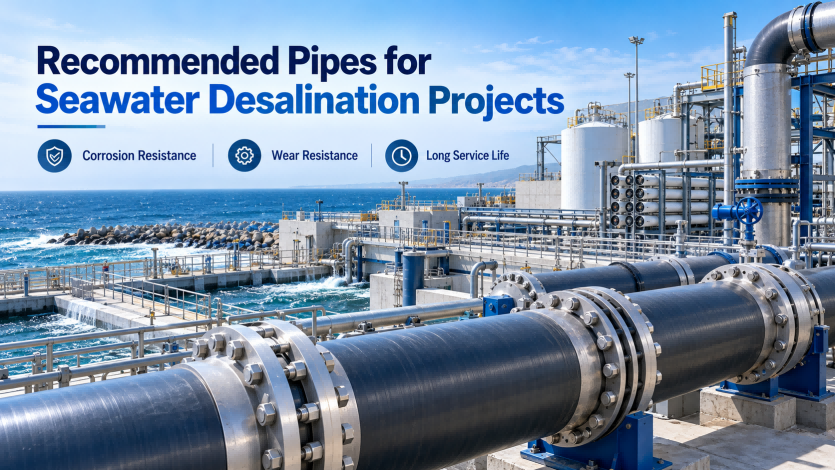
As global freshwater shortages become increasingly serious, seawater desalination has emerged as an essential solution for coastal cities, islands, industrial parks, and water-scarce regions.
From large-scale desalination plants in the Middle East to industrial water supply projects in Asia and independent water systems on remote islands, the demand for reliable seawater desalination infrastructure continues to grow.
However, pipeline systems are often underestimated during the planning and construction of desalination facilities.
A modern seawater desalination plant requires more than efficient reverse osmosis membranes, high-pressure pumps, and energy recovery equipment. It also depends on extensive piping networks responsible for seawater intake, pretreatment, brine discharge, and freshwater transportation.
These pipelines must operate under challenging conditions, including:
-
High salinity and corrosion: Chloride ions in seawater can cause localized corrosion in metallic piping systems.
-
Sand and particle abrasion: Suspended solids, sand, and other particles may accelerate internal pipe wear.
-
Continuous operation: Desalination facilities typically require high availability and reliable long-term performance.
-
Large-volume transportation: Industrial-scale desalination projects require large-diameter pipelines with stable hydraulic performance.
-
Complex maintenance conditions: Offshore, coastal, and remote installations often face higher maintenance costs.
-
Long-term operating expenses: Corrosion, leakage, pipe replacement, and unplanned shutdowns can significantly affect project economics.
Therefore, selecting piping materials for seawater desalination should involve more than comparing initial purchase prices.
Engineers and project owners must carefully evaluate corrosion resistance, abrasion resistance, pressure capacity, hydraulic efficiency, service life, and total cost of ownership.
For seawater intake, pretreatment, low-pressure transportation, and suitable brine discharge applications, steel–nylon composite pipes represent a promising alternative worth evaluating alongside conventional metallic and non-metallic piping materials.
By combining the structural strength of steel with the corrosion-resistant and wear-resistant characteristics of engineered nylon, steel–nylon composite piping systems offer a practical material option for challenging seawater transportation environments.
2. Why Do Seawater Desalination Projects Require Special Piping Materials?
2.1 High Chloride Concentrations Create Serious Corrosion Risks
Seawater contains significant concentrations of dissolved salts, particularly chloride ions, which are among the primary factors affecting the durability of metallic piping systems.
When conventional carbon steel pipes are continuously exposed to seawater, corrosion can become a major maintenance challenge.
If a protective coating is damaged, localized corrosion may develop and progressively affect the structural integrity of the pipe.
Even stainless steel does not provide complete protection against seawater corrosion.
For example, 304 stainless steel is generally unsuitable for continuous direct seawater exposure.
Although 316L stainless steel offers improved corrosion resistance, it may still experience pitting and crevice corrosion under unfavorable conditions, particularly in stagnant seawater, elevated temperatures, or chloride-rich environments.
Consequently, engineers must consider several potential corrosion mechanisms:
-
Internal corrosion during prolonged seawater exposure
-
Crevice corrosion around flanges and mechanical connections
-
Corrosion at welds and other vulnerable locations
-
Localized corrosion during shutdown periods
-
Material degradation in concentrated brine environments
Steel–nylon composite pipes address some of these challenges through a combined material structure.
The engineered nylon working layer acts as a barrier between the transported seawater and the underlying steel structure.
When the lining remains intact and material compatibility has been verified, this design can reduce direct exposure of the steel to corrosive seawater, helping control internal corrosion risks.
This structural approach is one of the principal advantages of composite piping systems in saline industrial environments.
2.2 Sand and Suspended Solids Increase Abrasion Risks
Seawater intake conditions vary significantly depending on project location.
Some desalination facilities obtain seawater through deep offshore intake systems, while others rely on nearshore intake structures in shallow coastal waters.
In many nearshore environments, seawater may contain:
-
Sand particles
-
Sediment and suspended solids
-
Shell fragments
-
Other abrasive materials
When these particles enter piping systems, they can cause internal erosion, particularly at elbows, tees, reducers, pump outlets, and locations where flow direction changes.
Higher velocities or increased solids concentrations can further accelerate wear.
Therefore, selecting a pipe based exclusively on corrosion resistance may not be sufficient.
Engineered nylon materials offer useful wear-resistant properties for certain industrial applications.
With appropriate lining thickness, structural design, and operating conditions, steel–nylon composite pipes can be considered for seawater transportation systems where corrosion and abrasion occur simultaneously.
They are particularly worth evaluating for sediment-containing intake pipelines, pretreatment lines, and localized high-wear sections.
Actual abrasion performance, however, should be established through testing or reliable operating data that reflect particle size, solids concentration, flow velocity, and impact conditions.
2.3 Continuous Operation Requires High Pipeline Reliability
Desalination facilities frequently provide essential water supplies for cities, industrial operations, and island communities.
A pipeline failure may therefore create costs that extend well beyond the replacement of a damaged pipe section.
Potential consequences include:
-
Reduced seawater intake capacity
-
Disruption of pretreatment operations
-
Unstable feedwater supply to reverse osmosis units
-
Decreased freshwater production
-
Increased maintenance labor and equipment costs
-
Unplanned plant shutdowns
For this reason, pipeline reliability must be evaluated throughout the intended operating life of a desalination facility.
The goal is not simply to transport seawater, but to maintain safe, stable, and predictable performance while minimizing maintenance-related interruptions.
3. Recommended Pipe Materials for Different Seawater Desalination Applications
Not every section of a desalination plant operates under the same conditions.
Operating pressure, flow rate, chemical composition, temperature, and equipment connections vary throughout the process.
For seawater reverse osmosis (SWRO) facilities, the piping system can be divided into several major applications.
| Application | Main Operating Conditions | Recommended Materials for Evaluation | Suitability of Steel–Nylon Composite Pipes |
|---|---|---|---|
| Seawater intake pipelines | Large flow volumes, salinity, possible sand content | HDPE, GRP, steel–nylon composite | Suitable for evaluating onshore and selected intake sections |
| Seawater pretreatment pipelines | Salinity, suspended solids, chemical treatment | HDPE, GRP, lined steel, steel–nylon composite | Strong candidate for evaluation |
| Low-pressure seawater pipelines | Continuous operation and corrosion exposure | HDPE, GRP, steel–nylon composite | Strong candidate for evaluation |
| High-pressure RO feed pipelines | High-pressure seawater | Super duplex stainless steel and suitable high-pressure alloys | Standard 1.0–4.0 MPa products are not suitable for typical SWRO high-pressure sections |
| Brine discharge pipelines | Concentrated salinity, varying pressure | GRP, HDPE, corrosion-resistant alloys, steel–nylon composite | Suitable for pressure-compatible discharge sections |
| Desalinated water pipelines | Water quality and hygienic requirements | Approved HDPE, stainless steel, certified composite pipes | Requires drinking-water contact compliance where applicable |
| Auxiliary industrial water lines | Variable pressure, corrosion, and flow | HDPE, GRP, steel–nylon composite | Suitable for evaluation |
Important Engineering Consideration
Typical seawater reverse osmosis systems operate at approximately 55–70 bar, equivalent to 5.5–7.0 MPa, depending on feedwater salinity, membrane design, recovery rate, and operating conditions.
Therefore, steel–nylon composite pipes rated for 1.0–4.0 MPa should not automatically be specified for high-pressure SWRO feed lines.
Their primary opportunities lie in seawater intake, pretreatment, low-pressure transportation, and selected brine discharge systems where the actual design pressure falls within the product's verified operating range.
Brine pipelines must also be assessed individually, since some sections may remain under high pressure before energy recovery or pressure reduction.
Proper material selection must always begin with actual operating conditions rather than assuming that one piping material is suitable throughout the entire desalination facility.
4. Why Consider Steel–Nylon Composite Pipes for Seawater Desalination?
Steel–nylon composite pipes combine the structural functionality of steel with the corrosion-resistant and wear-resistant characteristics of engineered nylon.
Compared with conventional metallic pipes or single-material plastic pipelines, this composite approach offers a different balance of mechanical performance and internal corrosion protection.
4.1 Steel Structural Support Combined with a Corrosion-Resistant Nylon Layer
Conventional metallic pipes provide structural strength and pressure-bearing capability.
However, seawater exposure creates significant challenges for long-term corrosion management.
Plastic pipes offer excellent resistance to many corrosive environments, but pressure ratings, pipe stiffness, support requirements, and mechanical loads must be considered carefully, especially for large-diameter installations.
Steel–nylon composite pipes integrate the respective functions of these materials into a single structure.
Steel structural component:
-
Provides mechanical support and structural stability
-
Carries loads within the verified design limits
-
Supports pressure-bearing requirements
-
Facilitates engineering design for supports and connections
Engineered nylon working layer:
-
Separates the conveyed fluid from the underlying steel
-
Provides a wear-resistant internal surface
-
Helps maintain a relatively smooth flow passage
-
Reduces direct internal corrosion exposure when chemical compatibility is confirmed
This composite structure does not eliminate the need for engineering verification.
Bond integrity, differential thermal expansion, end sealing, long-term deformation, and pressure performance remain important design considerations.
4.2 Improved Internal Corrosion Protection Can Reduce Maintenance Requirements
Traditional carbon steel seawater pipelines frequently rely on protective coatings, linings, corrosion allowances, and regular inspection programs.
When protective systems deteriorate, localized repair and replacement costs may increase.
Steel–nylon composite pipes incorporate a protective working layer into the pipe structure.
Provided that the nylon material is compatible with the process fluid and the lining retains its integrity, this arrangement can help protect the steel-bearing structure from direct internal seawater exposure.
Potential long-term advantages include:
-
Reduced internal corrosion risks
-
Lower demand for corrosion-related repairs
-
Fewer maintenance interventions in suitable applications
-
Improved operational stability
-
Reduced exposure to unplanned downtime
External steel surfaces still require appropriate corrosion protection, especially in coastal, submerged, or buried installations.
4.3 Wear-Resistant Performance for Sand-Containing Seawater
Seawater intake systems may face combined corrosion and abrasion challenges.
Pump outlets, elbows, and directional changes are particularly vulnerable to particle impact.
An engineered nylon internal layer can provide a useful wear-resistant solution for appropriate operating conditions.
By optimizing lining thickness, pipe geometry, bend radius, and flow velocity, engineers may improve the durability of sections exposed to abrasive particles.
For demanding applications, abrasion tests and pilot installations are recommended before implementing a full-scale material substitution.
4.4 Smooth Internal Surfaces Support Hydraulic Efficiency
Large-volume seawater transportation requires substantial pumping energy.
Pipeline friction losses depend on several factors, including:
-
Internal pipe diameter
-
Flow velocity
-
Pipeline length
-
Surface roughness
-
Fluid properties
The Darcy–Weisbach equation is commonly used to calculate frictional head loss:
[
h_f=f\frac{L}{D}\frac{v^2}{2g}
]
Where:
-
(h_f) = Frictional head loss
-
(f) = Darcy friction factor
-
(L) = Pipeline length
-
(D) = Internal pipe diameter
-
(v) = Average flow velocity
-
(g) = Gravitational acceleration
Under comparable operating conditions, lower internal surface roughness can contribute to reduced friction losses.
Steel–nylon composite pipes feature relatively smooth nylon working surfaces.
When properly designed and maintained, these surfaces can support stable hydraulic performance throughout the service period.
For large desalination intake and pretreatment pipelines, controlling long-term hydraulic resistance is particularly important.
However, actual energy savings must be calculated using measured roughness values, pipeline geometry, flow rates, and pump efficiency.
It should not be assumed that steel–nylon composite pipes always provide lower hydraulic losses than HDPE or GRP pipes.
4.5 Integrated Flange Connections Facilitate Installation
Connections are critical components of industrial piping systems.
Depending on pipe material and system design, conventional connections may require welding, protective coating repairs, complex joint preparation, or specialized installation procedures.
Steel–nylon composite piping products equipped with integrated flange designs can offer practical installation advantages.
Potential benefits include:
-
Convenient modular installation
-
Easier replacement of individual pipe sections
-
Reduced need for certain on-site hot-work operations
-
Compatibility with suitably designed flanged valves and equipment
-
Factory prefabrication opportunities
-
Easier access for connection inspection and maintenance
Desalination plants contain numerous pumps, filters, valves, and equipment interfaces.
Therefore, connection design can directly influence installation efficiency and long-term system reliability.
Flange pressure ratings, bolt preload, gasket selection, axial loads, and long-term sealing performance must still be verified according to project requirements.
5. Steel–Nylon Composite Pipes vs. Traditional Desalination Piping Materials
Several materials are widely considered for seawater transportation and desalination applications, including HDPE, GRP/FRP, stainless steel, lined steel, and composite piping systems.
Each has specific advantages and engineering limitations.
| Comparison Factor | HDPE Pipes | GRP/FRP Pipes | 316L Stainless Steel Pipes | Steel–Nylon Composite Pipes |
|---|---|---|---|---|
| Seawater corrosion resistance | Generally excellent | Depends on resin system | Susceptible to pitting and crevice corrosion | Depends on nylon compatibility and lining integrity |
| Abrasion resistance | Requires application-specific evaluation | Depends on internal lining system | Depends on solids and flow conditions | Wear-resistant nylon layer available |
| Pressure-bearing capacity | Depends on SDR and temperature | Depends on structural design and pressure class | High when properly designed | Depends on composite structure and verified rating |
| Large-diameter capability | Well established | Well established | Technically achievable, potentially expensive | Available through suitable manufacturing and custom design |
| Connection methods | Fusion and flanges | Flanges and mechanical joints | Welding and flanges | Flanged connections and other approved designs |
| Offshore pipeline installation | Established experience | Requires specific installation design | Possible with suitable corrosion protection | Requires dedicated offshore engineering verification |
| Maintenance considerations | Generally low | Depends on joints and material integrity | Localized corrosion must be monitored | Lining, seals, and external steel protection must be monitored |
| Life-cycle economics | Project-dependent | Project-dependent | Potentially high material costs | Worth evaluating through TCO analysis |
5.1 Steel–Nylon Composite Pipes vs. HDPE Pipes
HDPE pipes have an established track record in seawater intake and brine outfall systems.
They are particularly competitive in offshore pipelines because suitable designs can be installed using marine construction techniques.
HDPE is also inherently resistant to metallic corrosion.
Steel–nylon composite pipes offer a different structural approach by combining steel support with a protective nylon working layer.
They may be attractive in applications involving:
-
Complex mechanical loading
-
Aboveground pipe supports
-
Flanged equipment interfaces
-
Localized abrasion
-
Specific stiffness or structural requirements
For long offshore pipelines installed through floating and sinking methods, HDPE may remain the more practical solution.
The final material choice should reflect actual installation and operating conditions.
5.2 Steel–Nylon Composite Pipes vs. GRP/FRP Pipes
Glass-reinforced plastic pipes are widely used in corrosive industrial environments and large-diameter water transportation.
They offer good corrosion resistance when the resin system is properly selected.
Steel–nylon composite pipes provide an alternative design by combining steel structural support with an engineered nylon working layer.
In applications involving mechanical impact, abrasion, or particular connection requirements, these material systems should be compared through relevant engineering calculations and testing.
Neither material should be assumed to outperform the other under every operating condition.
5.3 Steel–Nylon Composite Pipes vs. Stainless Steel Pipes
High-grade duplex stainless steels, super duplex stainless steels, and other corrosion-resistant alloys are used in demanding seawater applications, particularly where high pressure and structural performance are required.
However, high-alloy metallic materials can involve considerable procurement costs.
For lower-pressure, large-diameter seawater transportation systems, steel–nylon composite pipes may offer an alternative worth evaluating.
Potential economic advantages depend on:
-
Pipe diameter and pressure class
-
Material purchase costs
-
Installation requirements
-
Corrosion and maintenance risks
-
Expected service life
-
Overall project conditions
A proper life-cycle cost comparison is essential before making a material substitution.
6. Five Promising Applications for Steel–Nylon Composite Pipes in Desalination Projects
Application 1: Onshore Seawater Intake Pumping Stations
Seawater intake pumping stations transport substantial water volumes toward pretreatment facilities.
These pipelines are frequently exposed to high salinity, continuous operation, and potentially abrasive suspended particles.
For suitable onshore applications, steel–nylon composite pipes can provide an attractive combination of structural support, corrosion-resistant lining, and abrasion-related design flexibility.
Application 2: Seawater Pretreatment Systems
Pretreatment is a critical process in reverse osmosis desalination.
Its primary purpose is to reduce suspended solids, turbidity, and other contaminants before seawater reaches membrane units.
Pretreatment facilities contain filters, pumps, valves, and interconnected piping networks.
Steel–nylon composite pipes may be evaluated for:
-
Seawater transfer mains
-
Filtration equipment connections
-
Low-pressure process pipelines
-
Selected circulation systems
Special attention must be given to chemical compatibility.
Chlorination, sodium hypochlorite exposure, oxidizing chemicals, and acid or alkaline cleaning processes may affect the long-term properties of nylon materials.
Pipelines exposed to these chemicals require separate compatibility assessment.
Application 3: Pressure-Compatible Brine Discharge Pipelines
Reverse osmosis produces concentrated brine with higher salinity than the original seawater.
Brine discharge piping must be selected according to:
-
Salt concentration and chemical composition
-
Actual operating and design pressure
-
Flow velocity
-
Corrosion conditions
-
Joint reliability
-
External environmental exposure
For brine pipelines operating within the product's verified pressure range, particularly downstream of pressure reduction or energy recovery equipment, steel–nylon composite pipes may be considered.
Long-term compatibility with concentrated brine and residual treatment chemicals must be confirmed.
Application 4: Coastal Industrial Seawater Transportation
Seawater is also widely used outside dedicated desalination facilities.
Potential applications include:
-
Coastal power plants
-
Chemical manufacturing facilities
-
Petrochemical complexes
-
Seawater cooling systems
-
Industrial circulation networks
These projects often require large-diameter pipelines capable of transporting significant water volumes over extended distances.
For suitable pressure and temperature conditions, steel–nylon composite piping systems offer opportunities for additional engineering evaluation and industrial application.
Application 5: Island and Remote Water Infrastructure
Remote islands and coastal communities often face limited maintenance resources and challenging logistics.
Reliable piping systems are essential for seawater intake, pretreatment, and auxiliary industrial water transportation.
Where conditions are suitable and verified, corrosion-resistant composite pipes may help reduce maintenance demands and replacement frequency.
For desalinated drinking-water systems, additional hygienic and material certification requirements apply.
For example, NSF/ANSI/CAN 61 addresses the health effects of materials and products in contact with drinking water.
A claim that nylon is non-toxic does not, by itself, establish certification of the complete piping system.
7. The Potential of Large-Diameter Steel–Nylon Composite Pipes in Desalination Engineering
Large-scale desalination facilities require substantial seawater intake capacity.
As production capacity increases, demand grows for large-diameter intake, pretreatment, and discharge pipelines.
However, large-diameter pipeline engineering involves much more than selecting a nominal diameter.
Key technical considerations include:
-
Hoop strength and axial load capacity
-
Pipe support spacing and deflection
-
Water hammer caused by pump startup and shutdown
-
Thermal expansion and contraction
-
Flange sealing and connection loads
-
Transportation, lifting, and installation conditions
-
Long-term structural stability
Our company specializes in the development and manufacturing of reinforced MC nylon pipes and steel–nylon composite pipes, including large-diameter and customized industrial piping solutions.
For seawater desalination projects, we can work with customers to evaluate pipe diameter, pressure requirements, structural configuration, flange connections, and special fittings.
The real value of large-diameter manufacturing lies not simply in producing larger pipes, but in achieving reliable quality while meeting project-specific pressure, loading, transportation, and installation requirements.
For DN1600 and larger pipe requirements, detailed engineering evaluation should be supported by applicable manufacturing capabilities, inspection documentation, and project design calculations.
8. Why Total Cost of Ownership Matters More Than Initial Pipe Price
In conventional procurement processes, pipeline materials are often compared primarily by unit price.
However, seawater desalination facilities are long-term infrastructure investments.
A material with a lower initial purchase price may not necessarily provide the lowest overall cost throughout the operating life of the plant.
This is why Total Cost of Ownership (TCO) should play an important role in piping material selection.
8.1 What Is Included in Pipeline Life-Cycle Cost?
A simplified total cost model can be expressed as:
[
TCO=C_0+C_i+C_m+C_r+C_d+C_e
]
Where:
-
(C_0) = Initial pipe and fitting procurement costs
-
(C_i) = Transportation, installation, and commissioning costs
-
(C_m) = Inspection and routine maintenance costs
-
(C_r) = Repair and replacement costs
-
(C_d) = Downtime-related losses
-
(C_e) = Pumping energy costs associated with pipeline hydraulic resistance
For formal investment decisions, annual cash flows, discount rates, residual values, and project risks should also be included.
8.2 How Can Steel–Nylon Composite Pipes Improve Long-Term Economics?
In corrosion-prone seawater transportation systems, conventional metallic pipelines may require ongoing coating repairs, corrosion inspections, and occasional pipe replacements.
For properly selected applications, steel–nylon composite pipes may offer economic advantages through several mechanisms.
Reduced corrosion-related maintenance
An intact corrosion-resistant nylon working layer can help minimize direct seawater exposure of the underlying steel structure.
Potentially longer replacement intervals
If the nylon layer maintains its mechanical and chemical integrity throughout operation, the pipeline may require fewer corrosion-related replacements.
Lower downtime exposure
For continuously operated desalination facilities, avoiding an unexpected shutdown may provide substantial economic value.
More stable hydraulic performance
Maintaining a relatively smooth internal surface may help control long-term friction losses and associated pumping costs.
These potential advantages should be demonstrated through appropriate material data, operating experience, and project-specific economic analysis.
8.3 How to Compare 20-Year Pipeline Costs
Engineers and project owners should compare alternative materials using consistent operating assumptions and a common evaluation period.
A discounted life-cycle cost model can be expressed as:
[
NPV_{\mathrm{TCO}}=
C_{\mathrm{initial}}+
\sum_{t=1}^{20}
\frac{
C_{\mathrm{operating},t}
+
C_{\mathrm{maintenance},t}
+
C_{\mathrm{replacement},t}
+
C_{\mathrm{downtime},t}
}{
(1+r)^t
}
]
Where:
-
(NPV_{\mathrm{TCO}}) = Net present value of total cost of ownership
-
(r) = Discount rate
-
(t) = Operating year
This approach allows project teams to compare steel–nylon composite pipes with HDPE, GRP, stainless steel, and other materials on an economically consistent basis.
For seawater desalination projects, the most cost-effective piping solution is not necessarily the cheapest pipe to purchase. It is the solution that delivers reliable performance at an acceptable total cost throughout the intended service life.
9. How to Select Steel–Nylon Composite Pipes for a Desalination Project
Proper technical evaluation is essential before selecting any piping material for seawater service.
9.1 Identify the Actual Fluid Composition
Project teams should confirm:
-
Seawater salinity and chloride concentration
-
Concentrated brine composition
-
Operating temperature and pH
-
Sand concentration and particle size
-
Presence of oxidizing chemicals
-
Acid or alkaline cleaning conditions
-
Continuous, intermittent, or stagnant operation
Different combinations of these factors may affect the long-term behavior of engineered nylon.
A general statement of seawater resistance should not replace detailed chemical compatibility analysis.
9.2 Confirm Operating Pressure and Temperature
The allowable operating range of steel–nylon composite pipes must be based on the verified specifications of the actual product.
For piping systems with nominal pressure classes in the 1.0–4.0 MPa range, engineers should evaluate:
-
Maximum continuous operating pressure
-
Allowable pressure at design temperature
-
Water hammer and transient pressure
-
Vacuum and external pressure conditions
-
Long-term pressure performance
-
Connection strength and sealing reliability
For high-pressure reverse osmosis systems, short-term pressure resistance must never be treated as equivalent to a verified long-term pressure rating.
9.3 Determine Pipe Diameter and Design Flow
Pipe diameter should be selected using:
-
Required flow capacity
-
Acceptable flow velocity
-
Pressure loss calculations
-
Pump characteristics
-
Operational flexibility
Hydraulic analysis and surge calculations may be necessary for large systems.
Existing pipeline dimensions should not automatically be adopted when changing to a different material.
9.4 Evaluate Installation Conditions
Different installation environments impose different structural and maintenance requirements.
Examples include:
-
Aboveground supported pipelines
-
Underground buried pipelines
-
Coastal environments exposed to salt spray
-
Outdoor installations near seawater
-
Submerged pipelines
-
Offshore installations
For offshore or subsea applications, additional analysis may be required for external pressure, buoyancy, joint integrity, corrosion protection, and installation procedures.
Onshore pipeline designs should not be transferred directly to subsea applications without dedicated verification.
9.5 Establish Quality Inspection and Acceptance Requirements
For international EPC and industrial procurement projects, technical purchase specifications should clearly define:
-
Material and product specifications
-
Pressure design basis
-
Inspection and test plans
-
Dimensional and visual inspection
-
Nylon working-layer thickness and integrity
-
Flange and connection performance
-
Factory pressure testing
-
Relevant compatibility and long-term performance documentation
-
Product traceability and delivery records
Detailed communication during the early design stage can significantly reduce the risks associated with material substitution and project implementation.
10. Why Choose Us as Your Steel–Nylon Composite Pipe Supplier?
Selecting pipes for a seawater desalination project involves more than choosing a material.
It also means selecting a supplier capable of understanding operating conditions, supporting engineering decisions, delivering consistent product quality, and meeting project requirements.
Our company focuses on the development and manufacturing of reinforced MC nylon pipes and steel–nylon composite piping products for demanding industrial environments.
10.1 Specialized in Corrosion-Resistant and Wear-Resistant Industrial Pipes
Our product development focuses on industrial applications involving:
-
High-salinity fluid transportation
-
Corrosive industrial liquids
-
Abrasive particle-containing fluids
-
Industrial circulating water
-
Chemical and mining pipeline systems
This application-oriented approach allows us to evaluate piping requirements based on actual service conditions rather than pipe dimensions alone.
10.2 Steel–Nylon Composite Structural Design
By combining steel structural components with engineered nylon working layers, our steel–nylon composite pipes are designed to address requirements for:
-
Structural support
-
Internal corrosion resistance
-
Abrasion resistance
-
Industrial fluid transportation
-
Customized connections
Actual operating limits and performance specifications depend on the selected product design and supporting verification documents.
10.3 Large-Diameter and Customized Piping Solutions
Seawater desalination facilities frequently require specialized pipeline dimensions, connection arrangements, and fittings.
We support technical discussions concerning:
-
Custom pipe diameters
-
Pressure ratings
-
Structural design
-
Flange configurations
-
Special fittings
-
Manufacturing and quality inspection requirements
Our objective is to help international customers develop practical piping solutions suited to their engineering conditions.
10.4 Engineering-Oriented Technical Support
Our approach extends beyond product quotation.
We emphasize early-stage communication to help project teams evaluate potential materials and identify technical risks before procurement.
We can work with overseas project owners, EPC contractors, engineering consultants, and industrial pipe distributors on:
-
Fluid compatibility evaluation
-
Pressure and temperature requirements
-
Material comparison
-
Pipeline structure and connection design
-
Manufacturing and inspection planning
-
Project-specific delivery requirements
For new applications involving significant technical uncertainty, sample testing or pilot installations should be considered before full-scale implementation.
11. Frequently Asked Questions About Seawater Desalination Pipes
Q1: What is the best pipe material for seawater desalination plants?
There is no single pipe material suitable for every section of a seawater desalination facility.
HDPE and GRP are established material options for seawater intake and discharge systems.
High-pressure seawater applications often require appropriately designed corrosion-resistant alloys or other materials specifically qualified for high-pressure service.
Steel–nylon composite pipes are worth evaluating for seawater intake pumping stations, pretreatment systems, low-pressure seawater transport, and pressure-compatible brine discharge applications.
Q2: Can carbon steel pipes be used for seawater transportation?
Yes, carbon steel pipes can be used when suitable corrosion protection systems, design allowances, and maintenance procedures are implemented.
However, prolonged seawater exposure creates significant internal corrosion challenges.
For long-term seawater service, alternative materials such as corrosion-resistant alloys, non-metallic pipes, lined steel pipes, and composite pipes should also be considered.
Q3: Can steel–nylon composite pipes replace 316L stainless steel pipes?
Steel–nylon composite pipes may be evaluated as alternatives to 316L stainless steel in selected seawater transportation applications where pressure, temperature, chemical compatibility, and structural requirements are satisfied.
However, direct substitution is not appropriate for all high-pressure RO feed pipelines or specialized equipment connections.
Material selection must follow the relevant design specifications and engineering requirements.
Q4: Are steel–nylon composite pipes suitable for large-diameter seawater pipelines?
Yes, large-diameter steel–nylon composite pipes can be evaluated and manufactured according to suitable product capabilities and engineering requirements.
However, large-diameter applications require additional consideration of pressure resistance, structural loading, support design, transportation, water hammer, and flange sealing performance.
Q5: What is the service life of steel–nylon composite pipes in seawater applications?
Service life depends on operating pressure, temperature, fluid chemistry, abrasive particle exposure, pipe structure, installation quality, and maintenance conditions.
Projects may target 20-year, 30-year, or other design service periods, but these targets must be supported by appropriate material qualification and long-term performance verification.
A specific service life should not be guaranteed without sufficient supporting evidence.
Q6: Can steel–nylon composite pipes reduce the total cost of desalination projects?
They may provide economic advantages in suitable applications.
Potential benefits include reduced corrosion-related maintenance, fewer replacement interventions, improved operational reliability, and stable hydraulic performance.
However, actual cost savings depend on the operating environment, product cost, installation requirements, maintenance strategy, and verified service life.
A project-specific total cost of ownership analysis is recommended.
12. Conclusion: Reliable and Cost-Effective Piping Solutions for Modern Seawater Desalination
As seawater desalination projects become larger, more technologically advanced, and increasingly focused on long-term operating efficiency, pipeline material selection is becoming a critical engineering decision.
Traditional carbon steel requires effective corrosion protection.
Stainless steel must be evaluated carefully for chloride-induced localized corrosion.
HDPE and GRP require appropriate pressure, mechanical loading, joint design, and installation considerations.
Against this background, steel–nylon composite pipes provide another valuable material option for selected desalination applications.
By combining steel structural support with an engineered nylon working layer, these composite pipes offer several potential advantages:
-
Improved internal corrosion protection
-
Wear-resistant solutions for sand-containing seawater
-
Structural support within verified pressure ratings
-
Practical flange connection configurations
-
Relatively smooth internal surfaces for stable hydraulic performance
-
Opportunities to reduce maintenance requirements and improve life-cycle economics
However, successful application depends on proper material qualification, pressure compatibility, detailed engineering, and appropriate quality assurance.
For seawater desalination projects, steel–nylon composite pipes are particularly worth considering for seawater intake pumping stations, pretreatment systems, low-pressure transportation, and selected brine discharge pipelines operating within verified design limits.
With appropriate material selection and professional manufacturing, steel–nylon composite pipes can contribute to reliable, corrosion-resistant, wear-resistant, and economically sustainable seawater transportation infrastructure.
Contact Us: Find the Right Piping Solution for Your Seawater Desalination Project
Are you planning a seawater desalination plant, coastal industrial water supply project, island water infrastructure system, or large-diameter seawater transportation network?
We specialize in the manufacturing of reinforced MC nylon pipes and steel–nylon composite pipes for demanding industrial applications.
We welcome cooperation with international EPC contractors, engineering companies, seawater desalination equipment suppliers, industrial pipe distributors, and project owners.
If your project faces challenges involving seawater corrosion, pipeline abrasion, large-diameter transportation, or high maintenance costs associated with traditional piping materials, our technical team is ready to discuss your requirements.
To support an initial technical evaluation, please provide:
-
Fluid type and chemical composition
-
Nominal pipe diameter (DN)
-
Design pressure
-
Operating temperature
-
Required flow rate
-
Installation environment
-
Project location
Our goal is to help international customers identify reliable and economically practical composite piping solutions that meet the technical demands of modern industrial water treatment and seawater desalination projects.
Steel–Nylon Composite Pipes — Engineered for Corrosion Resistance, Wear Resistance, and Long-Term Industrial Performance.
Technical references: DuPont FilmTec seawater reverse osmosis technical literature; British Stainless Steel Association guidance on seawater corrosion; ISO 14692 for GRP piping; and NSF/ANSI/CAN 61 for drinking-water contact materials. Actual product suitability must be established through engineering design, qualification testing, and applicable project acceptance requirements.
Corrosion-Resistant Piping Solutions for Coastal Areas: How Steel–Nylon Composite Pipes Address High Salinity, Humidity, and Harsh Corrosive Environments
Seawater Pipeline Material Selection Guide: How to Choose Corrosion-Resistant, Wear-Resistant, and Long-Lasting Industrial Pipes