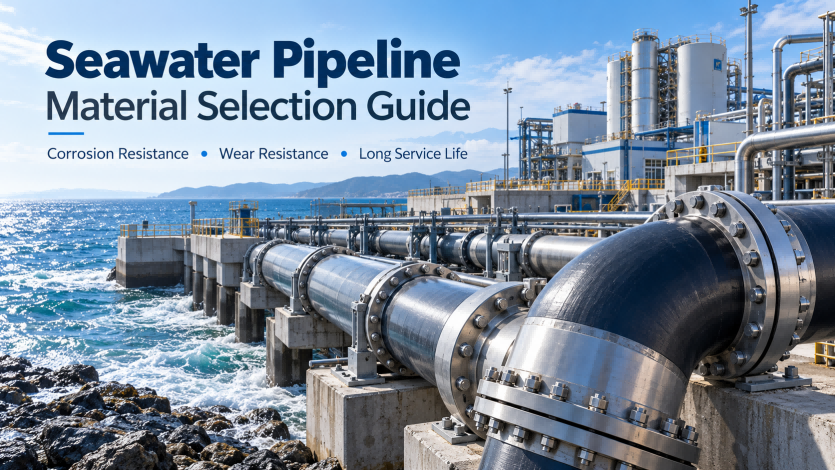
Seawater Pipeline Material Selection Guide: How to Choose Corrosion-Resistant, Wear-Resistant, and Long-Lasting Industrial Pipes
Introduction: Why Is Seawater Pipeline Material Selection More Challenging Than Conventional Industrial Piping?
With the continued development of seawater desalination, coastal industries, offshore energy projects, and large-scale water infrastructure worldwide, seawater transportation pipelines have become essential components of modern industrial systems.
From seawater intake systems at desalination plants to cooling water networks at coastal power stations and industrial pipelines serving chemical complexes, these pipelines must transport large volumes of highly corrosive water continuously and reliably.
However, seawater is far from an ordinary transportation medium.
It contains high concentrations of chloride ions and other dissolved salts. Its corrosive behavior is further influenced by dissolved oxygen, temperature, microorganisms, suspended particles, and variations in flow velocity.
Over extended operating periods, seawater pipelines may experience:
-
Localized corrosion and perforation caused by chloride ions.
-
Erosion and abrasion from sand and suspended particles.
-
Biological fouling and sediment accumulation.
-
Scaling that reduces effective flow area and increases hydraulic resistance.
-
Leakage at flanges, elbows, and pipe connections.
-
Structural damage caused by pressure fluctuations and water hammer.
These challenges affect not only pipeline service life but also pumping energy consumption, maintenance costs, and overall system reliability.
Therefore, selecting pipes for seawater transportation requires much more than comparing initial purchase prices.
Engineers must evaluate corrosion resistance, mechanical strength, abrasion resistance, connection reliability, installation conditions, and total cost of ownership (TCO).
In recent years, steel-nylon composite pipes have emerged as a promising alternative for certain demanding seawater transportation applications.
By combining the structural strength of steel with the corrosion-resistant and wear-resistant characteristics of engineered nylon, these composite pipelines offer an opportunity to address some of the limitations associated with conventional metallic and non-metallic pipe materials.
This guide examines the challenges of seawater transportation, compares commonly used pipe materials, and explains how steel-nylon composite pipes can provide engineering and economic advantages under suitable operating conditions.
1. Five Major Challenges in Seawater Pipeline Systems
1.1 High Chloride Concentrations and Corrosion Risks
Typical seawater has a salinity of approximately 3.5%, although the actual concentration varies depending on geographic location, evaporation, and industrial processing conditions.
For conventional metallic pipelines, chloride ions are among the most important factors affecting long-term corrosion resistance.
Carbon steel pipelines are particularly vulnerable to electrochemical corrosion when exposed to seawater, especially in environments containing dissolved oxygen, sediment deposits, and fluctuating flow conditions.
Although stainless steel benefits from a protective passive film, it is not completely immune to seawater corrosion.
For example, 316L stainless steel may still experience pitting and crevice corrosion in chloride-rich seawater.
Areas around flange connections, gasket interfaces, and sediment deposits are particularly susceptible to localized corrosion.
For systems involving continuous exposure to natural seawater under demanding conditions, engineers often consider higher-alloy stainless steels, super duplex stainless steel, or suitable non-metallic and composite piping materials.
Key takeaway: Seawater pipeline selection should be based on verified resistance to chloride-induced corrosion rather than simply assuming that stainless steel or a corrosion-resistant coating will provide adequate protection.
1.2 Abrasion Caused by Sand and Suspended Solids
Seawater intake systems frequently transport more than just water.
Depending on intake location and filtration conditions, seawater may contain:
-
Fine sand and seabed sediments.
-
Broken shell particles.
-
Inorganic suspended solids.
-
Marine biological debris.
-
Particles discharged during filtration or backwashing.
When these particles travel through a pipeline at high velocity, they can gradually erode the internal pipe surface.
The problem is often more severe at elbows, tees, reducers, pump outlets, and other locations where fluid flow changes direction.
In conventional coated steel pipelines, repeated particle impact can damage protective coatings and eventually expose the underlying steel to seawater.
Once the protective barrier is compromised, corrosion and erosion may accelerate together.
Consequently, pipelines handling sand-containing seawater must be evaluated for both chemical corrosion resistance and mechanical wear resistance.
A material that performs well in a static corrosion environment may not necessarily provide sufficient durability under high-velocity abrasive flow.
1.3 Biological Fouling and Sediment Accumulation
Seawater naturally contains microorganisms and marine organisms.
Under favorable conditions, bacterial biofilms, algae, and shell-forming organisms may develop inside seawater intake facilities and associated pipelines.
Biological fouling can cause:
-
Reduced effective internal diameter.
-
Increased hydraulic resistance.
-
Higher pumping energy consumption.
-
More frequent cleaning requirements.
-
Increased risks of localized under-deposit corrosion.
The internal surface characteristics of seawater pipes should therefore be considered alongside filtration, cleaning procedures, and biological fouling control systems.
Smooth internal surfaces may contribute to favorable hydraulic performance, but they do not completely prevent biological attachment or mineral scaling.
1.4 Pressure Fluctuations and Water Hammer
Large seawater transportation systems typically rely on continuous pumping operations.
Sudden changes in operating conditions, such as pump shutdowns, rapid valve closure, emergency power failures, or abrupt flow adjustments, can generate transient pressure waves.
For large-diameter and long-distance pipelines, water hammer may cause:
-
Short-term internal overpressure.
-
Increased mechanical loading on flange connections.
-
Excessive forces on pipe supports and anchors.
-
Localized negative pressure or structural instability.
-
Fatigue damage to fittings and connections.
Therefore, seawater pipeline design must account for both normal operating pressure and potential transient pressure conditions.
A reliable system requires coordinated evaluation of pipe materials, wall thickness, fittings, connections, supports, and surge protection measures.
1.5 Difficult Maintenance in Coastal and Offshore Environments
Seawater pipelines are frequently installed in challenging environments, including coastal industrial facilities, underground corridors, offshore structures, and submarine routes.
When a pipeline develops serious corrosion or leakage, repairs may require:
-
System shutdown and isolation.
-
Excavation or marine construction.
-
Heavy lifting equipment.
-
Replacement of damaged pipe sections.
-
Pressure testing and recommissioning.
Compared with conventional indoor piping, the cost and complexity of maintaining seawater infrastructure can be considerably higher.
For these projects, reducing maintenance frequency and unplanned downtime may provide greater economic value than minimizing initial pipe procurement costs.
2. Comparison of Common Seawater Pipeline Materials
Several materials are commonly considered for seawater transportation systems, including carbon steel, stainless steel, HDPE, fiberglass-reinforced plastic (FRP/GRP), and advanced composite pipes.
Each material offers specific advantages and limitations.
| Pipe Material | Key Advantages | Main Limitations | Typical Applications |
|---|---|---|---|
| Carbon Steel | High mechanical strength, established manufacturing processes | Requires reliable internal and external corrosion protection | Large-diameter industrial pipelines |
| 316L Stainless Steel | Good mechanical properties and fabrication capability | Susceptible to localized corrosion under certain seawater conditions | Selected applications after corrosion assessment |
| Duplex / Super Duplex Stainless Steel | High strength and improved chloride corrosion resistance in suitable grades | Higher material and fabrication costs | Demanding seawater process systems |
| HDPE | Excellent resistance to seawater corrosion, good flexibility | Temperature limitations, creep, external pressure and structural design considerations | Seawater intake, discharge and selected pressure pipelines |
| FRP / GRP | Good corrosion resistance, relatively lightweight, suitable for large diameters | Requires careful consideration of impact resistance, joint design and installation quality | Seawater cooling and large-scale transportation |
| Steel-Nylon Composite Pipe | Combines steel structural strength with a corrosion-resistant and wear-resistant polymer lining | Requires validation of long-term immersion behavior, bonding integrity and connection design | Industrial seawater pipelines requiring combined strength and durability |
Note: These comparisons describe typical engineering characteristics. Final material selection must be based on actual product specifications, operating conditions, applicable standards, and qualification testing.
Why Is 316L Stainless Steel Not Always the Best Choice?
Although 316L stainless steel performs well in many industrial applications, continuous exposure to chloride-rich seawater can create significant localized corrosion risks.
Crevices, deposits, biological films, and elevated temperatures may further increase susceptibility.
Therefore, the designation "316L stainless steel" alone is insufficient to demonstrate suitability for long-term seawater transportation.
Why Are HDPE and FRP Not Universal Solutions?
HDPE is widely used in seawater intake and discharge systems, particularly where flexibility and established marine installation methods offer advantages.
However, long-term mechanical loading, elevated temperatures, negative pressure conditions, and pipe support requirements must be properly evaluated.
FRP and GRP piping systems are also widely used in seawater applications.
Their successful operation depends on appropriate resin selection, pressure ratings, impact resistance, joint design, and installation quality.
Where a project demands a combination of mechanical strength, structural rigidity, abrasion resistance, and reliable flanged connections, steel-nylon composite pipes deserve consideration as an alternative engineering solution.
3. Why Consider Steel-Nylon Composite Pipes for Seawater Transportation?
Steel-nylon composite pipes combine metallic and polymeric materials within a single engineered piping structure.
The fundamental design principle is straightforward:
Steel provides the primary structural strength, while the engineered nylon lining acts as a protective barrier between the transported medium and the steel structure.
This combination can provide several advantages in suitable seawater transportation applications.
3.1 Corrosion Protection Through an Engineered Nylon Lining
In steel-nylon composite pipes, the transported seawater comes into contact primarily with the engineered nylon inner layer rather than directly contacting the steel structure.
When the nylon material is chemically compatible with the medium, the lining remains intact, and the pipe ends are properly protected, this arrangement can significantly reduce direct seawater exposure of the steel substrate.
Compared with unprotected carbon steel pipelines, the composite design offers a potentially more effective internal corrosion protection approach.
This characteristic is particularly relevant to seawater circulation systems, desalination pretreatment pipelines, and coastal industrial water transportation.
However, engineering nylon is a moisture-absorbing polymer.
Its water absorption, dimensional stability, mechanical properties, and long-term aging behavior must be verified for the specific nylon formulation under actual operating conditions.
Short-term immersion tests alone are not sufficient to establish long-term service compatibility.
3.2 Steel Reinforcement for Mechanical Strength
Unlike pipelines that rely entirely on a polymer structure for mechanical loading, steel-nylon composite pipes use a steel component to provide structural support.
When properly designed, this construction can help accommodate:
-
Higher internal transportation pressures.
-
Mechanical loads in large-diameter pipelines.
-
Installation and handling stresses.
-
Additional loads near pump outlets and equipment connections.
-
Complex support conditions in industrial facilities.
Our company manufactures steel-nylon composite pipes for a range of industrial applications and provides technical assistance based on individual project requirements.
Selected product configurations are associated with pressure classes ranging from 1.0 to 4.0 MPa.
However, the allowable operating pressure of any specific pipe must be confirmed according to its diameter, temperature, lining structure, connection design, and manufacturing test results.
For seawater pipelines exposed to pressure fluctuations, the pipe body, flanges, fittings, and supporting structures should be assessed as an integrated system.
3.3 Wear Resistance for Sand-Containing Seawater
Suspended particles in seawater can create continuous abrasive contact with internal pipe surfaces.
Abrasion is particularly significant in areas where fluid velocity is high or flow direction changes.
Properly formulated and tested reinforced engineering nylon can offer useful wear-resistant properties.
By combining a wear-resistant internal layer with a steel load-bearing structure, steel-nylon composite pipes provide a potential solution for applications involving both corrosion and particle-induced abrasion.
This makes them worth evaluating for seawater intake systems containing suspended sand and other abrasive solids.
However, actual wear performance depends on multiple factors, including particle size, solids concentration, particle hardness, flow velocity, and impact angle.
Project-specific abrasion testing is recommended for demanding service conditions.
3.4 Smooth Internal Surfaces and Hydraulic Efficiency
The internal roughness of a pipeline directly affects friction losses under a given flow rate and internal diameter.
In long-distance seawater transportation systems, even relatively small differences in hydraulic resistance can influence pumping requirements and operating costs.
Steel-nylon composite pipes incorporate a relatively smooth polymer lining, which can help maintain favorable internal flow conditions.
Compared with conventional steel pipes whose inner surfaces may become increasingly rough due to corrosion, a properly maintained nylon lining may provide more stable hydraulic characteristics over time.
However, actual energy savings must be evaluated using the effective internal diameter, surface roughness, water characteristics, and operating conditions.
It should not be assumed that steel-nylon composite pipes automatically have lower friction losses than every HDPE or FRP alternative.
3.5 Integrated Flange Design for Reliable Installation
Flanged connections represent important potential leakage and corrosion points in seawater pipeline systems.
In conventional corrosion-protected steel pipes, inadequate treatment of pipe ends and sealing surfaces can expose the steel substrate to seawater.
Our steel-nylon composite pipe solutions emphasize integrated flange construction and carefully designed connection interfaces.
Depending on the specific product design, these features can provide several benefits:
-
Improved manufacturing consistency at pipe ends.
-
Reduced need for complex secondary fabrication on site.
-
Convenient assembly of prefabricated flanged pipe sections.
-
Reduced on-site welding and hot work under suitable installation arrangements.
-
Easier dismantling and replacement of individual pipe sections during maintenance.
For seawater applications, flange sealing continuity, gasket compatibility, bolt tightening requirements, and corrosion protection of any exposed steel components must still be verified.
Reliable connections are essential not only for installation efficiency but also for the long-term integrity of the entire seawater pipeline system.
4. How to Select Pipes for Different Seawater Transportation Applications
Not all seawater transportation systems operate under the same conditions.
Material selection should reflect the specific combination of operating pressure, water quality, installation environment, and maintenance requirements.
4.1 Seawater Desalination Intake and Pretreatment Systems
Desalination plants require continuous transportation of large volumes of seawater.
Typical operating characteristics include:
-
High-volume flow.
-
Elevated salt concentrations.
-
Potential suspended sediment and sand.
-
High sensitivity to unplanned shutdowns.
-
Exposure to humid and saline environments.
For long-distance submarine intake pipelines, HDPE and suitable GRP systems are often important options because of their installation characteristics and established engineering applications.
For onshore pumping stations, pretreatment facilities, and pipeline sections exposed to higher mechanical loading, steel-nylon composite pipes can be included in material and life cycle cost comparisons.
Importantly, the pressure requirements of seawater intake systems are different from those of high-pressure reverse osmosis processes.
A piping solution suitable for low-pressure seawater intake should not automatically be applied to high-pressure reverse osmosis lines.
4.2 Seawater Cooling Systems in Coastal Power Plants
Coastal thermal power plants and other industrial facilities frequently use seawater as a cooling medium.
These systems typically prioritize:
-
Continuous operational reliability.
-
Mechanical stability in large-diameter pipelines.
-
Corrosion and biological fouling management.
-
Long-term hydraulic performance.
-
Reduced shutdown and maintenance costs.
For onshore pipe sections that require structural strength and internal corrosion protection, steel-nylon composite pipes may provide an alternative worth evaluating.
If chlorination or other chemical treatments are used to control biological fouling, the long-term effects of oxidizing chemicals on the nylon lining must be carefully assessed.
4.3 Seawater Pipelines in Coastal Chemical Industrial Parks
Coastal chemical plants may use seawater for industrial cooling, utilities, and selected auxiliary processes.
Such facilities often contain complex pipe racks, numerous equipment connections, and frequent changes in pipeline direction.
In addition to corrosion resistance, engineers must consider:
-
Mechanical strength.
-
Flange connection reliability.
-
Customized fittings.
-
Installation efficiency.
-
Ease of maintenance.
For projects aiming to reduce field welding and increase the use of prefabricated pipe sections, flanged steel-nylon composite pipes may offer practical installation benefits.
4.4 Concentrated Brine and Desalination Discharge Pipelines
Seawater desalination processes generate concentrated brine with salinity levels higher than those of the original seawater.
These applications require additional assessment of:
-
Actual salt concentration and temperature.
-
Chemical additives or treatment residues.
-
Internal pressure and flow velocity.
-
Scaling and sediment deposition.
-
Onshore or submarine installation requirements.
The suitability of steel-nylon composite pipes for concentrated brine service must be established through chemical compatibility assessment and long-term performance verification of the specific nylon lining and composite structure.
5. Seven Critical Parameters for Seawater Pipeline Material Selection
Before selecting a pipeline material, engineers should establish a comprehensive operating conditions data sheet.
| Parameter | Key Information Required | Influence on Material Selection |
|---|---|---|
| Seawater Salinity | Chloride concentration, total dissolved solids, salinity variation | Corrosion and chemical compatibility |
| Operating Temperature | Normal, maximum and abnormal temperatures | Material durability and allowable pressure |
| Operating Pressure | Steady-state pressure, design pressure, vacuum and water hammer | Pressure rating and structural requirements |
| Pipe Diameter | Nominal diameter, actual internal diameter and design flow | Flow velocity, pressure loss and structural design |
| Suspended Solids | Sand concentration, particle size and hardness | Abrasion and erosion resistance |
| Installation Environment | Onshore, buried, submarine, aboveground or tidal zone | External corrosion, supports and installation design |
| Design Service Life | Expected years of operation and maintenance intervals | Long-term material qualification and TCO |
Three considerations are particularly important.
5.1 Design Pressure Is Not the Same as Normal Operating Pressure
Normal operating pressure reflects steady-state system conditions.
Water hammer and other hydraulic transients may temporarily produce higher or lower pressures.
The complete operating pressure envelope must therefore be evaluated.
5.2 Nominal Diameter Is Not the Same as Actual Internal Diameter
Pipes with the same nominal diameter may have different effective internal diameters depending on wall thickness and lining construction.
Hydraulic comparisons should always use actual internal dimensions.
5.3 Corrosion Resistance Does Not Mean Maintenance-Free Operation
Even if a pipe lining provides strong corrosion resistance, flanges, gaskets, exposed steel components, supports, and other accessories may still require inspection and maintenance.
The objective of material optimization is not to eliminate responsible maintenance practices but to improve reliability and reduce avoidable repair work.
6. Why Large-Diameter Seawater Pipelines Require Greater Attention to Structural Design and Manufacturing
As large desalination facilities, coastal power plants, and industrial water supply systems continue to develop, large-diameter seawater pipelines are becoming increasingly important.
Compared with smaller pipelines, large-diameter systems impose more demanding requirements on manufacturing accuracy, mechanical strength, connection integrity, and installation.
6.1 Larger Diameters Create More Complex Loading Conditions
As pipe diameter increases, the pipeline may experience greater loads from its own weight, the transported water, support reactions, and installation activities.
Buried pipelines also require consideration of soil pressure, traffic loads, and differential settlement.
Submarine pipelines must be evaluated for external hydrostatic pressure, wave and current loading, buoyancy, and seabed stability.
6.2 Fitting Quality Is Essential to System Reliability
Large seawater pipeline networks consist of more than straight pipe sections.
Elbows, tees, reducers, flanges, and specially designed fittings are often exposed to more complex local loading conditions.
For this reason, pipe procurement should evaluate the complete piping system rather than focusing exclusively on the unit price of straight pipes.
6.3 Manufacturing Consistency Supports Reliable Project Delivery
Our company has accumulated extensive manufacturing experience in reinforced MC nylon pipes and steel-nylon composite pipes, serving industrial applications where corrosion resistance and abrasion resistance are important.
For large-diameter and non-standard pipeline projects, we emphasize structural design, dimensional control, matching flange components, and factory inspection.
We also work with overseas EPC contractors and engineering companies to evaluate customized requirements and provide manufacturing support for specific projects.
Available diameters, pressure ratings, manufacturing configurations, and delivery scopes should be confirmed through approved project specifications.
7. How to Evaluate the Total Cost of Ownership of Seawater Pipelines
Conventional procurement practices often begin with a simple comparison of pipe prices per meter.
However, seawater transportation infrastructure is generally designed for long-term operation.
Focusing exclusively on initial material costs may overlook substantial future expenses.
A more appropriate approach is to evaluate the total cost of ownership.
7.1 Understanding the TCO Model
A basic life cycle cost model can be expressed as:
TCO = Initial Procurement Cost + Installation Cost + Energy Cost + Maintenance Cost + Downtime Losses + Replacement Cost + End-of-Life Cost
For long-term engineering projects, future costs should also be discounted to their present value to enable a consistent economic comparison.
7.2 Lower Initial Cost Does Not Always Mean Lower Overall Cost
Consider a seawater transportation project designed for continuous operation over an extended period.
Option A uses conventional steel pipes with protective coatings and a relatively low initial procurement cost.
Option B uses steel-nylon composite pipes with a higher initial purchase price but the potential to reduce internal corrosion-related maintenance under properly verified operating conditions.
The two solutions may differ as follows:
| Cost Factor | Conventional Coated Steel Pipe | Steel-Nylon Composite Pipe |
|---|---|---|
| Initial Procurement | May be lower | Depends on product configuration and quotation |
| Internal Corrosion Protection | Relies on coating integrity | Relies on lining integrity and connection protection |
| Maintenance Focus | Coating condition, corrosion and leakage | Lining condition, flanges, exposed steel and joints |
| Operating Energy | Depends on actual diameter and internal roughness | Depends on actual diameter and internal roughness |
| Replacement Requirements | Influenced by coating durability and corrosion | Influenced by verified composite service life |
| Long-Term Economics | Requires project-specific analysis | Requires project-specific analysis |
The potential economic value of steel-nylon composite pipes may come from reduced corrosion-related maintenance, improved connection reliability, and a lower risk of unplanned shutdowns.
However, any projected savings should be supported by actual quotations, performance data, maintenance records, and hydraulic calculations.
7.3 Downtime Costs Can Be More Important Than Pipe Price Differences
For large seawater desalination plants, power stations, and industrial facilities, a major pipeline failure can interrupt essential operations.
Potential costs include:
-
Repair labor and equipment.
-
Replacement pipe sections and lifting operations.
-
Lost production or interrupted water supply.
-
Pumping system restart and recommissioning.
-
Indirect impacts on connected industrial processes.
Consequently, pipeline reliability should be treated as an economic performance indicator.
The most important question is not which pipeline has the lowest initial purchase price, but which solution can provide reliable transportation capacity at a reasonable total cost throughout the intended service life.
8. How Overseas Engineering Projects Can Reduce the Risks of Changing Pipeline Materials
For projects considering replacement of conventional carbon steel, FRP, or HDPE pipelines with steel-nylon composite pipes, a structured engineering validation process is recommended.
Step 1: Collect Comprehensive Operating Data
Identify seawater composition, salinity, temperature, pressure, flow rate, suspended solids, chemical treatments, installation conditions, and expected service life.
Step 2: Evaluate Material Compatibility
Confirm whether the selected nylon formulation is suitable for the actual seawater, chemically treated water, or concentrated brine.
Where necessary, conduct long-term immersion testing, accelerated aging studies, and wet-condition mechanical property evaluations.
Step 3: Verify Composite Structure and Connection Performance
Important tests and assessments may include:
-
Internal pressure resistance.
-
Composite interface integrity.
-
Lining stability under moisture exposure and temperature fluctuations.
-
Flange sealing performance.
-
Compatibility between straight pipes and fittings.
-
Corrosion protection of exposed steel components.
Step 4: Conduct a Field Trial
For demanding applications, a preliminary installation of 100–500 meters, or another appropriate test length, may help verify actual performance.
During the trial, operators should monitor pressure, flow rate, leakage, lining condition, flange integrity, and maintenance requirements.
Step 5: Expand Application Based on Verified Results
Once the trial demonstrates satisfactory performance, the project team can evaluate broader implementation.
This approach helps reduce the technical risks associated with adopting a new pipe material while generating reliable performance data under actual operating conditions.
9. Why Choose Us as Your Steel-Nylon Composite Pipe Supplier?
Seawater pipeline engineering involves materials science, corrosion engineering, fluid mechanics, structural design, manufacturing, and installation.
A reliable industrial pipe supplier should therefore provide more than product pricing.
It should understand the operating challenges of each project and help customers evaluate technically appropriate solutions.
Our company specializes in the development and manufacturing of reinforced MC nylon pipes and steel-nylon composite pipes.
We are committed to providing corrosion-resistant and wear-resistant pipeline solutions for demanding industrial transportation applications.
9.1 Engineering Support for Complex Media
During the early stages of a project, we work with customers to assess the transported medium, operating temperature, pressure, flow rate, and installation environment.
This information supports the evaluation of suitable pipe structures and product configurations.
9.2 Combining Corrosion Resistance, Wear Resistance, and Structural Strength
Our steel-nylon composite pipes combine metallic reinforcement with engineered polymer materials.
This construction provides an additional material option for projects requiring a balance between structural strength and internal corrosion protection.
9.3 Attention to Flange Design and Connection Reliability
We emphasize integrated flange structures, pipe-end manufacturing quality, and matching components.
These features are intended to support consistent installation practices and improve overall piping system reliability.
9.4 Large-Diameter and Customized Pipeline Solutions
For large-diameter industrial transportation projects and special engineering requirements, we can discuss non-standard dimensions, customized fittings, and project-specific manufacturing configurations.
9.5 Technical Cooperation With Overseas EPC Contractors
For international engineering projects, we support communication throughout the process, from operating condition assessment and preliminary material selection to product confirmation, manufacturing inspection, and delivery coordination.
Our objective is not simply to supply industrial pipes.
We aim to help customers identify piping solutions that match their operating requirements and provide reliable long-term performance.
10. Frequently Asked Questions (FAQ)
Q1: Which Pipe Material Is Best for Seawater Transportation?
There is no single material suitable for every seawater transportation application.
HDPE, FRP, corrosion-resistant alloys, and steel-nylon composite pipes can all be appropriate under specific operating conditions.
The best choice depends on water composition, pressure, temperature, diameter, external loads, installation environment, and life cycle cost.
Q2: Is 316L Stainless Steel Suitable for Long-Term Seawater Transportation?
316L stainless steel can experience pitting and crevice corrosion in natural seawater.
Its suitability for continuous seawater service should not be assumed based solely on its material designation.
For demanding applications, higher corrosion-resistant alloys or qualified non-metallic and composite piping systems should be considered.
Q3: Can Steel-Nylon Composite Pipes Be Used in Seawater Desalination Plants?
Steel-nylon composite pipes may be considered for selected seawater transportation, pretreatment, and industrial circulation systems.
However, suitability must be verified against the actual operating pressure, temperature, chemical additives, connection requirements, and long-term material performance.
Q4: Are Steel-Nylon Composite Pipes Suitable for Sand-Containing Seawater?
Properly formulated and tested reinforced nylon linings may offer useful abrasion resistance for seawater containing suspended particles.
For highly abrasive conditions involving large particles, high solids concentrations, or elevated flow velocities, additional wear testing is recommended.
Q5: Can Seawater Pipelines Achieve a Service Life of 30 or 50 Years?
Some seawater transportation systems are designed with target service lives of 30 or 50 years.
However, a specified design life does not automatically guarantee that a particular material or pipeline will achieve that period of operation.
Actual service life depends on material properties, structural design, manufacturing quality, installation conditions, corrosion exposure, and maintenance practices.
For steel-nylon composite pipes, long-term service life claims should likewise be supported by appropriate testing, operating records, and engineering validation.
Conclusion: The Future of Seawater Pipelines Lies in Corrosion Resistance, Reliability, and Life Cycle Cost Optimization
Seawater pipeline material selection is no longer simply a choice between metal pipes and plastic pipes.
As industrial projects face increasingly demanding requirements for corrosion resistance, continuous operation, hydraulic efficiency, and cost control, engineers must evaluate the overall performance of piping systems.
Several important directions are shaping the development of seawater transportation infrastructure:
-
Advanced corrosion-resistant materials and composite structures.
-
Reliable pressure-bearing and connection systems.
-
Improved abrasion resistance for demanding fluid conditions.
-
Better hydraulic efficiency and energy management.
-
Stronger manufacturing, installation, and quality control practices.
-
Engineering decisions based on total life cycle costs.
By combining the structural advantages of steel with the material characteristics of reinforced engineering nylon, steel-nylon composite pipes provide an additional solution for selected complex seawater transportation applications.
They are particularly worth evaluating in industrial systems where corrosion resistance, abrasion resistance, pressure-bearing capability, and long-term maintenance costs must be considered together.
For seawater transportation projects, selecting the right pipe material is not only about extending pipeline service life.
It is also about improving the reliability, operating efficiency, and long-term economic performance of the entire transportation system.
Looking for a Reliable Seawater Pipeline Solution?
Are you planning a seawater desalination plant, coastal cooling water system, industrial seawater transportation network, or large-diameter seawater pipeline project?
Our technical team can help you evaluate whether steel-nylon composite pipes are suitable for your specific application.
Simply provide the following project information:
-
Seawater composition and operating conditions.
-
Operating and design temperatures.
-
Working pressure and pressure rating requirements.
-
Pipe diameter and required flow rate.
-
Installation environment and project specifications.
Based on your requirements, we can provide preliminary material selection assistance, technical discussions, and customized pipe manufacturing support.
Contact Us for Steel-Nylon Composite Pipe Solutions
Corrosion Resistance · Wear Resistance · Structural Strength · Long-Term Value
Build More Reliable Industrial Pipeline Systems with Steel-Nylon Composite Technology.
Recommended Pipes for Seawater Desalination Projects: How to Choose Corrosion-Resistant, Wear-Resistant, and Long-Life Piping Systems 1. Introduction: Why Pipeline Selection Matters in Seawater Desalination Projects
How to Extend the Service Life of Municipal Water Supply and Drainage Pipelines to 50 Years: An Engineering Guide