How Is Material Selection for Seawater Piping Systems Changing?
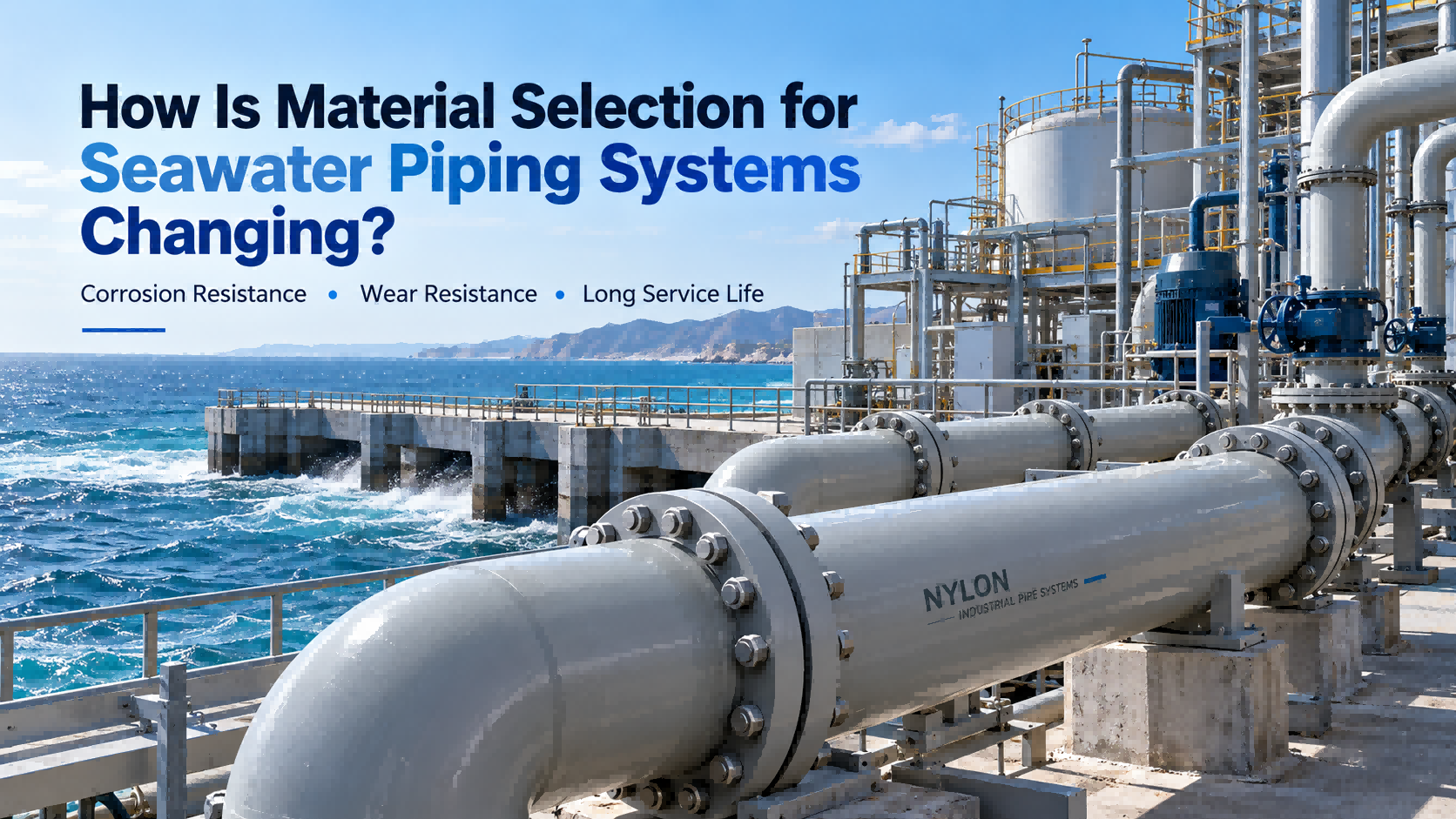
As desalination, coastal industries, power plant cooling systems, marine engineering, salt and chemical processing, aquaculture, and seawater recycling projects continue to expand worldwide, material selection for seawater piping systems is undergoing a significant change.
In the past, the first question engineers often asked was:
Which material can resist seawater corrosion?
Today, owners, EPC contractors, and engineering companies are increasingly asking a much broader question:
Which piping material can operate reliably in seawater over the long term while reducing corrosion, scaling, maintenance, installation, and replacement costs?
This shift means that seawater pipeline material selection is moving away from simply choosing a “corrosion-resistant material.”
Instead, engineers are increasingly evaluating piping systems based on reliability, maintenance requirements, installation efficiency, hydraulic performance, and total cost of ownership (TCO).
For reinforced nylon pipes and other advanced engineering polymer piping systems, this change is creating new application opportunities.
1. Why Are Seawater Piping Systems So Challenging?
From a chemical perspective, seawater is much more complicated than ordinary salt water.
It contains high concentrations of chloride ions and dissolved salts, while actual seawater systems may also contain:
-
dissolved oxygen;
-
microorganisms;
-
suspended solids;
-
sand and sediment;
-
shells and biological debris;
-
marine organisms;
-
various treatment chemicals.
As a result, seawater pipelines may simultaneously face several operating challenges:
-
chloride-induced corrosion;
-
pitting corrosion;
-
crevice corrosion;
-
electrochemical corrosion;
-
marine biological fouling;
-
erosion caused by sand and suspended solids;
-
salt deposition and scaling;
-
atmospheric corrosion in coastal environments;
-
erosion at high flow velocities;
-
water hammer and pressure fluctuations.
The challenge becomes even more complicated in seawater desalination plants.
A typical system may include:
Seawater Intake → Raw Water Transmission → Pretreatment → RO System → Brine Discharge → Cleaning System → Product Water Transmission
The pressure, salinity, temperature, chemical exposure, and flow conditions at each section can be very different.
Therefore, it is becoming increasingly difficult to use one single piping material throughout an entire seawater system.
Modern seawater engineering is gradually moving from:
one-material-for-the-whole-system
toward:
material selection based on individual operating zones.
This is one of the most important changes taking place in seawater pipeline engineering.
2. The Main Challenge for Traditional Steel Pipe Is Not Strength — It Is Long-Term Corrosion
One of the greatest advantages of carbon steel pipe is its high mechanical strength and mature engineering standards.
However, when carbon steel is used to transport seawater, corrosion control quickly becomes a major engineering issue.
To extend pipeline service life, seawater steel piping systems may require:
-
internal protective coatings;
-
external anti-corrosion coatings;
-
cathodic protection;
-
corrosion allowance;
-
regular inspections;
-
coating repairs;
-
corrosion monitoring.
This creates an important economic question.
The original pipe itself may not necessarily represent the largest long-term expense.
Corrosion prevention and maintenance can become much more significant over the entire service life of the pipeline.
This problem becomes especially important in coastal installations.
The inside of the pipe is exposed to seawater, while the outside may continuously face humid, salt-rich marine air.
In other words, the pipeline may experience:
internal seawater corrosion + external marine atmospheric corrosion.
As a result, more seawater projects are beginning to ask:
Can corrosion be addressed through the piping material itself instead of continuously relying on coatings and corrosion protection systems?
This question is one of the key reasons why polymer and composite piping materials are receiving increasing attention.
3. Stainless Steel Does Not Automatically Mean “No Seawater Corrosion”
A common material selection approach is:
Carbon steel corrodes, so use stainless steel.
However, seawater is a particularly aggressive environment for many metallic materials.
Because of the high chloride concentration, engineers need to pay close attention to:
-
pitting corrosion;
-
crevice corrosion;
-
corrosion around welded areas;
-
stagnant seawater conditions;
-
elevated temperatures.
For example, 316L stainless steel cannot be assumed to provide reliable long-term performance under every seawater condition.
Duplex stainless steels such as 2205 provide significantly better resistance to chloride-related corrosion, but specific combinations of temperature, stagnant seawater, crevices, and chemical conditions may still require careful engineering evaluation.
For more demanding applications, super duplex stainless steels and high-alloy stainless steels may be selected.
This reveals an important reality:
As the corrosion resistance of metallic materials increases, material cost can also rise significantly.
Therefore, for seawater transportation sections that do not involve extremely high temperatures or extremely high pressures, engineers are increasingly considering alternative material technologies.
4. Why Are HDPE, FRP, and Other Non-Metallic Materials Increasingly Used in Seawater Projects?
One of the most visible trends in seawater pipeline engineering over recent decades has been the increasing use of non-metallic piping.
HDPE and GRP/FRP pipes are already widely used in applications such as:
-
seawater intake pipelines;
-
brine discharge systems;
-
cooling water systems;
-
low-pressure seawater transmission;
-
coastal industrial water systems.
The engineering logic behind this development is relatively straightforward.
Traditional metallic corrosion is fundamentally an electrochemical process.
If a piping material does not experience conventional metallic electrochemical corrosion, the corrosion protection strategy changes significantly.
Instead of continuously asking:
How can we protect this steel pipe from seawater?
Engineers can begin asking:
Can we use a piping material that does not depend on conventional metallic corrosion protection at all?
However, this does not mean that all non-metallic materials perform in the same way.
Different polymers and composite materials have different strengths, limitations, pressure capabilities, mechanical behavior, installation requirements, and long-term performance characteristics.
5. Seawater Pipeline Material Selection Is Entering the “Performance Combination” Era
Future competition among seawater piping materials will not simply be:
Steel Pipe vs. Plastic Pipe
Instead, materials will increasingly be evaluated across multiple engineering parameters.
Important selection factors include:
| Selection Factor | Importance |
|---|---|
| Seawater corrosion resistance | Very High |
| Pressure capability | Very High |
| Impact resistance | High |
| Abrasion resistance | High |
| Scaling resistance | High |
| Large-diameter manufacturing capability | High |
| Installation efficiency | High |
| Connection reliability | Very High |
| Long-term maintenance cost | Very High |
| Total cost of ownership | Very High |
Simply being “corrosion resistant” may no longer be sufficient.
Engineering customers increasingly want answers to questions such as:
-
What pressure can the pipe withstand?
-
What diameters are available?
-
Can it be used near pump outlets?
-
How does it perform under higher flow velocities?
-
Is it resistant to abrasion?
-
Will the internal surface scale easily?
-
How heavy is the pipeline?
-
How are flanged connections handled?
-
Can damaged sections be replaced quickly?
-
Is hot work required during installation?
-
What will the operating cost look like after 10 or 20 years?
This is exactly where reinforced nylon piping systems deserve greater attention.
6. Why Should Reinforced Nylon Pipe Be Considered for Seawater Transportation?
Nylon is not a new engineering material.
It has been widely used for decades in machinery, mining, transportation equipment, petrochemical applications, and other industrial environments.
Engineering-grade nylon materials are known for their useful combination of:
-
mechanical strength;
-
abrasion resistance;
-
impact resistance;
-
relatively low friction;
-
corrosion resistance.
Through material formulation, polymerization technology, structural design, and reinforcement technologies, nylon can move beyond traditional mechanical components and become a potential material for industrial fluid transportation systems.
For seawater applications, reinforced nylon pipe provides several characteristics worth evaluating.
6.1 Avoiding Conventional Metallic Corrosion Mechanisms
This is one of the most important advantages of nylon piping.
Chloride ions in seawater do not attack nylon through the same electrochemical corrosion mechanism that causes carbon steel to rust.
As a result, properly engineered nylon piping systems generally do not depend on traditional corrosion protection measures such as:
-
internal anti-corrosion coatings;
-
metallic plating;
-
anti-rust paint inside the pipe;
-
sacrificial anodes;
-
conventional metallic corrosion allowance.
For projects transporting seawater, circulating seawater, or high-salinity water over long periods, this can fundamentally simplify corrosion management.
The design philosophy changes from:
“How do we stop the pipe from corroding?”
to:
“Can we select a pipe material that does not rely on conventional metallic corrosion protection?”
7. When Seawater Contains Sand, Abrasion Resistance Becomes Increasingly Important
Real seawater is not always clean.
This is particularly true in:
-
seawater intake systems;
-
coastal pumping stations;
-
port facilities;
-
tidal zones;
-
nearshore industrial cooling systems.
Seawater may carry:
-
sand;
-
sediment;
-
shell fragments;
-
suspended solids;
-
other abrasive particles.
When flow velocity increases, these particles can continuously impact the internal pipe wall.
The problem is therefore not only:
Corrosion
It can also be:
Erosion and Abrasion
This is why evaluating only corrosion resistance may be insufficient.
Reinforced nylon materials offer good abrasion and impact resistance, making them particularly interesting for piping applications where corrosion and wear occur simultaneously.
This combination can be especially valuable in seawater intake and coastal industrial water systems.
8. A Smooth Internal Surface Can Help Maintain Long-Term Hydraulic Efficiency
Energy consumption is an important factor in large seawater transmission systems.
Internal pipe roughness directly affects friction losses and therefore influences pumping energy requirements.
Traditional steel piping can experience a gradual process such as:
Corrosion → Surface Roughness → Deposits → Scaling → Increased Flow Resistance
As the internal condition deteriorates, pumping resistance may increase.
Polymer piping systems do not experience conventional steel rusting, which means their internal hydraulic condition can remain more stable when properly designed and operated.
A relatively smooth internal surface may help reduce long-term friction losses.
For large seawater pumping stations operating thousands of hours every year, even relatively small improvements in hydraulic efficiency can create meaningful differences in long-term energy consumption.
Therefore, modern pipeline economics is increasingly moving beyond:
Pipe Purchase Price
toward:
Pumping Energy + Maintenance + Downtime + Replacement + Service Life
The cheapest pipe to purchase is not necessarily the least expensive pipe to own.
9. Lower Pipe Weight Can Change the Entire Installation Strategy
For DN500, DN800, DN1000, and even larger industrial pipelines, pipe weight becomes an important engineering consideration.
Weight can directly influence:
-
crane capacity;
-
support structures;
-
transportation requirements;
-
construction equipment;
-
installation manpower;
-
installation time;
-
access requirements.
Compared with many thick-wall metallic pipes, engineering polymer piping systems can provide significant weight advantages.
This becomes especially valuable in:
-
existing plant retrofits;
-
restricted coastal sites;
-
island projects;
-
pumping stations;
-
locations where heavy lifting equipment has limited access.
In some projects, the economic value of easier transportation and installation can be just as important as the purchase price of the pipe itself.
10. Connection Reliability Will Become More Important in Future Seawater Systems
Many pipeline failures do not occur in long straight pipe sections.
They often occur around:
-
flanges;
-
elbows;
-
tees;
-
reducers;
-
pump discharge sections;
-
valve connections;
-
other transition areas.
For this reason, the next stage of seawater pipeline development will increasingly focus on the performance of the complete piping system, rather than only the straight pipe.
In our reinforced nylon piping solutions, particular attention is given to matching the pipe with:
-
flanges;
-
elbows;
-
tees;
-
reducers;
-
other engineered fittings.
Industrial customers do not simply need a “corrosion-resistant pipe.”
They need an integrated system consisting of:
Pipe + Fittings + Flanges + Connections + Engineering Support
Connection design and system compatibility can be just as important as the pipe material itself.
11. Nylon Pipe Is Not Intended to Replace Every Seawater Piping Material
Professional material selection should never be based on the assumption that one material is suitable for every operating condition.
For example, high-pressure sections of reverse osmosis desalination systems may operate under demanding pressure conditions.
These sections require detailed evaluation of:
-
pressure rating;
-
long-term creep;
-
operating temperature;
-
flange strength;
-
fatigue behavior;
-
valve connections;
-
safety factors;
-
applicable engineering standards.
For these applications, super duplex stainless steel, high-alloy metals, and other validated high-pressure piping systems continue to have important roles.
The strongest opportunity for reinforced nylon pipe is therefore not necessarily to replace every material in the seawater system.
Instead, it should be considered for applications where several challenges exist simultaneously:
Corrosion + Wear + Maintenance Cost + Installation Cost
Potential applications may include:
-
seawater intake pipelines;
-
seawater circulation pipelines;
-
coastal industrial cooling water systems;
-
high-salinity water pipelines;
-
brine transportation pipelines;
-
salt chemical industry water systems;
-
seawater pumping station piping;
-
selected low- and medium-pressure desalination piping sections.
In these areas, reinforced nylon pipe can provide an additional engineering option alongside HDPE, FRP, steel pipe, and selected metallic piping systems.
12. Seawater Pipeline Materials Should Not Be Selected Based Only on the Name of the Medium
Many customers initially provide only one piece of information:
Medium: Seawater
From an engineering perspective, this is not enough.
Two systems transporting “seawater” can have completely different design requirements.
Before making a material recommendation, we normally recommend confirming at least the following parameters.
1. Medium
Is it raw seawater, filtered seawater, circulating seawater, or concentrated brine?
2. Chloride Concentration / Salinity
What is the salt or chloride concentration?
3. Operating Temperature
What is the normal operating temperature and maximum temperature?
4. Operating Pressure
What is the normal working pressure?
5. Design Pressure
What pressure should the pipeline be designed to withstand?
6. Pipe Diameter
Is the project DN100, DN500, DN1000, or larger?
7. Flow Velocity
What is the expected operating velocity?
8. Suspended Solids
Does the seawater contain sand, sediment, or other solid particles?
9. Installation Conditions
Will the pipeline be buried, above ground, indoors, outdoors, or installed in a coastal environment?
10. Chemical Cleaning
Will acids, alkalis, biocides, or other water-treatment chemicals be used?
These parameters collectively determine whether a piping material is suitable.
13. An Important Point: Not All “Nylon” Materials Are the Same
This is particularly important in engineering applications.
Different nylon materials can have very different performance depending on:
-
polymer formulation;
-
polymerization process;
-
reinforcement technology;
-
molecular structure;
-
manufacturing process;
-
additives;
-
pipe structure.
PA6 materials, for example, have moisture absorption characteristics.
Different formulations and processing technologies can result in different levels of:
-
water absorption;
-
dimensional stability;
-
mechanical strength;
-
impact resistance;
-
temperature capability;
-
long-term performance.
Therefore, it would be technically incorrect to assume:
“PA6 can resist seawater, therefore every nylon pipe is automatically suitable for every seawater application.”
Professional pipeline selection should also evaluate:
-
actual material formulation;
-
dimensional changes after long-term immersion;
-
temperature effects;
-
pressure rating;
-
long-term creep performance;
-
pipe wall thickness;
-
flange design;
-
support spacing;
-
UV exposure;
-
expected service life.
The material name is only the beginning of pipeline selection. Complete engineering data should determine the final decision.
This is also why we emphasize selecting pipes according to actual operating conditions rather than simply quoting a price according to pipe diameter.
14. Future Seawater Systems May Increasingly Use “Zoned Material Selection”
One important future direction is that seawater projects may increasingly use different piping materials in different parts of the system.
Instead of insisting that the entire plant use one material, engineers can select the most appropriate material for each operating zone.
Low-Pressure, High-Flow Seawater Intake Systems
Key considerations include:
-
corrosion resistance;
-
large diameter;
-
installation efficiency;
-
project economics.
HDPE, FRP, and suitable engineering polymer piping systems can be competitive in these applications.
Medium-Pressure Seawater Transmission and Industrial Circulating Water Systems
Key considerations include:
-
corrosion resistance;
-
mechanical strength;
-
impact resistance;
-
abrasion resistance;
-
connection reliability;
-
maintenance cost.
This is one area where reinforced nylon pipe may offer significant development potential.
High-Pressure RO and Critical Equipment Connections
Key considerations include:
-
high-pressure capability;
-
high safety factors;
-
fatigue performance;
-
long-term reliability.
Super duplex stainless steel, high-alloy materials, and proven high-pressure piping technologies continue to play important roles in these areas.
This philosophy can be summarized in one sentence:
Use the Right Material in the Right Position.
The objective is not to select the most expensive material.
Nor is it simply to select the cheapest pipe.
The real objective is:
to identify the material that delivers the lowest lifecycle cost and the lowest operational risk for each specific part of the system.
15. Ultimately, Seawater Pipeline Competition Will Be About Total Cost of Ownership
Consider two hypothetical piping systems.
Option A
The initial purchase price is relatively low, but:
-
corrosion repairs are required after several years;
-
vulnerable pipe sections require frequent replacement;
-
shutdowns occur regularly;
-
internal roughness gradually increases;
-
heavy equipment is required for maintenance.
Option B
The initial investment may be slightly higher, but:
-
the material provides strong seawater corrosion resistance;
-
maintenance frequency is lower;
-
installation is easier;
-
the internal surface remains relatively stable;
-
service life is longer.
If the evaluation only considers initial purchase price:
Option A may appear cheaper.
But if the project calculates:
TCO = Purchase + Installation + Energy + Maintenance + Downtime + Replacement
the final economic result can be completely different.
This is why Life Cycle Cost is becoming increasingly important in seawater pipeline material selection.
For industrial operators, avoiding one major shutdown or pipeline replacement can sometimes create far more value than saving a small percentage on the original pipe purchase.
16. The Future of Seawater Piping Will Not Necessarily Belong to One Single Material
Seawater pipeline material selection is undergoing an important transformation.
In the past, the main question was:
Which material has the best seawater corrosion resistance?
In the future, the more important question will increasingly be:
Which material can deliver the lowest long-term cost and the highest reliability under this specific operating condition?
Steel pipe offers a mature engineering system and high structural strength.
High-alloy stainless steels offer excellent performance for demanding and high-pressure applications.
HDPE has extensive experience in large-diameter seawater projects.
FRP offers corrosion resistance and large-diameter capability.
And reinforced nylon pipe offers a different combination of corrosion resistance, abrasion resistance, mechanical performance, impact resistance, relatively lightweight construction, and low maintenance requirements.
Therefore, the future development of seawater piping systems will probably not involve one material completely replacing another.
The real change is that:
Material selection is becoming more precise.
Pipeline design is becoming more operating-condition-oriented.
Owners are paying more attention to lifecycle economics.
Materials capable of addressing several challenges simultaneously—
Corrosion + Wear + Pressure + Installation + Maintenance
—will have increasing opportunities in future seawater transportation projects.
For seawater intake, coastal industrial circulating water, concentrated brine, and other high-salinity transportation systems, we recommend evaluating the complete operating conditions at the beginning of the project, including:
Medium Composition + Pipe Diameter + Pressure + Temperature + Flow Velocity + Solid Content + Installation Conditions
Only by evaluating these parameters together can engineers select a piping system capable of delivering stable long-term performance.
Conclusion
The future of seawater pipeline material selection is not about choosing the most expensive material.
It is about choosing the most suitable material over the entire lifecycle of the system.
As seawater infrastructure continues to expand, reinforced nylon piping can provide engineers with an additional option for projects requiring a combination of:
corrosion resistance, abrasion resistance, mechanical strength, installation efficiency, and lower long-term maintenance requirements.
For seawater projects, the most effective material strategy is increasingly clear:
Do not select a pipe only for its purchase price. Select it for how it will perform throughout its entire service life.
Why Coastal Infrastructure Needs More Corrosion-Resistant Piping
What Pipe Material Demands Will Be Driven by the Growth of Seawater Desalination Projects?