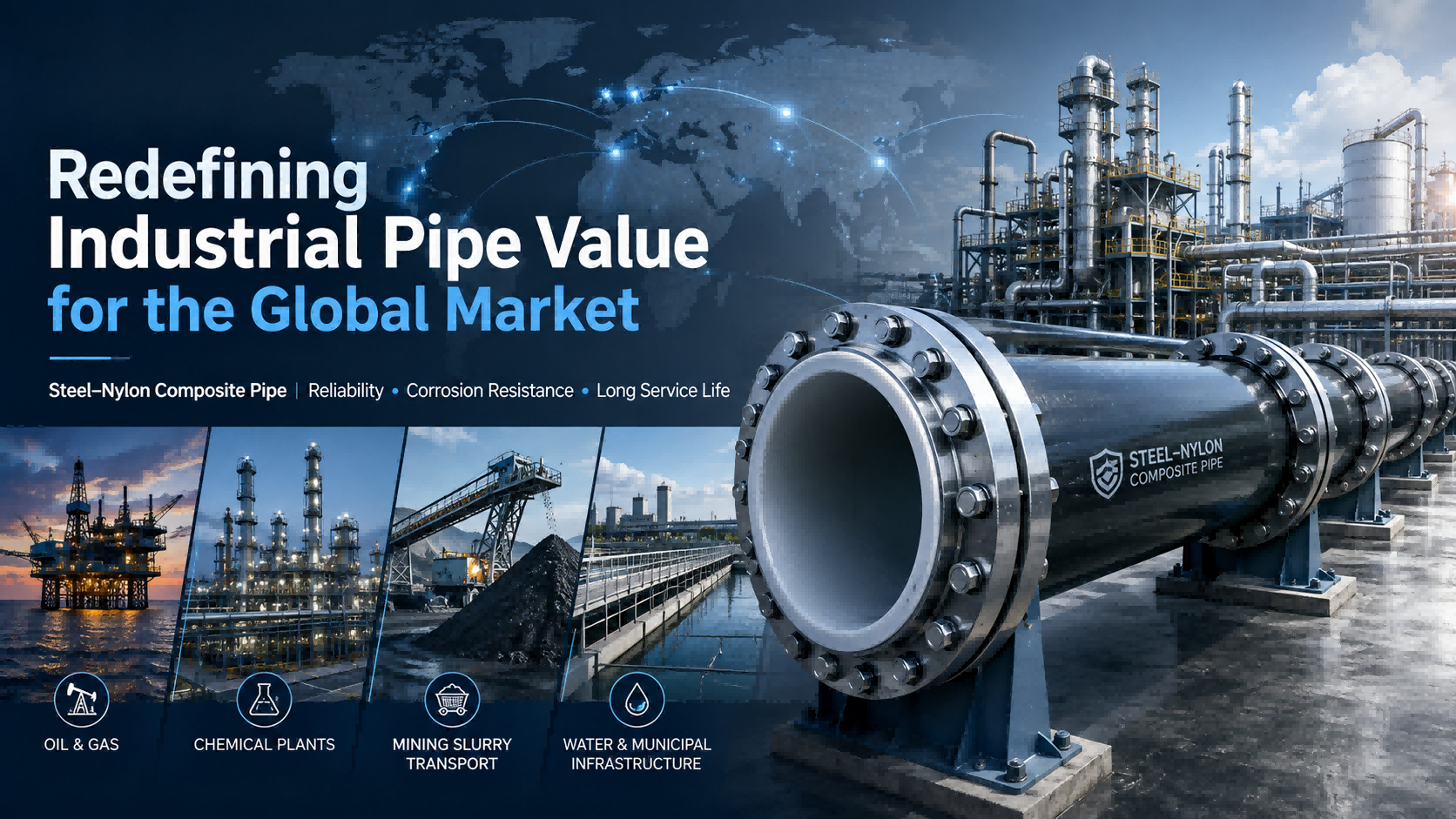
From a Single Pipe Material to an Industrial Conveying Solution: Our Product Evolution Journey

In the past, industrial buyers often focused primarily on material, diameter, wall thickness, and purchase price. But as oil & gas, chemical, mining, power, and other large industrial projects place greater emphasis on safety, operational continuity, and lifecycle cost, simply comparing “which pipe material is cheaper” is no longer enough to solve real engineering problems.
Pipelines are evolving from standardized material products into critical infrastructure within industrial production systems.
This has also been the central logic behind our product development over the years:
From manufacturing a single type of pipe to providing industrial conveying solutions tailored to different media, pressures, temperatures, and operating conditions.
And the steel–nylon composite pipe has become one of the core products in this evolution.
1. Why Is Selling a Single Pipe Material No Longer Enough for Industrial Customers?
In ordinary water supply and drainage projects, operating conditions may be relatively straightforward.
But once pipelines enter industrial environments such as oilfields, chlor-alkali plants, soda ash plants, salt chemical facilities, phosphate chemical plants, or mining slurry systems, a single pipeline may be exposed to several failure mechanisms simultaneously.
For example, an industrial pipeline may face:
-
Corrosive process media
-
Solid-particle erosion and abrasion
-
Relatively high operating pressure
-
Temperature fluctuations
-
Long-term continuous operation
-
Severe localized wear at elbows and tees
-
Outdoor weathering and aging
-
Pressure changes during startup and shutdown
-
Leakage risks around flanges and valves
-
Significant indirect costs caused by maintenance shutdowns
This means industrial pipe selection is no longer simply a question of:
“Should we use stainless steel, PE, FRP, or carbon steel?”
Instead, the more important question becomes:
What material, structure, connection method, and system design can deliver better lifecycle performance under this specific operating condition?
These two questions may sound similar, but they represent fundamentally different approaches.
The first is about selling materials.
The second is about solving industrial conveying problems.
2. Stage One: Starting with the Performance of Nylon Materials
Our product evolution began with continuous observation of failure problems in industrial piping systems.
Traditional industrial piping materials have long faced several inherent trade-offs.
Carbon steel offers good structural strength and pressure resistance, but can suffer from corrosion, perforation, and internal scaling when transporting corrosive media.
Stainless steel can solve certain corrosion problems, but in environments involving chlorides, strong alkalis, or other complex chemical media, engineers still need to consider pitting, crevice corrosion, stress corrosion cracking, and risks associated with welded areas.
Polymer pipes such as PE and HDPE offer excellent corrosion resistance, but their suitability must be carefully evaluated in high-temperature, high-pressure, large-diameter, and high-stiffness applications.
FRP offers corrosion resistance and relatively low weight, but mechanical impact, complex loading conditions, joint design, and long-term interlaminar structural stability also need to be considered according to actual operating conditions.
What industrial users truly need is not another so-called “universal material.”
Instead, they need a piping structure that can achieve a better balance among:
corrosion resistance, abrasion resistance, mechanical strength, temperature adaptability, and engineering installation requirements.
This is where nylon became an important technological foundation for our products.
Through continuous application and optimization, reinforced nylon pipe has developed several properties that are particularly valuable for industrial conveying systems, including:
high abrasion resistance, good corrosion resistance, a smooth internal surface, reduced scaling tendency, and a broad operating temperature range.
Under appropriate media and operating conditions, our nylon piping products can be applied in environments involving weak acids, strong alkalis, and various industrial process fluids.
However, as applications became increasingly demanding, we also recognized that non-metallic pipe alone could not cover every industrial conveying scenario.
In particular, higher-pressure, large-diameter, long-distance, and mechanically demanding applications require not only corrosion resistance but also greater structural strength.
This led to the second stage of our product development.
3. Stage Two: From Nylon Pipe to Steel–Nylon Composite Pipe
The fundamental concept behind steel–nylon composite pipe is not simply combining two materials.
Its real value lies in:
allowing each material to perform the function it does best.
The steel structure primarily provides:
-
Mechanical strength
-
Pressure-bearing capability
-
Pipeline rigidity
-
Structural support for large diameters
-
Resistance to external mechanical loads
The nylon functional layer primarily provides:
-
Direct contact with the conveyed medium
-
Corrosion resistance
-
Abrasion resistance
-
Reduced scaling tendency
-
Lower risk of internal corrosion
This “structural layer + functional layer” design moves industrial piping away from competition between single materials and toward composite structural engineering.
This is one of the reasons composite pipe technologies are becoming increasingly important.
Industrial engineering rarely requires one material to achieve the highest possible performance in every category.
Instead, the goal is:
To achieve the most appropriate overall performance of the entire piping system under the target operating conditions.
The steel–nylon composite structure was developed around precisely this objective.
4. Our Product Evolution Reflects a Deeper Understanding of Industrial Operating Conditions
As our products were applied across more industries, we increasingly recognized that even two DN300 pipelines can require completely different design philosophies simply because the conveyed medium and operating environment differ.
For example:
Oil & Gas Gathering Pipelines
Key considerations may include:
-
H₂S and CO₂ corrosion
-
High water-cut fluids
-
Crude oil viscosity
-
Sand erosion
-
Scaling
-
Pressure fluctuations
Chlor-Alkali and Salt Chemical Industries
Greater attention may need to be given to:
-
Alkaline media such as NaOH
-
Salt solutions
-
Temperature
-
Corrosion
-
Crystallization and scaling
-
Continuous-process reliability
Soda Ash Industry
Potential challenges include:
-
Mother liquor corrosion
-
Crystal erosion
-
Pipeline scaling
-
High-flow continuous operation
Mining Slurry Transportation
The main issues may instead be:
-
Solid concentration
-
Flow velocity
-
Elbow wear
-
Pipeline service life
-
Replacement frequency
This means that:
“Steel–nylon composite pipe” is only the product name. The real engineering value depends on how well the product is matched to the actual operating conditions.
As a result, our product development has gradually evolved from:
Manufacturing standard pipes
to:
Understanding the medium → analyzing failure mechanisms → determining the material structure → designing the connection system → optimizing pipeline operation.
This represents a critical step in moving from a pipe manufacturer toward an industrial conveying solution provider.
5. From Standard Products to Multiple Pressure Classes and Large-Diameter Capability
As industrial projects have become larger in scale, standard pipe sizes are no longer sufficient for every application.
Different projects may involve:
DN100, DN300, DN800, DN1200, or even DN2000-class large-diameter pipelines.
At the same time, operating pressure requirements may increase from conventional low-pressure systems to:
1.0–4.0 MPa pressure classes.
This creates entirely different engineering requirements for composite pipelines.
As diameter increases:
-
Hoop stress becomes more significant
-
Pipe-wall structural stability becomes increasingly important
-
Flange rigidity requirements increase
-
Pipe weight and support design become more complex
-
Installation tolerances become more critical
-
Thermal expansion and contraction have a greater effect
As a result, we have gradually developed a product portfolio ranging from conventional sizes to ultra-large-diameter piping, with manufacturing capability for special industrial pipelines above DN2000 mm.
This means our product development is no longer limited to material properties alone.
It now extends to:
structural design, manufacturing capability, connection technology, and adaptability to large-scale industrial projects.
6. Connection Design Is Also Part of an Industrial Piping Solution
Pipeline failures do not necessarily occur in straight pipe sections.
In many projects, the actual weak points are often:
-
Flanges
-
Welds
-
Elbows
-
Tees
-
Reducers
-
Sections upstream and downstream of valves
-
Pump discharge sections
Therefore, focusing only on the material performance of straight pipe can easily overlook the areas where piping systems are most vulnerable.
To meet industrial installation and maintenance requirements, our steel–nylon composite pipes primarily use flanged connections.
This design provides several practical advantages.
Reduced On-Site Hot Work
Compared with metallic piping systems that rely heavily on welding, flanged connections can significantly reduce the amount of welding required on site.
This is particularly valuable in oil, gas, and chemical facilities where hot-work control is strictly regulated.
Easier Installation and Replacement
When localized maintenance is required, individual pipe sections, elbows, or equipment connection sections can be replaced without extensive cutting and rewelding.
Better Integration with Industrial Equipment
Pumps, valves, heat exchangers, storage tanks, and other industrial equipment commonly use flange interfaces.
A standardized flange connection system makes pipeline integration with existing industrial equipment easier.
Therefore, in our product system:
The connection method is not an accessory feature—it is an integral part of the industrial conveying solution.
7. From Entire Pipeline Replacement to Critical Failure-Point Management
As more industrial projects enter the retrofit and maintenance phase, we have observed another important market change.
Not every customer needs—or wants—to replace an entire pipeline at once.
In many plants, the most urgent problem may simply be:
An elbow that wears through every few months.
A pump discharge section suffering continuous erosion.
A valve manifold repeatedly experiencing corrosion and leakage.
Or one section of an aging pipeline becoming the maintenance bottleneck of the entire system.
This means an industrial conveying solution should not be limited to:
“Replace the entire pipeline.”
It should also provide another approach:
Start by solving the critical locations with the highest failure rates and maintenance costs.
Our product system can therefore be extended to include:
-
Wear-resistant elbows
-
Tees
-
Reducers
-
Pump discharge pipe sections
-
Upstream and downstream valve sections
-
High-wear spool pieces
-
Trial sections
-
Partial replacement solutions for aging pipelines
For many industrial customers, this is a more practical upgrade path.
For example, a 100–500 meter trial pipeline can first be installed to evaluate:
corrosion resistance, abrasion resistance, operational stability, and maintenance intervals
under actual operating conditions before deciding whether to expand the application.
This approach does more than reduce procurement risk.
More importantly, it reduces uncertainty in material replacement decisions.
8. From Purchase Price to Total Cost of Ownership
Another major change is taking place in the industrial piping industry:
More customers are recognizing that:
The cheapest pipe is not necessarily the lowest-cost pipe.
The real cost of a pipeline should include:
Initial Procurement Cost
Pipe, fittings, flanges, and transportation.
Installation Cost
Welding, lifting, labor, construction equipment, and site management.
Maintenance Cost
Corrosion protection, leak repair, descaling, inspection, and periodic maintenance.
Replacement Cost
Materials, construction, and dismantling.
Production Downtime
In continuous-process industries, this cost can be far greater than the cost of the pipeline itself.
For this reason, we increasingly emphasize another key metric:
TCO — Total Cost of Ownership
If a pipe has a lower initial purchase price but requires frequent:
repairs, leak treatment, descaling, or replacement,
its long-term total cost may ultimately be much higher.
The value of steel–nylon composite pipe should therefore not be measured only by asking:
“How much does one meter cost?”
A more meaningful comparison is:
What is the total cost per cubic meter of medium transported over five, ten, or even more years of operation?
Once the evaluation standard changes, the role of the pipeline supplier changes as well.
From simply selling products,
to helping customers reduce:
maintenance frequency, unplanned shutdowns, and total lifecycle costs.
9. Why We Increasingly Emphasize “Solutions” Rather Than Just “Products”
In the past, a customer might ask:
How much does your steel–nylon composite pipe cost per meter?
Today, before answering that question, we would rather understand:
-
What medium is being transported?
-
What is its concentration?
-
Does it contain solid particles?
-
What is the operating temperature?
-
What is the operating pressure?
-
What is the pipe diameter?
-
What is the flow velocity?
-
Is the system operated continuously or intermittently?
-
What pipe material is currently being used?
-
What is the main failure mechanism?
-
Is the main problem corrosion, abrasion, scaling, or leakage?
-
How frequently does the existing pipeline require maintenance?
-
Which locations fail most often?
Only after answering these questions can we properly determine:
whether steel–nylon composite pipe is suitable for the project and what type of design should be used.
This reflects a fundamental change in our product philosophy.
First-Generation Approach
Sell whatever pipe products we manufacture.
Second-Generation Approach
Offer different products for different industries.
Third-Generation Approach
Select product structures according to specific operating conditions.
The Next Stage
Provide integrated industrial conveying solutions covering material selection, piping design, high-wear component optimization, and lifecycle cost management.
This is the direction of our product evolution.
10. The Core Value of Steel–Nylon Composite Pipe Is Not to Replace Every Other Pipe Material
Every industrial piping material has its own appropriate application range.
316L stainless steel has its advantages.
Duplex stainless steel has its advantages.
FRP, PE, HDPE, and rubber-lined steel pipes also have suitable applications.
Therefore, we do not believe that:
Steel–nylon composite pipe should replace every industrial piping material.
Sound engineering material selection should always be based on specific media, pressure, temperature, abrasion severity, structural loading, and lifecycle objectives.
The real competitive advantage of steel–nylon composite pipe lies in applications that simultaneously require:
high mechanical strength + corrosion resistance + abrasion resistance + broad temperature adaptability + industrial pressure capability.
For these complex operating conditions, it provides engineers with another material and structural option.
Our current product system can support applicable operating conditions involving:
-
Temperatures from −36°C to 160°C
-
Pressure classes from 1.0 to 4.0 MPa
-
DN100 through large industrial diameters
-
Special ultra-large-diameter pipelines above DN2000 mm
-
Applicable corrosive media including weak acids and strong alkalis
-
Media containing solid particles and abrasive materials
-
Indoor and outdoor industrial pipeline systems
These products can be engineered for applications in:
oil & gas, soda ash, chlor-alkali, salt chemicals, phosphate chemicals, mining, power generation, seawater desalination, and municipal water supply and drainage.
11. The Future of Industrial Piping Competition Will Increasingly Be About System Engineering
An important transformation is taking place in the industrial materials industry:
Competition based solely on individual material properties is gradually shifting toward competition based on overall system reliability.
Future customers will not only ask:
Which pipe has the best corrosion resistance?
They will increasingly ask:
Which piping system can operate reliably for the longest period?
They will not simply compare:
How much does one meter of pipe cost?
Instead, they will compare:
What is the total cost over ten years?
And increasingly:
How much would a single unplanned shutdown cost us?
As a result, the future development of industrial piping technology is likely to focus increasingly on:
composite materials, functional structures, operating-condition customization, modular installation, and lifecycle management.
Steel–nylon composite pipe reflects this engineering philosophy.
The steel structure addresses mechanical strength and pressure-bearing requirements, while the nylon functional layer addresses corrosion, abrasion, and scaling on the medium-contact surface.
The ultimate goal is not to manufacture a more complicated pipe.
It is to make industrial conveying systems:
more reliable, easier to maintain, and less costly over their operating life.
12. Our Evolution: From Manufacturing Pipes to Solving Conveying Problems
Looking back at our product development, the journey can be divided into four stages.
Stage 1: Material Innovation
Starting with the properties of nylon materials to address corrosion and abrasion problems found in conventional industrial pipelines.
↓
Stage 2: Structural Innovation
Combining steel and nylon to achieve a more effective balance between mechanical strength, corrosion resistance, and abrasion resistance.
↓
Stage 3: Product System Development
Developing different pipe diameters, pressure classes, fittings, and flange connection systems to meet increasingly complex industrial project requirements.
↓
Stage 4: Solution-Based Engineering
Moving beyond selling pipe products to carrying out comprehensive analysis based on:
Medium + Temperature + Pressure + Flow Velocity + Abrasion + Installation + Lifecycle
and providing industrial conveying solutions better matched to actual operating conditions.
This may ultimately become one of the most important competitive advantages for industrial pipeline manufacturers in the future.
Conclusion: Industrial Customers Need More Than Just a Pipe
An industrial pipeline may appear to be only a basic component within a plant.
But in a continuous production system, it is effectively the lifeline that keeps process media moving throughout the entire production chain.
One corrosion perforation,
one worn-through elbow,
one pipeline blockage,
or even one leaking flange
can disrupt the stability of an entire production system.
For this reason, our understanding of steel–nylon composite pipe continues to evolve.
It is no longer simply:
a corrosion-resistant and abrasion-resistant composite pipe.
It is becoming an important technical platform for building comprehensive industrial conveying solutions.
Looking forward, we aim to further develop integrated capabilities in:
material selection, pipeline structure, fitting systems, flange connections, critical failure-point optimization, trial-section verification, and total lifecycle cost analysis.
From:
“Manufacturing a better pipe”
to:
“Helping customers build a more reliable industrial conveying system.”
That is our journey from a single pipe material to a complete industrial conveying solution.
Long-Term Thinking: Why Industrial Pipeline Manufacturing Requires Decades of Engineering Experience
Why We Focus on Corrosion-Resistant and Wear-Resistant Industrial Pipeline Technology