How Steel and Nylon Combine Structural Rigidity with Corrosion Resistance

In industrial piping material selection, engineers have long faced a fundamental challenge:
Materials with high mechanical strength often face corrosion problems, while materials with excellent corrosion resistance may not always provide the rigidity, pressure capability, or structural stability required for large-diameter and demanding industrial piping systems.
Steel pipe offers mature structural strength, pressure-bearing capability, and well-established engineering installation practices. However, when exposed to brine, alkaline solutions, high-water-cut crude oil, industrial wastewater, and other corrosive media, internal corrosion can become one of the major factors limiting pipeline service life.
Nylon, on the other hand, provides excellent corrosion resistance, wear resistance, and low-friction characteristics. But when a non-metallic material is expected to carry all structural loads on its own, additional considerations may arise in high-pressure, large-diameter, long-span, or mechanically demanding applications.
This leads to an important engineering concept:
Let steel provide the structure, and let nylon handle contact with the transported medium.
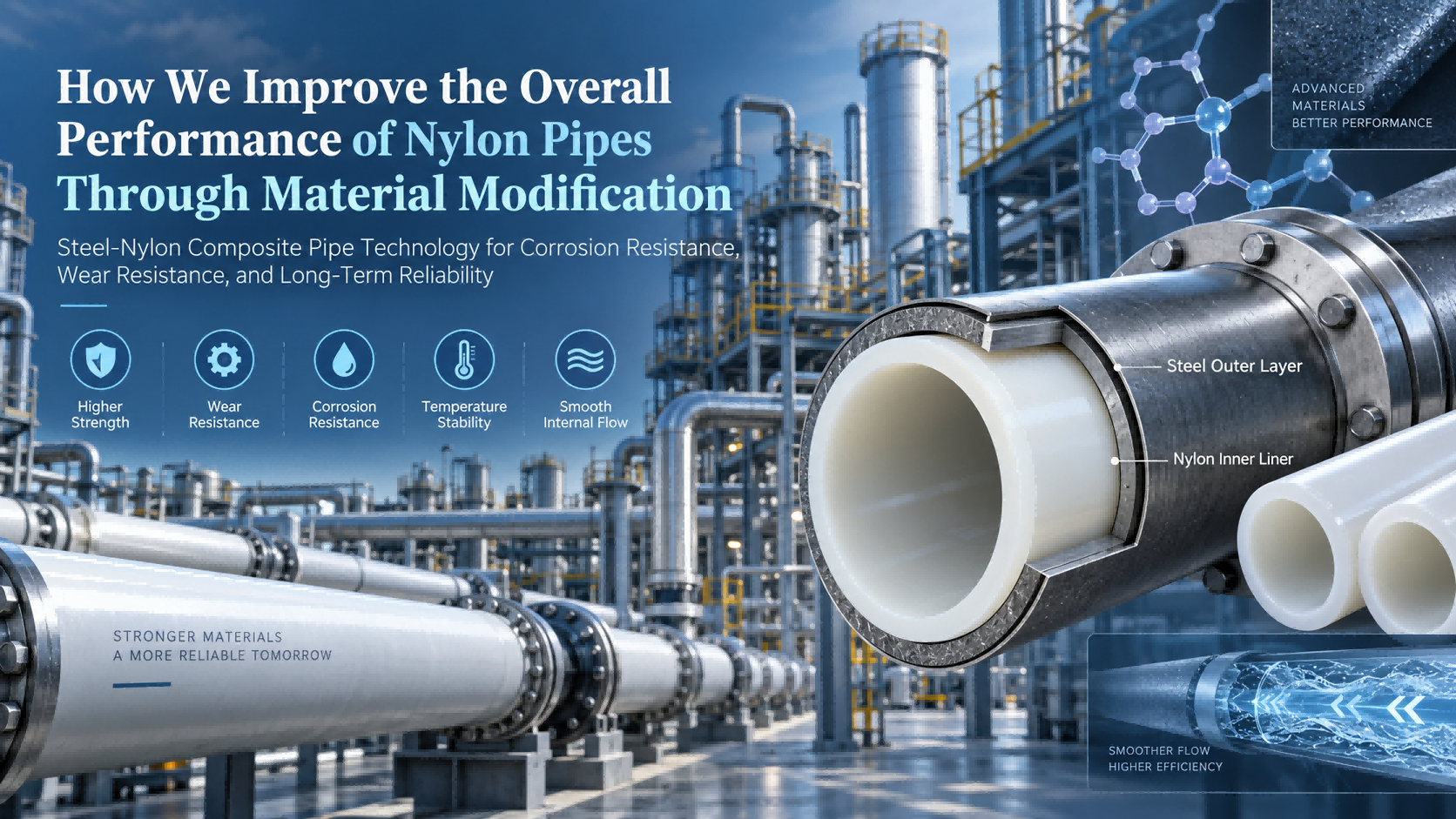
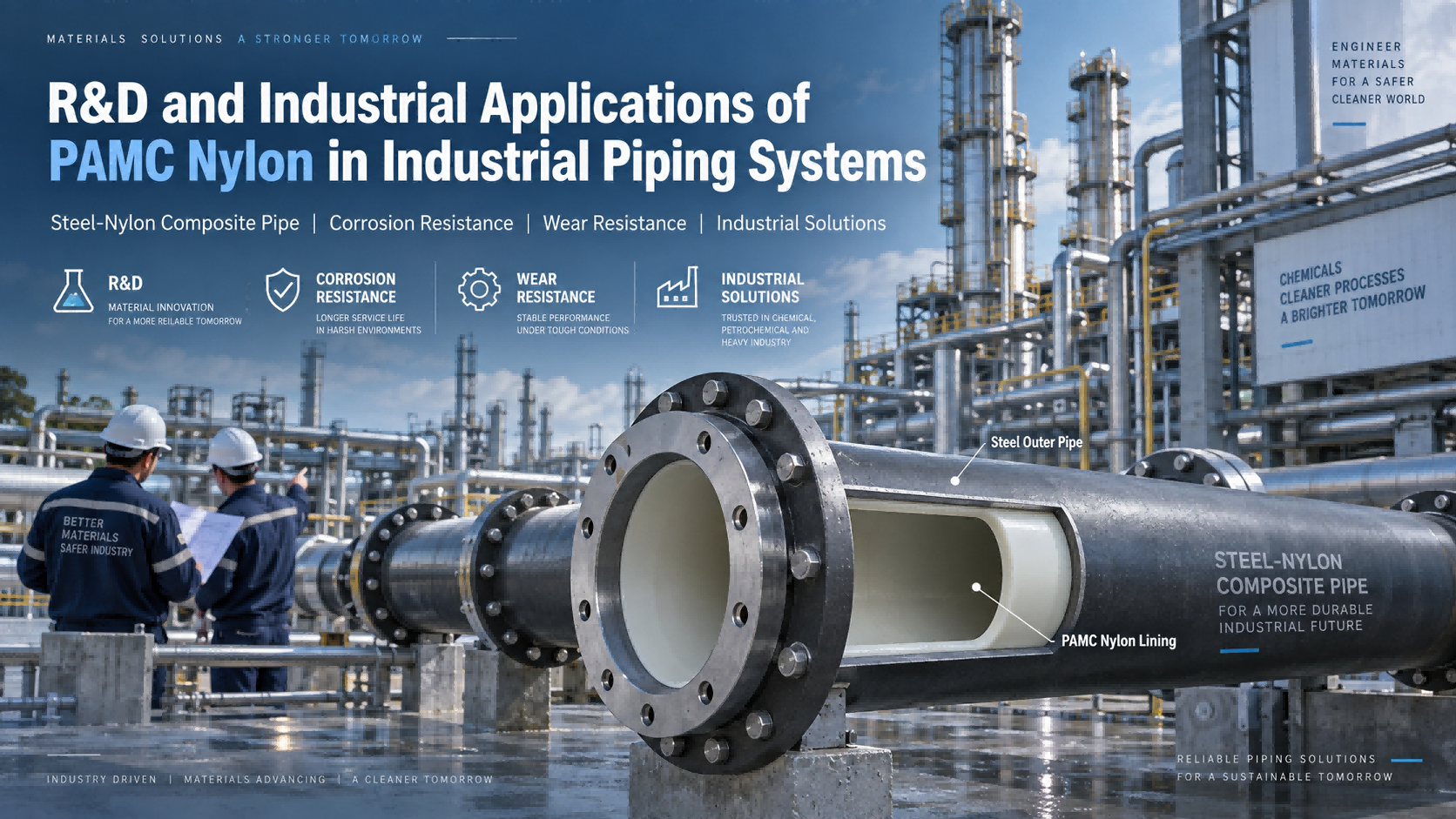
Steel–nylon composite pipe is built around this principle. It combines the rigidity and pressure-bearing strength of steel with the corrosion-resistant and wear-resistant characteristics of nylon, moving beyond single-material design toward a more functional composite structure.
1. Why Are Single-Material Pipes Increasingly Challenged by Complex Industrial Conditions?
Modern industrial piping systems operate under increasingly demanding conditions.
A single pipeline may simultaneously face:
-
corrosive internal media;
-
erosion from solid particles;
-
internal operating pressure;
-
temperature variations;
-
pipe dead weight;
-
equipment vibration;
-
flange loads;
-
external support and installation stresses;
-
long-term continuous operation requirements.
This means pipeline material selection can no longer be based on one simple question:
“Is this material corrosion resistant?”
Engineers must instead ask:
Can the piping system simultaneously satisfy chemical resistance, mechanical strength, wear resistance, connection reliability, and long-term operating stability?
Carbon steel has obvious advantages.
It offers mature engineering standards, high mechanical strength, good structural rigidity, and a well-established manufacturing and installation ecosystem. This is why steel remains one of the most widely used materials in industrial piping.
However, when steel is directly exposed to corrosive media, it may experience:
-
uniform corrosion;
-
localized corrosion;
-
pitting;
-
erosion-corrosion;
-
accumulation of corrosion products;
-
gradual wall-thickness loss.
The problem becomes even more complicated when corrosion and abrasion occur simultaneously.
For example, when saline water, suspended particles, or slurry flows through a pipeline, protective corrosion films may continuously be removed by mechanical erosion. Fresh metal surfaces are repeatedly exposed to the medium, creating a combined corrosion–erosion mechanism.
This is one reason why simply increasing the wall thickness of carbon steel pipe does not always solve the underlying problem of frequent maintenance and replacement.
2. Why Is Nylon Suitable as the Medium-Contacting Functional Layer?
The role of nylon in a steel–nylon composite structure is not to replace steel as the primary structural material.
Instead, nylon is used where its material characteristics are most valuable: at the interface between the pipe and the transported medium.
Its primary purpose is to address two major weaknesses of conventional steel piping:
corrosion and wear on the internal surface.
Isolating the Steel Substrate from Corrosive Media
One of the most important principles behind steel–nylon composite pipe is the use of a nylon inner layer to isolate the steel structure from the process medium.
The transported fluid contacts the nylon layer first rather than the steel substrate.
As a result, the steel structure does not need to remain continuously exposed to the corrosive internal environment.
For compatible salt solutions, alkaline media, industrial wastewater, and certain weakly acidic operating conditions, this structure can fundamentally change the corrosion mechanism found in conventional steel pipe.
In other words:
The objective is not to make steel itself “non-corrosive,” but to minimize direct contact between the corrosive medium and the steel substrate.
This is fundamentally different from simply increasing the corrosion allowance of a steel pipe.
Increasing steel wall thickness essentially provides more material that can be consumed by corrosion.
Using a corrosion-resistant inner layer, by contrast, attempts to reduce the corrosion mechanism at the medium–material interface.
3. Steel Solves the Structural Problem
If nylon is responsible for contact with the transported medium, what is the role of steel?
The answer is straightforward:
Steel provides the mechanical framework required by the piping system.
Industrial piping is not simply a material sample tested in a laboratory.
During actual operation, pipelines must withstand internal pressure, dead weight, pipe-support loads, flange forces, valve weight, equipment connections, and various mechanical stresses.
The steel structure provides several important advantages.
High Circumferential Strength
Internal pressure creates hoop stress in the pipe wall.
For pressurized industrial pipelines, reliable structural load-bearing capability is essential.
The well-understood mechanical properties of steel allow it to serve as the primary pressure-bearing structure of a composite pipe.
High Axial Rigidity
Long industrial pipelines often have to deal with pipe-support spacing, equipment connections, valve loads, thermal displacement, and other mechanical conditions.
Adequate axial rigidity helps maintain structural stability throughout the pipeline system.
Strong Foundation for Large-Diameter Pipe Manufacturing
As chemical processing, mining, salt chemical production, circulating water, and industrial wastewater projects continue to expand, large-diameter and even ultra-large-diameter pipelines are becoming increasingly common.
Large-diameter pipelines place greater demands on:
-
roundness;
-
structural stability;
-
transportation;
-
installation;
-
connection design.
Steel provides a mature engineering foundation for meeting these requirements.
From a structural perspective:
Steel is not the component that steel–nylon composite pipe is trying to eliminate. It is an essential structural backbone of the composite system.
4. Nylon Addresses More Than Corrosion—It Can Also Improve Wear Resistance
Many industrial pipeline failures are not caused by chemical corrosion alone.
Examples of abrasive process media include:
-
mineral slurry;
-
salt mud;
-
sand-containing crude oil;
-
process mother liquor;
-
solid–liquid mixtures;
-
industrial wastewater containing suspended solids.
As these media move through the pipeline, particles continuously impact and rub against the internal pipe surface.
Wear can become particularly severe in:
-
elbows;
-
tees;
-
reducers;
-
pump discharge sections;
-
upstream and downstream sections of valves;
-
areas where flow velocity changes significantly.
Nylon has good wear resistance and relatively low friction characteristics. Under suitable operating conditions, it can therefore function as both a corrosion-resistant layer and a wear-resistant layer.
This means the value of steel–nylon composite pipe should not simply be described as “preventing rust.”
A more accurate description is:
Steel solves structural and pressure-related challenges, while nylon addresses corrosion, abrasion, and the fluid-contact interface.
5. Why Does a Smooth Inner Surface Matter?
After years of operation, industrial piping problems are often caused by more than wall-thickness loss.
Scaling, deposition, and increasing internal surface roughness can also significantly increase operating costs.
As internal roughness increases:
-
flow resistance rises;
-
pressure loss increases;
-
conveying capacity decreases;
-
pumping energy consumption increases;
-
deposition may become more severe.
A nylon inner surface is relatively smooth and can help reduce friction between the transported medium and the pipe wall.
Under compatible operating conditions, this characteristic may also help reduce the tendency for deposition and scaling.
For industrial systems designed for long-term continuous operation, a pipeline should therefore not be evaluated only according to its condition at the time of installation.
The more important question is:
What will the internal surface look like after five or ten years of operation?
This is an important consideration in lifecycle cost analysis, yet it is frequently overlooked during initial material selection.
6. “Steel + Nylon” Is More Than Simply Putting Two Materials Together
The real technical challenge of composite piping is not simply placing nylon inside a steel pipe.
What determines long-term reliability is how two fundamentally different materials are integrated into a stable composite structure.
Steel and nylon differ significantly in terms of:
-
elastic modulus;
-
thermal expansion behavior;
-
surface characteristics;
-
forming processes;
-
stress response.
If structural design and manufacturing processes are not properly controlled, potential problems may include:
-
localized liner separation;
-
gaps at the material interface;
-
uneven liner thickness;
-
localized stress concentration;
-
insufficient sealing reliability at flange ends;
-
reduced interface stability after repeated temperature cycling.
For this reason, the real competitiveness of a high-quality steel–nylon composite pipe depends not only on the raw materials themselves, but on an integrated system of:
material formulation + structural design + forming technology + interface control + dimensional control + inspection and testing.
This is also why the manufacturing capability of an industrial composite pipe supplier cannot be judged by appearance alone.
7. Why Is Flange Connection Well Suited to Industrial Composite Piping?
In chemical plants, oilfields, mines, and other industrial facilities, pipelines must connect with a wide variety of equipment, including:
-
pumps;
-
valves;
-
filters;
-
heat exchangers;
-
storage tanks;
-
process equipment;
-
existing steel piping networks.
Standardized connections are therefore extremely important.
By using flanged connections, steel–nylon composite pipes can retain an installation method familiar to industrial piping systems while allowing the nylon inner layer to perform its medium-isolation function.
Compared with some non-metallic piping systems that require field heat fusion, flange connections can be particularly advantageous for:
-
rehabilitation of aging pipelines;
-
shutdown maintenance;
-
partial pipeline replacement;
-
replacement of high-wear fittings;
-
installation of trial sections.
In industrial environments where hot work is restricted, a properly designed flange connection system may also help reduce the need for field welding.
This is not merely a difference in connection method.
It can directly affect installation planning, shutdown duration, and maintenance efficiency.
8. Why Is This Structure Suitable for Combined Corrosion and Abrasion?
Traditional material selection often focuses on a single performance parameter.
For example:
“If corrosion is severe, choose a corrosion-resistant material.”
“If abrasion is severe, choose a wear-resistant material.”
However, real industrial process conditions are rarely that simple.
Consider slurry transportation.
The pipeline may simultaneously experience:
chemical corrosion + solid-particle abrasion + pressure + temperature + vibration.
If corrosion resistance is improved but abrasion is ignored, service life may still remain limited.
Likewise, if wear resistance is improved but corrosion is ignored, premature failure may still occur.
The advantage of the steel–nylon composite concept is that different functions can be assigned to different materials.
| Engineering Requirement | Primary Material Function |
|---|---|
| Structural strength | Steel |
| Pipe rigidity | Steel |
| Pressure-bearing structure | Steel |
| Corrosion resistance | Nylon inner layer |
| Wear resistance | Nylon inner layer |
| Reduced internal friction | Nylon inner layer |
| Standardized flange connection | Steel structure + composite end design |
This design philosophy is essentially based on functional specialization.
Rather than requiring one material to perform every task, each material performs the function it is best suited to handle.
9. How Does Steel–Nylon Composite Pipe Differ from Stainless Steel?
Stainless steel is a common solution for corrosive industrial environments.
However, its design philosophy is fundamentally different.
With stainless steel:
The metal itself remains in direct contact with the process medium and relies on its inherent corrosion resistance.
Steel–nylon composite pipe follows another approach:
A functional non-metallic inner layer contacts the medium, while the steel structure carries the mechanical loads.
Neither approach is universally superior.
A proper comparison should consider:
-
chemical composition of the medium;
-
concentration;
-
temperature;
-
pressure;
-
flow velocity;
-
solid-particle content;
-
chloride concentration;
-
pipe diameter;
-
required service life;
-
initial investment;
-
maintenance cost.
For some high-temperature, strongly oxidizing, highly acidic, or chemically incompatible environments, other materials may be more appropriate than nylon.
However, in compatible salt, alkaline, weakly acidic, and combined corrosion–abrasion environments, a steel–nylon composite structure can provide a competitive engineering alternative.
Material selection must always be based on actual operating conditions rather than simply on the name of the material.
10. Steel–Nylon Composite Pipe Is Ultimately About System Service Life
Industrial users are not really purchasing a piece of pipe.
They are purchasing years of reliable operation.
If two piping materials have different initial costs, comparing only the price per meter can easily lead to an incomplete purchasing decision.
A more comprehensive approach is to evaluate total cost of ownership:
TCO = Initial Purchase Cost + Installation Cost + Maintenance Cost + Replacement Cost + Downtime Loss + Energy Cost
If a lower-cost pipe requires frequent repairs and replacement, its total cost over the operating lifecycle may be considerably higher.
The value of steel–nylon composite pipe should therefore be evaluated based on questions such as:
-
Can it reduce corrosion-related perforation?
-
Can it lower the wear rate?
-
Can it extend maintenance intervals?
-
Can it reduce replacement frequency?
-
Can it lower the risk of unplanned shutdowns?
-
Can it maintain long-term conveying efficiency?
-
Can damaged sections be repaired or replaced conveniently?
This reflects an important change taking place in modern industrial piping procurement:
The focus is gradually shifting from “buying a pipe” to “buying a longer and more reliable operating cycle.”
11. Which Industrial Applications Should Consider Steel–Nylon Composite Pipe?
Steel–nylon composite structures are particularly worth evaluating in operating environments involving corrosion, abrasion, or a combination of both.
Oilfield Gathering and Water Injection Systems
High-water-cut crude oil, produced water, and injection water systems may contain salts, CO₂, H₂S, suspended solids, and other corrosive components.
Where nylon is chemically compatible with the medium and operating conditions, isolating the steel substrate from the transported fluid can provide an effective approach to reducing internal corrosion risk.
Chlor-Alkali and Salt Chemical Industries
Caustic solutions, brine, process mother liquor, and salt mud systems frequently face a combination of corrosion, deposition, and abrasion.
Combining a steel structural framework with a corrosion-resistant inner layer can help balance mechanical strength and chemical compatibility.
Soda Ash Production
Mother liquor, salt mud, wastewater, and other process pipelines often operate continuously for extended periods.
Maintenance frequency can directly affect plant availability.
As a result, these applications should evaluate not only initial material cost but also long-term operating stability.
Phosphate Chemical and Slurry Transportation
Slurries containing suspended solids continuously wear the internal pipeline surface.
Material selection must therefore consider both corrosion resistance and abrasion resistance.
The dual-material structure of steel–nylon composite pipe offers an alternative to conventional single-metal piping in these demanding conditions.
Industrial Wastewater Systems
Industrial wastewater chemistry can vary considerably between processes.
After evaluating chemical composition, concentration, temperature, and material compatibility, steel–nylon composite piping may be considered for selected corrosive wastewater applications.
12. What Parameters Should Be Confirmed Before Selecting Steel–Nylon Composite Pipe?
Every industrial piping material has its own operating limits.
Before selecting steel–nylon composite pipe, at least the following parameters should be confirmed:
-
exact composition of the transported medium;
-
concentration of each major component;
-
normal operating temperature;
-
maximum design temperature;
-
normal operating pressure;
-
design pressure;
-
flow velocity;
-
presence of solid particles;
-
particle size and solids concentration;
-
pipe diameter;
-
installation environment;
-
presence of negative pressure or vacuum conditions;
-
frequency of temperature cycling;
-
required design service life.
One point is particularly important:
“Corrosion resistance” is never an absolute property.
The chemical resistance of the same material can change substantially depending on temperature, concentration, and the combination of chemicals involved.
For this reason, we do not recommend selecting piping materials simply according to broad labels such as “acid,” “alkali,” or “salt.”
Professional industrial piping selection should always be based on specific operating data.
13. Why Will Composite Materials Become Increasingly Important in Industrial Piping?
Historically, industrial material selection focused heavily on the properties of a single material.
In the future, more engineering systems are likely to move toward functional material design.
Instead of requiring one material to provide the highest strength, best corrosion resistance, greatest wear resistance, and lowest cost simultaneously, engineers can use composite structures in which different materials perform different functions.
This is the fundamental technical logic behind steel–nylon composite pipe.
Steel provides strength. Nylon provides protection.
Steel provides rigidity. Nylon isolates corrosive media.
Steel forms the pressure-bearing framework. Nylon forms the fluid-contacting interface.
The result is an industrial piping structure designed to balance mechanical performance with resistance to demanding process media.
Conclusion: Advanced Material Design Is About Choosing the Right Combination, Not Simply the “Strongest” Material
Industrial piping material selection is gradually moving away from simple material competition toward integrated engineering design.
Steel and nylon should not be viewed as competing materials.
In fact, their properties are highly complementary.
Steel provides structural strength, rigidity, and pressure-bearing capability.
Nylon addresses internal corrosion, abrasion, and the fluid-contact interface.
Through appropriate material formulation, composite structural design, manufacturing processes, dimensional control, and quality inspection, the advantages of both materials can be integrated into a single piping system.
This is also why we continue to focus on the development and manufacturing of steel–nylon composite piping systems.
For oilfield, chemical, salt chemical, soda ash, slurry, mining, and industrial wastewater projects where corrosion or combined corrosion–abrasion is a major concern, piping material selection should not be based solely on the initial cost per meter.
More important questions should be asked:
How long can the pipeline operate reliably?
How many maintenance cycles will be required?
How much production loss could pipeline failure cause?
What will the total lifecycle cost of the piping system actually be?
When the procurement mindset shifts from initial material price to long-term reliability and total cost of ownership, the engineering value of combining steel and nylon becomes much clearer.
How We Improve the Overall Performance of Nylon Pipes Through Material Modification