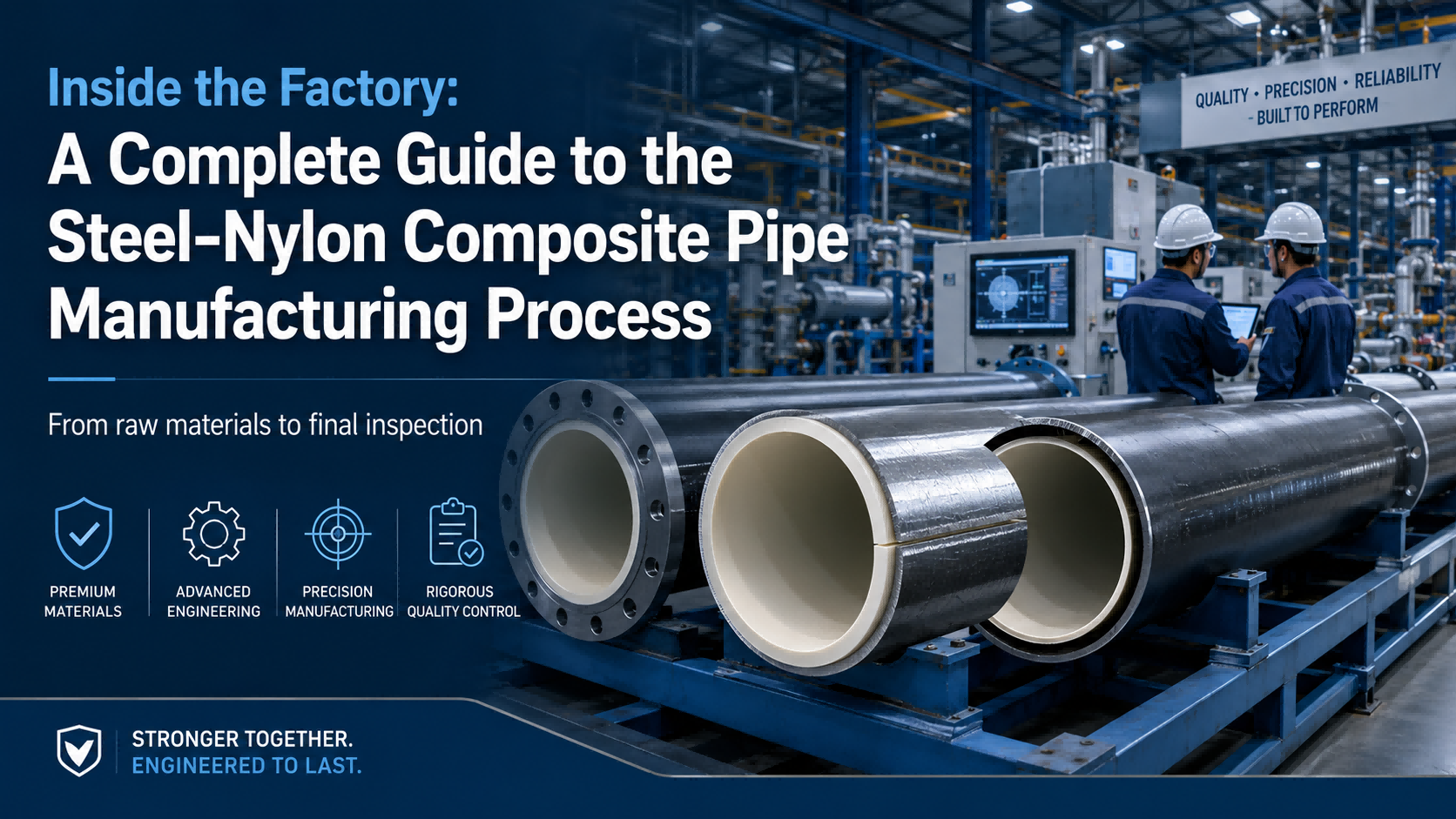
Inside the Factory: A Complete Guide to the Steel-Nylon Composite Pipe Manufacturing Process
For industrial piping systems, long-term reliability is not determined simply by how thick, heavy, or robust a pipe appears when it leaves the factory.
What truly determines its performance is often hidden inside the product: the material system, composite structure, forming technology, manufacturing precision, and quality-control process.
This is particularly important in demanding industrial applications such as oil and gas produced water transportation, gathering pipelines, water injection systems, salt chemical processing, chlor-alkali plants, soda ash production, mining, and other environments involving severe corrosion and abrasion.
In these applications, pipelines may have to withstand multiple challenges simultaneously, including:
-
Corrosion
-
Erosion and abrasion
-
Pressure fluctuations
-
Temperature changes
-
Scaling and deposits
-
Solid-particle impact
-
Long-term continuous operation
For this reason, we do not simply define a steel-nylon composite pipe as:
“A steel pipe with a nylon liner inside.”
A reliable steel-nylon composite pipe is actually an engineered composite piping structure.
Its basic design principle is:
Steel provides mechanical strength, structural rigidity, and pressure resistance, while high-performance nylon creates a corrosion-resistant, wear-resistant, and low-friction internal surface. Through a controlled composite manufacturing process, the advantages of both materials are integrated into one pipeline system.
So how exactly is a steel-nylon composite pipe manufactured?
In this article, we take you inside the factory and explain the complete manufacturing process, from raw-material preparation to final inspection.
1. Engineering Analysis: Manufacturing Starts with the Operating Conditions
Industrial pipe manufacturing does not actually begin with cutting steel or operating production equipment.
It begins with understanding the application conditions.
Different industrial projects may have completely different:
-
Transported media
-
Operating pressures
-
Temperatures
-
Flow velocities
-
Solid-particle concentrations
-
Corrosion conditions
-
Installation environments
Before production begins, engineers therefore need to confirm key operating parameters such as:
-
Transported medium
-
Operating pressure
-
Design temperature
-
Pipeline diameter
-
Flow velocity
-
Solid-particle content
-
Corrosiveness of the medium
-
Indoor or outdoor installation
-
Above-ground or buried installation
-
Positive-pressure or negative-pressure conditions
-
Flange standard and pressure rating
-
Required fittings
-
Pipeline length
-
Site installation conditions
For example, an industrial cooling-water pipeline and a pipeline transporting high-salinity oilfield produced water, sand-containing crude oil, or alkaline mother liquor require completely different engineering considerations.
The first may primarily require long-term corrosion resistance and hydraulic efficiency.
The second may also require resistance to:
abrasion, erosion, scaling, pressure cycling, and complex chemical attack.
For this reason, we prefer to define steel-nylon composite piping as an:
Engineered Pipeline Solution
rather than simply a standardized pipe material.
2. Steel Structure Preparation
The manufacturing process begins by establishing a reliable mechanical structure.
Within a steel-nylon composite pipe, the steel structure is primarily responsible for:
-
Pressure resistance
-
Mechanical strength
-
Structural rigidity
-
Large-diameter dimensional stability
-
Resistance to external loads
-
Mechanical support during installation
This is one of the fundamental differences between steel-nylon composite pipes and conventional plastic pipes.
For materials such as HDPE, PVC, and certain fully non-metallic pipes, most mechanical performance depends on the polymer structure itself.
A steel-nylon composite pipe follows a different principle:
Steel Strength + Nylon Corrosion Resistance
Each material performs the function for which it is best suited.
This structural concept becomes particularly valuable in large-diameter, pressurized, and demanding industrial pipeline systems.
Depending on project requirements, manufacturing control may include:
-
Steel wall thickness
-
Pipe diameter
-
Roundness
-
Pipe length
-
Flange structure
-
Welding quality
-
Concentricity
Only when the load-bearing steel structure is stable can a reliable foundation be created for the subsequent composite-forming process.
3. Steel Substrate Surface Preparation
Surface preparation is one of the most important stages in composite pipe manufacturing, yet it is often underestimated.
In composite structures, long-term reliability depends not only on the properties of the individual materials but also on:
Interface Quality
Before nylon composite forming begins, the steel substrate must therefore undergo controlled surface preparation.
The objectives typically include:
-
Removing oil and contamination
-
Removing oxide layers and impurities
-
Improving surface cleanliness
-
Controlling interface conditions
-
Creating a stable foundation for subsequent composite forming
If substrate preparation is insufficient, a product may appear acceptable initially but develop interface-related problems after long-term exposure to:
-
Temperature cycling
-
Pressure fluctuations
-
Mechanical loads
-
Continuous fluid erosion
For industrial composite piping, the real question is not:
“Can the two materials be combined?”
The more important question is:
Can the composite structure remain stable after years of pressure cycling, temperature changes, and continuous operation?
This is where manufacturing experience becomes particularly important.
4. Nylon Raw Material Preparation and Performance Control
After preparation of the steel substrate, another key material enters the production process: nylon.
The nylon functional layer performs several important roles within the pipeline system:
-
Corrosion resistance
-
Wear resistance
-
Reduction of hydraulic resistance
-
Reduction of scaling tendency
-
Isolation of corrosive media from the steel structure
-
Improvement of long-term transport stability
However, nylon used in industrial pipelines should not simply be compared with conventional nylon used in consumer products.
The material system must be designed around industrial operating conditions.
Important characteristics include:
Mechanical Properties
The material must maintain adequate strength and toughness.
Wear Resistance
In slurry transportation, mining pipelines, sand-containing fluids, and oilfield produced fluids, solid particles continuously impact and erode the pipe wall.
The internal material therefore needs not only chemical resistance but also strong erosion and abrasion resistance.
Temperature Performance
The material system must accommodate temperature fluctuations commonly encountered in industrial environments.
Chemical Stability
For saline water, alkaline media, and complex industrial liquids, material compatibility must be evaluated according to actual operating conditions.
Depending on the engineering conditions and specific product design, our steel-nylon composite pipe systems can cover application temperatures approximately ranging from:
-36°C to 160°C
For combined high-temperature and chemically aggressive conditions, however, the final material selection should always be verified according to:
chemical concentration, temperature, pressure, and operating conditions.
This engineering approach is more reliable than selecting a pipeline simply based on the generic name of a material.
5. Composite Forming: The Core of the Manufacturing Process
Once the steel structure and nylon material are prepared, production enters one of its most important stages:
Composite Forming
The value of steel-nylon composite piping does not come merely from putting two different materials together.
The critical challenge is creating a structure in which the two materials can work together reliably over the long term.
In an optimized structure:
Steel provides structural performance, while nylon provides the fluid-contacting functional surface.
Each material performs the task for which it is most suitable.
This is fundamentally different from certain simple loose-lining structures.
In conventional lined piping systems, long-term operation may potentially lead to problems such as:
-
Liner movement
-
Local bulging
-
Interface separation
-
Negative-pressure deformation
-
Failure caused by differential thermal expansion
For this reason, our manufacturing approach places greater emphasis on:
Integral Composite Structure
Through controlled forming technology, the distribution of the nylon layer, wall thickness, concentricity, and structural stability are carefully managed.
The objective is to create a stable steel-nylon composite structure and reduce the risk of long-term structural separation.
6. Integrated Flange Forming
In industrial pipeline systems, many failures occur not in straight pipe sections but around:
-
Welds
-
Joints
-
Flanges
-
Reducers
-
Elbows
-
Valve connections
Connection design is therefore an important part of overall pipeline reliability.
Our steel-nylon composite pipes use an integrated flange connection design.
This provides several practical advantages.
1. Reduced On-Site Welding
Conventional steel pipe installation often requires extensive field welding.
In chemical plants, oilfields, and other industrial environments, welding can result in:
-
Additional installation procedures
-
Higher labor costs
-
Hot-work management requirements
-
Additional weld inspections
-
Potential corrosion-sensitive locations
Flanged connections can significantly reduce dependence on on-site welding.
2. No Heat-Fusion Connection Required
Many thermoplastic piping systems rely on heat-fusion equipment and operator-controlled procedures.
For large-diameter pipelines in particular, heat-fusion quality may be affected by:
-
Ambient temperature
-
Wind conditions
-
Equipment accuracy
-
End-face preparation
-
Heating time
-
Operator experience
Integrated flanged connections make installation more compatible with conventional industrial piping practices.
3. Easier Connection to Valves and Equipment
Oilfield and chemical process systems typically include numerous:
-
Valves
-
Pumps
-
Filters
-
Instruments
-
Tees
-
Reducers
-
Equipment interfaces
Flanged connections make steel-nylon composite piping easier to integrate into existing industrial systems.
This can be particularly valuable in pipeline renovation and replacement projects.
7. Cooling, Form Stabilization, and Dimensional Control
Composite forming does not mark the end of the manufacturing process.
Materials undergo dimensional changes during forming and cooling.
The pipe therefore requires further stabilization and dimensional control.
Key inspection parameters include:
-
Outside diameter
-
Inside diameter
-
Wall thickness
-
Roundness
-
Concentricity
-
Flange dimensions
-
Sealing surfaces
-
Overall pipe length
Manufacturing a DN100 pipe, a DN500 pipe, and a DN1600+ pipe involves completely different technical challenges.
As the diameter increases, factors such as:
-
Pipe weight
-
Roundness
-
Structural stability
-
Flange alignment
-
Concentricity
become increasingly difficult to control.
For this reason, large-diameter composite pipe manufacturing capability reflects much more than the size of a production machine.
It represents the combined capability of a manufacturer in:
materials, equipment, molds, structural design, and process control.
Our steel-nylon composite pipe manufacturing capabilities can support large industrial pipeline systems, including diameters of:
DN2000 and above
depending on project design requirements.
8. Manufacturing Elbows, Tees, Reducers, and Other Fittings
A real industrial piping system never consists only of straight pipe sections.
A complete project may require:
-
Elbows
-
Tees
-
Reducers
-
Flanges
-
Manifolds
-
Pump connection sections
-
Valve connection sections
-
Customized fittings
If corrosion-resistant materials are used only for the straight pipe while elbows, tees, and reducers remain conventional carbon steel, the system still contains obvious weak points.
In many operating conditions:
Fittings can fail faster than straight pipe sections.
The reason is related to fluid dynamics.
At elbows, fluid direction changes and particles can cause localized erosion.
At reducers, velocity changes may increase turbulence.
At tees, flow disturbance becomes more complex.
This is why we emphasize a:
Full Pipeline System Solution
rather than supplying straight pipe alone.
By combining steel-nylon composite:
-
Straight pipes
-
Elbows
-
Tees
-
Reducers
-
Equipment connection sections
-
Customized fittings
a more complete corrosion- and wear-resistant pipeline system can be established.
9. Internal Surface Quality Inspection
The internal pipe wall directly affects fluid transportation performance.
An ideal industrial pipe surface should be:
-
Smooth
-
Continuous
-
Dimensionally stable
-
Free of significant defects
-
Properly transitioned around connections and fittings
Nylon provides favorable surface characteristics for many industrial fluid applications.
Compared with traditional carbon steel pipelines that may gradually develop corrosion products, rough surfaces, and scale deposits, a relatively smooth nylon internal surface can help reduce the interaction between:
Corrosion + Scaling + Hydraulic Resistance
In certain service environments, a conventional carbon steel pipeline may experience the following cycle:
Corrosion → Rougher Internal Surface → Increased Scaling → Reduced Effective Diameter → Higher Flow Resistance → Increased Pumping Energy → Further Localized Corrosion
By separating the steel structure from the transported medium and providing a relatively smooth nylon internal surface, the pipeline can potentially maintain more stable hydraulic performance over a longer operating period.
Therefore, pipeline evaluation should not focus only on:
Initial Purchase Price
It should also consider:
Transport Efficiency After 5, 10, or More Years of Operation
10. Dimensional and Visual Inspection
After forming, the finished product enters a systematic inspection process.
Key inspection items may include:
-
External appearance
-
Internal wall condition
-
Pipe dimensions
-
Flange dimensions
-
Bolt-hole positions
-
Sealing surfaces
-
Pipe length
-
Wall thickness
-
Roundness
For engineering projects, dimensional precision affects not only product quality but also:
Installation Efficiency
If pipe or flange dimensions deviate excessively, additional adjustment may be required at the installation site.
This reduces construction efficiency and may introduce unnecessary stress into flange connections.
A high-quality industrial pipe should therefore not only be:
“Qualified inside the factory.”
It should also be:
“Easy to install at the project site.”
11. Pressure and Structural Performance Testing
For pressurized pipelines, one of the most important questions is:
Can the pipe remain reliable under pressure?
According to the pipe design and project requirements, pressure and structural performance tests can be carried out to evaluate:
-
Pipe-body stability
-
Flange areas
-
Composite structure
-
Sealing performance
-
Deformation
-
Abnormal leakage
Depending on pipe structure and engineering requirements, our steel-nylon composite pipe product systems can support pressure classes approximately within:
1.0–4.0 MPa
The final allowable operating pressure must always be determined according to:
diameter, temperature, structural design, transported medium, and project requirements.
This is another reason why industrial pipeline selection should be based on engineering conditions rather than material name alone.
12. Final Inspection, Identification, and Shipment
After the manufacturing and inspection stages are completed, the pipeline enters final product management.
Depending on project requirements, products can be identified and classified according to:
-
Specification
-
Diameter
-
Length
-
Project batch
-
Product number
-
Fitting type
Systematic identification is especially important for large industrial projects.
A single project may include:
-
Hundreds of straight pipe sections
-
Elbows with different angles
-
Multiple tee configurations
-
Reducers
-
Valve connection sections
-
Customized fittings
Clear production-stage identification helps improve:
Site Installation Efficiency and Product Traceability
13. What Is Really Being Manufactured Behind a Steel-Nylon Composite Pipe?
When the complete production process is examined as a whole, it becomes clear that every manufacturing stage contributes directly to final pipeline performance.
| Manufacturing Stage | Key Control Point | Impact on Final Performance |
|---|---|---|
| Operating Condition Analysis | Medium, temperature, pressure, velocity | Correct material and structural design |
| Steel Structure Manufacturing | Strength, roundness, wall thickness | Pressure resistance and stability |
| Substrate Preparation | Surface condition | Composite reliability |
| Nylon Material Preparation | Material properties | Corrosion and wear resistance |
| Composite Forming | Wall thickness, interface, concentricity | Long-term structural stability |
| Flange Forming | Dimensions and structure | Easier installation |
| Cooling and Stabilization | Dimensional stability | Geometric accuracy |
| Fitting Manufacturing | System completeness | Fewer weak points |
| Internal Surface Inspection | Surface quality | Reduced flow resistance and scaling risk |
| Pressure Testing | Pressure performance | Improved operational reliability |
| Final Inspection | Overall quality | Manufacturing consistency |
From this perspective:
We are not simply manufacturing a pipe.
We are manufacturing a long-term industrial fluid transportation unit.
14. Why Combine Steel and Nylon?
Industrial pipe materials have always faced a fundamental engineering challenge:
Materials with high strength are not always corrosion-resistant.
Conventional carbon steel provides excellent mechanical properties.
However, in high-salinity water, corrosive industrial liquids, and certain chemical environments, it may experience:
-
Internal corrosion
-
External corrosion
-
Pitting
-
Perforation
-
Scaling
At the same time, many corrosion-resistant non-metallic materials may face other challenges, including:
-
Limited rigidity
-
Pressure limitations
-
Temperature limitations
-
Large-diameter deformation
-
Negative-pressure stability
-
Installation requirements
Composite material technology offers another engineering approach:
Instead of asking one material to solve every problem, different materials are assigned the functions they perform best.
Steel provides:
Strength
Nylon provides:
Corrosion and Wear Resistance
The overall composite structure provides:
Long-Term Reliability
This is the fundamental engineering logic behind steel-nylon composite pipe technology.
15. Core Advantages of Steel-Nylon Composite Pipes
Through a controlled manufacturing process, steel-nylon composite piping can provide several important performance advantages.
1. Excellent Corrosion Resistance
The nylon functional layer separates the transported medium from the steel structure.
For high-salinity water, selected acidic or alkaline media, and complex industrial liquids, this can significantly reduce the risk of direct corrosion of the steel structure.
2. Strong Wear Resistance
For applications involving:
-
Sand-containing crude oil
-
Oilfield produced fluids
-
Mining slurry
-
Industrial slurry
-
Particle-containing liquids
the pipeline must resist both corrosion and continuous particle erosion.
Therefore:
Corrosion Resistance + Wear Resistance
is often more important than corrosion resistance alone.
3. Steel Structure Provides Strength and Rigidity
Compared with many fully polymeric pipes, the steel structure provides strong mechanical support.
This is particularly valuable for:
-
Large-diameter pipelines
-
Above-ground pipelines
-
Industrial pipe racks
-
Pressurized transportation systems
4. Integral Composite Structure
Through structural design and controlled manufacturing, the nylon functional layer and steel structure form a stable composite system.
This helps reduce risks associated with certain conventional lining structures, including:
-
Liner movement
-
Bulging
-
Local separation
-
Negative-pressure instability
5. Smooth Internal Surface and Reduced Scaling Tendency
The relatively smooth nylon transport surface can help reduce deposits and hydraulic resistance.
For long-term fluid transportation systems, the value of a pipeline is therefore not limited to:
“Does it leak?”
It should also be evaluated based on whether it can:
Maintain Transport Capacity Over the Long Term
6. Integrated Flange Connections
Steel-nylon composite pipes can use integrated flange connections, reducing the need for:
-
Field welding
-
Hot-work operations
-
Heat-fusion equipment
The system can also be conveniently connected to:
valves, pumps, process equipment, and existing pipeline systems.
7. Large-Diameter Manufacturing Capability
Our steel-nylon composite pipe systems can support large industrial fluid transportation applications, with manufacturing capability extending to:
DN2000 and above
depending on engineering design requirements.
This provides an additional pipeline material option for large oil and gas, chemical, mining, power, and infrastructure projects.
16. Why Does the Manufacturing Process Affect Pipeline Life-Cycle Cost?
Many industrial projects initially compare pipeline materials based on:
Price per Meter
However, the true economics of a pipeline are often determined by:
Cost per Year of Operation
A pipe may have a relatively low initial purchase price.
But if it experiences repeated:
-
Corrosion perforation
-
Leakage
-
Shutdowns
-
Emergency repairs
-
Replacement
-
Scale removal
-
Weld repair
the maintenance costs accumulated over time may greatly exceed the savings achieved during procurement.
A more appropriate evaluation method is:
Pipeline Life-Cycle Cost
This can be simplified as:
TCO = Initial Procurement + Installation + Maintenance + Shutdown Losses + Replacement + Energy Consumption + Risk Costs
One of the primary objectives behind steel-nylon composite pipe development is therefore to improve:
-
Corrosion resistance
-
Wear resistance
-
Structural reliability
-
Maintenance intervals
and ultimately reduce the total life-cycle cost of an industrial pipeline system.
17. What Decades of Industrial Application Experience Have Taught Us
Industrial pipelines differ from ordinary products because their real performance must be verified over time.
A pipeline that does not leak immediately after installation is not necessarily a high-quality industrial piping system.
The real questions are:
What happens after five years?
What happens after ten years?
What happens after continuous corrosion, erosion, pressure cycling, and temperature changes?
Reinforced nylon pipe and steel-nylon composite pipe technology has accumulated long-term application experience in industrial sectors including:
-
Petroleum
-
Chemical processing
-
Mining
-
Power generation
-
Seawater-related systems
-
Urban infrastructure
Typical applications include:
-
Oil & Gas Gathering
-
Oilfield Produced Water
-
Water Injection Pipelines
-
Soda Ash Industry
-
Chlor-Alkali Industry
-
Salt Chemical Industry
-
Phosphate Chemical Industry
-
Mining Pipelines
-
Power Plant Systems
-
Industrial Water Systems
-
Municipal Water Supply and Drainage
Long-term engineering applications continuously contribute to product improvement:
Material Optimization → Structural Optimization → Mold Optimization → Process Optimization → Product Upgrading
This is why manufacturing experience cannot simply be obtained by purchasing a production line.
It develops through long-term engineering practice.
18. The Future Competition in Industrial Piping Is a Competition of Manufacturing Systems
The industrial pipeline market is changing.
In the past, customers often started with one question:
“What is the price per meter?”
Today, more industrial project owners, EPC contractors, and engineering teams are asking:
-
How many years can the pipeline operate?
-
How frequently will maintenance be required?
-
Can it resist the actual corrosive environment?
-
Are compatible fittings available?
-
Can large-diameter pipes be manufactured consistently?
-
Is installation convenient?
-
What is the potential shutdown cost if failure occurs?
-
What is the ten-year life-cycle cost?
This means the industrial pipeline industry is gradually moving from:
Material Procurement
toward:
Pipeline System Engineering
The ability of a manufacturer to provide a true system solution ultimately depends on:
material expertise, manufacturing technology, engineering experience, and quality-control capability.
Conclusion: The Real Value of Steel-Nylon Composite Pipe Is Built into Every Manufacturing Stage
From steel structure preparation to substrate treatment;
from nylon material control to integral composite forming;
from flange design to elbows, tees, and reducers;
from dimensional control to final pressure verification—
behind every steel-nylon composite pipe is a complete industrial manufacturing system.
For us, the objective is not simply to:
Make a Pipe.
The more important goal is to:
Build a Pipeline That Keeps Working.
For corrosive, abrasive, high-salinity, chemically complex, and continuously operating industrial environments, steel-nylon composite piping combines the structural advantages of steel with the corrosion- and wear-resistant properties of nylon.
It therefore provides another engineering option alongside conventional:
-
Carbon steel
-
Stainless steel
-
FRP
-
HDPE
-
Other industrial piping materials
For major industrial projects, the most meaningful comparison should not be limited to initial pipe price.
The more important question is:
Which pipeline system can continue operating for the next 5, 10, or more years with fewer repairs, fewer shutdowns, lower maintenance requirements, and more stable transport performance?
That is the real value behind the continued development of steel-nylon composite pipe manufacturing technology.
FAQ: Steel-Nylon Composite Pipe Manufacturing and Selection
1. Is a steel-nylon composite pipe simply a steel pipe with a nylon liner?
No.
A high-reliability steel-nylon composite pipe requires systematic engineering of the steel structure, nylon material, interface condition, composite-forming process, and overall structural design.
It should not simply be considered equivalent to a conventional loose-lined pipe.
2. What is the maximum diameter of a steel-nylon composite pipe?
Our manufacturing system can support steel-nylon composite pipes with diameters of DN2000 and above, depending on project design, pressure requirements, and structural conditions.
3. What operating pressure can steel-nylon composite pipes handle?
Depending on the specific product structure and engineering design, our product systems can cover approximately 1.0–4.0 MPa.
The final pressure rating should be determined according to diameter, operating temperature, medium, and pipeline design.
4. Can steel-nylon composite pipes be used at high temperatures?
Depending on the material system and product design, applications can cover approximately -36°C to 160°C.
For operating conditions combining high temperatures with aggressive chemical media, chemical compatibility should be evaluated based on the actual medium, concentration, pressure, and temperature.
5. How are steel-nylon composite pipes connected?
The products can use integrated flange connections.
This reduces the need for extensive field welding commonly required for steel piping and avoids the heat-fusion joining procedures commonly associated with certain thermoplastic pipes.
6. Can elbows, tees, and reducers also be manufactured?
Yes.
A complete industrial piping system can include:
-
Straight pipes
-
Elbows
-
Tees
-
Reducers
-
Equipment connection sections
-
Valve connection sections
-
Customized fittings
This allows the corrosion- and wear-resistant design to extend throughout the entire pipeline system rather than only the straight pipe sections.
7. Which industries are suitable for steel-nylon composite pipes?
Typical applications include:
-
Oil and gas gathering
-
Oilfield produced water
-
Water injection pipelines
-
Soda ash production
-
Chlor-alkali processing
-
Salt chemical industries
-
Phosphate chemical industries
-
Mining slurry transportation
-
Power plant systems
-
Industrial water transportation
-
Municipal water supply and drainage
Steel-nylon composite piping is particularly suitable for projects where corrosion resistance, wear resistance, structural strength, long service life, and reduced maintenance costs are important considerations.
How Are DN2000 Ultra-Large-Diameter Industrial Pipes Manufactured?