Steel-Nylon Composite Pipe: Structure & Benefits Explained

Steel-Nylon Composite Pipe Structure Explained: How Steel Strength and Nylon Performance Work Together
In modern industrial fluid transportation systems, pipelines must do more than withstand internal pressure. They must also operate reliably under challenging conditions involving corrosion, abrasion, temperature fluctuations, mechanical loads, and aggressive industrial media.
Traditional carbon steel pipes provide excellent mechanical strength and pressure resistance. However, when transporting saline water, industrial wastewater, chemical solutions, or particle-laden fluids, they may experience internal corrosion, scaling, erosion, and gradual wall thickness reduction.
Engineering plastic pipes can address certain corrosion-related challenges. Nevertheless, large-diameter applications, high mechanical loads, and complex installation environments may introduce additional concerns regarding structural stiffness, long-term deformation, and joint reliability.
Steel-Nylon Composite Pipes offer an engineering solution based on the complementary properties of steel and nylon.
By combining a high-strength steel structure with a protective Nylon 6 (PA6) layer, these composite pipes are designed to achieve a balance between mechanical strength, corrosion resistance, abrasion resistance, and installation efficiency.
This article explores the structural principles of steel-nylon composite pipes from four technical perspectives: material science, structural mechanics, composite manufacturing, and engineering applications.
It also explains how our steel-nylon composite piping solutions help industrial projects address demanding operational requirements while improving overall pipeline reliability.
1. What Is a Steel-Nylon Composite Pipe?
A steel-nylon composite pipe is an industrial piping product that combines the structural properties of steel with the functional characteristics of engineering nylon.
Its fundamental design principle is straightforward:
Steel provides structural strength and mechanical support, while nylon protects the internal surface against direct exposure to the transported medium.
Unlike conventional carbon steel pipes, all-plastic pipes, or ordinary lined piping systems, steel-nylon composite pipes integrate different materials into a coordinated structural design.
From a functional perspective, the pipe consists of three essential systems:
-
Steel load-bearing structure: Provides mechanical strength, structural rigidity, and pressure resistance.
-
Nylon 6 functional layer: Creates a protective barrier against suitable corrosive and abrasive media.
-
Composite interface and connection system: Maintains structural integrity, accommodates differences in material behavior, and supports reliable sealing at pipe joints.
However, a steel-nylon composite pipe is not simply a steel pipe combined with a plastic layer.
Its long-term performance depends on how effectively the materials, composite structure, manufacturing process, and connection system work together.
Understanding this relationship is essential when selecting composite piping for demanding industrial environments.
2. Core Structural Components of Steel-Nylon Composite Pipes
2.1 Steel Load-Bearing Structure: Providing Strength and Mechanical Stability
Steel serves as the primary load-bearing component of a steel-nylon composite pipe.
During industrial operation, a pipeline is subjected to various mechanical forces, including:
-
Internal pressure
-
Hoop and axial stresses
-
Pipeline self-weight
-
Support reactions
-
Thermal expansion and contraction
-
Installation loads
-
External impact and vibration
The steel structure performs several important functions.
First, it provides the mechanical strength required to resist internal pressure.
Second, it increases overall pipeline rigidity, which is particularly important for large-diameter industrial piping systems.
Third, it helps control excessive deformation under external mechanical loads.
Fourth, it provides structural support for flanges, fittings, and connections.
Finally, it contributes to the stability of aboveground pipelines and industrial installations operating under complex loading conditions.
For a thin-walled cylindrical pipe, hoop stress can be approximated using the following equation:
σ ≈ PD / 2t
Where:
-
σ = Hoop stress
-
P = Internal design pressure
-
D = Characteristic pipe diameter
-
t = Load-bearing wall thickness
This simplified relationship demonstrates that, under the same internal pressure and wall thickness, hoop stress generally increases as the pipe diameter increases.
Consequently, when pipeline diameters increase from DN200 to DN1000 or even DN2000, structural design becomes increasingly important.
In practical engineering, pressure ratings must also account for allowable material stress, wall thickness tolerances, welding quality, temperature, external loads, and applicable piping design standards.
The simplified equation should therefore be used only to explain the structural principle rather than determine the final pressure rating.
Our Product Advantage
Our steel-nylon composite pipes combine the mechanical strength of steel with a carefully engineered composite structure.
We provide piping solutions for different diameters, pressure requirements, and installation environments, supporting large industrial fluid transportation systems.
This structural approach makes our products suitable for various large-diameter, long-distance, and mechanically demanding pipeline applications, subject to project-specific engineering verification.
2.2 Nylon 6 Functional Layer: Creating an Internal Corrosion and Abrasion Barrier
If steel determines the structural load-bearing capability of the pipe, the nylon layer plays a critical role in determining how the internal surface interacts with the transported medium.
Our composite piping solutions use engineering nylon materials based primarily on Nylon 6 (PA6), with material and structural designs selected according to specific application requirements.
Nylon 6 is an engineering thermoplastic belonging to the polyamide family.
It offers a useful combination of mechanical strength, toughness, processability, and friction and wear properties.
When properly selected for compatible operating conditions, a Nylon 6 functional layer can provide several important advantages.
A. Reducing Direct Exposure of Steel to Corrosive Media
Conventional carbon steel pipelines can experience electrochemical corrosion when exposed to saline water, industrial wastewater, or certain chemical solutions.
A continuous and intact nylon layer separates the transported medium from the steel structure.
This protective barrier helps reduce direct internal corrosion of the steel substrate.
The design is particularly valuable in applications where both structural strength and internal corrosion protection are required.
However, chemical compatibility must always be evaluated based on the actual operating medium, concentration, temperature, and exposure duration.
B. Improving Abrasion Resistance in Suitable Particle-Laden Applications
In slurry transportation systems, sand-containing water pipelines, and industrial suspension systems, solid particles continuously interact with pipe walls.
These interactions may cause friction, particle impact, and gradual material removal.
Engineering nylon possesses toughness and useful wear characteristics that may help reduce internal surface wear under appropriate conditions.
Actual performance depends on several factors:
-
Particle hardness
-
Particle size and shape
-
Solid concentration
-
Fluid velocity
-
Impact angle
-
Operating temperature
-
Nylon material formulation
Therefore, abrasion resistance should be evaluated through representative material testing and operating experience rather than assumed from material classification alone.
C. Maintaining a Relatively Smooth Internal Surface
A properly manufactured nylon inner surface can provide a comparatively smooth flow passage.
Compared with carbon steel pipes that have experienced corrosion, rust formation, or internal surface deterioration, nylon-protected surfaces may help reduce certain sources of flow resistance and deposit accumulation.
Potential hydraulic benefits include:
-
Reduced roughness associated with internal rust formation
-
More stable internal surface conditions
-
Lower risk of certain corrosion-related deposits
-
Improved flow consistency in suitable applications
However, actual pressure loss also depends on pipe diameter, flow velocity, fluid properties, pipeline length, fittings, and operating conditions.
Hydraulic calculations are required to quantify performance.
D. Reducing Maintenance Associated With Internal Corrosion and Wear
Traditional steel pipelines may require maintenance or replacement due to corrosion perforation, localized wall thinning, or internal deterioration.
A properly engineered steel-nylon composite structure can reduce exposure to certain degradation mechanisms.
This creates the potential for lower maintenance requirements and improved operational continuity in compatible applications.
For industrial facilities operating continuously, these benefits can contribute significantly to the overall economic value of a piping system.
2.3 Composite Interface: A Critical Factor in Long-Term Reliability
One of the most important technical challenges in steel-nylon composite piping is maintaining structural stability between two materials with different physical properties.
Steel and Nylon 6 differ in several important characteristics:
-
Coefficient of thermal expansion
-
Elastic modulus
-
Moisture absorption
-
Creep behavior
-
Stress relaxation
-
Dimensional response to temperature changes
When a pipeline experiences temperature fluctuations, pressure cycling, or mechanical loading, the steel structure and nylon functional layer may respond differently.
If the composite interface is not properly designed, potential problems may include:
-
Localized delamination
-
Liner deformation
-
Internal blistering
-
Movement near pipe ends
-
Reduced interface stability
-
Deformation under negative pressure conditions
Therefore, the reliability of a steel-nylon composite pipe cannot be evaluated solely by considering the individual properties of steel and nylon.
A more important engineering question is:
Can the steel structure and nylon functional layer maintain stable, coordinated performance after long-term thermal cycling and pressure fluctuations?
Our composite piping design emphasizes overall structural integrity, nylon layer uniformity, interface stability, and pipe-end protection.
Through appropriate structural engineering, controlled manufacturing processes, and quality inspection, the risk of composite instability can be reduced.
Applications involving frequent startup and shutdown, vacuum conditions, or significant temperature variations should undergo additional engineering assessment.
3. How Do Steel-Nylon Composite Pipes Withstand Internal Pressure?
The pressure-resistance principle of a steel-nylon composite pipe does not mean that steel and nylon each carry half of the internal pressure.
Instead, the structure follows a coordinated load-bearing concept:
The steel structure carries the primary mechanical loads, while the nylon functional layer provides internal medium isolation and surface protection.
When internal pressure acts on the pipeline, the following process occurs:
Step 1: Internal pressure acts on the pipe wall.
The transported fluid applies pressure to the internal surface of the nylon functional layer.
Step 2: Loads are transferred through the composite structure.
The nylon layer remains supported by the load-bearing steel structure while maintaining the integrity of the internal protective surface.
Step 3: The steel structure resists the primary mechanical stresses.
The steel component carries the principal hoop and axial loads generated by the pressurized fluid.
Step 4: The connection and support systems maintain overall pipeline integrity.
Flanges, sealing elements, fasteners, and pipe supports work together to maintain structural stability and pressure-boundary integrity.
The specific mechanism of load transfer depends on the composite configuration and interface design.
Different steel-nylon composite products may use different manufacturing and mechanical retention methods.
Why Is This Structure Suitable for Large-Diameter Industrial Pipelines?
Large-diameter pipelines create substantial structural design challenges.
When engineering plastics are used as the primary pressure-bearing material, designers must carefully evaluate:
-
Long-term creep behavior
-
Structural deformation
-
External support requirements
-
Temperature-related strength reduction
-
Joint stability
-
Pressure and vacuum resistance
Steel-nylon composite pipes address these challenges through a different structural strategy.
The steel component provides the principal load-bearing strength, reducing reliance on the nylon layer as the primary pressure-containing material.
Meanwhile, the nylon functional layer provides protection against compatible corrosive and abrasive media.
This combination can be particularly valuable in:
-
Large-diameter industrial water supply systems
-
Industrial wastewater pipelines
-
Chemical processing facilities
-
Oilfield produced-water transportation
-
Soda ash and salt chemical industries
-
Mining slurry transportation
-
Power plant circulation systems
The key advantage is the ability to optimize mechanical performance and internal protection within a single composite piping structure.
4. Why Is Nylon 6 an Important Material for Composite Pipes?
Nylon 6 is neither ordinary polyethylene nor Nylon 12.
It is an engineering thermoplastic that offers a useful balance of mechanical strength, toughness, and manufacturing versatility.
When properly selected and engineered, Nylon 6 can provide valuable functional properties in industrial composite piping systems.
4.1 Balance Between Mechanical Strength and Toughness
Nylon 6 has useful strength and toughness characteristics.
Under appropriate conditions, these properties help the functional layer withstand mechanical interactions with the transported fluid and suspended particles.
This can be beneficial in systems experiencing vibration, pressure fluctuations, or particle impact.
However, performance must be evaluated under actual operating conditions, especially where long-term moisture exposure or elevated temperatures are involved.
4.2 Good Processing and Manufacturing Potential
With suitable material formulation and manufacturing control, Nylon 6 can be processed into engineered structures.
For steel-nylon composite pipes, successful manufacturing requires attention to more than the polymer itself.
Important considerations include:
-
Inner surface continuity
-
Layer thickness uniformity
-
Dimensional accuracy
-
Pipe-end integrity
-
Composite stability
-
Consistent manufacturing quality
These factors directly influence whether the finished pipe can deliver reliable service.
4.3 Combination of Corrosion and Wear Protection
Nylon 6 exhibits compatibility with various oils, salts, and selected industrial media.
When combined with a steel load-bearing structure, it can support piping applications that require both mechanical strength and internal protection.
Nevertheless, Nylon 6 is not universally resistant to all chemicals.
Strong acids, certain oxidizing chemicals, and some elevated-temperature aqueous environments may cause material degradation.
Nylon 6 also absorbs moisture, which can affect its dimensions and mechanical properties.
Consequently, long-term water-contact applications should include appropriate assessments of moisture absorption, dimensional changes, and aging behavior.
Our material selection philosophy focuses on balancing mechanical performance, chemical compatibility, temperature resistance, and long-term structural reliability rather than maximizing a single material property.
5. How Does Thermal Expansion Affect Steel-Nylon Composite Pipes?
Thermal expansion is a critical consideration when evaluating composite piping systems.
Steel and Nylon 6 have different thermal expansion characteristics.
When temperature changes, the two materials generally experience different amounts of free thermal deformation.
Linear thermal expansion can be estimated using:
ΔL = α × L × ΔT
Where:
-
ΔL = Change in length
-
α = Linear thermal expansion coefficient
-
L = Original length
-
ΔT = Temperature change
In a composite structure, steel and nylon cannot always expand or contract independently.
As a result, differences in thermal movement may generate stresses at the composite interface.
For large industrial pipelines or systems experiencing significant temperature fluctuations, engineers should evaluate:
-
Thermal expansion characteristics of the actual materials.
-
Deformation compatibility between the composite layers.
-
Pipe supports and thermal movement accommodation.
-
Flange sealing stability during temperature changes.
-
Potential interface fatigue or stress relaxation after repeated thermal cycling.
For water-containing applications, the dimensional effects of Nylon 6 moisture absorption should also be considered.
Therefore, composite pipe design must address more than mechanical strength at a single operating temperature.
It should evaluate structural integrity throughout the expected temperature range.
Appropriate material selection, composite structural design, and installation engineering can improve the system's ability to accommodate thermal variations.
6. Why Are Integral Flange Connections One of Our Key Product Advantages?
Industrial pipeline reliability depends not only on straight pipe sections but also on the performance of flanges, elbows, tees, reducers, and equipment connections.
Conventional steel pipeline installation often requires field welding.
Such operations may involve:
-
Welding equipment and trained personnel
-
Hot-work permits
-
Weld inspection
-
On-site surface preparation
-
Corrosion protection of welded areas
-
Additional installation coordination
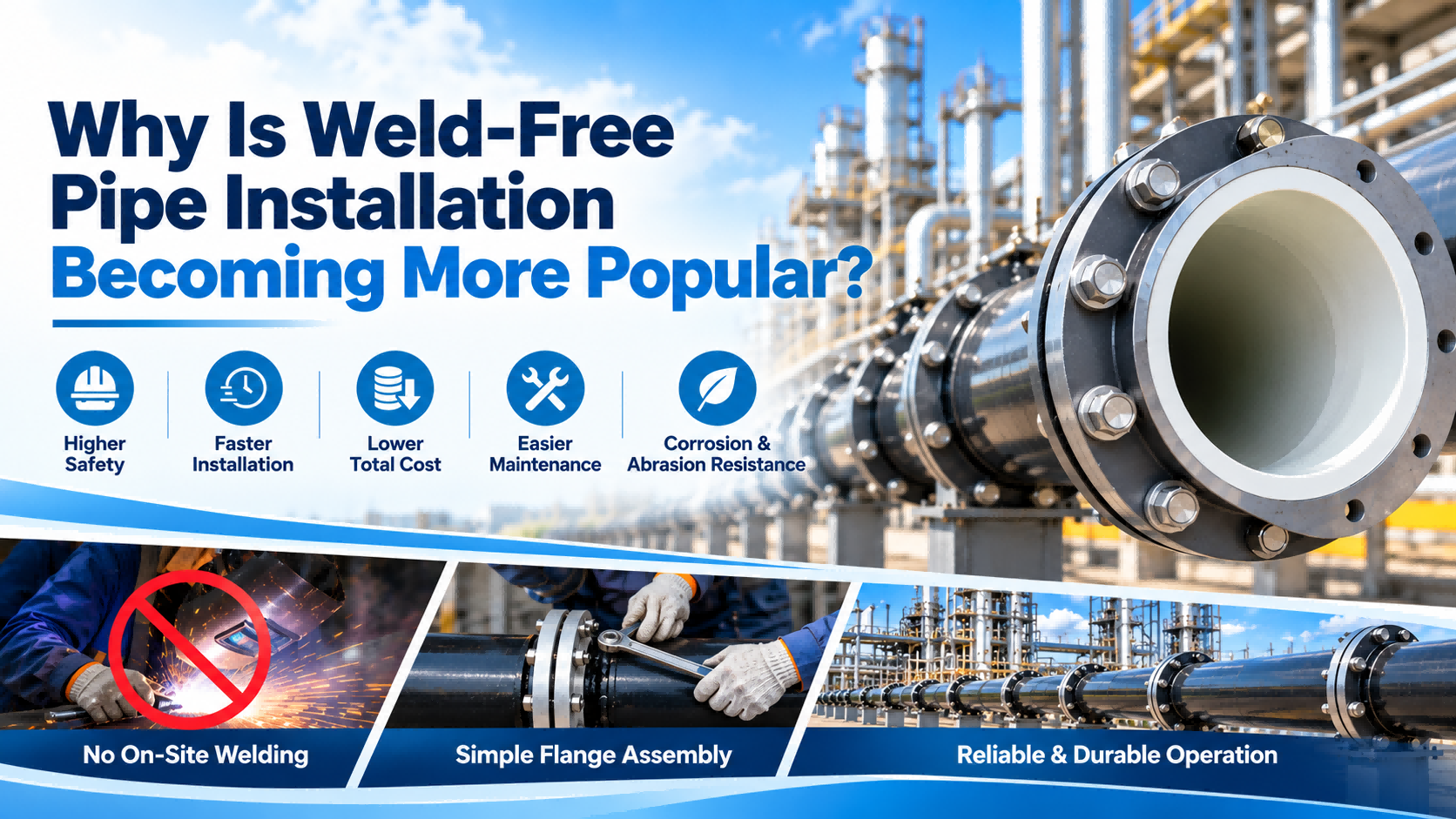
Our steel-nylon composite piping solutions incorporate integral flange connection designs, allowing pipe sections to be assembled primarily through bolted flange joints.
6.1 Reduced Field Welding Requirements
Pipe sections can be connected using compatible flanges, sealing gaskets, and fasteners.
This arrangement helps reduce the need for field welding of the pipe bodies.
For petrochemical facilities, mining operations, and existing industrial plants, reducing hot-work activities may simplify installation planning and safety management.
6.2 Improved Installation Standardization
Consistent flange dimensions, bolt-hole positioning, sealing surface flatness, and pipe-end accuracy help support reliable field assembly.
Standardized connections can reduce the amount of on-site fabrication required.
This is especially valuable for large-diameter pipelines and long-distance industrial transportation systems involving many pipe sections.
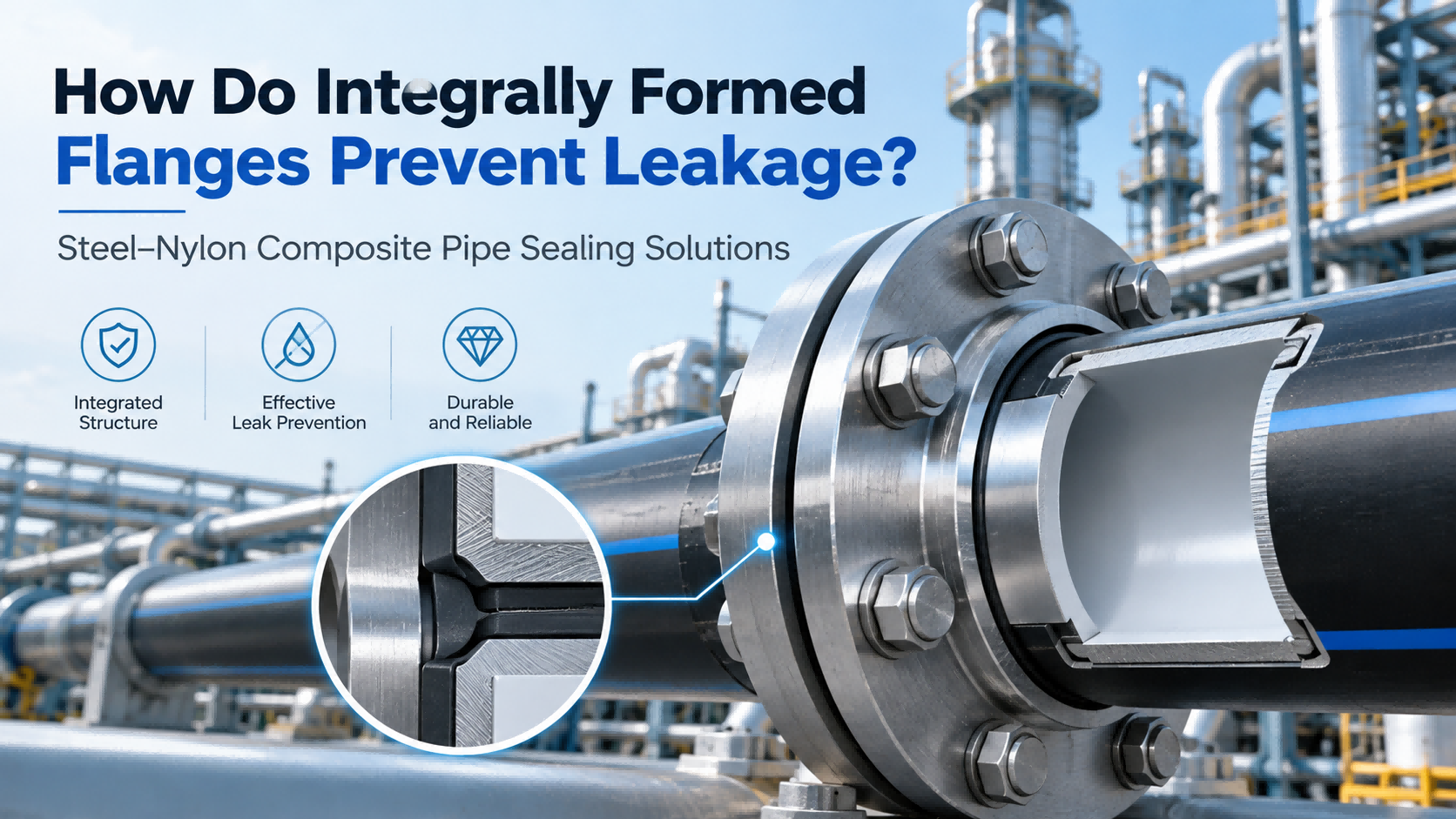
6.3 Improved Protection at Pipe Ends
Although internal corrosion protection is important, the connection area is equally critical.
If transported fluid penetrates through an improperly sealed pipe end or damaged connection, it may reach the interface between the nylon layer and steel structure.
This could lead to concealed corrosion or localized composite deterioration.
Our integral flange design emphasizes coordination between the pipe-end structure, internal nylon protection, and sealing system.
The objective is to maintain reliable protection and sealing continuity across the pipeline connection.
The final protection and sealing configuration must be selected according to the actual product design and operating conditions.
6.4 Easier Inspection, Maintenance, and Pipe Replacement
Flanged pipe sections can be disconnected when inspection, maintenance, or replacement becomes necessary.
This offers practical advantages for:
-
Chemical processing plants
-
Industrial pumping stations
-
Water circulation systems
-
Industrial pipeline renovation projects
However, the use of integral flanges does not eliminate the need for proper engineering procedures.
Gasket selection, bolt tightening, flange alignment, and pressure testing remain essential for maintaining connection reliability.
7. Steel-Nylon Composite Pipes vs. Traditional Pipe Materials
Different piping materials have different strengths and limitations.
Selecting the most suitable pipe requires consideration of mechanical loads, chemical compatibility, operating temperature, installation conditions, and lifecycle costs.
| Comparison Factor | Carbon Steel Pipe | HDPE Pipe | FRP Pipe | Steel-Nylon Composite Pipe |
|---|---|---|---|---|
| Primary structural material | Steel | Polyethylene | Fiber-reinforced resin | Steel |
| Internal corrosion protection | May require coating or lining | Provided by the polymer itself | Depends on resin system | Provided by nylon functional layer |
| Large-diameter rigidity | Generally high | Requires deformation control | Depends on laminate design | Primarily supported by steel |
| Abrasion performance | Depends on medium and surface condition | Application-dependent | Depends on wear-resistant layer | Potential advantage in suitable conditions |
| Common connections | Welding, flanges | Heat fusion, electrofusion, flanges | Flanges, bonded or mechanical joints | Integral flanges |
| Main engineering considerations | Corrosion and wall thickness loss | Creep, temperature, pressure | Laminate integrity and installation loads | Composite interface, temperature, and sealing |
The comparison demonstrates an important distinction.
Steel-nylon composite pipes do not depend on a single material to perform every function.
Instead, their engineering concept assigns different responsibilities to different materials.
This makes them particularly worth evaluating in projects where mechanical strength, internal corrosion protection, abrasion resistance, and installation efficiency are all significant considerations.
8. What Are Our Steel-Nylon Composite Pipe Manufacturing Advantages?
For industrial buyers, EPC contractors, and engineering consultants, understanding material properties is only the beginning.
The more important question is whether the manufacturer can consistently transform those materials into reliable products that meet project requirements.
Our manufacturing approach focuses on several key areas.
8.1 Large-Diameter Manufacturing Capability
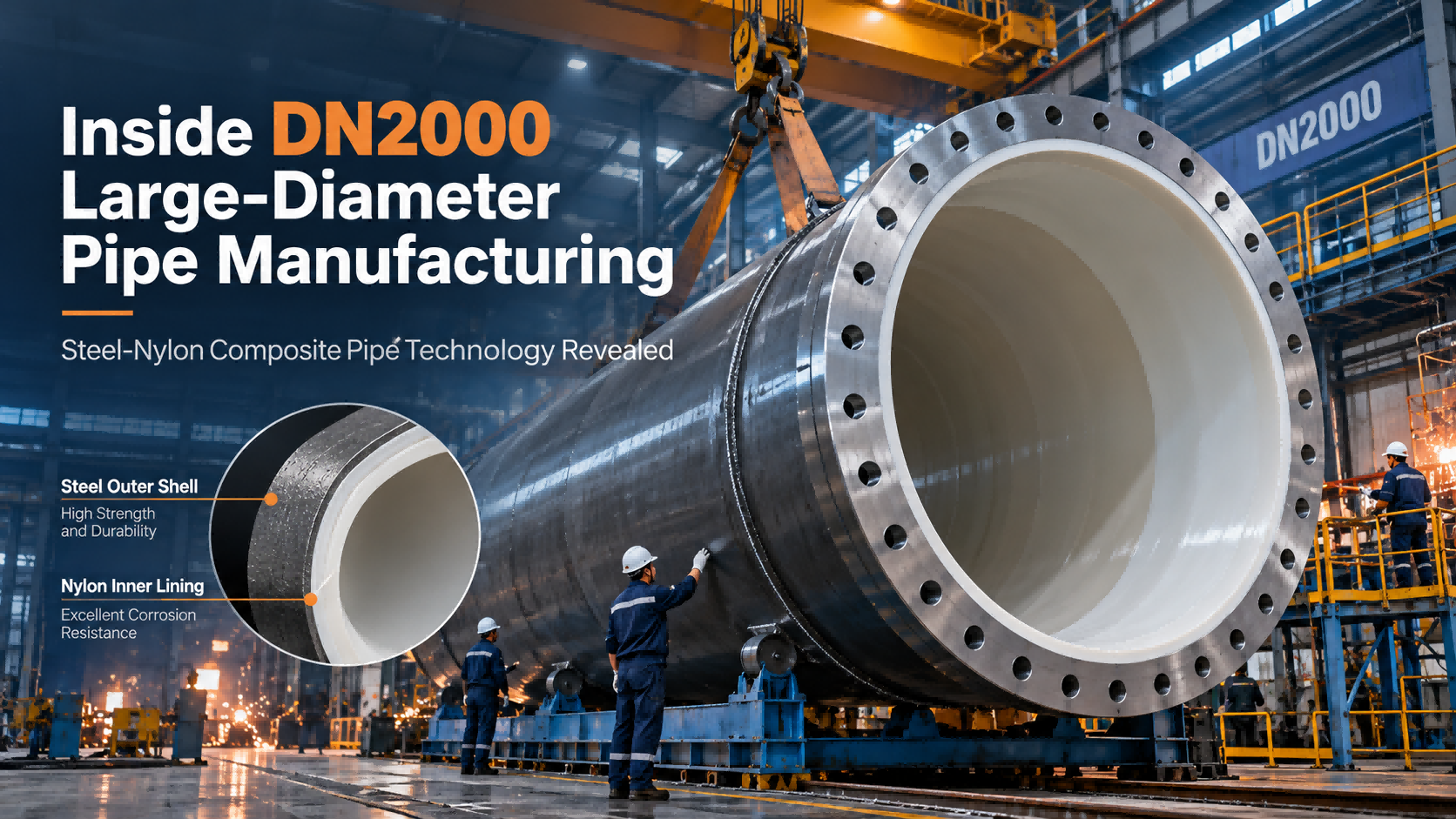
Our steel-nylon composite piping solutions support engineering requirements across nominal diameters from DN100 to DN2000, with larger or special sizes subject to customized manufacturing assessment.
Large-diameter pipe production requires careful control over:
-
Pipe roundness
-
Pipe straightness
-
Structural rigidity
-
Nylon layer thickness uniformity
-
Flange flatness
-
Flange perpendicularity
-
Transportation and lifting stability
-
Installation-related mechanical loads
For DN2000-class industrial pipes, manufacturing capability means more than producing a large pipe diameter.
It also requires maintaining structural accuracy, composite stability, and connection quality throughout the manufacturing process.
Our large-diameter product design approach focuses on the combined performance of the steel structure, internal nylon layer, and flange connection system.
8.2 Engineering Design for Different Pressure Classes
Our product engineering approach can address various industrial pressure requirements, including applications in the approximate 1.0–4.0 MPa range, subject to the specific product configuration and engineering verification.
Actual allowable pressure depends on:
-
Nominal diameter
-
Steel wall thickness
-
Operating temperature
-
Transported medium
-
Connection design
-
Manufacturing quality
-
Applicable testing results
We emphasize evaluating the steel load-bearing structure and nylon functional layer as an integrated system.
Pressure suitability should always be determined using the approved technical specifications of the particular pipe product.
8.3 Composite Structure Quality Control
The quality of a steel-nylon composite pipe directly affects its long-term reliability.
Our manufacturing philosophy emphasizes process control from raw material selection through finished-product inspection.
Important quality factors include:
-
Steel structure dimensional accuracy
-
Nylon layer uniformity
-
Composite interface integrity
-
Pipe-end structural consistency
-
Flange dimensional accuracy
-
Sealing performance
Depending on project requirements, appropriate dimensional inspections, pressure tests, and quality verification procedures can be incorporated into the manufacturing and delivery process.
8.4 Integrated Pipe Fittings and System Supply
Industrial piping projects rarely require straight pipes alone.
A complete piping network typically includes:
-
Elbows
-
Tees
-
Reducers
-
Flange connection components
-
Equipment connection sections
-
Customized pipe fittings
We provide engineering and manufacturing support for compatible piping components.
This system-oriented approach helps customers consider internal protection and connection reliability throughout the piping network rather than only within individual straight pipe sections.
8.5 Customized Solutions for Demanding Applications
Every industrial project has different requirements.
Operating conditions may vary significantly in terms of:
-
Chemical composition
-
Pressure
-
Temperature
-
Flow velocity
-
Solid particle concentration
-
Installation environment
-
Maintenance expectations
For this reason, we focus on selecting suitable materials and structural configurations according to actual project parameters.
Rather than applying one standard pipe configuration to every operating environment, our approach emphasizes application-specific engineering.
This capability is particularly valuable for chemical processing, oilfields, mining, soda ash production, and large industrial water transportation projects.
9. Typical Industrial Applications of Steel-Nylon Composite Pipes
9.1 Chemical Processing and Salt Chemical Industries
Many chemical production processes involve saline solutions, industrial liquids, and process media that may cause corrosion or deposition.
Steel-nylon composite pipes offer a structural concept that combines steel pressure resistance with internal protective properties.
When the transported medium is compatible with the nylon layer, this structure can provide practical advantages in chemical fluid transportation.
For concentrated alkaline solutions, elevated-temperature applications, or chemically aggressive media, long-term chemical resistance must be verified carefully.
9.2 Oilfield Gathering and Produced-Water Transportation
Oilfield produced water may contain dissolved salts, suspended particles, and various process-related contaminants.
Conventional carbon steel pipelines can experience internal corrosion, scaling, and localized erosion under certain operating conditions.
Steel-nylon composite pipes can be considered as an alternative material solution.
Their internal nylon functional layer may help reduce direct contact between the transported medium and steel, while the steel structure provides the necessary mechanical support.
Actual suitability should be verified against the complete fluid composition and operating conditions.
9.3 Mining Slurry Transportation
Slurry and tailings transportation systems often face significant challenges involving abrasion, pressure losses, and maintenance frequency.
In appropriate operating conditions, a nylon functional layer may improve resistance to certain abrasive wear mechanisms.
Potential applications include:
-
Mineral slurry transportation
-
Tailings pipelines
-
Particle-containing industrial water systems
-
Selected mining process pipelines
High-velocity flow, hard particles, and severe directional changes may create especially demanding wear conditions.
In such cases, representative wear testing and detailed engineering evaluation are essential.
9.4 Industrial Water Supply and Wastewater Systems
Large industrial water systems often involve substantial pipe diameters, continuous operation, and limited maintenance windows.
A steel-nylon composite structure combines the structural support of steel with an internal protective surface.
This makes it a potential option for industrial water transportation projects where pressure capacity, corrosion protection, and maintenance considerations must be balanced.
9.5 Seawater and Coastal Industrial Pipelines
Seawater and highly saline environments can accelerate the internal corrosion of unprotected carbon steel.
For projects where the nylon material has demonstrated suitable chemical compatibility, steel-nylon composite pipes can reduce direct contact between saline water and the steel substrate.
However, the external steel surface still requires corrosion protection appropriate to the environmental exposure.
For coastal and marine industrial projects, internal and external corrosion management should therefore be considered separately.
10. From Structural Design to Service Life: Evaluating Long-Term Economic Value
The initial purchase price of industrial piping represents only one component of its overall cost.
A more comprehensive assessment considers Total Cost of Ownership (TCO).
A simplified lifecycle cost model can be expressed as:
TCO = Initial Purchase Cost + Installation Cost + Maintenance Cost + Replacement Cost + Downtime Losses + Operating-Related Costs
Traditional carbon steel pipes may provide an initial cost advantage in certain projects.
However, where internal corrosion or abrasion is severe, maintenance, replacement, and production interruptions may increase lifecycle expenditure.
Steel-nylon composite pipes can create economic value through three main mechanisms.
10.1 Reduced Maintenance Associated With Internal Degradation
By combining internal medium isolation with an appropriate wear-resistant design, steel-nylon composite pipes may reduce maintenance associated with corrosion and abrasion.
This can be particularly valuable in continuously operating industrial facilities.
10.2 More Efficient Field Installation
Integral flange connections can help reduce field welding requirements.
Depending on project conditions, this may simplify installation procedures, reduce hot-work activities, and improve construction organization.
10.3 Improved Maintainability
Flanged pipe sections are easier to disconnect than permanently welded pipe sections when localized replacement or system modification is necessary.
This may simplify certain maintenance and retrofit activities.
However, economic performance varies according to the application.
A reliable lifecycle cost comparison should use actual quotations, installation estimates, maintenance records, expected operating conditions, and available service-life data.
Our objective is not simply to supply individual steel-nylon composite pipes, but to help industrial customers achieve an appropriate balance between mechanical reliability, installation efficiency, maintenance requirements, and lifecycle economics.
11. What Technical Parameters Should Buyers Verify Before Purchasing?
Engineering consultants, EPC contractors, and industrial buyers should evaluate the complete operating environment before selecting steel-nylon composite pipes.
The following technical parameters are particularly important.
11.1 Transported Medium
Confirm the chemical composition, concentration, pH level, suspended solids, and particle characteristics.
Chemical compatibility should be verified using the actual Nylon 6 material formulation.
11.2 Temperature Conditions
Evaluate normal operating temperature, maximum temperature, startup conditions, and potential thermal fluctuations.
Long-term performance should not be estimated solely from short-term polymer temperature ratings.
11.3 Pressure Requirements
Determine operating pressure, design pressure, pressure fluctuations, surge conditions, and possible vacuum exposure.
11.4 Structural Specifications
Review nominal diameter, steel wall thickness, nylon layer thickness, dimensional tolerances, and applicable manufacturing requirements.
11.5 Composite Interface Performance
Evaluate interface stability, dimensional changes after thermal cycling, and relevant mechanical or durability test results.
11.6 Connection Reliability
Confirm flange dimensions, gasket compatibility, fastener requirements, sealing arrangements, and pressure testing procedures.
11.7 Installation Environment
Consider whether the pipeline will be buried, installed aboveground, exposed to outdoor weather, or operated in a coastal industrial environment.
External mechanical loading and support requirements must also be evaluated.
11.8 Quality Documentation
Request relevant documents such as:
-
Material records
-
Dimensional inspection records
-
Pressure test reports
-
Quality inspection documents
-
Applicable engineering specifications
For high-temperature, highly corrosive, severely abrasive, or continuously operating systems, project-specific material testing and long-term performance evaluation may be necessary.
12. Frequently Asked Questions (FAQ)
Q1: What Is the Difference Between Steel-Nylon Composite Pipes and Conventional Plastic-Lined Steel Pipes?
Both piping systems combine the mechanical strength of steel with an internal non-metallic protective layer.
However, their performance depends on the specific liner material, manufacturing process, interface retention method, and pipe-end design.
Our steel-nylon composite pipes emphasize coordinated structural design, Nylon 6 functional protection, and integral flange connections for industrial installation requirements.
Q2: Can Steel-Nylon Composite Pipes Replace Stainless Steel Pipes?
In certain industrial applications, steel-nylon composite pipes may be considered an alternative to stainless steel.
They can be particularly relevant where internal corrosion protection and structural strength are both important.
However, substitution must be evaluated according to chemical compatibility, temperature, pressure, hygiene requirements, applicable standards, and lifecycle economics.
Q3: Are Steel-Nylon Composite Pipes Suitable for High-Temperature Applications?
Temperature capability depends on the Nylon 6 material formulation, composite structure, pressure rating, transported medium, and long-term aging performance.
The continuous service temperature of a complete composite piping system cannot be determined solely from the melting point of Nylon 6 or short-term material test data.
Project-specific verification is essential.
Q4: Are Steel-Nylon Composite Pipes Prone to Delamination?
Delamination risk depends on composite interface design, manufacturing quality, temperature fluctuations, pressure cycling, and actual operating conditions.
Appropriate structural engineering and manufacturing quality control can help reduce this risk.
Special applications involving significant thermal cycling or vacuum conditions may require additional testing.
Q5: Can Steel-Nylon Composite Pipes Be Manufactured in DN2000 Sizes?
Yes. Steel-nylon composite structures can be designed for DN2000-class industrial piping applications.
However, large-diameter products require appropriate structural engineering and quality verification.
Important factors include steel rigidity, nylon layer uniformity, flange dimensional accuracy, transportation loads, lifting procedures, and installation support conditions.
Conclusion: The Real Value of Steel-Nylon Composite Pipes Comes From Structural and Material Synergy
The technical value of steel-nylon composite piping is not simply the combination of steel and nylon.
It lies in the engineering principle of assigning different functions to materials best suited to perform them.
Steel provides mechanical strength and structural rigidity. Nylon 6 creates an internal protective layer against compatible media. The composite interface and flange connection system support overall structural integrity and reliable pipeline assembly.
For chemical plants, mining operations, oilfields, industrial water systems, and large infrastructure projects, this design offers an alternative approach to balancing mechanical performance, internal protection, installation efficiency, and maintenance requirements.
We specialize in the manufacturing of Steel-Nylon Composite Pipes and industrial corrosion-resistant and abrasion-resistant piping solutions.
Our manufacturing focus includes:
-
Large-diameter composite piping
-
Steel and Nylon 6 structural integration
-
Integral flange connection systems
-
Industrial pipe fittings
-
Application-specific piping solutions
-
Manufacturing quality and structural reliability
Our goal is to provide industrial piping solutions that help customers optimize installation procedures, reduce avoidable maintenance, and improve the long-term reliability of fluid transportation systems.
Looking for a Reliable Steel-Nylon Composite Pipe Manufacturer?
If your industrial project faces challenges involving corrosion, abrasion, frequent maintenance, large-diameter pressure piping, or complicated field installation, our technical team can help evaluate an appropriate piping solution.
We support engineering customers with product selection and customized piping solutions based on fluid composition, operating temperature, pressure requirements, nominal diameter, and installation conditions.
Visit our official website: www.nylonpipeline.com
Explore our steel-nylon composite pipes, manufacturing capabilities, and customized industrial piping solutions.
Contact us to discuss your project requirements and discover how our steel-nylon composite piping technology can support your next industrial project.