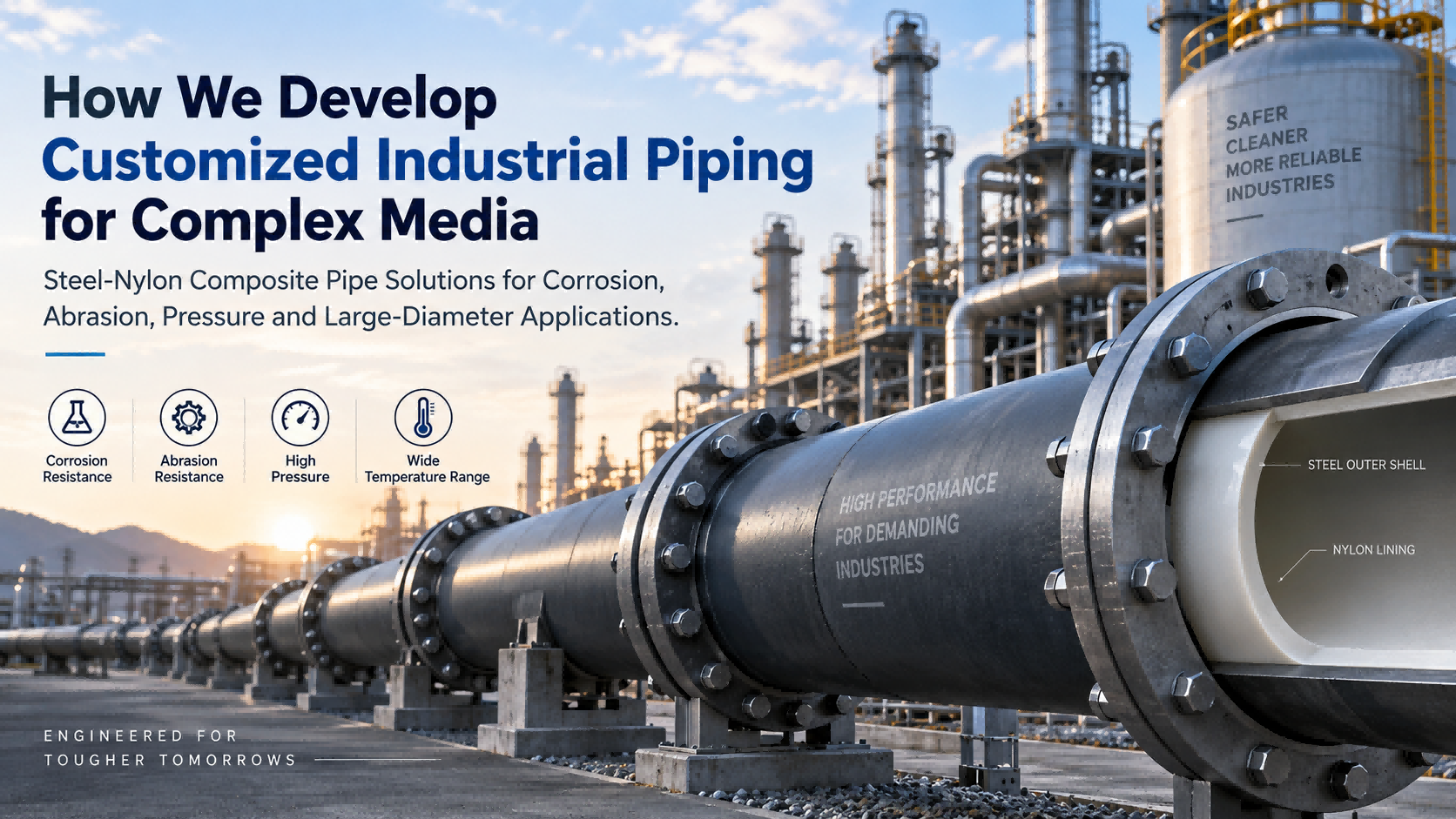
Core Directions for the Continuous Technological Advancement of Steel–Nylon Composite Pipes

In industries such as oil and gas, chemicals, mining, salt chemicals, chlor-alkali, soda ash, and industrial water treatment, pipeline systems are being exposed to increasingly demanding operating conditions.
In the past, industrial pipeline material selection often revolved around one primary question:
Which material offers better corrosion resistance?
Today, however, engineering requirements have changed significantly. More and more industrial piping systems must simultaneously withstand corrosion, abrasion, pressure, temperature fluctuations, slurry erosion, scaling, frequent start-stop cycles, and large-volume transportation.
As a result, competition among industrial piping materials is no longer simply about corrosion resistance.
The more important question is:
Can the pipeline maintain structural integrity, liner stability, hydraulic efficiency, and overall system reliability under complex operating conditions over an extended service life?
Steel–nylon composite pipe technology continues to evolve in response to these challenges.
By combining the mechanical strength of steel with the corrosion resistance, wear resistance, and low-friction properties of a nylon inner liner, steel–nylon composite pipes create a composite structure capable of balancing mechanical performance with resistance to aggressive process media.
However, steel–nylon composite pipe technology is not a finished or static technology.
The future competitiveness of this piping system will not be determined simply by increasing wall thickness or improving one isolated performance parameter. Instead, technological advancement will increasingly focus on the coordinated optimization of materials, structural design, manufacturing, connections, quality control, and lifecycle performance.
1. Why Does Steel–Nylon Composite Pipe Technology Need to Keep Evolving?
The development of industrial piping technology is fundamentally driven by changes in operating conditions.
In the past, a chemical pipeline might have transported a relatively stable liquid.
Today, the same industrial pipeline may need to withstand several challenges at the same time:
-
Corrosive liquids
-
Solid-particle erosion
-
Temperature fluctuations
-
High flow velocities
-
Pressure fluctuations
-
Vacuum or negative-pressure conditions
-
Large-diameter transportation
-
Long-distance operation
-
Frequent start-stop cycles
-
High maintenance-cost constraints
This is particularly important in systems handling oilfield produced fluids, mineral slurry, salt sludge, mother liquor, caustic solutions, industrial wastewater, and other particle-containing corrosive media.
Simply solving the corrosion problem is no longer enough.
One material may provide excellent corrosion resistance but suffer rapid wear under high solids concentrations. Another material may perform well against abrasion but have limitations related to temperature, pressure, or connection reliability.
Therefore, the next stage of steel–nylon composite pipe development should follow a broader principle:
The objective must shift from solving a single material problem to improving the reliability of the entire piping system.
2. Core Direction One: From General-Purpose Nylon to Application-Specific Material Systems
One of the most important functional layers in a steel–nylon composite pipe is the nylon liner that comes into direct contact with the transported medium.
The properties of the nylon liner directly influence:
-
Corrosion resistance
-
Wear resistance
-
Temperature capability
-
Impact resistance
-
Dimensional stability
-
Long-term aging performance
Future technological development should therefore move away from using a single material formulation for every application and toward more specialized application-specific material systems.
Strong-Alkali Applications
Industries such as chlor-alkali, soda ash, and salt chemicals frequently involve alkaline solutions, mother liquors, and high-salinity media.
In these environments, the liner material must maintain not only chemical stability but also long-term mechanical integrity.
Combined Corrosion and Abrasion
Mineral slurry, salt sludge, and sand-containing oilfield produced fluids create a different challenge.
These applications require a combination of:
Corrosion resistance + abrasion resistance + impact resistance
rather than relying on corrosion resistance alone.
Temperature-Fluctuation Conditions
Some industrial systems experience substantial operating changes during startup, shutdown, cleaning, and seasonal temperature variations.
The material must therefore tolerate a realistic range of operating temperatures rather than being evaluated solely at one laboratory test temperature.
One important future direction for steel–nylon composite pipe technology is consequently the establishment of a more systematic relationship between:
Material grade – medium – concentration – temperature – pressure – flow velocity – solids concentration
This will transform pipeline selection from simply choosing a pipe material into designing a material system specifically matched to the operating environment.
3. Core Direction Two: Improving Long-Term Stability at the Steel–Nylon Interface
The true technical challenge of composite piping is often not the performance of the individual materials themselves.
The more difficult question is:
How can two different materials continue to function reliably as one integrated structure over many years of operation?
Steel and nylon have significantly different physical and mechanical properties, including:
-
Different elastic moduli
-
Different thermal expansion behavior
-
Different surface characteristics
-
Different load-bearing characteristics
The manufacturing of steel–nylon composite pipes must therefore focus heavily on the long-term stability of the interface between the steel structure and the nylon liner.
A high-quality composite pipe should not merely demonstrate that the two materials were successfully combined at the time of production.
The more important question is:
Will the composite structure remain stable after years of field operation?
Future technological development will increasingly focus on several areas.
3.1 Steel Substrate Surface Preparation
The surface condition of the steel substrate can influence the stability of the composite interface.
Rust removal, cleaning, surface preparation, surface roughness, and pre-forming treatment can therefore become important parts of the overall quality-control process.
3.2 Stability of the Forming Process
Temperature, processing time, material flow behavior, and cooling conditions can all affect the final composite structure.
If manufacturing parameters are not consistently controlled, different pipes from the same production batch may exhibit variations in performance.
3.3 Thermal Stress Management
Steel and nylon respond differently to temperature changes.
Reducing interface stress caused by long-term thermal cycling through improved structural design and manufacturing processes will therefore be an important route toward extending service life.
The competitive advantage of future composite pipe manufacturers will increasingly shift from:
“Can we manufacture this pipe?”
to:
“Can we manufacture it consistently, reliably, and with stable quality across large production batches?”
4. Core Direction Three: Larger Diameters, Higher Pressure Ratings, and More Complex Structures
The increasing scale of industrial plants is driving demand for larger pipeline systems.
Historically, some non-metallic piping materials have been used primarily in small- and medium-diameter, relatively low-pressure systems.
Large chemical plants, mining facilities, oilfields, and industrial transportation projects increasingly require:
-
Diameters above DN500
-
Large pipelines above DN1000
-
DN1600 and even DN2000-class ultra-large-diameter pipelines
-
Higher design pressures
-
High-volume continuous transportation
These requirements place much greater demands on composite pipe manufacturing.
As pipe diameter increases, many manufacturing challenges become more pronounced, including:
-
Roundness control
-
Wall-thickness uniformity
-
Liner-thickness consistency
-
Flange alignment
-
Structural rigidity
-
Uniform forming temperature
-
Cooling shrinkage
-
Deformation during lifting
-
Stability during transportation
For this reason, producing large-diameter steel–nylon composite pipes is not simply a matter of making a small pipe larger.
It requires comprehensive improvements in:
-
Production equipment
-
Tooling and molds
-
Material formulation
-
Steel structural design
-
Manufacturing processes
-
Inspection systems
Our steel–nylon composite pipe product system is designed to accommodate a wide range of industrial diameters and pressure requirements, while manufacturing capabilities continue to advance toward DN2000-class ultra-large diameters and stable production across pressure ratings from 1.0 to 4.0 MPa.
For large industrial projects, this capability has an important practical implication:
Corrosion-resistant and wear-resistant composite piping can increasingly be applied to major process pipelines rather than being restricted to small auxiliary lines.
5. Core Direction Four: From Corrosion Resistance to Combined Corrosion and Wear Resistance
Many industrial pipeline failures are not caused by chemical corrosion alone.
This is especially true in systems handling:
-
Sand-containing oilfield produced fluids
-
Mine tailings
-
Phosphate slurry
-
Salt sludge
-
Lime slurry
-
Industrial solid-liquid mixtures
-
High-velocity mother liquor
The pipe wall may simultaneously experience:
Chemical corrosion + mechanical erosion
When particles continually damage the material surface, fresh material is repeatedly exposed to the corrosive medium.
As a result, corrosion and abrasion can reinforce each other.
This explains why some materials that perform well in static corrosion testing may still experience significantly reduced service life when exposed to actual slurry transportation conditions.
An important development direction for steel–nylon composite pipes is therefore to further improve performance under these combined operating conditions.
The nylon inner surface provides strong wear resistance, while the steel structure carries the main mechanical loads.
This combination makes steel–nylon composite pipes particularly suitable for applications where:
Corrosion and abrasion occur simultaneously.
Future evaluation of industrial piping materials should therefore move beyond simple corrosion-resistance classifications and consider a broader range of factors, including:
-
Corrosion performance
-
Wear rate
-
Flow velocity
-
Solids concentration
-
Particle size
-
Temperature
-
Pressure
-
Long-term cyclic performance
This provides a much more realistic basis for engineering material selection than simply comparing material names.
6. Core Direction Five: Reducing Flow Resistance and Scaling Risk
Industrial pipelines are more than pressure-containing structures.
They are also long-term fluid transportation systems.
The condition of the internal pipe surface can directly affect:
-
Flow capacity
-
Pumping energy consumption
-
Pressure drop
-
Scaling rate
-
Cleaning frequency
-
Overall operating efficiency
In some traditional metallic pipelines, long-term operation may result in the following progression:
Corrosion products accumulate → internal surface becomes rougher → scaling increases → effective internal diameter decreases → flow resistance rises
This means that even if a pipe has not yet leaked, its operating cost may gradually increase because of reduced hydraulic efficiency.
The relatively smooth nylon inner surface of steel–nylon composite pipes can help reduce friction between the transported medium and the pipe wall and may reduce deposition and adhesion under suitable operating conditions.
An important future area of technological development will therefore be the relationship between:
Internal surface performance and the energy efficiency of the entire transportation system.
Pipeline value should no longer be evaluated only by asking:
“How many years can the pipe last?”
It should also consider:
-
How much pumping energy is consumed during its service life?
-
How often does the line require cleaning?
-
How frequently does operation need to stop for maintenance?
This represents an important transition from selling a piping material to providing a system-efficiency solution.
7. Core Direction Six: Continuous Optimization of Flanged Connections and Modular Installation
Pipeline reliability is not determined by straight pipe sections alone.
Many leakage and maintenance problems occur around:
-
Flanges
-
Elbows
-
Tees
-
Reducers
-
Valves
-
Pump discharge sections
-
Pipeline connection points
For this reason, the future development of steel–nylon composite piping systems cannot focus only on the pipe body.
A mature industrial piping solution should gradually develop into a complete system consisting of:
Straight pipes + elbows + tees + reducers + flanges + special fittings
Steel–nylon composite pipes use flanged connections, allowing a significant portion of field assembly to be completed mechanically.
For chemical plants, oilfields, and retrofit projects where frequent welding or hot work is undesirable, this connection method can provide important engineering advantages.
It is particularly suitable for staged replacement and localized upgrades, including:
-
Replacement of high-wear elbows
-
Pump discharge pipe upgrades
-
Pipe sections upstream and downstream of valves
-
100–500 meter trial sections
-
Partial replacement of aging pipelines
This allows the most vulnerable parts of a system to be upgraded without necessarily replacing the entire pipeline.
Future development should further improve:
-
Flange dimensional consistency
-
Sealing reliability
-
Installation standardization
-
Completeness of the fitting system
-
Ease of field maintenance
The ultimate goal is to create a more modular industrial piping installation system.
8. Core Direction Seven: External Corrosion Protection as a New Competitive Advantage
Discussions about composite piping often focus mainly on internal corrosion.
In real industrial environments, however, the outside surface of the pipeline may also be exposed to severe corrosion.
Marine and Coastal Environments
Salt spray, high humidity, and chloride exposure can aggressively attack external steel surfaces.
Chemical Plants
Acid mist, alkaline mist, salt aerosols, and corrosive gases can create highly aggressive atmospheric conditions.
Oilfield Environments
Buried installation, moisture, saline-alkali soils, and outdoor exposure may all contribute to external steel corrosion.
Future steel–nylon composite pipe technology will therefore increasingly emphasize:
Internal corrosion resistance + external corrosion protection
Different external protection systems can be developed for different environments, such as:
-
Standard industrial versions
-
Enhanced chemical-plant versions
-
High-salt-spray coastal versions
-
Marine-environment versions
-
Buried-service versions
This development allows steel–nylon composite pipes to evolve from solving only process-medium corrosion to addressing:
The overall corrosion risk of the pipeline in its complete operating environment.
9. Core Direction Eight: From Final Product Inspection to Full-Process Quality Control
As industrial pipelines become larger and more demanding, relying solely on final inspection before shipment is no longer sufficient.
A stable manufacturing system must move quality control upstream into every stage of production.
A comprehensive quality-control system should include:
Raw Material Control
Verification of nylon raw materials, steel materials, and critical auxiliary materials to ensure consistency.
Steel Structure Manufacturing
Control of dimensions, roundness, welding quality, and flange accuracy.
Surface Preparation
Ensuring that the steel surface meets the required condition before composite forming.
Nylon Forming
Control of temperature, processing time, material condition, and liner thickness.
Finished Product Inspection
Inspection of dimensions, appearance, pressure performance, and critical structural characteristics.
For advanced composite pipe manufacturers, future competitiveness will no longer depend simply on whether inspection equipment is available.
The more important question will be:
Can the manufacturer establish a complete and traceable production-quality data chain?
Ultimately, each production batch—and potentially each individual pipe—can be linked to corresponding production and inspection records.
For large international engineering projects, this level of manufacturing traceability will become increasingly important.
10. Core Direction Nine: From Standard Products to Industry-Specific Pipeline Solutions
There is no single industrial piping material suitable for every chemical medium and every operating condition.
This is also one of the most important principles that steel–nylon composite pipe suppliers must recognize.
A professional supplier should not simply tell customers:
“Steel–nylon composite pipe can transport everything.”
Instead, the supplier should first understand:
-
What medium is being transported?
-
What is its concentration?
-
What is the operating temperature?
-
What is the design pressure?
-
Does the medium contain solid particles?
-
What is the flow velocity?
-
Is vacuum or negative pressure possible?
-
Is the installation indoors or outdoors?
-
Is the pipeline buried?
-
Is the external environment exposed to salt spray or chemical atmospheric corrosion?
Only after these factors are understood should material suitability be evaluated.
Typical applications where steel–nylon composite pipes can offer significant advantages include:
-
Oilfield gathering and transportation systems
-
Sand-containing produced fluids
-
Oilfield water injection
-
Chlor-alkali production
-
Caustic soda and alkaline media
-
Soda ash mother liquor
-
Salt chemical processing
-
Certain weak-acid applications
-
Mineral slurry transportation
-
Phosphate slurry systems
-
Corrosive industrial wastewater
-
Applications involving both corrosion and abrasion
For strongly oxidizing media, concentrated strong acids, or other special chemical environments outside the appropriate material range, detailed chemical compatibility evaluation should be performed before material selection.
Correct material selection is itself a core technical capability.
11. Core Direction Ten: From Selling Pipe to Optimizing Total Cost of Ownership
Industrial pipeline procurement is undergoing an important transition.
In the past:
Initial purchase price was often one of the dominant decision criteria.
Increasingly:
Total Cost of Ownership (TCO) is becoming a more important consideration.
The actual cost of an industrial pipeline should include:
TCO = Initial Purchase Cost + Installation Cost + Maintenance Cost + Downtime Losses + Replacement Cost + Energy Cost
If a pipe has a low initial purchase price but requires frequent:
-
Leak repairs
-
Replacement
-
Cleaning
-
Production shutdowns
its long-term cost may ultimately be much higher than that of a more durable pipeline system with a higher initial investment.
The future value proposition of steel–nylon composite pipe technology should therefore go beyond the statement:
“The material is corrosion resistant.”
The more important question is:
Can it reduce maintenance frequency, minimize unplanned shutdowns, and extend the operating cycle of the entire piping system under the specified conditions?
That is the ultimate objective of technological advancement in steel–nylon composite piping.
12. What Will Define the Future Competitiveness of Steel–Nylon Composite Pipes?
Future competition in steel–nylon composite piping will increasingly be determined not simply by the name of the material, but by the supplier's overall technical capabilities.
| Core Capability | Engineering Value |
|---|---|
| Material development capability | Adapting materials to different media and demanding operating conditions |
| Structural design capability | Improving pressure resistance and long-term structural stability |
| Large-diameter manufacturing capability | Supporting large-scale industrial projects |
| Batch quality-control capability | Ensuring dimensional and performance consistency across project quantities |
| Application engineering capability | Reducing lifecycle risks under complex operating conditions |
A professional steel–nylon composite pipe manufacturer should therefore be able to answer more than:
“What is the largest diameter you can produce?”
It should also be able to answer:
“Why is this structure suitable for this operating condition?”
“Is the material compatible with the process medium?”
“What are the main long-term failure risks?”
“How can maintenance frequency and unplanned shutdowns be reduced?”
These questions increasingly define the real technological competition in industrial piping.
13. Our Technology Development Direction
We have long focused on the development and manufacturing of corrosion-resistant and wear-resistant industrial piping systems, with core products including reinforced MC nylon pipes and steel–nylon composite pipes.
Our technology development is not simply aimed at creating more product models.
Instead, we continue to strengthen our capabilities around demanding industrial applications, including:
-
Integrated corrosion- and wear-resistant design
-
Long-term stability between the steel structure and nylon liner
-
Manufacturing across 1.0–4.0 MPa pressure classes
-
Large-diameter and DN2000-class manufacturing capabilities
-
Flanged connection systems and matching fittings
-
Dimensional and performance consistency in large production batches
-
Application engineering for chemical, oilfield, mining, and salt chemical industries
-
Long-service-life and low-maintenance piping solutions
Our objective is not simply to provide another piping material.
It is to help customers solve a much more practical engineering problem:
How can demanding industrial fluid transportation systems operate longer and more reliably while reducing repeated maintenance and pipeline replacement?
Conclusion: The Next Generation of Steel–Nylon Composite Pipes Is Ultimately About System Reliability
The future development of steel–nylon composite pipe technology will not be defined by improvements to one isolated performance parameter.
Instead, it will depend on systematic advancement across:
Materials, structural design, manufacturing, connections, quality control, and engineering application.
As industrial pipelines become larger, required operating cycles become longer, and the financial consequences of shutdowns continue to increase, customers will increasingly look beyond the question:
“How much does this pipe cost per meter?”
Instead, they will ask:
-
How long can it operate?
-
Can it withstand the actual process conditions?
-
Is it easy to maintain?
-
Is it prone to scaling?
-
Will frequent shutdowns be required?
-
Is batch-to-batch quality consistent?
-
Can the supplier solve complex engineering problems?
The evolution of steel–nylon composite pipe technology is therefore part of a broader transformation in the industrial piping industry—from material procurement toward system reliability and lifecycle value.
For industrial pipelines exposed to combinations of corrosion, abrasion, large diameters, elevated pressure requirements, or high maintenance costs, this transition will become increasingly important.
Need to evaluate whether steel–nylon composite pipe is suitable for your project?
Provide us with your process medium, concentration, operating temperature, design pressure, pipe diameter, flow velocity, and solids content. Based on the actual operating conditions, we can evaluate material suitability and develop an appropriate piping solution.
R&D and Industrial Applications of PAMC Nylon in Industrial Piping Systems