Long-Term Performance Review of Steel–Nylon Composite Pipes in Oilfield Gathering and Transportation Systems
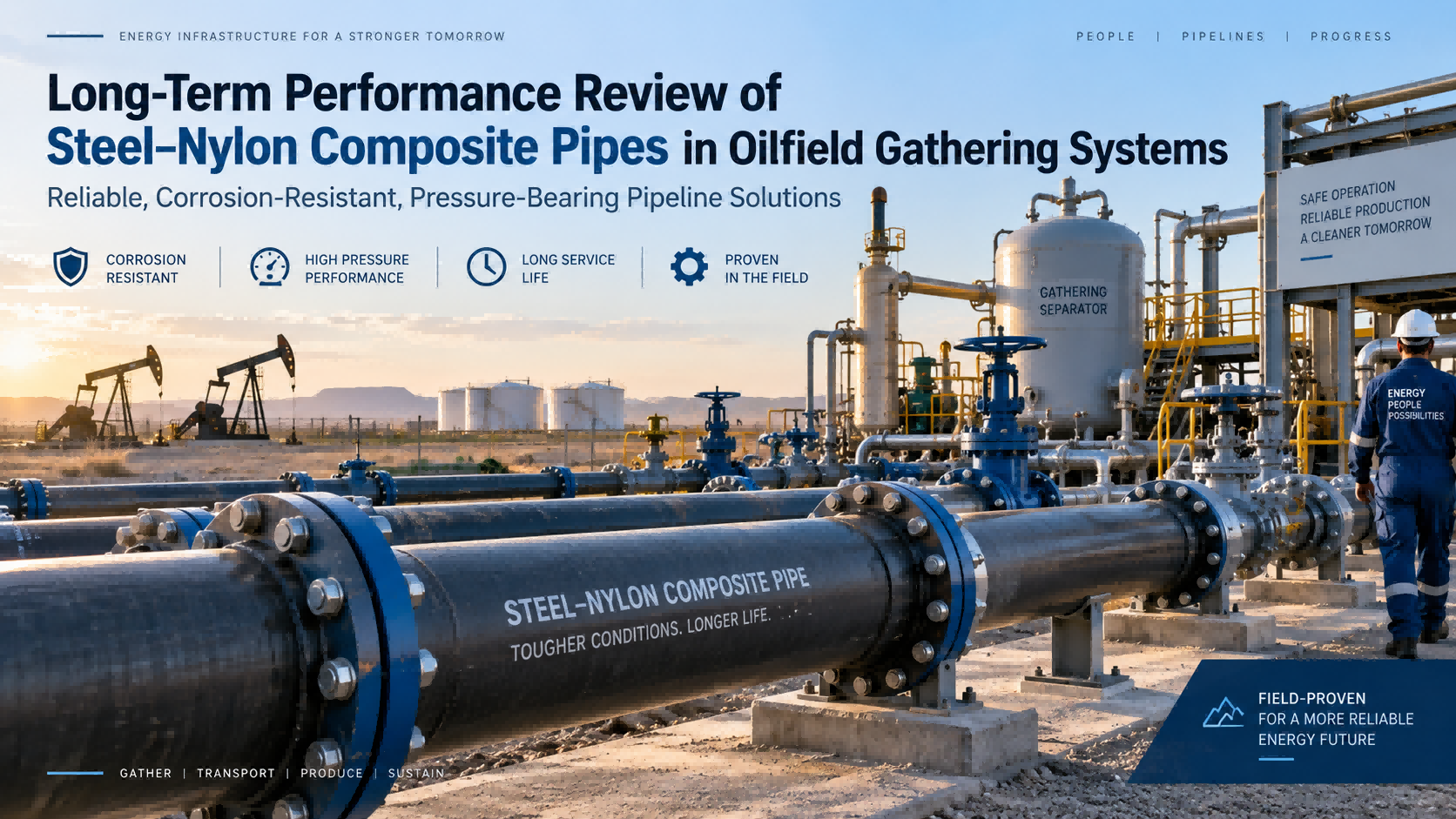
From Pipeline Corrosion Control to Lifecycle Management: How Steel–Nylon Composite Pipes Improve the Long-Term Reliability of Oilfield Gathering Systems
Introduction: The Real Test of Oilfield Pipelines Is Not Installation, but Long-Term Operational Reliability
In oil and gas development, gathering and transportation systems play a critical role in collecting, transporting, and processing crude oil, natural gas, produced water, and multiphase fluids. These systems connect wellheads, gathering stations, treatment facilities, and downstream production infrastructure.
Compared with conventional industrial pipelines, oilfield gathering pipelines often operate under more challenging conditions.
On the one hand, produced fluids in certain oilfields contain high concentrations of dissolved salts and chloride ions, while some operating environments also involve hydrogen sulfide (H₂S), carbon dioxide (CO₂), and corrosive aqueous phases.
On the other hand, as oilfields mature, produced water content, fluid composition, transportation pressure, and operating temperature may change significantly.
For conventional carbon steel pipelines, internal corrosion, localized wall thinning, leakage, and frequent maintenance can become major challenges affecting long-term operational reliability.
Consequently, pipeline material selection in oilfield gathering systems is gradually shifting from an emphasis on initial procurement costs toward a more comprehensive evaluation of corrosion resistance, structural reliability, maintenance requirements, and total lifecycle costs.
Steel–nylon composite pipes offer an engineering solution that combines pressure-bearing capability, corrosion resistance, and mechanical performance to meet the demanding requirements of oilfield gathering and transportation systems.
Our company specializes in the research, development, and manufacturing of reinforced MC nylon pipes and steel–nylon composite pipes.
Through material engineering, composite structural design, and innovative connection technologies, we are committed to providing reliable industrial piping solutions for oil and gas operations, chemical processing, and other demanding industrial applications.
This article reviews the key considerations involved in the long-term application of steel–nylon composite pipes in oilfield gathering systems, focusing on material selection, corrosion resistance, connection design, operational maintenance, and lifecycle economics.
It also explores the potential value of steel–nylon composite pipes in oilfield pipeline modernization.
Note: This article is structured around typical oilfield gathering conditions and the technical considerations involved in long-term pipeline performance reviews. Since specific project operating records have not been provided, no project names, actual operating durations, leakage rates, or cost savings have been fabricated. Verified project documentation and field inspection results should be incorporated before publishing this article as a specific engineering case study.
1. Project Background: Why Do Oilfield Gathering Systems Need to Reconsider Conventional Pipeline Materials?
1.1 The Impact of Highly Mineralized Produced Fluids on Pipeline Service Life
In some oilfield gathering systems, the water content of produced fluids gradually increases as oilfields enter the middle and later stages of development.
When produced water contains high concentrations of chloride ions, dissolved salts, and corrosive gases, conventional carbon steel pipelines may experience increasingly complex corrosion conditions.
In particular, when free water and CO₂ are present, dissolved carbon dioxide can create a corrosive aqueous environment, potentially causing uniform or localized corrosion of carbon steel.
The presence of H₂S may also introduce additional risks, including sulfide-related corrosion and, under certain conditions, sulfide stress cracking in susceptible materials.
When corrosion and solid-particle erosion occur simultaneously, localized material loss may become more severe.
For long-distance oilfield gathering pipelines, these problems can affect pipeline service life while increasing the complexity of leakage control, production shutdowns, and field maintenance.
Therefore, selecting pipeline materials solely based on initial procurement prices may fail to reflect their actual value throughout the entire operating lifecycle.
1.2 The Challenges of Maintaining Oilfield Gathering Pipelines
Oilfield gathering systems often extend across large geographical areas and involve long transportation distances and complex operating environments.
Some pipelines are located in deserts, remote oilfields, cold regions, or areas with limited transportation infrastructure.
When pipeline leakage occurs, repairs may involve production shutdowns, pipeline isolation, draining, cleaning, excavation, and replacement of damaged sections.
For systems transporting flammable, explosive, or H₂S-containing fluids, maintenance activities must also comply with strict safety procedures.
These factors have increased the importance of long-term pipeline reliability in oilfield development and operations.
Under appropriate design and operating conditions, selecting pipeline materials with improved corrosion resistance can help reduce maintenance requirements associated with internal corrosion.
This is one of the primary reasons why steel–nylon composite pipes are attracting attention as a potential solution for oilfield gathering and transportation applications.
2. Material Selection Review: Why Consider Steel–Nylon Composite Pipes?
Conventional oilfield gathering pipelines commonly use carbon steel, internally coated steel, non-metallic pipes, and other composite piping materials.
Each material has its own advantages and limitations.
For example, carbon steel pipes benefit from established manufacturing and installation processes. However, when transporting corrosive produced fluids, they may require internal coatings, corrosion inhibitor injection, or other corrosion control measures.
Certain non-metallic pipes offer excellent corrosion resistance. Nevertheless, their long-term pressure performance, deformation characteristics, and connection reliability must be carefully evaluated under elevated pressures, temperature variations, and complex mechanical loads.
Steel–nylon composite pipes take a different approach.
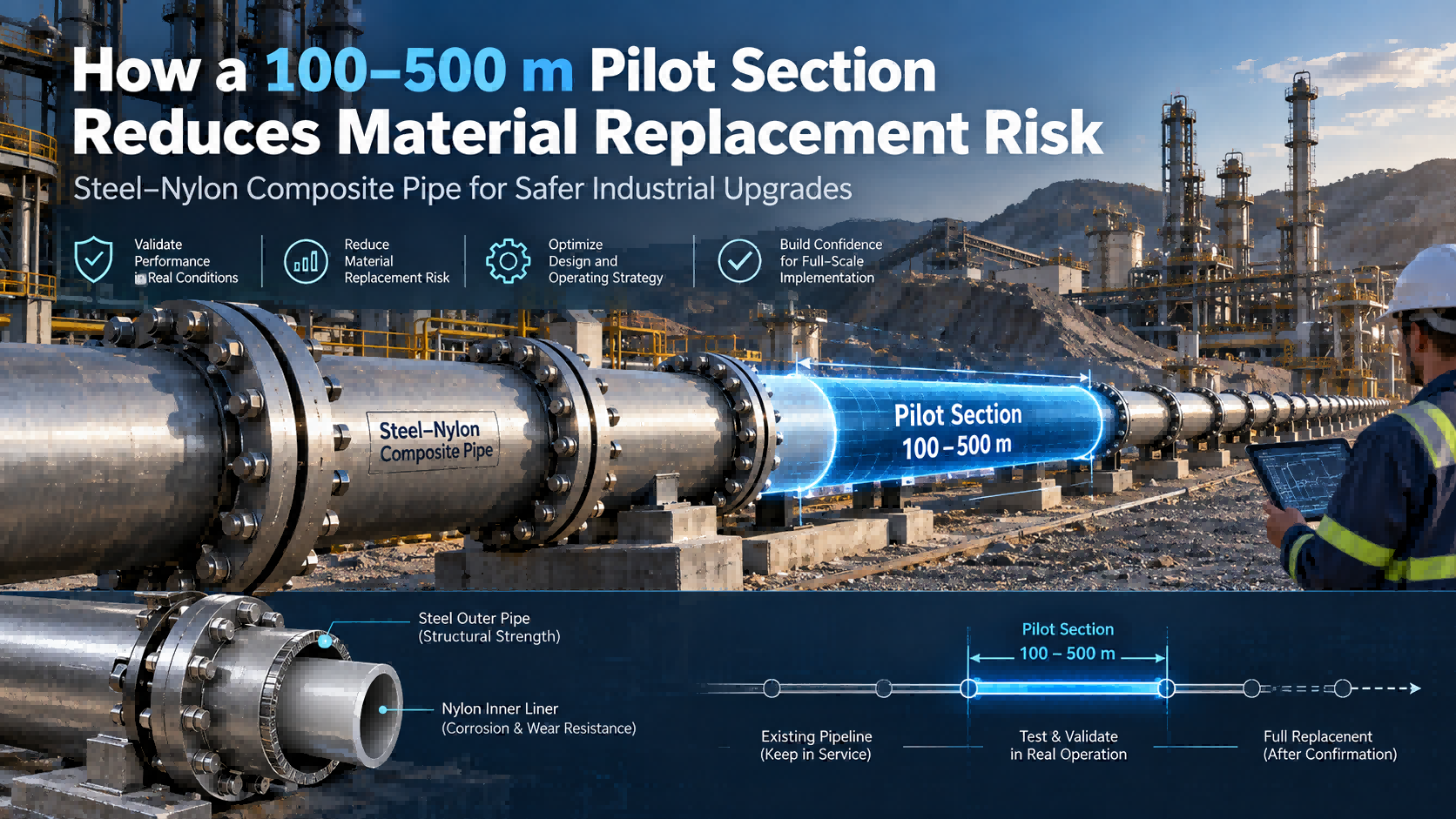
Their design combines the structural load-bearing properties of steel with the corrosion resistance and wear resistance of nylon.
Through an engineered composite structure, the two materials perform complementary functions within the pipeline.
2.1 Steel Provides Structural Support and Pressure-Bearing Capability
In steel–nylon composite pipes, the steel structure provides essential mechanical support.
By properly designing the steel wall thickness, connection components, and overall pipeline structure, the pipe can be engineered to meet the internal pressure, mechanical loading, and dimensional stability requirements of different industrial projects.
Our steel–nylon composite pipes are available in pressure rating series ranging from 1.0 to 4.0 MPa, providing product options for industrial transportation systems with different design pressure requirements.
However, the allowable design pressure for a specific project must be determined by considering pipe diameter, operating temperature, connection structure, mechanical loads, and applicable engineering standards.
A product's nominal pressure rating should not be used as a substitute for project-specific engineering verification.
2.2 Nylon Provides a Protective Layer in Contact with the Transported Medium
Another important feature of steel–nylon composite pipes is the use of nylon as the functional layer in contact with the transported fluid.
When material compatibility has been verified, the nylon layer can reduce direct contact between corrosive fluids and the steel structure, thereby reducing the risk of internal steel corrosion.
This material combination is particularly relevant to applications involving highly mineralized produced water, dissolved salts, and certain abrasive particles.
Nylon also possesses wear-resistant properties, making it a potential material for selected applications involving fluids containing solid particles.
However, actual wear performance depends on several factors, including particle hardness, particle size, concentration, flow velocity, impact angle, and operating temperature.
The primary advantage of steel–nylon composite pipes does not depend on the performance of a single material. Instead, it lies in the functional combination of steel and nylon to achieve both structural strength and protection against aggressive transported media.
3. Key Factors Affecting Long-Term Performance: What Challenges Must Composite Pipelines Address?
The operational reliability of oilfield pipelines depends not only on pipe materials but also on structural design, connection methods, operating conditions, and installation quality.
For steel–nylon composite pipes, several factors require particular attention during long-term operation.
3.1 Corrosion Resistance: Reducing the Impact of Corrosive Media on the Steel Structure
For oilfield gathering pipelines with high produced water content, continuous contact between the pipe's internal surface and produced water can create conditions for internal corrosion.
In steel–nylon composite pipes, the nylon layer serves as a protective barrier between the transported fluid and the steel structure.
Provided that the nylon layer remains intact, continuous, and compatible with the transported medium, it can reduce direct contact between corrosive fluids and the steel.
This design can help reduce internal corrosion risks associated with direct exposure of steel to corrosive media.
However, for oil and gas transportation systems containing H₂S, CO₂, or other complex fluid components, the long-term chemical compatibility of nylon must be carefully evaluated.
Gas permeation behavior and material performance under changing pressure and temperature conditions also require consideration.
In applications involving high gas partial pressures or rapid depressurization, the suitability of the nylon layer and composite interface should be assessed through appropriate testing and engineering analysis.
Furthermore, corrosion protection for the external steel structure, flanges, and fasteners should be incorporated into the overall corrosion control strategy.
A comprehensive approach to both internal and external corrosion protection is essential for achieving long-term pipeline reliability.
3.2 Wear Resistance: Managing Long-Term Erosion from Sand-Containing Produced Fluids
Some oil wells produce fluids containing sand and other solid particles.
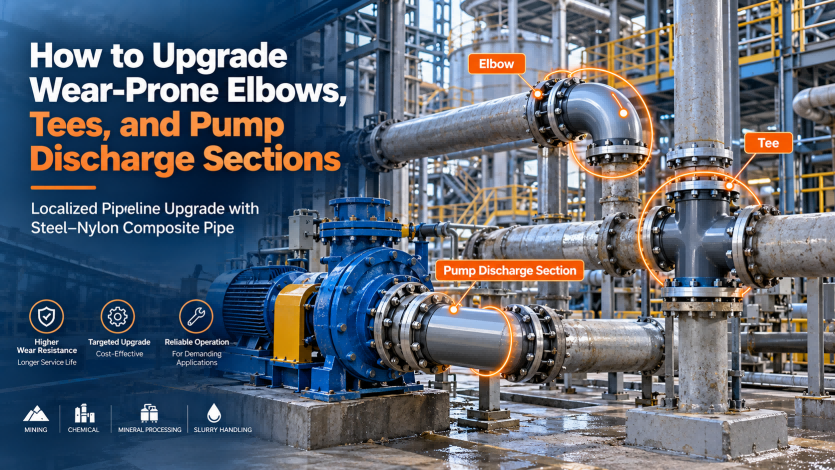
When these fluids pass through elbows, tees, reducers, and other components where flow direction changes, localized erosion may become more pronounced.
Under these conditions, pipeline materials must provide both suitable corrosion resistance and sufficient wear resistance to withstand the actual operating environment.
The reinforced MC nylon materials used in our products offer wear-resistant properties and can be considered for selected applications where corrosion and abrasion occur simultaneously.
However, in applications involving high sand concentrations, high flow velocities, or severe particle impact, the actual wear resistance of pipes, elbows, and connection components must be verified through appropriate testing and engineering assessment.
Pipeline design should also consider flow velocity control, optimized routing, and additional protection for locations susceptible to localized erosion.
For long-term oilfield applications, material performance and hydraulic design should work together. No single material can eliminate every form of erosion or wear.
3.3 Temperature Resistance: Evaluating Both Material Properties and Composite Structural Stability
The operating temperature of oilfield gathering pipelines varies according to geographical location, wellhead fluid temperature, ambient conditions, and production processes.
In cold-region oilfields, pipeline materials must be evaluated for low-temperature toughness, connection sealing performance, and the effects of temperature fluctuations.
For systems transporting higher-temperature produced fluids, the long-term thermal properties and creep behavior of nylon must be considered.
Differences in thermal expansion between steel and nylon also require appropriate structural design.
Our company provides steel–nylon composite pipe products for different operating conditions.
However, the allowable operating temperature of a specific product should be determined according to its material grade, structural design, verified test data, and project-specific requirements.
For long-term applications, it is particularly important to confirm the pipe's sustained performance under combined temperature and pressure conditions.
Material selection should not be based solely on short-term temperature resistance.
4. Connection Design Review: Why Are Flanged Connections Important for Long-Term Pipeline Reliability?
In oilfield gathering systems, pipe connections are critical components affecting the overall sealing reliability of a pipeline.
Even when the pipe body provides excellent corrosion resistance, poorly designed connections can still experience leakage due to sealing failure, installation misalignment, or localized stress concentration.
For this reason, our company places considerable emphasis on the development and optimization of flanged connection structures for steel–nylon composite pipes.
4.1 Integrally Formed Flange Design
Steel–nylon composite pipes can incorporate integrally formed flange connection solutions designed to match the pipe's composite structure.
By optimizing the structural design of the pipe body and flange connection, the system can be better suited to prefabrication and on-site assembly.
For projects meeting the relevant design requirements, prefabricated flanged pipe sections can reduce the need for on-site welded connections.
This approach can reduce reliance on welding equipment and certain hot-work activities during installation.
It may be particularly valuable in industrial environments where hot-work operations must be strictly controlled.
However, using flanged connections does not mean that an entire installation project will be completely free of hot work.
Actual construction procedures must still comply with applicable safety requirements for pipeline installation, support fabrication, and other on-site activities.
4.2 Maintaining Corrosion Protection at Pipe Connections
The corrosion protection performance of steel–nylon composite pipes depends not only on the internal nylon layer but also on the design of flange sealing surfaces and pipe-end structures.
For corrosive fluid transportation, the materials and sealing structures in contact with the transported medium must be suitable for the actual operating conditions.
Connection designs should prevent corrosive fluids from reaching vulnerable steel components through gaps, discontinuities, or other defects.
Proper pipe-end design, flange sealing surface engineering, and gasket selection can help improve the overall reliability of pipeline connections.
4.3 Reducing On-Site Installation Complexity
Long-distance oilfield gathering pipelines require numerous pipe connections during installation.
Prefabricated pipe sections with flanged connections allow certain assembly operations to be completed at the factory.
This can reduce the amount of on-site fabrication required.
Nevertheless, flanged connections still require appropriate gasket selection, bolt preload control, flange alignment, and management of additional mechanical loads.
During long-term operation, critical connection points should be inspected according to fluid characteristics, temperature variations, and operating requirements.
The value of integrally formed flange technology therefore extends beyond installation convenience.
It also lies in the coordinated improvement of connection design, prefabrication quality, and on-site construction management.
5. From Commissioning to Long-Term Operation: How Should the Performance of Steel–Nylon Composite Pipe Projects Be Evaluated?
For oilfield pipelines, installation and acceptance represent only the beginning of the operational lifecycle.
The true value of a pipeline is demonstrated by its performance under actual operating conditions over time.
Therefore, long-term performance reviews of steel–nylon composite pipes should be based on continuous operating records and field inspection data.
Stage 1: Installation and Commissioning Acceptance
Before commissioning, pipelines should undergo appropriate inspections in accordance with applicable engineering standards, design requirements, and product specifications.
These inspections may include dimensional and visual checks, connection inspections, specified pressure or leak-tightness testing, and verification of pipeline supports and layout.
For steel–nylon composite pipes, particular attention should be paid to the integrity of the nylon functional layer and the condition of pipe-end connection structures.
Installation records, pressure test results, and initial condition assessments provide an essential reference for subsequent operational evaluations.
Stage 2: Initial Operational Monitoring
After commissioning, operators should verify that actual operating pressure, temperature, fluid composition, and flow rate remain consistent with the design conditions.
Flanged connections should be inspected for abnormal leakage.
Pipeline supports, vibration, and the effects of temperature variations should also be monitored.
Initial operational monitoring is particularly important for gathering pipelines exposed to high sand concentrations or significant pressure fluctuations.
Identifying differences between actual operating conditions and the original design assumptions allows operators to make appropriate adjustments and develop more effective maintenance plans.
Stage 3: Long-Term Condition Assessment
As pipelines enter sustained operation, evaluation should focus on the long-term stability of materials, structural components, and connections.
Depending on the actual operating environment, the following indicators should be monitored.
| Evaluation Category | Key Inspection and Monitoring Items | Engineering Significance |
|---|---|---|
| Pipe body integrity | Abnormal deformation, structural damage, or leakage | Evaluates overall structural condition |
| Corrosion resistance | Condition of the nylon layer and possible corrosion of steel components | Assesses the effectiveness of corrosion protection |
| Wear resistance | Wear conditions at elbows, tees, and other critical locations | Identifies localized erosion risks |
| Connection reliability | Condition of flanges, gaskets, and fasteners | Evaluates long-term sealing performance |
| Operational stability | Changes in pressure, temperature, flow rate, and fluid composition | Determines whether the pipeline remains within its design conditions |
| Maintenance requirements | Inspection, repair, replacement, and shutdown records | Provides data for evaluating maintenance costs |
It is important to recognize that the performance of steel–nylon composite pipes cannot be evaluated solely through conventional steel pipe wall-thickness inspection methods.
Inspection procedures should be developed according to the characteristics of the composite structure.
By combining product specifications, critical-location inspections, and actual operating records, operators can establish a more comprehensive understanding of pipeline condition.
Only through long-term, traceable operating data can the actual performance and service life of composite pipelines be evaluated objectively.
6. The Economic Value of Long-Term Operation: How Can the Lifecycle Cost of Steel–Nylon Composite Pipes Be Evaluated?
For oilfield operators, the economic value of a pipeline extends beyond its initial procurement price.
Installation, operation, maintenance, production shutdowns, and pipeline replacement must all be considered.
When comparing steel–nylon composite pipes with conventional piping materials, a lifecycle cost (LCC) assessment provides a more comprehensive basis for decision-making.
6.1 Initial Investment Costs
Initial investment costs generally include:
-
Procurement of pipes, fittings, and connection components.
-
Transportation, handling, and on-site installation.
-
Pipeline supports, corrosion protection, and supporting facilities.
-
Pressure testing, inspection, and project acceptance.
Steel–nylon composite pipes incorporate both steel and nylon components.
Their initial procurement costs depend on pipe diameter, pressure rating, product structure, and project purchasing volume.
It should not be assumed that composite pipes always have lower or higher initial costs than alternative materials.
A meaningful comparison must be based on equivalent design conditions, project scope, and acceptance requirements.
6.2 Operating and Maintenance Costs
Conventional metallic pipelines exposed to internal corrosion may require additional corrosion control measures during operation.
Depending on the application, these measures may include corrosion inhibitor injection, pipeline cleaning, periodic inspections, and repairs to corroded sections.
Under verified operating conditions, steel–nylon composite pipes can reduce direct contact between corrosive fluids and the steel structure through their nylon functional layer.
This may help reduce certain maintenance requirements associated with internal corrosion.
However, any reduction in corrosion inhibitor consumption, extension of inspection intervals, or decrease in repair frequency must be supported by project-specific risk assessments and operating data.
Using corrosion-resistant pipeline materials does not eliminate the need for appropriate inspection and maintenance.
6.3 Production Shutdown and Replacement Costs
For long-distance oilfield gathering systems, pipeline leakage or corrosion-related failures can lead to additional production losses.
Beyond repair expenses, operators may incur costs associated with production shutdowns, pipeline cleaning, environmental remediation, and recommissioning.
If a pipeline material maintains stable performance for an extended period under actual operating conditions, it may reduce the frequency of unplanned shutdowns and pipe section replacements caused by material failure.
Therefore, the economic value of steel–nylon composite pipes should be evaluated over the entire operating lifecycle rather than solely at the procurement stage.
6.4 Lifecycle Cost Calculation Model
The lifecycle cost of an oilfield pipeline can be evaluated using the following model:
LCC = Initial Investment Cost + Operating and Maintenance Costs + Production Shutdown Losses + Pipeline Replacement Costs + Decommissioning Costs
In actual projects, the evaluation period, price basis, and discount rate should be consistent across the alternatives being compared.
Residual value may also be considered where appropriate.
For example, a cost comparison model can be established between carbon steel pipelines and steel–nylon composite pipelines under equivalent design conditions.
The model should estimate the initial investment, periodic maintenance, corrosion control, anticipated replacements, and shutdown costs of both solutions over the selected evaluation period.
Historical operating records, equipment maintenance data, and engineering budgets can then be used to calculate their comparative economic performance.
If steel–nylon composite pipes reduce actual corrosion-related repairs and pipeline replacements, they may provide lifecycle cost advantages.
However, these advantages should be demonstrated through verifiable project data rather than inferred solely from material properties.
7. Potential Applications of Steel–Nylon Composite Pipes in Oilfield Gathering Systems
Based on their composite structure, steel–nylon composite pipes can be considered as a potential piping solution for several oilfield transportation applications.
Their suitability must be verified according to fluid composition, pressure, temperature, and actual loading conditions.
7.1 Transportation of Produced Fluids with High Water Content
For gathering systems transporting produced fluids containing corrosive aqueous phases, the nylon functional layer can reduce direct contact between the transported medium and the steel structure.
Material selection should consider the oil-to-water ratio, fluid temperature, chloride concentration, H₂S and CO₂ partial pressures, and the effects of oil-phase components on nylon.
For multiphase oil, gas, and water transportation, gas permeation, rapid depressurization, flow patterns, and localized erosion must also be evaluated.
7.2 Oilfield Produced Water and Water Injection Systems
Oilfield produced water and injection water may contain high concentrations of dissolved salts, along with dissolved gases, suspended solids, and other impurities.
Once material suitability has been verified, steel–nylon composite pipes can be considered for relevant water transportation applications.
By combining the nylon functional layer with a steel load-bearing structure, the composite design offers a potential solution for systems requiring both corrosion resistance and pressure-bearing capability.
For high-pressure water injection projects, pipe selection must strictly follow the project's design pressure requirements.
Pressure ratings intended for conventional gathering pipelines must not be applied directly to higher-pressure injection systems without appropriate engineering verification.
7.3 Remote Oilfields and Long-Distance Gathering Pipelines
Some oil and gas fields are located in deserts, remote regions, or areas with limited transportation infrastructure.
In these environments, pipeline maintenance and replacement can involve substantial field operation costs.
For projects where material suitability has been confirmed, composite pipes with corrosion-resistant functional layers may help reduce repair requirements caused by internal corrosion.
Prefabricated flanged pipe sections can also facilitate certain on-site connection operations and subsequent pipe section replacements.
However, long-distance pipelines must still be designed to accommodate thermal expansion and contraction, support requirements, terrain variations, external loads, and pipeline anchoring.
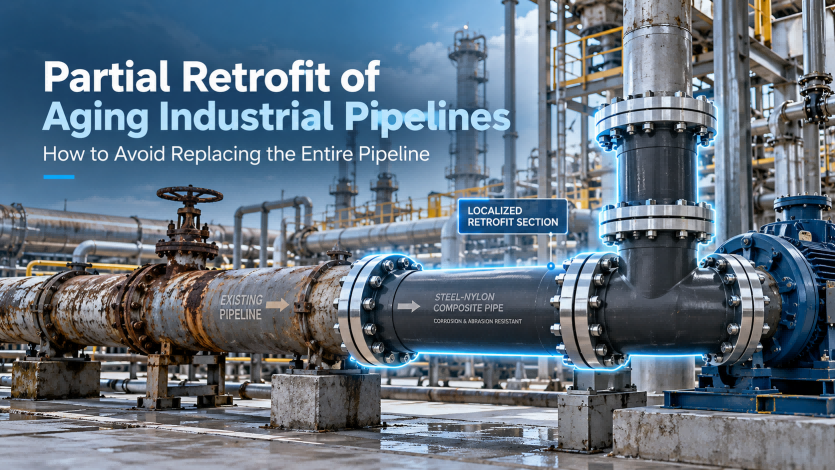
7.4 Modernization of Existing Oilfield Pipeline Infrastructure
In oilfield gathering systems that have operated for many years, some pipelines may experience increasing corrosion, wear, and maintenance requirements.
During pipeline replacement or modernization, steel–nylon composite pipes can be evaluated alongside carbon steel, internally coated steel, and other composite piping materials.
The assessment should focus on the failure mechanisms affecting the existing pipeline, current fluid conditions, anticipated future operating changes, and installation requirements.
For corrosive applications requiring sufficient pressure-bearing capability, steel–nylon composite pipes may offer a technically suitable option for further engineering evaluation.
8. Key Competitive Advantages of Steel–Nylon Composite Pipes in Long-Term Oilfield Applications
For oilfield gathering systems, the performance of an individual material does not determine the reliability of the entire pipeline.
A pipeline solution with long-term engineering value must integrate material properties, mechanical structure, connection design, and manufacturing quality.
Our company focuses on several key areas in the research, development, and manufacturing of steel–nylon composite pipes.
8.1 Composite Structure Combining Steel and Nylon
The steel structure provides the foundation for mechanical strength and pressure-bearing capability, while the nylon functional layer protects the internal surface in contact with the transported fluid.
Through an engineered composite structure, each material contributes its respective performance advantages.
Compared with pipeline solutions that rely on a single material to meet all operating requirements, this composite approach provides an alternative engineering solution for demanding industrial fluid transportation.
8.2 Designed for Complex Conditions Involving Corrosion and Wear
Pipeline failures in oilfield gathering systems are often caused by multiple interacting factors rather than a single mechanism.
Highly mineralized water, corrosive gases, solid particles, pressure variations, and temperature fluctuations may collectively affect pipeline performance.
Our company emphasizes the wear resistance and corrosion resistance of reinforced MC nylon materials, together with optimized composite structural design.
Our objective is to develop piping products that meet the combined performance requirements of different industrial transportation systems.
For special media and demanding operating conditions, further material compatibility analysis, structural optimization, and targeted technical verification can be performed.
8.3 Integrally Formed Flanges and Prefabricated Connection Technology
By optimizing flange connections and pipe-end structures, steel–nylon composite pipes can be better adapted to practical engineering installation requirements.
For projects suitable for prefabricated flanged connections, certain on-site welding operations can be reduced, improving the convenience of pipe section assembly.
At the same time, optimized sealing structures and manufacturing quality control help support the long-term reliability of pipeline connections.
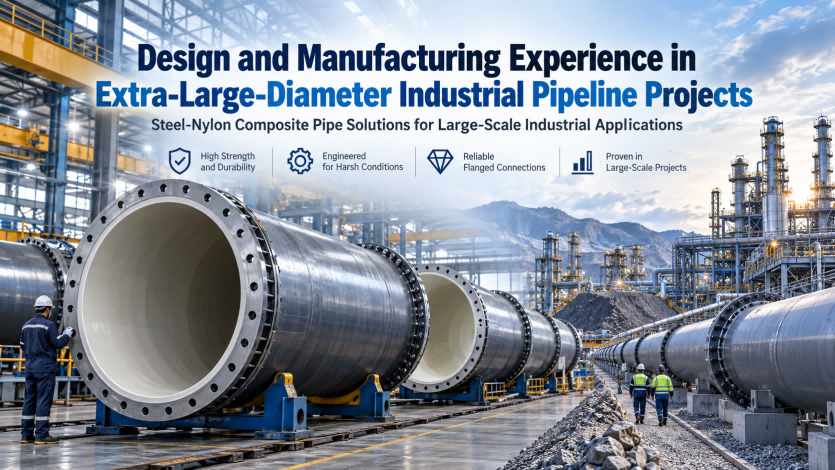
8.4 Manufacturing Capabilities for Large-Diameter Pipes and Multiple Pressure Ratings
Oilfield and chemical transportation systems vary considerably in pipe diameter, pressure rating, and fluid characteristics.
Our steel–nylon composite pipe products cover pressure rating series from 1.0 to 4.0 MPa.
We also have large-diameter pipe manufacturing capabilities and can provide different product specifications according to project requirements.
For large-diameter pipes and special applications, wall thickness, structural stability, connection strength, support requirements, and long-term performance must be evaluated according to the actual design conditions.
Manufacturing capability is not simply the ability to produce pipes of larger diameters.
It also involves maintaining dimensional consistency, structural integrity, and quality traceability throughout batch production.
8.5 Moving from Product Supply to Comprehensive Industrial Piping Solutions
The long-term reliability of oilfield gathering systems requires collaboration among pipe manufacturers, engineering designers, construction contractors, and operating companies.
Our company focuses not only on pipe manufacturing but also on fluid compatibility, pressure ratings, connection design, installation requirements, and maintenance considerations.
By providing products matched to actual operating conditions, we aim to help customers consider the long-term value of their piping systems from the early stages of project development.
9. Lessons from Long-Term Applications: Four Principles for Industrial Pipeline Material Selection
For oilfield projects considering steel–nylon composite pipes, the value of long-term operational experience extends beyond demonstrating the performance of a particular material.
It also helps establish engineering practices that can be applied to future pipeline projects.
Principle 1: Material Selection Must Be Based on Actual Operating Conditions
Engineers should thoroughly understand the transported fluid composition, water content, sand concentration, H₂S and CO₂ levels, operating pressure, temperature, and anticipated future changes.
For special or complex media, targeted material compatibility testing should be conducted.
Principle 2: Pipeline Reliability Must Be Evaluated at the System Level
The pipe body, flanges, gaskets, fasteners, supports, and other connection components should be considered as an integrated system.
Localized connection failures or installation defects can compromise the reliability of the entire pipeline.
Principle 3: Long-Term Value Must Be Supported by Operating Data
Material corrosion resistance, pipeline maintenance frequency, service life, and economic performance should be assessed using traceable engineering records.
Actual operating duration, inspection results, and maintenance records provide more meaningful evidence than general descriptions of material performance alone.
Principle 4: Long-Service-Life Design Does Not Mean Maintenance-Free Operation
The corrosion-resistant nylon functional layer in steel–nylon composite pipes can help reduce certain corrosion risks, but it cannot eliminate every potential failure mechanism.
Operators must still establish appropriate inspection, maintenance, and operational management procedures based on project risks and applicable standards.
Only through proper material selection, controlled manufacturing, correct installation, and continuous operational management can the long-term value of composite pipelines be fully realized.
10. Future Outlook: Development Directions for Steel–Nylon Composite Pipes in Oilfield Gathering Systems
As oil and gas development environments and fluid transportation requirements continue to evolve, oilfield pipeline technology must address increasingly diverse engineering challenges.
For steel–nylon composite pipes, future development can focus on three major areas.
10.1 Improving Long-Term Performance Under Complex Fluid Conditions
Through material modification, composite structural optimization, and operating condition simulation, further research can be conducted into the long-term behavior of nylon functional layers in highly mineralized produced water, fluids containing corrosive gases, and sand-containing liquids.
Particular attention should be given to material permeation behavior, composite interface stability, and the effects of pressure and temperature cycling.
10.2 Enhancing the Overall Reliability of Pipeline Connections
Continued optimization of integrally formed flanges and pipe-end structures can help improve the sealing performance of connections under different fluid and temperature conditions.
Standardized prefabrication, manufacturing process control, and on-site installation guidance can further improve the engineering suitability of pipeline systems.
10.3 Establishing Comprehensive Long-Term Operating Databases
For steel–nylon composite pipe projects already in operation, manufacturers and operators should progressively establish engineering databases covering operating pressure, temperature, fluid characteristics, inspection results, and maintenance records.
By continuously collecting field data from different oilfields, transportation media, and operating periods, these databases can provide valuable references for future structural optimization, material development, and product selection.
The future of oilfield pipeline technology requires not only higher-performance materials but also comprehensive transportation solutions supported by long-term engineering evidence.
Conclusion: From Material Performance to Engineering Value — The Long-Term Potential of Steel–Nylon Composite Pipes
Oilfield gathering and transportation systems are essential to oil and gas production.
Their long-term operational reliability directly affects production continuity, field maintenance requirements, and pipeline asset management.
In applications involving highly mineralized produced water, corrosive media, and certain abrasive conditions, conventional metallic pipelines may face challenges related to internal corrosion and increasing maintenance requirements.
By combining the structural load-bearing properties of steel with the corrosion resistance and wear resistance of nylon, steel–nylon composite pipes provide a potential material solution for selected demanding oilfield gathering applications.
Our company continues to focus on material development, composite structural optimization, large-diameter manufacturing, and integrally formed flange connection technology.
We are committed to providing industrial piping products that meet the practical operating requirements of the oil and gas and chemical industries.
We believe that the long-term value of pipeline products should be demonstrated through actual engineering performance.
From initial material selection to installation and commissioning, and from continuous operation to lifecycle cost evaluation, integrating material performance with engineering practice is essential for improving the long-term reliability of industrial transportation systems.
For oilfield operators, choosing a pipeline is not simply about selecting a material. It is a long-term investment decision that can affect production safety, maintenance costs, and asset management for years to come.
The value of steel–nylon composite pipes lies in their engineered composite structure, which provides a technical approach to combining pressure-bearing capability, corrosion resistance, and wear resistance for demanding industrial fluid transportation.
Contact Us | Find the Right Piping Solution for Your Oilfield Gathering Project
If your oilfield project is experiencing corrosion caused by highly mineralized produced water, frequent gathering pipeline repairs, erosion from sand-containing fluids, or the need to modernize aging pipeline infrastructure, contact our technical team.
We can provide steel–nylon composite pipe product selection assistance and technical support based on your specific engineering requirements.
To help us better understand your project, please provide the following information:
-
Transported medium: Crude oil, produced water, oil–gas–water mixtures, or other industrial fluids.
-
Operating conditions: Design pressure, operating pressure, operating temperature, and flow rate.
-
Fluid characteristics: Water content, salinity, H₂S and CO₂ concentrations, and solid particle content.
-
Pipeline specifications: Nominal diameter, transportation distance, and connection requirements.
-
Project requirements: New pipeline construction, existing pipeline replacement, or customized solutions for special operating conditions.
Contact Us Today — Explore Steel–Nylon Composite Pipe Solutions for Your Oilfield Gathering and Transportation Project
By thoroughly understanding your operating conditions, we can help you evaluate the suitability of steel–nylon composite pipes and provide technical support for the long-term reliability of your oilfield gathering system.
Recommendations for Publishing This Article on Your Google-Focused Independent Website
For your company's international website, this article is best positioned as a technical engineering review and long-term pipeline performance analysis, rather than simply a general introduction to the advantages of steel–nylon composite pipes.
Authentic engineering project documentation can further strengthen the article's technical credibility and help build trust among potential international customers.
If your company has completed oilfield gathering projects with substantial operating histories, consider incorporating the following information before publication.
| Information to Include | Recommended Content | Value to International Customers |
|---|---|---|
| Project background | Oilfield location, construction year, and pipeline commissioning date | Establishes the project's actual engineering background |
| Operating conditions and product specifications | Pipe diameter, pressure rating, fluid composition, and operating temperature | Helps customers evaluate similarities with their own projects |
| Actual operating performance | Verified operating duration as of 2026, inspection results, and maintenance records | Provides evidence of long-term pipeline performance |
| Field application photographs | Installation site, flange connections, operating pipelines, and inspection photographs | Demonstrates the product's application in real oilfield environments |
| Customer feedback and acceptance records | Authorized customer evaluations, operating reports, and inspection documentation | Strengthens the credibility of the engineering case study |
We particularly recommend including an authentic photograph of a steel–nylon composite pipeline installed in an oilfield gathering system.
The photograph should clearly show the pipe's appearance, flanged connection structure, and actual installation environment.
Where permitted, add a caption identifying the project, pipe specifications, and commissioning year.
If verified operating records are available, this article can be further developed into a more detailed engineering case study under the title:
Steel–Nylon Composite Pipes in Oilfield Gathering Systems: A Long-Term Field Performance Case Study
Such a case study can demonstrate your company's product technology, practical engineering capabilities, and long-term operating performance, helping international oilfield operators, EPC contractors, and pipeline procurement engineers evaluate whether your products are suitable for their projects.
Over 20 Years of Nylon Pipe Application Experience in the Soda Ash Industry: The Long-Term Value of Steel–Nylon Composite Pipes