Strong Alkali Service Pipeline Selection Guide: How to Choose Corrosion-Resistant and Long-Life Industrial Pipes?

In chemical, metallurgical, and mining industries, pipeline selection for strong alkali service has always been a major engineering challenge.
Although strong alkaline media are generally considered less corrosive than acids, long-term operation with high-concentration alkalis can still cause serious damage to conventional pipeline materials.
Typical problems include:
-
Carbon steel pipelines suffering from corrosion thinning and leakage;
-
Stainless steel facing risks under high-temperature and high-concentration alkali conditions;
-
PE and HDPE pipes being limited by pressure and temperature resistance;
-
FRP pipelines experiencing resin aging, delamination, and leakage;
-
Lined steel pipes suffering from lining separation, blistering, and failure.
Therefore, selecting pipeline materials for strong alkali applications should not only focus on corrosion resistance. Engineers must also consider:
chemical compatibility, temperature resistance, wear resistance, pressure rating, connection reliability, and total lifecycle cost (TCO).
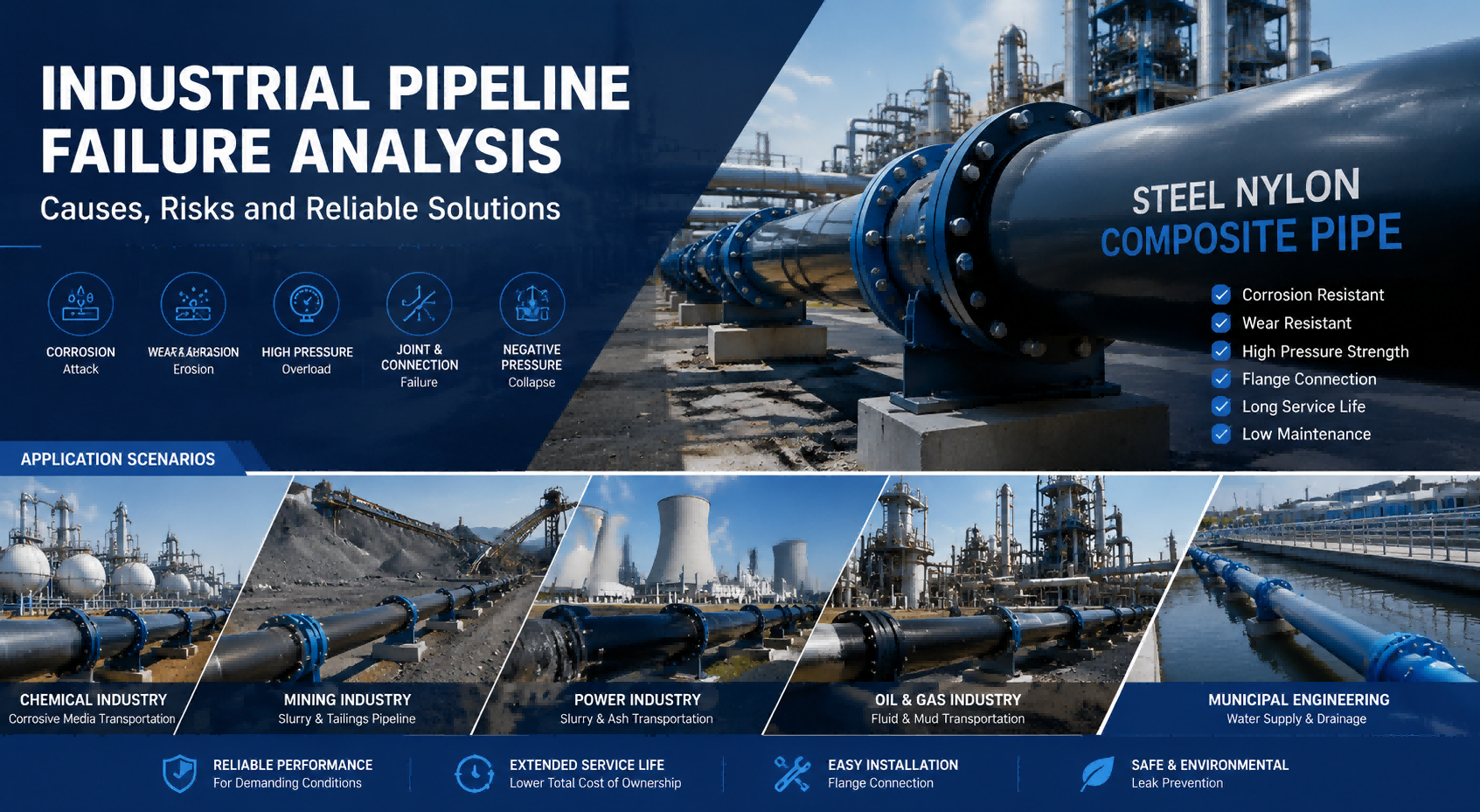
This article provides an in-depth analysis of common pipeline materials used in strong alkali environments and explains why steel-nylon composite pipes are becoming an increasingly popular upgrade solution for chemical industries.
1. What Challenges Do Strong Alkali Conditions Create for Industrial Pipelines?
1.1 Chemical Corrosion Risks from Strong Alkali Media
Common strong alkaline media include:
| Medium | Typical Applications | Pipeline Challenges |
|---|---|---|
| Sodium hydroxide (NaOH) | Chlor-alkali, chemical processing, paper industry | High concentration alkali corrosion |
| Potassium hydroxide (KOH) | Fine chemical production | High-temperature chemical attack |
| Sodium carbonate (Na₂CO₃) | Soda ash production | Crystal erosion and abrasion |
| Ammonia soda mother liquor | Soda ash industry | Corrosion + particle wear |
| Alkaline slurry | Mining industry | Combined corrosion and abrasion |
In industries such as soda ash and chlor-alkali production, the transported medium often contains not only alkaline chemicals but also:
-
Solid particles;
-
Salt crystals;
-
High flow velocity;
-
Temperature fluctuations;
-
Continuous long-term operation.
This creates a dual damage mechanism:
Chemical corrosion + mechanical abrasion.
2. Comparison of Common Pipeline Materials for Strong Alkali Applications
2.1 Carbon Steel Pipe: Low Initial Cost but High Maintenance Risk
Carbon steel pipelines have been widely used in industrial systems for decades.
Advantages:
-
Low initial investment;
-
High mechanical strength;
-
Easy fabrication.
However, strong alkali service can create several problems:
Common Issues:
-
Internal corrosion causes wall thickness reduction;
-
Weld areas become weak points;
-
Frequent anti-corrosion maintenance is required;
-
Unexpected shutdowns affect production efficiency.
For continuous chemical production facilities, the lowest purchase price does not always mean the lowest operating cost.
2.2 Stainless Steel Pipe: Corrosion Resistant but Not a Universal Solution
304 and 316L stainless steel are often considered premium materials.
Advantages:
-
Smooth internal surface;
-
Good mechanical strength;
-
Excellent appearance.
However, under strong alkali and high-temperature conditions:
-
Protective alloy layers may be affected;
-
Material performance may decrease in concentrated alkali environments;
-
Investment cost is significantly higher;
-
Welding points increase installation complexity.
Especially for large-diameter systems above DN500, stainless steel pipeline investment can become extremely high.
2.3 PE / HDPE Pipe: Excellent Chemical Resistance but Limited Pressure and Temperature Performance
PE pipes have good chemical stability and are widely used in water and chemical applications.
Advantages:
-
Resistant to many acids and alkalis;
-
Lightweight;
-
Easy installation.
However, large-scale industrial alkali systems often require:
-
Long-distance transportation;
-
Higher operating pressure;
-
Elevated temperature resistance.
Conventional PE pipelines may face:
-
Limited temperature capability;
-
Lower pressure rating;
-
Long-term creep deformation;
-
Reliability challenges for large-diameter connections.
Therefore, their application is restricted in heavy-duty chemical pressure pipeline systems.
2.4 FRP Pipe: Good Corrosion Resistance but Vulnerable to Long-Term Impact
FRP (Fiberglass Reinforced Plastic) pipes are widely used in chemical industries.
Advantages:
-
Good initial corrosion resistance;
-
Lightweight;
-
Convenient installation.
However, long-term operation may cause:
-
Resin aging;
-
Inner layer wear;
-
Delamination;
-
Impact damage.
For alkaline slurry transportation containing solid particles, maintenance risks increase significantly.
3. Steel-Nylon Composite Pipe: A New Solution for Strong Alkali Service
To overcome the limitations of traditional materials, steel-nylon composite pipe combines:
The mechanical strength of steel + the corrosion and wear resistance of nylon.
This creates a composite pipeline solution designed for demanding industrial environments.
4. Why Are Steel-Nylon Composite Pipes Suitable for Strong Alkali Applications?
4.1 Nylon Inner Layer Provides Excellent Alkali Resistance
Steel-nylon composite pipes use high-performance reinforced nylon as the internal contact layer.
Key advantages:
-
No corrosion reaction with strong alkali media;
-
Excellent chemical resistance;
-
Smooth inner surface to reduce scaling;
-
Lower flow resistance.
Suitable for transporting:
-
NaOH solutions;
-
Sodium carbonate mother liquor;
-
Chlor-alkali production fluids;
-
Salt chemical circulation liquids.
4.2 Steel Structural Layer Provides High Pressure Capability
Compared with pure plastic pipes, steel-nylon composite pipes provide significantly higher mechanical strength.
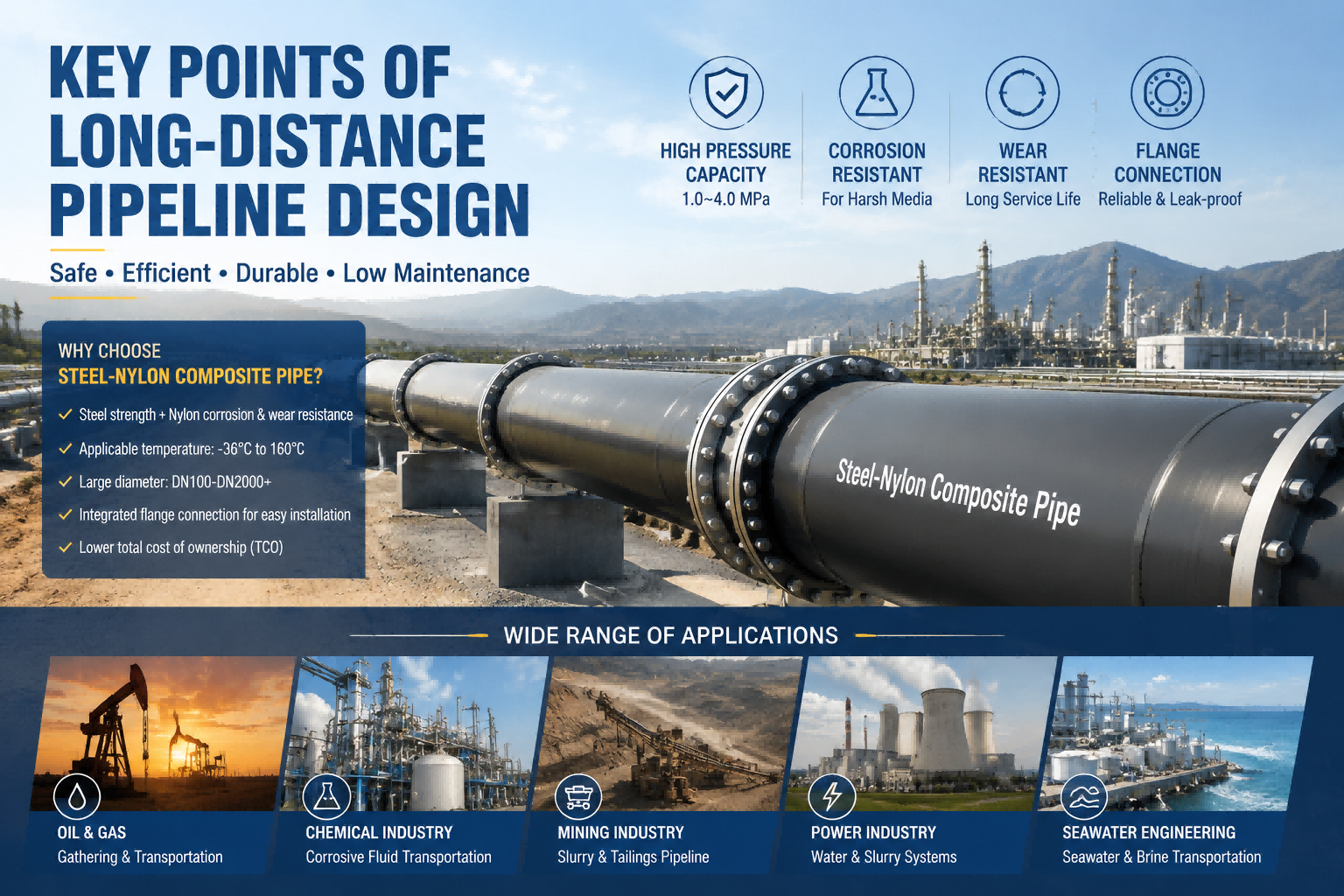
Typical specifications:
-
Diameter range: DN100–DN2000;
-
Working pressure: 1.0–4.0 MPa;
-
Operating temperature: -36°C to 160°C.
These characteristics meet the requirements of large-scale industrial pipeline systems.
4.3 Superior Wear Resistance Solves Alkali Slurry Erosion Problems
Many strong alkali systems transport more than simple liquids.
For example, soda ash mother liquor may contain:
-
Salt crystals;
-
Solid particles;
-
High-speed flow.
Traditional metal pipelines often experience:
Corrosion thinning → Local damage → Leakage
Steel-nylon composite pipes utilize the excellent wear resistance of nylon to reduce:
-
Elbow erosion;
-
Pump outlet wear;
-
Internal wall abrasion.
They are especially suitable for high-wear components:
-
Elbows;
-
Tees;
-
Pump outlet sections;
-
Valve upstream and downstream sections.
4.4 Integrated Flange Design Improves Installation Reliability
One of the biggest risks in industrial pipeline systems is often not the pipe itself, but the connection points.
Traditional steel pipes:
-
Require welding;
-
Have many weld seams;
-
Need additional corrosion protection.
Lined steel pipes:
-
May suffer lining damage during flange installation.
Steel-nylon composite pipes feature:
integrally formed flange connections.
Advantages:
-
No field welding required;
-
Fewer leakage points;
-
Faster installation;
-
Easier maintenance.
This provides significant advantages for chemical plant upgrades and replacement projects.
5. Application Example: Strong Alkali Mother Liquor Pipeline Upgrade in Soda Ash Industry
A large soda ash production plant experienced long-term problems in its mother liquor transportation system:
-
Pipeline corrosion;
-
Particle erosion;
-
Frequent maintenance;
-
Production interruptions.
After replacing traditional pipelines with reinforced nylon pipes and steel-nylon composite pipes, the upgraded system was applied to:
-
Mother liquor transportation pipelines;
-
Outdoor pipe racks;
-
High-wear elbows and fittings.
After years of operation:
-
Pipeline performance remained stable;
-
Maintenance intervals were significantly extended;
-
Unplanned shutdowns were reduced.
This application demonstrates that for strong alkali + abrasive service, traditional corrosion-resistant materials alone may not provide sufficient long-term reliability.
6. Strong Alkali Pipeline Material Selection Recommendations
| Operating Condition | Recommended Material |
|---|---|
| Normal temperature, low-pressure alkali liquid | PE / PP |
| High-temperature strong alkali | Steel-Nylon Composite Pipe |
| Alkali liquid containing particles | Steel-Nylon Composite Pipe |
| Large-diameter pipeline systems | Steel-Nylon Composite Pipe |
| High-pressure alkali transportation | Steel-Nylon Composite Pipe |
| Long service life requirements | Steel-Nylon Composite Pipe |
7. Why Are More Industrial Projects Choosing Steel-Nylon Composite Pipes?
Compared with traditional materials, steel-nylon composite pipes provide:
✅ High mechanical strength of steel pipelines
✅ Excellent corrosion resistance from nylon lining
✅ Outstanding wear resistance
✅ Wide temperature range: -36°C to 160°C
✅ Large diameter capability: DN100–DN2000
✅ Pressure rating: 1.0–4.0 MPa
✅ Integrated flange connection for safer installation
Steel-nylon composite pipe is not simply a replacement material. It is a complete pipeline optimization solution designed for complex industrial operating conditions.
Conclusion: Strong Alkali Pipeline Selection Requires Lifecycle Thinking
In strong alkali applications, the lowest purchase price does not always represent the lowest cost.
A reliable industrial pipeline system must achieve:
-
Chemical stability;
-
Mechanical strength;
-
Long wear life;
-
Reliable connections;
-
Low lifecycle cost.
With the combination of steel structural reinforcement and nylon corrosion-resistant wear-resistant lining, steel-nylon composite pipes are becoming an advanced solution for strong alkali transportation systems in:
-
Chlor-alkali plants;
-
Soda ash factories;
-
Salt chemical industries;
-
Mining operations;
-
Chemical processing facilities.
Choosing the right pipeline material today can significantly reduce maintenance costs for the next decade.
Slurry Pipeline Selection Guide: How to Choose Wear-Resistant, Corrosion-Resistant and High-Reliability Industrial Slurry Pipes
Weak Acid Pipeline Material Selection Guide: How to Choose Industrial Pipes with Superior Corrosion Resistance and Long-Term Reliability?