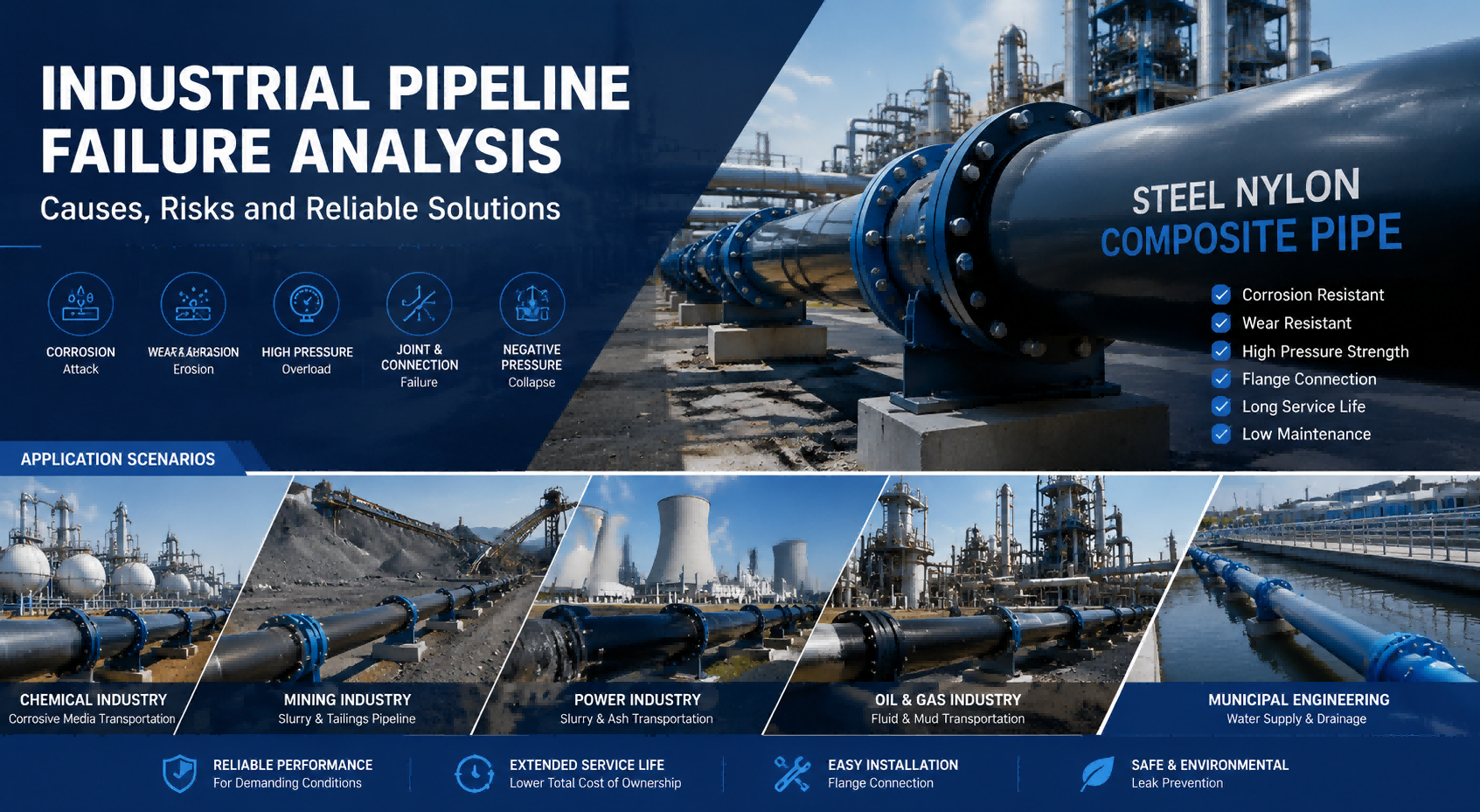
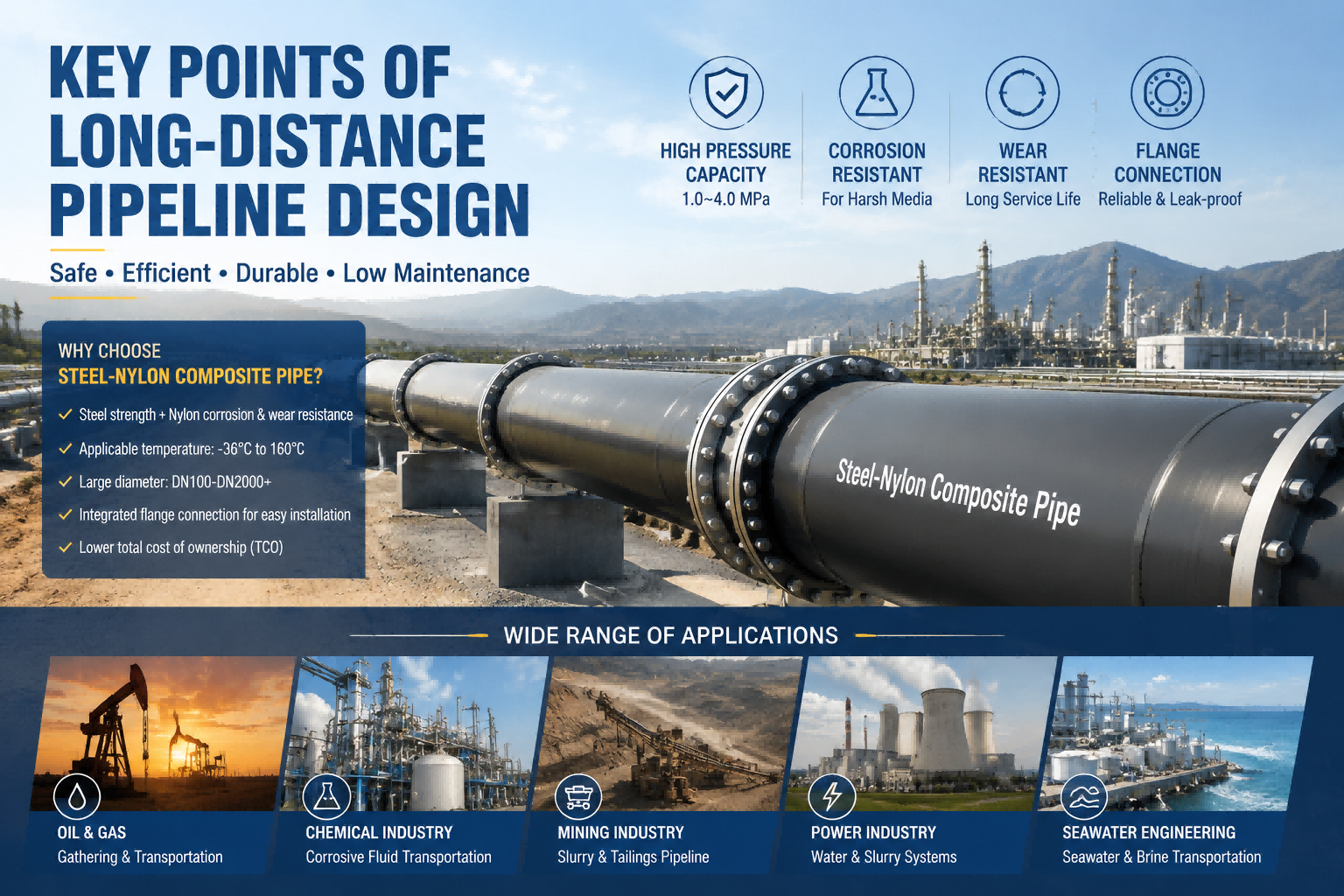
Weak Acid Pipeline Material Selection Guide: How to Choose Industrial Pipes with Superior Corrosion Resistance and Long-Term Reliability?

Introduction: Are Weak Acid Conditions Really “Low Risk” for Pipeline Systems?
In industries such as chemical processing, mining, metallurgy, environmental protection, and water treatment, weak acid media transportation is a very common application scenario.
Typical weak acid media include:
-
Diluted hydrochloric acid (low concentration HCl)
-
Diluted sulfuric acid (low concentration H₂SO₄)
-
Phosphoric acid solutions
-
Acid washing wastewater
-
Acid-containing industrial circulating water
-
Acid mine drainage
Because the acid concentration is relatively low, many engineers assume:
“Weak acid media are not highly corrosive, so conventional carbon steel or plastic pipes should be sufficient.”
However, in real industrial operating environments, weak acid pipelines still experience frequent failures, including:
-
Carbon steel pipe corrosion and leakage;
-
Stainless steel pitting and crevice corrosion;
-
Lining separation in lined steel pipes;
-
Aging and cracking of FRP pipes;
-
Deformation of PE pipes under long-term pressure.
Therefore, pipeline selection for weak acid applications should not only focus on corrosion resistance, but also consider:
-
Corrosion resistance;
-
Wear resistance;
-
Pressure capability;
-
Service life;
-
Installation reliability;
-
Total lifecycle cost (TCO).
This article provides an in-depth analysis of different pipeline materials in weak acid applications and explains why steel-nylon composite pipes are becoming an advanced solution for industrial weak acid transportation systems.
1. What Challenges Do Weak Acid Conditions Bring to Industrial Pipelines?
1. Long-Term Acid Corrosion Causes Metal Pipeline Failure
Although weak acids have lower corrosion intensity compared with strong acids, continuous exposure over years can still damage metal materials.
Carbon Steel Pipes
Advantages:
-
Low initial investment;
-
High mechanical strength;
-
Mature manufacturing technology.
However, in weak acid environments:
-
Electrochemical corrosion gradually damages the steel surface;
-
Pipe walls become thinner over time;
-
Weld areas often become the first failure points.
Typical problem:
A newly installed carbon steel pipeline operates normally at the beginning but develops leakage after several years, requiring frequent repair and replacement.
2. Solid Particles Accelerate Pipeline Wear
Many industrial weak acid media are not pure liquids. They may contain:
-
Solid particles;
-
Salt crystals;
-
Mineral impurities.
Examples include:
-
Acidic mineral slurry;
-
Phosphate chemical filtration liquids;
-
Acid cleaning circulation systems.
These applications involve a combination of:
Chemical corrosion + mechanical erosion
Many conventional anti-corrosion pipes can resist chemical attack but fail when exposed to continuous particle impact.
3. Large Diameter and High Pressure Applications Require Better Materials
Industrial weak acid transportation systems often involve:
-
Process pipelines above DN100;
-
Long-distance transmission pipelines;
-
Pump outlet pressure pipelines.
Therefore, pipeline materials must provide:
-
Large diameter capability;
-
Stable pressure performance;
-
Long-term operational reliability.
2. Performance Comparison of Common Weak Acid Pipeline Materials
| Pipeline Material | Corrosion Resistance | Wear Resistance | Pressure Capability | Long-Term Reliability |
|---|---|---|---|---|
| Carbon Steel Pipe | ★ | ★★ | ★★★★★ | ★★ |
| 304 Stainless Steel | ★★★ | ★★ | ★★★★★ | ★★★ |
| 316L Stainless Steel | ★★★★ | ★★ | ★★★★★ | ★★★★ |
| FRP Pipe | ★★★★ | ★★★ | ★★★ | ★★★ |
| PE Pipe | ★★★★ | ★★★ | ★★ | ★★★ |
| Steel-Nylon Composite Pipe | ★★★★★ | ★★★★★ | ★★★★★ | ★★★★★ |
3. Limitations of Traditional Pipeline Materials in Weak Acid Applications
1. Stainless Steel Pipe: Corrosion Resistant but High Cost
Many engineering projects consider:
“316L stainless steel is the safest choice for weak acid applications.”
316L stainless steel does provide good corrosion resistance. However, in actual industrial environments, it may still face:
-
Chloride-induced pitting corrosion;
-
Weld zone corrosion;
-
Crevice corrosion.
In addition, large diameter stainless steel pipelines have disadvantages:
-
High material cost;
-
Complex fabrication;
-
Strict welding requirements;
-
Higher maintenance expenses.
For large pipelines such as:
-
DN500;
-
DN800;
-
DN1000 and above,
the total project investment can become significantly higher.
2. FRP Pipe: Excellent Chemical Resistance but Limited Impact Resistance
FRP (Fiberglass Reinforced Plastic) pipes provide good corrosion resistance.
However, industrial environments are often complicated:
-
Damage may occur during transportation;
-
Installation impacts may create cracks;
-
Long-term pressure cycles may cause fatigue failure.
Especially at:
-
Pump outlets;
-
Elbows;
-
Pipe support points;
FRP pipes require additional protection and inspection.
4. Steel-Nylon Composite Pipe: A New Solution for Weak Acid Transportation
Steel-Nylon Composite Pipe combines:
High-strength steel structure + corrosion-resistant nylon lining
Creating a dual protection system:
“Steel provides mechanical strength, while nylon provides chemical protection.”
1. Nylon Inner Layer Provides Excellent Corrosion Resistance
The inner layer uses high-performance reinforced nylon as the media contact surface.
Advantages:
-
Excellent stability against weak acid media;
-
No metal corrosion;
-
No rust contamination;
-
Smooth inner surface reduces flow resistance.
Suitable for:
-
Diluted hydrochloric acid;
-
Diluted sulfuric acid;
-
Phosphoric acid;
-
Acid wastewater;
-
Chemical circulation fluids.
2. Steel Reinforcement Ensures High Pressure Performance
Compared with conventional plastic pipes, steel-nylon composite pipes provide much higher structural strength.
Advantages:
-
Pressure rating from 1.0 to 4.0 MPa;
-
Large diameter capability from DN100 to DN2000;
-
Stable performance in long-distance transportation systems.
Ideal for:
-
Chemical plant pipelines;
-
Mining transportation systems;
-
Large-scale environmental projects.
3. Superior Wear Resistance Solves Corrosion + Abrasion Problems
Many weak acid applications also involve abrasive particles.
For example:
Acidic mining slurry contains:
Acid corrosion + solid particle erosion
Steel-nylon composite pipes provide:
-
High toughness;
-
Excellent impact resistance;
-
Superior abrasion resistance compared with conventional metal pipes.
4. Integrated Flange Design Improves Installation Reliability
Traditional pipelines usually require:
-
Welding;
-
On-site anti-corrosion treatment;
-
Weld inspection.
Every welded joint creates a potential leakage point.
Steel-nylon composite pipes feature:
Integrated flange forming technology.
Advantages:
-
No field welding required;
-
Faster installation;
-
Fewer leakage risks;
-
Ideal for chemical plant upgrades and replacement projects.
5. Typical Applications of Steel-Nylon Composite Pipes in Weak Acid Systems
1. Chemical Industry
Applications:
-
Acid transportation pipelines;
-
Chemical circulation systems;
-
Waste acid treatment systems.
Benefits:
Reduce:
-
Corrosion maintenance;
-
Production downtime;
-
Pipeline replacement frequency.
2. Mining Industry
Applications:
-
Acidic slurry transportation;
-
Tailings treatment;
-
Hydrometallurgy systems.
Benefits:
Solves multiple challenges:
-
Corrosion;
-
Abrasion;
-
Pressure requirements.
3. Environmental Protection and Water Treatment
Applications:
-
Acid wastewater pipelines;
-
Industrial wastewater systems;
-
Seawater desalination auxiliary pipelines.
Benefits:
-
Long service life;
-
Stable operation;
-
Reduced maintenance requirements.
6. Key Parameters for Weak Acid Pipeline Selection
When selecting pipelines for weak acid applications, engineers should evaluate:
1. Medium Characteristics
Including:
-
Acid type;
-
Acid concentration;
-
Operating temperature;
-
Solid particle content.
2. Operating Conditions
Including:
-
Working pressure;
-
Pipe diameter;
-
Transportation distance;
-
Pressure fluctuations.
3. Lifecycle Cost Analysis
Pipeline selection should not only consider initial purchase price.
The real cost includes:
Initial investment + Installation cost + Maintenance cost + Downtime losses
In many cases, steel-nylon composite pipes provide better economic value because of:
-
Longer service life;
-
Less maintenance;
-
Lower operational risks.
Conclusion: Weak Acid Applications Still Require Professional Pipeline Selection
Although weak acids are less aggressive than strong acids, industrial systems face continuous challenges from:
Long-term corrosion + abrasion + pressure stress
For projects requiring:
-
High reliability;
-
Long service life;
-
Large diameter capability;
-
High pressure performance;
steel-nylon composite pipes provide a more reliable and cost-effective solution.
With advantages including:
✅ Excellent corrosion resistance
✅ Superior wear resistance
✅ Pressure rating up to 4.0 MPa
✅ DN100-DN2000 large diameter capability
✅ Integrated flange structure without welding
✅ Reduced lifecycle maintenance costs
Steel-Nylon Composite Pipe is becoming a next-generation pipeline solution for weak acid transportation in chemical, mining, and environmental industries.
Strong Alkali Service Pipeline Selection Guide: How to Choose Corrosion-Resistant and Long-Life Industrial Pipes?
Low-Temperature Pipeline Material Selection Guide: How to Choose Reliable, Safe, and Long-Lasting Piping Systems