Applications of High Wear-Resistant Piping in the Chemical Industry: From Frequent Replacement to Long-Service-Life Pipeline Systems
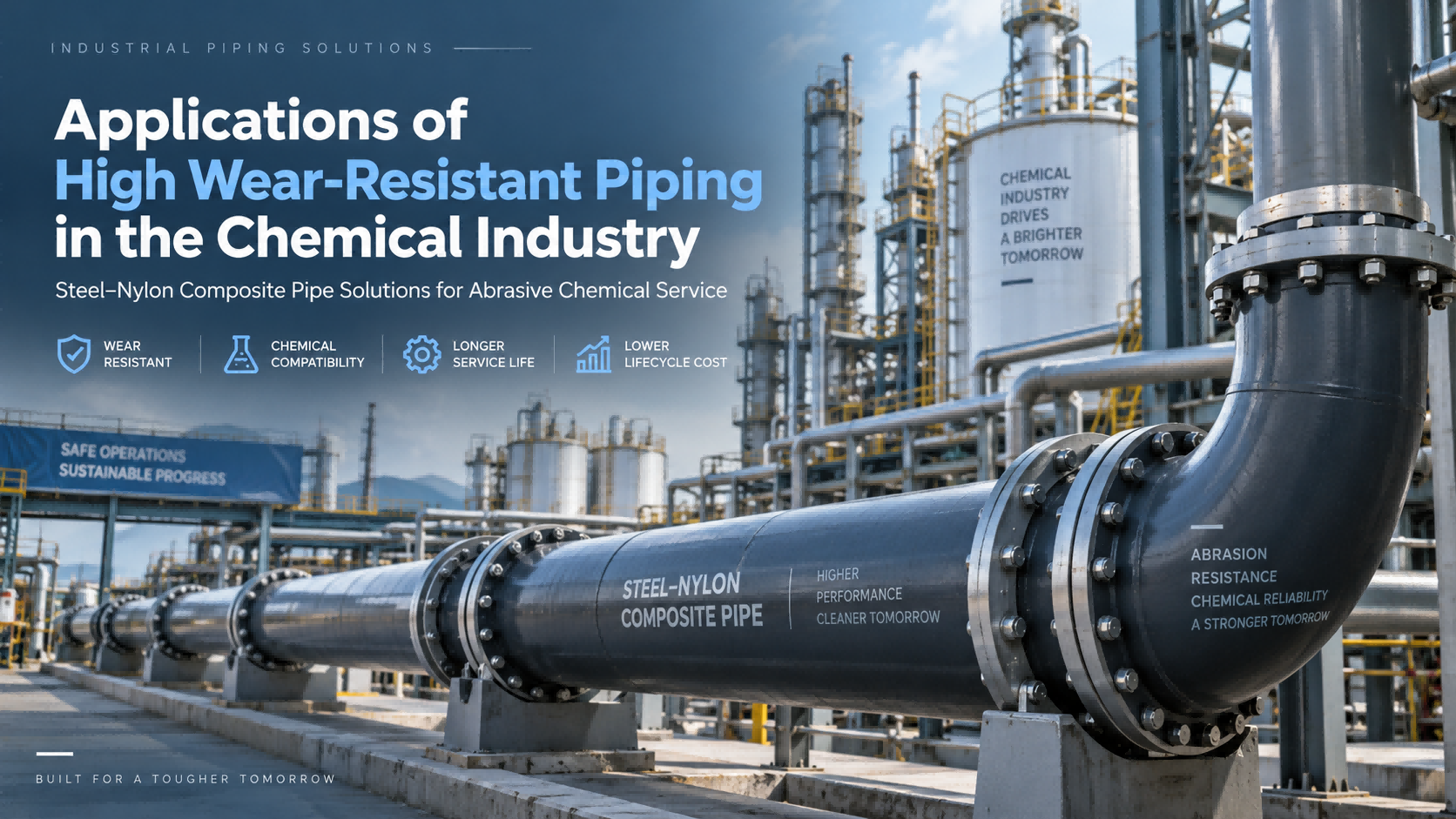
Pipeline failure in chemical plants is not caused by corrosion alone.
In industries such as phosphate chemicals, salt chemicals, soda ash production, slurry transportation, flue gas desulfurization, and other chemical processes involving solids-laden fluids, another long-overlooked problem is becoming increasingly important:
abrasive wear.
When solid particles are carried through a pipeline at relatively high velocity, they continuously impact and scour the internal pipe surface. Wear can become particularly severe at elbows, tees, reducers, upstream and downstream sections of valves, pump discharge lines, and other locations where the flow direction or velocity changes.
The situation becomes even more complicated when the transported medium is also corrosive.
Corrosion weakens the pipe surface, while abrasive particles continuously remove the affected layer, exposing fresh material to the corrosive medium again.
This creates a repeating cycle of:
Corrosion → Surface Degradation → Erosion → Fresh Surface Exposure → Further Corrosion
As a result, more chemical plants are no longer looking simply for a “corrosion-resistant pipe.”
They increasingly need piping systems that combine:
-
Corrosion resistance
-
Wear resistance
-
Mechanical strength
-
Reliable pressure performance
-
Lower maintenance frequency
-
Long-term operating reliability
This is one of the reasons why steel–nylon composite pipes are attracting increasing attention in chemical applications where corrosion and abrasion occur simultaneously.
1. Why Do Chemical Pipelines Experience Severe Wear?
Pipeline abrasion is often associated primarily with the mining industry.
However, many chemical production processes also involve solid-liquid two-phase or multiphase transportation.
Typical media may include:
-
Phosphate slurry
-
Salt mud
-
Lime slurry
-
Crystallized slurry
-
Catalyst particles
-
Industrial wastewater containing suspended solids
-
Process liquids containing abrasive impurities
These materials can continuously scour the internal surface of pipelines.
The rate of wear is usually influenced by several factors.
1.1 Solid Particle Concentration
The higher the concentration of solids in the medium, the more particles may contact and impact the internal pipe wall over a given period.
Therefore, the service life of the same pipe material can vary significantly between clean-water service and high-solids slurry transportation.
1.2 Particle Hardness and Shape
Hard, sharp, and irregular particles generally have a stronger cutting and abrasive effect.
When these particles repeatedly strike the pipe wall, the process can resemble continuous microscopic sandblasting.
Over time, the pipe wall gradually becomes thinner.
1.3 Flow Velocity
Higher flow velocity can increase transportation capacity, but it may also substantially increase the impact energy of solid particles against the pipe wall.
For this reason, slurry pipeline design should not simply pursue the highest possible velocity.
Instead, engineers need to balance:
transportation capacity, sedimentation risk, energy consumption, and pipeline wear.
1.4 Pipeline Geometry
Wear is often relatively uniform along straight pipe sections.
However, localized wear can become much more severe at:
Elbows → Tees → Reducers → Valve Sections → Pump Discharges → Directional Changes
At these locations, changes in flow direction, turbulence, and particle concentration can create intense localized erosion.
For this reason, a reliable wear-resistant piping system cannot focus only on straight pipes.
Fittings are often the components that determine the actual service life of the entire pipeline system.
2. The More Difficult Challenge: Corrosion and Wear Occurring Together
Wear alone can significantly reduce pipeline service life.
However, one of the biggest challenges in chemical applications is that many process fluids are both corrosive and abrasive.
Examples include:
-
Salt-containing slurry
-
Chemical mother liquor
-
Mineral slurry
-
Certain industrial wastewater streams
Under these conditions, a typical corrosion–erosion synergy may occur.
Carbon steel is first attacked chemically.
The resulting weakened surface layer or corrosion products are then removed by high-velocity particles.
Fresh metal becomes exposed.
Corrosion begins again.
The damaged layer is removed again.
The cycle continues.
As a result, pipe wall loss may not occur evenly.
Instead, localized failures can develop first, including:
-
Grooving
-
Pitting
-
Perforation
-
Elbow wall thinning
-
Leakage near joints and flanges
Eventually, these failures can lead to unplanned shutdowns.
3. Why Traditional Wear-Resistant Pipes Are Not Always Ideal for Chemical Applications
The difficulty of material selection in chemical plants is that:
wear resistance does not automatically mean corrosion resistance, and corrosion resistance does not automatically mean wear resistance.
Many conventional materials are strong in one area but weaker in another.
4. Carbon Steel Pipe: High Strength, but Limited Under Combined Corrosion and Abrasion
Carbon steel offers several clear advantages:
-
Mature manufacturing technology
-
High mechanical strength
-
Good pressure resistance
-
Well-established supply chains
-
Competitive initial cost
It therefore remains one of the most widely used industrial pipeline materials.
However, in highly abrasive chemical service—particularly where corrosion and abrasion occur simultaneously—the internal steel surface can suffer continuous material loss.
This often leads to a traditional response:
increase the wall thickness.
But increasing wall thickness does not eliminate the underlying corrosion and wear mechanisms.
This is why more industrial projects are shifting from simply using thicker steel toward:
changing the material that directly contacts the process medium.
5. Stainless Steel: Corrosion Resistance Does Not Automatically Mean Wear Resistance
304, 316L, and other stainless steels are widely used in chemical plants.
However, engineers must clearly distinguish between:
corrosion resistance and wear resistance.
When a process fluid contains large amounts of hard particles, even corrosion-resistant metallic materials can experience significant erosion over time.
In addition, as pipe diameter and wall thickness increase, the material cost of stainless steel systems can rise rapidly.
For large slurry transportation systems, this creates an important engineering question:
Can steel provide the structural strength while another material protects the internal surface from the process medium?
This is one of the fundamental design concepts behind composite piping.
6. Rubber-Lined Steel Pipe: Strong Wear Resistance, but Operating Conditions Matter
Rubber-lined steel pipe is an established solution for many slurry transportation systems.
Under suitable operating conditions, rubber linings can provide excellent abrasion resistance.
However, chemical projects still need to carefully evaluate factors such as:
-
Operating temperature
-
Chemical compatibility
-
Liner aging
-
Joint design
-
Vacuum conditions
-
Long-term bonding reliability
-
Maintenance and replacement requirements
This is why many engineering projects are not looking for a single “universal material.”
Instead, they select the most appropriate lining or composite structure based on the actual operating conditions.
7. The Design Logic of Steel–Nylon Composite Pipe: Steel Provides Strength, Nylon Faces the Medium
Steel–nylon composite pipe is based on a clear composite-material design philosophy:
The outer structure provides mechanical strength, while the inner layer provides functional protection.
The steel structure is mainly responsible for:
-
Mechanical strength
-
Pipeline rigidity
-
Pressure-bearing capability
-
Structural stability for large-diameter pipes
The nylon inner layer is designed to:
-
Directly contact the transported medium
-
Resist corrosion
-
Resist abrasive particle erosion
-
Reduce internal friction
-
Reduce scaling and deposition tendency
The two materials are not simply combined.
Instead, each material performs the function for which it is best suited.
This is particularly valuable in highly abrasive chemical pipeline systems.
8. Why Nylon Can Be Suitable as a Wear-Resistant Pipe Lining Material
Engineering nylon has long been used for mechanical components such as:
-
Gears
-
Bushings
-
Guide rails
-
Wear-resistant components
One reason is its combination of:
wear resistance, toughness, and relatively low friction characteristics.
When nylon is used as the internal contact layer of a pipeline, its wear mechanism differs from that of conventional metallic pipe surfaces.
8.1 Relatively Low Friction
In slurry transportation, particles do not only strike the pipe wall.
They also slide along the internal surface.
A relatively low-friction surface can help reduce certain forms of sliding wear.
At the same time, a smoother internal surface may help reduce the tendency for solids to adhere, settle, or form scale.
8.2 Good Toughness
A wear-resistant material does not necessarily need to be extremely hard.
Some highly rigid materials provide excellent cutting resistance but may be more susceptible to brittle damage under repeated impact.
Engineering nylon combines wear resistance with a degree of elasticity and toughness.
When particles strike the internal surface, the material can absorb part of the impact energy through deformation.
8.3 Corrosion Resistance and Wear Resistance Can Work Together
This is one of the important advantages of steel–nylon composite pipe in chemical applications.
Many industrial pipelines do not face only one problem.
They may simultaneously experience:
corrosion + abrasion + friction + pressure.
If the internal lining can isolate the steel structure from corrosive media while also resisting particle erosion, it may help reduce the repeated corrosion–erosion cycle commonly experienced by conventional metal pipes.
9. Which High-Wear Chemical Applications Are Suitable for Steel–Nylon Composite Pipe?
Depending on the process medium and operating conditions, several application areas deserve particular attention.
9.1 Phosphate Slurry Transportation
Phosphate slurry typically contains a significant quantity of solid particles.
Severe local wear can occur at:
-
Elbows
-
Tees
-
Pump discharge sections
-
Reducers
These systems require a combination of:
wear resistance + corrosion resistance + pressure resistance + long-distance transportation stability.
A steel–nylon composite structure can use the steel layer for mechanical support and pressure resistance while the nylon inner layer helps withstand direct slurry contact and erosion.
9.2 Mother Liquor and Salt Mud Systems in Soda Ash Production
Soda ash production may involve mother liquor, salt mud, and other solids-containing process media.
Traditional metallic pipelines can be exposed to several problems simultaneously:
corrosion, erosion, and scaling.
When pipelines require frequent repair, the impact extends beyond maintenance cost.
It can directly affect continuous plant operation.
For this reason, pipeline selection in continuous-process industries should not focus only on purchase price.
A more important question is:
How frequently will the pipeline need to be replaced or repaired?
9.3 Slurry Transportation in the Salt Chemical Industry
Some salt chemical processes involve media containing both high levels of dissolved salts and suspended solids.
These operating conditions can be difficult for conventional carbon steel.
Composite piping provides another engineering approach by separating:
structural strength from internal corrosion and wear protection.
9.4 Chemical Wastewater Transportation
Chemical wastewater is not always a simple liquid.
It may contain:
-
Crystals
-
Sand
-
Process residues
-
Suspended solids
-
Reaction by-products
Over long operating periods, these materials can continuously abrade the internal pipe wall.
For this reason, industrial wastewater pipeline material selection should also consider wear resistance.
9.5 Desulfurization and Lime Slurry Systems
Limestone slurry, lime slurry, and similar desulfurization media are typical abrasive fluids.
In addition to internal wear, engineers also need to consider:
sedimentation and scaling.
A smoother internal surface can help reduce the tendency of deposits to adhere to the pipe wall and may help maintain a more stable effective flow area.
10. In a True Wear-Resistant Pipeline System, Straight Pipe Is Often Not the Weakest Point
One issue is frequently overlooked:
Many companies focus primarily on the straight pipe material when replacing an old pipeline system.
However, actual failure often begins at fittings.
Consider a 500-meter slurry pipeline.
The straight sections may still be operational.
But if one elbow is worn through, the entire line may need to be shut down.
Therefore, a truly wear-resistant pipeline system must consider the complete system.
Straight Pipes
Provide the main transportation path.
Elbows
Need additional attention because particles can impact the outer radius at higher intensity.
Tees
Flow separation and mixing can create localized erosion.
Reducers
Changes in flow velocity can result in concentrated wear.
Pump Discharge Sections
These areas frequently experience high velocity and turbulence.
Upstream and Downstream Valve Sections
Changes in pressure and velocity can also create severe localized erosion.
This is one reason why wear-resistant fittings are an important part of our steel–nylon composite piping system.
11. Why Are Flanged Connections Suitable for Chemical Plant Retrofit Projects?
Pipeline material is only one part of system reliability.
The connection method can also directly influence installation and maintenance efficiency.
Our steel–nylon composite pipes use flanged connection systems.
For many chemical plants, this provides several practical advantages.
First, flange connections make on-site installation more standardized.
Second, in certain pipeline retrofit projects, they can reduce the need for complex on-site welding.
More importantly:
when one high-wear pipeline section needs replacement, modular replacement becomes possible.
For example, a plant can prioritize replacement of:
-
Pump discharge sections
-
Elbows
-
Tees
-
Upstream and downstream valve sections
-
100–500 meter high-wear trial sections
This means a chemical plant does not necessarily need to replace an entire production pipeline at the beginning of a material upgrade project.
For companies evaluating a new pipeline material, this provides a lower-risk path toward system modernization.
12. Why Are Composite Structures Particularly Valuable for Large-Diameter Wear-Resistant Pipelines?
As pipe diameter increases, the limitations of single-material pipeline systems can become more obvious.
If an entire pipeline is manufactured from high-grade alloy materials, project costs can rise significantly.
If the entire system uses polymer piping, engineers may need to reconsider:
-
Rigidity
-
Pressure resistance
-
Support spacing
-
Structural stability
-
Large-diameter deformation
This is why large industrial pipelines can benefit from a:
Structural Layer + Functional Layer
design philosophy.
For steel–nylon composite pipes:
The steel structure provides:
Strength / Rigidity / Pressure Resistance
The nylon internal layer provides:
Corrosion Resistance / Wear Resistance / Smooth Internal Surface
This combination can be particularly valuable in large-diameter industrial slurry transportation systems.
13. From “Buying Pipe” to Calculating Total Lifecycle Cost
One of the biggest mistakes in wear-resistant pipeline selection is comparing only the initial purchase price.
Consider two piping systems.
Pipeline A has a lower initial cost but requires replacement every two years.
Pipeline B has a higher purchase price but significantly extends the maintenance interval.
The real comparison should not be limited to:
Pipe Purchase Cost
It should evaluate:
Total Lifecycle Cost (TCO)
including:
Pipeline purchase cost
Installation cost
Maintenance cost
Production shutdown losses
Labor cost
Spare parts
Leakage and failure risk
For large continuous chemical plants, the financial impact of a single unplanned shutdown can sometimes be more significant than the original difference in pipe purchase price.
Therefore, industrial pipeline procurement is increasingly shifting from:
Lowest Initial Cost
toward:
Lowest Lifecycle Cost.
14. What Parameters Should Be Considered When Selecting a High Wear-Resistant Pipeline?
Before selecting a pipeline material, engineers should confirm at least the following parameters.
Medium Parameters
-
Chemical composition
-
pH
-
Concentration
-
Solid content
-
Particle size
-
Particle hardness
Operating Parameters
-
Operating temperature
-
Operating pressure
-
Design pressure
-
Normal flow velocity
-
Maximum flow velocity
-
Pressure fluctuation conditions
Pipeline Parameters
-
Pipe diameter
-
Total pipeline length
-
Number of elbows
-
Number of tees
-
Elevation differences
-
Pump station arrangement
Operational Requirements
-
Continuous operating duration
-
Planned maintenance interval
-
Acceptable shutdown duration
-
Required design life
Only when these parameters are evaluated together can engineers determine whether a particular pipe material is truly suitable.
15. Steel–Nylon Composite Pipe Is Not Suitable for Every Chemical Medium
This point is important.
Every engineering material has its own operating limits.
Steel–nylon composite pipe can be suitable for many industrial applications involving corrosion, wear, or a combination of both.
However, it should not be understood as universally suitable for every acid, alkali, solvent, and temperature condition.
Particular attention should be given to:
-
Strong oxidizing media
-
High-concentration strong acids
-
Certain organic solvents
-
Extreme temperature conditions
Material compatibility must be evaluated based on:
Medium + Concentration + Temperature + Pressure + Operating Duration
Professional pipeline material selection should therefore not ask only:
“Is this material corrosion resistant?”
The better question is:
Can this material operate reliably for the required service life under this specific combination of temperature, concentration, pressure, and flow velocity?
This is one of the major differences between industrial pipeline engineering and ordinary piping applications.
16. How We Define a High Wear-Resistant Pipeline
For us, a high wear-resistant pipeline is not simply a pipe with a thicker wear layer.
A reliable industrial wear-resistant piping system should address several requirements simultaneously:
Wear Resistance
Ability to withstand abrasive solids and slurry erosion.
Corrosion Resistance
Ability to withstand aggressive chemical media.
Pressure Resistance
Ability to operate reliably under required system pressure.
Structural Stability
Ability to maintain dimensional and mechanical stability.
Connection Reliability
Reliable joints for long-term industrial operation.
Maintenance Efficiency
Reduced maintenance complexity and shorter replacement time.
This is why the purpose of developing steel–nylon composite piping is not simply to replace one traditional pipe material with another.
The objective is to provide another engineering solution for industrial pipelines where:
corrosion + abrasion + pressure + continuous operation
must all be considered together.
17. From Complete Pipeline Replacement to Targeted Upgrading of High-Wear Sections
For chemical plants with existing pipeline systems, replacing the entire pipeline network at once may not always be necessary.
A more practical strategy is to first identify the locations with the highest wear rates.
These usually include:
-
Elbows
-
Tees
-
Pump discharge sections
-
Upstream and downstream valve sections
-
Reducers
-
Frequently leaking pipeline sections
These high-risk areas can then be replaced with steel–nylon composite piping.
After a defined operating period, performance can be compared with the original piping system based on:
-
Wall thickness loss
-
Number of leakage events
-
Maintenance frequency
-
Shutdown duration
-
Maintenance cost
This creates a practical:
100–500 m Industrial Pipeline Trial Section
evaluation model.
For international customers considering a new piping material, trial sections can significantly reduce the technical and commercial risk of adopting an unfamiliar solution.
18. The Future of Chemical Piping Is Not Simply About Finding the Cheapest Pipe
The industrial pipeline market is undergoing an important change.
Traditionally, procurement departments often focused on one question:
How much does the pipe cost per meter?
Increasingly, industrial users are asking another question:
How many times will this pipeline need to be replaced over the next ten years?
The reason is straightforward.
As labor costs, shutdown losses, safety requirements, and environmental compliance costs increase, frequent maintenance is becoming increasingly expensive.
Therefore, the real value of a high wear-resistant pipeline is not simply that:
“the pipe wears more slowly.”
Its real value lies in:
Fewer repairs
Fewer replacements
Less downtime
Lower leakage risk
and ultimately:
Longer pipeline service life and lower long-term operating costs.
Conclusion: Wear Resistance Is Becoming a Critical Factor in Chemical Pipeline Material Selection
In the past, corrosion resistance was often the primary concern when selecting chemical pipelines.
However, as slurry, salt mud, mother liquor, industrial wastewater, and other solids-containing process streams become more common, abrasive wear is receiving increasing attention from engineers and plant operators.
For demanding applications where corrosion and abrasion occur simultaneously, a single conventional material may not always provide the optimal balance of performance.
Steel–nylon composite pipe offers a different design philosophy:
Steel provides structural strength, while nylon provides corrosion resistance, wear resistance, and a smooth internal surface.
For applications involving:
-
Phosphate chemicals
-
Salt chemicals
-
Soda ash production
-
Chemical slurry transportation
-
Industrial wastewater
-
Other abrasive industrial media
this composite structure can be evaluated as part of the material-selection process.
If your pipeline system frequently experiences:
elbow wear-through, pipe wall thinning, slurry erosion, corrosion leakage, or excessively short maintenance intervals,
the issue may no longer be simply whether the pipe wall should be thicker.
It may be time to reconsider:
the entire pipeline material system.
Need a Wear-Resistant Pipeline Solution?
We manufacture steel–nylon composite pipes and wear-resistant industrial piping systems for demanding chemical and slurry transportation applications.
Our solutions can include:
-
Straight steel–nylon composite pipes
-
Integrated flanged connections
-
Wear-resistant elbows
-
Tees
-
Reducers
-
Pump discharge pipe sections
-
Upstream and downstream valve sections
-
100–500 m trial pipeline sections
For a preliminary pipeline material assessment, provide the following operating information:
Medium + Concentration + Temperature + Pressure + Pipe Diameter + Flow Velocity + Solid Content
This allows the pipeline material and structural configuration to be evaluated according to the actual operating conditions before final selection.
Ultra-Large-Diameter Pipeline Applications in the Chemical Industry: From High-Flow Transportation to High-Reliability System Design
Chemical Pipeline Corrosion Failure Analysis: Why Most Pipeline Failures Are the Result of Long-Term Damage Accumulation