Applications of Wear-Resistant Pipes in Thermal Power Plants: Reducing Abrasion, Corrosion, and Downtime in Slurry Transport Systems
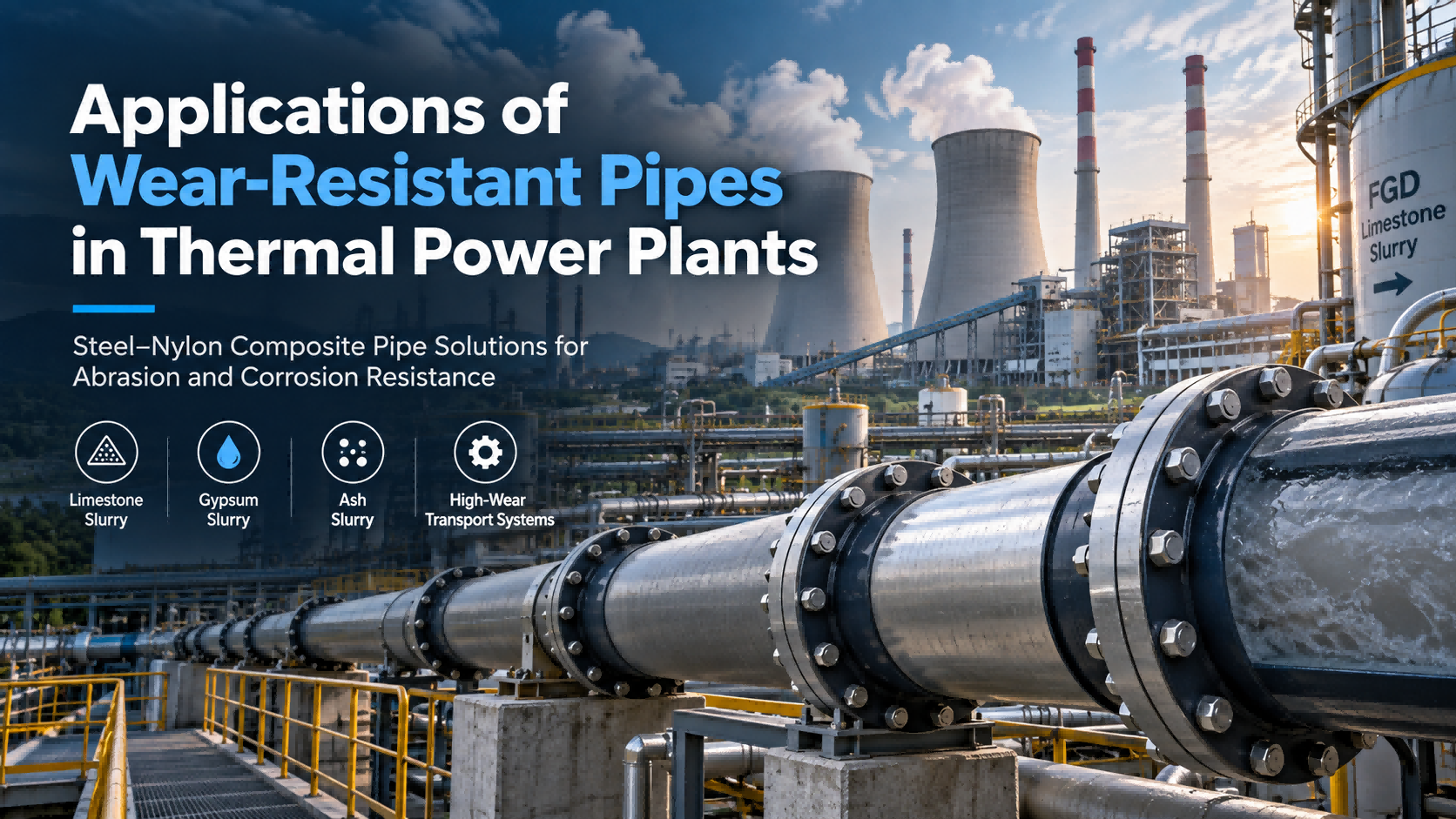
In thermal power plants, piping systems are used not only for transporting water, steam, and chemical media, but also extensively for handling limestone slurry, gypsum slurry, ash-water mixtures, industrial wastewater, and other solid-containing fluids.
Compared with ordinary water pipelines, these systems face a much more complex challenge:
Corrosion and abrasion often occur simultaneously.
This is particularly evident in wet flue gas desulfurization (FGD), ash handling, and high-solids slurry transportation systems. Solid particles continuously impact and abrade the pipe wall, while chlorides, salts, acidic or alkaline components may further accelerate material degradation.
Therefore, selecting wear-resistant piping for thermal power plants should not focus on abrasion resistance alone. Engineers must also consider:
-
Corrosion resistance
-
Pressure-bearing capability
-
Particle erosion
-
Localized wear at elbows and reducers
-
Reliability of pipe connections
-
Long-term maintenance costs
-
Risk of unplanned shutdowns
-
Total lifecycle cost
As power plants increasingly prioritize long-term operational reliability, pipelines are gradually evolving from conventional “consumable components” into a critical part of overall system reliability design.
1. Which Systems in Thermal Power Plants Require Wear-Resistant Pipes Most?
Not every pipeline in a thermal power plant requires wear-resistant materials.
The most demanding applications are generally those involving a combination of solid particles, relatively high flow velocities, corrosive media, and continuous erosion.
1.1 Limestone Slurry Pipelines
Wet flue gas desulfurization systems require large quantities of limestone slurry.
As limestone particles travel through the pipeline at relatively high velocity, they continuously abrade the internal surface.
In straight pipe sections, wear may be relatively uniform. However, when the slurry passes through:
-
Elbows
-
Tees
-
Reducers
-
Areas upstream and downstream of valves
-
Pump discharge sections
-
Slurry distribution headers
the flow pattern changes significantly.
The angle and velocity at which particles strike the pipe wall increase, causing these areas to become common locations for accelerated wall thinning, perforation, and leakage.
2. Why Do Gypsum Slurry Pipelines Experience Severe Localized Wear?
Gypsum slurry formed after the desulfurization reaction is another typical solid-liquid two-phase medium.
When the slurry contains a high concentration of solid particles and is transported at elevated velocity, continuous erosion can occur along the internal pipe surface.
The problem becomes especially severe where the pipeline changes direction abruptly.
Due to inertia, solid particles may concentrate their impact on specific areas of the pipe wall.
This often leads to a common situation in industrial plants:
Straight pipe sections may still be serviceable while elbows have already suffered severe wall thinning.
For this reason, wear-resistant pipeline design should not simply apply the same material and wall thickness throughout the entire system.
A more effective approach is to use:
Different wear-protection strategies for straight pipes, elbows, tees, pump discharge sections, and other critical locations according to their actual erosion intensity.
3. Ash Slurry and Solid-Containing Wastewater: More Than an Abrasion Problem
Ash handling systems in thermal power plants often transport fluids containing significant quantities of suspended solids.
In these environments, conventional carbon steel pipes may be exposed to:
Particle abrasion + electrochemical corrosion.
Once corrosion begins roughening the internal pipe surface, particle erosion may intensify further.
This interaction is commonly referred to as:
Corrosion–Erosion Synergy
Under these conditions, the combined material loss can be more severe than either corrosion or abrasion acting independently.
As a result, some pipelines may have relatively thick walls but still experience unsatisfactory service life.
The reason is simple:
Increasing steel wall thickness alone does not eliminate the underlying corrosion and erosion mechanisms.
This is one of the reasons why more power plant operators are evaluating composite piping solutions.
4. Why Do Conventional Carbon Steel Pipes Fail in Slurry Systems?
Carbon steel has several important advantages:
-
High structural strength
-
Mature manufacturing technology
-
Easy fabrication
-
Relatively low initial purchase cost
However, it also has clear limitations in highly abrasive and corrosive slurry environments.
Once corrosion creates pits and roughness on the internal surface, solid particles can generate stronger turbulence and localized impact.
A typical deterioration process may develop as follows:
Corrosion → Surface Roughening → Increased Erosion → Wall Thinning → Localized Perforation
If a power plant simply increases carbon steel wall thickness to extend pipeline life, the failure may be delayed, but the fundamental deterioration mechanism remains unchanged.
Therefore, in severe wear zones, comparing only the purchase price of different piping materials can be misleading.
A more useful metric is:
Cost per Operating Year
In other words:
How much does the pipeline actually cost for every year of reliable operation?
5. Why Are Rubber-Lined Steel Pipes Commonly Used in Power Plants?
Rubber-lined steel pipe has traditionally been widely used in flue gas desulfurization systems.
The steel structure provides mechanical strength, while the rubber lining isolates the corrosive medium from the steel substrate.
However, several factors must be considered during long-term operation:
-
Rubber aging
-
Local delamination
-
Joint damage
-
Wear in high-velocity areas
-
Installation quality
-
Difficulty of field repair
In slurry systems with high flow velocity and high solids content, premature damage to the lining may expose the underlying steel directly to the process medium.
Once this occurs, localized corrosion may accelerate rapidly.
Therefore, for continuously operating systems, the conventional concept of “steel pipe + flexible lining” is not necessarily the only available engineering solution.
6. Are Ceramic Wear-Resistant Pipes the Best Solution for Abrasive Applications?
Ceramic materials offer extremely high hardness and can perform very well in certain severe abrasive applications.
Typical applications may include:
-
Dry ash conveying
-
Highly abrasive particles
-
High-hardness solids
In these environments, ceramic-lined pipes can offer significant advantages.
However, pipeline material selection in thermal power plants cannot be based on hardness alone.
Other considerations include:
-
Brittleness
-
Impact loading
-
Installation requirements
-
Pipe weight
-
Complex fitting geometry
-
Thermal stress
-
Large-diameter manufacturing
-
Field maintenance
Therefore:
The material with the highest hardness is not necessarily the material with the best overall pipeline performance.
For solid-liquid slurry transportation, the balance between abrasion resistance, toughness, corrosion resistance, and structural strength is often more important than a single extreme material property.
7. Why Can Steel–Nylon Composite Pipe Be Considered for Wear-Resistant Power Plant Applications?
Steel–nylon composite pipe uses a multi-material structural design.
Its engineering principle is not to rely on one material to solve every problem. Instead, different materials are assigned different functions.
Outer Steel Structure
The steel structure mainly provides:
-
Pressure resistance
-
Mechanical load capacity
-
Installation strength
-
Overall structural stability
Internal Reinforced Nylon Functional Layer
The reinforced nylon layer mainly provides:
-
Direct contact with the transported medium
-
Resistance to particle abrasion
-
Corrosion resistance
-
Separation of corrosive media from the steel substrate
The result is:
Steel Strength + Nylon Protection
In other words:
Steel provides structural strength, while reinforced nylon provides corrosion and wear protection.
This design philosophy differs fundamentally from conventional single-material piping systems.
8. A Key Advantage of Steel–Nylon Composite Pipe: Addressing Both Corrosion and Abrasion
The real challenge in thermal power plant slurry pipelines is usually not abrasion alone, nor corrosion alone.
It is the combination of:
Corrosion + Abrasion
For example, FGD slurry may simultaneously contain:
-
Solid particles
-
Chloride ions
-
Salts
-
Suspended solids
-
Corrosive chemical components
If engineers focus only on abrasion resistance, the selected material may still suffer chemical corrosion.
If they focus only on corrosion resistance, the material may not withstand long-term particle erosion.
The value of steel–nylon composite pipe lies in its ability to integrate:
Abrasion resistance, corrosion resistance, and pressure-bearing capability within one composite piping structure.
This makes it particularly suitable for industrial slurry applications where several performance requirements must be addressed simultaneously.
9. What Advantages Can a Smoother Internal Surface Provide?
For long-distance slurry pipelines, material durability is not the only important factor.
Another frequently overlooked consideration is:
Hydraulic Efficiency
If corrosion gradually roughens the internal pipe surface, hydraulic resistance may increase.
This can lead to:
-
Higher pump loads
-
Increased energy consumption
-
Reduced conveying capacity
-
Higher operating costs
Nylon materials generally provide a relatively smooth internal surface.
Under suitable operating conditions, a smoother inner wall can help reduce additional resistance caused by severe surface roughness and irregular deposits.
For long-distance conveying systems, pipeline evaluation should therefore consider more than initial wall thickness.
Engineers should also ask:
Will the internal surface remain relatively stable after years of operation?
10. Elbows Are Critical in Wear-Resistant Pipeline Design
Many industrial pipeline failures do not begin in straight pipe sections.
They begin at the:
Elbows
The reason is straightforward.
When solid particles enter an elbow, inertia causes them to impact the outer radius of the bend.
As a result, the outer wall of an elbow may experience highly concentrated erosion.
When designing slurry pipelines for thermal power plants, engineers should pay close attention to several key parameters.
10.1 Flow Velocity
Higher velocity increases the kinetic energy of particles.
10.2 Solids Concentration
Higher solids concentration means more particles strike the pipe wall within a given period.
10.3 Particle Size
Larger particles generally carry greater impact energy.
10.4 Particle Hardness
Harder particles can produce stronger abrasive action against the pipe wall.
10.5 Bend Radius
An excessively small bend radius can increase localized particle impact.
Therefore:
An effective wear-resistant pipeline solution is not simply a material-selection problem. It is also a pipeline system design problem.
11. Why Is the Pump Discharge Section Another High-Risk Area?
Pump discharge sections frequently experience a combination of:
-
High flow velocity
-
Turbulence
-
Pressure fluctuations
-
Particle impact
-
Unstable flow patterns
For this reason, they are often among the most wear-intensive areas in slurry transport systems.
For pipelines continuously transporting limestone slurry, gypsum slurry, or ash slurry, engineers should consider the following components as one integrated wear zone:
Pump discharge section + first elbow + reducer section
If only the elbow is upgraded while adjacent pipe sections are ignored, the wear problem may simply shift to a new location.
12. Comparison of Common Wear-Resistant Pipe Materials for Thermal Power Plants
| Pipe Material | Corrosion Resistance | Wear Resistance | Structural Strength | Impact Resistance | Suitability for Complex Slurries |
|---|---|---|---|---|---|
| Carbon Steel | Moderate | Moderate | High | High | Moderate |
| Rubber-Lined Steel | Good | Good | High | Good | Good |
| FRP | Good | Depends on Structural Design | Moderate | Requires Evaluation | Moderate |
| Ceramic Wear-Resistant Pipe | Good | Very High | High | Brittleness Must Be Considered | Suitable for Specific Conditions |
| Steel–Nylon Composite Pipe | Good | Good | High | Good | Suitable for Combined Corrosion and Abrasion |
It is important to emphasize that:
There is no single industrial pipe material that is ideal for every operating condition.
Material selection should always consider:
-
Temperature
-
Pressure
-
Solids concentration
-
Particle size
-
Particle hardness
-
Chemical composition of the medium
-
Flow velocity
-
Pipe diameter
-
Installation conditions
This engineering approach is one of the key differences between a professional piping solution provider and a supplier focused only on selling pipe products.
13. Wear-Resistant Piping Should Not Be Evaluated Only by Purchase Price
Consider two hypothetical pipeline solutions.
Pipeline A
It has a lower initial purchase price but requires frequent:
-
Welding repairs
-
Patch repairs
-
Elbow replacement
-
Pipe section replacement
-
Maintenance shutdowns
Pipeline B
Its initial investment is higher, but it provides longer operating cycles and lower maintenance frequency.
Which one costs less over ten years?
The answer cannot be determined from the purchase price alone.
The correct approach is to evaluate:
Total Cost of Ownership (TCO)
A complete TCO calculation should include at least:
**Pipe purchase cost
-
Installation cost
-
Maintenance cost
-
Spare parts cost
-
Labor cost
-
Downtime losses
-
Replacement cost
-
Energy cost**
For a large thermal power plant, the economic impact of a single unplanned shutdown may sometimes be far greater than the purchase cost of the pipeline itself.
Therefore:
The real value of a wear-resistant pipeline is not simply that it loses fewer millimeters of wall thickness. Its value lies in improving the continuous operating capability of the entire production system.
14. Wear-Resistant Piping Is Moving from “Material Upgrades” to “System Upgrades”
The future development of wear-resistant piping in thermal power plants is unlikely to focus solely on one question:
Which material has the highest wear resistance?
Instead, the more important question will become:
Which solution can keep the entire conveying system operating reliably for longer?
As a result, project design will increasingly focus on:
-
Wear classification for different pipeline sections
-
Reinforcement of high-risk locations
-
Remaining service-life prediction
-
Online wall-thickness monitoring
-
Modular replacement
-
Reduced planned maintenance frequency
-
Fewer unplanned shutdowns
-
Full lifecycle pipeline management
Steel–nylon composite pipe is one material solution worth evaluating within this broader trend.
Rather than maximizing one isolated property, the objective is to achieve a more practical balance between:
Corrosion resistance, abrasion resistance, pressure capability, toughness, and long-term maintenance cost.
15. Which Thermal Power Plant Pipelines Are Suitable for Evaluating Steel–Nylon Composite Pipe?
Steel–nylon composite pipe can be considered for technical evaluation in several demanding applications.
Wet Flue Gas Desulfurization Systems
-
Limestone slurry pipelines
-
Gypsum slurry pipelines
-
Slurry circulation pipelines
-
Selected FGD wastewater pipelines
Ash and Slag Handling Systems
-
Ash slurry pipelines
-
Solid-containing wastewater pipelines
-
High-wear discharge pipelines
Industrial Wastewater Systems
Particularly where the medium contains both:
Corrosive components + suspended solid particles
Long-Distance Slurry Pipelines
If conventional steel piping frequently suffers from:
-
Corrosion
-
Abrasion
-
Perforation
-
Leakage
-
Frequent replacement
-
High maintenance costs
then steel–nylon composite piping may be worth including in a detailed technical and economic comparison.
16. Do Not Replace the Entire Pipeline Immediately: Start with a Trial Section
For a large thermal power plant already in operation, replacing an entire pipeline system with a new material may not be practical.
A more controlled approach is to select:
-
One severely worn elbow
-
One pump discharge pipe section
-
One straight section with a history of frequent repair
-
One representative slurry transport branch
and establish a trial section.
During operation, engineers can record:
-
Initial wall thickness
-
Operating time
-
Flow rate
-
Slurry concentration
-
Particle characteristics
-
Periodic wall-thickness measurements
-
Historical service life of the original pipeline
The data can then be used to compare:
Wear Rate
In other words, the rate of material loss over a defined operating period.
Compared with relying exclusively on laboratory data, real operating data from a representative trial section can provide plant engineers with stronger evidence when determining whether a new piping material is suitable for their specific operating conditions.
17. Our Steel–Nylon Composite Pipe Solutions
We specialize in the development and manufacturing of steel–nylon composite pipes and reinforced nylon industrial piping systems, providing pipeline solutions for complex industrial fluid transportation environments.
For highly abrasive and corrosive systems in thermal power plants, our focus is not simply on supplying a pipe product.
Instead, we evaluate the actual operating conditions, including:
Medium composition + solids concentration + particle characteristics + temperature + pressure + flow velocity + pipe diameter + installation environment
Based on these parameters, we assess whether a steel–nylon composite structure can help address common problems associated with conventional piping systems, including:
-
Corrosion
-
Abrasion
-
Frequent leakage
-
Short elbow service life
-
Frequent pipeline maintenance
-
Extended shutdown periods
For large industrial projects, a staged technical approach can also be adopted:
Operating Condition Analysis → Material Selection → Trial Section Installation → Performance Data Evaluation → Large-Scale Application
This approach can help industrial customers reduce engineering risks when introducing a new pipeline material.
Conclusion: The Real Goal of Wear-Resistant Piping Is Long-Term Reliability
The key challenge in thermal power plant slurry transportation is not simply identifying the material with the highest hardness.
The real engineering question is:
How can a pipeline maintain reliable operation for a longer period under the combined effects of corrosion, abrasion, pressure, particle impact, and continuous industrial service?
As thermal power plants place greater emphasis on equipment reliability, reduced maintenance frequency, and lifecycle economics, conventional approaches based solely on increasing carbon steel wall thickness or repeatedly replacing worn pipe sections are becoming less attractive.
For limestone slurry, gypsum slurry, ash-water mixtures, and other combined corrosion-abrasion applications, steel–nylon composite pipe provides an alternative technical approach that combines the structural strength of steel with the corrosion and wear resistance of reinforced nylon.
The future of wear-resistant piping in thermal power plants will increasingly shift away from the question:
“Which pipe has the lowest purchase price?”
toward a more important question:
“Which piping solution can provide more stable operation and lower total maintenance costs throughout its service life?”
This is precisely why steel–nylon composite pipe deserves further technical evaluation for demanding material-handling and slurry transportation systems in modern thermal power plants.
Trends in Smart Mining Material Conveying Systems: From Conventional Pipelines to Intelligent, Predictive, and Low-Maintenance Infrastructure
Recommended Piping for Power Plant FGD Systems: How to Select Pipe Materials When Corrosion, Abrasion, and Scaling Occur Together