Why Customers Turn to Composite Piping After Frequent Replacement of Traditional Pipes
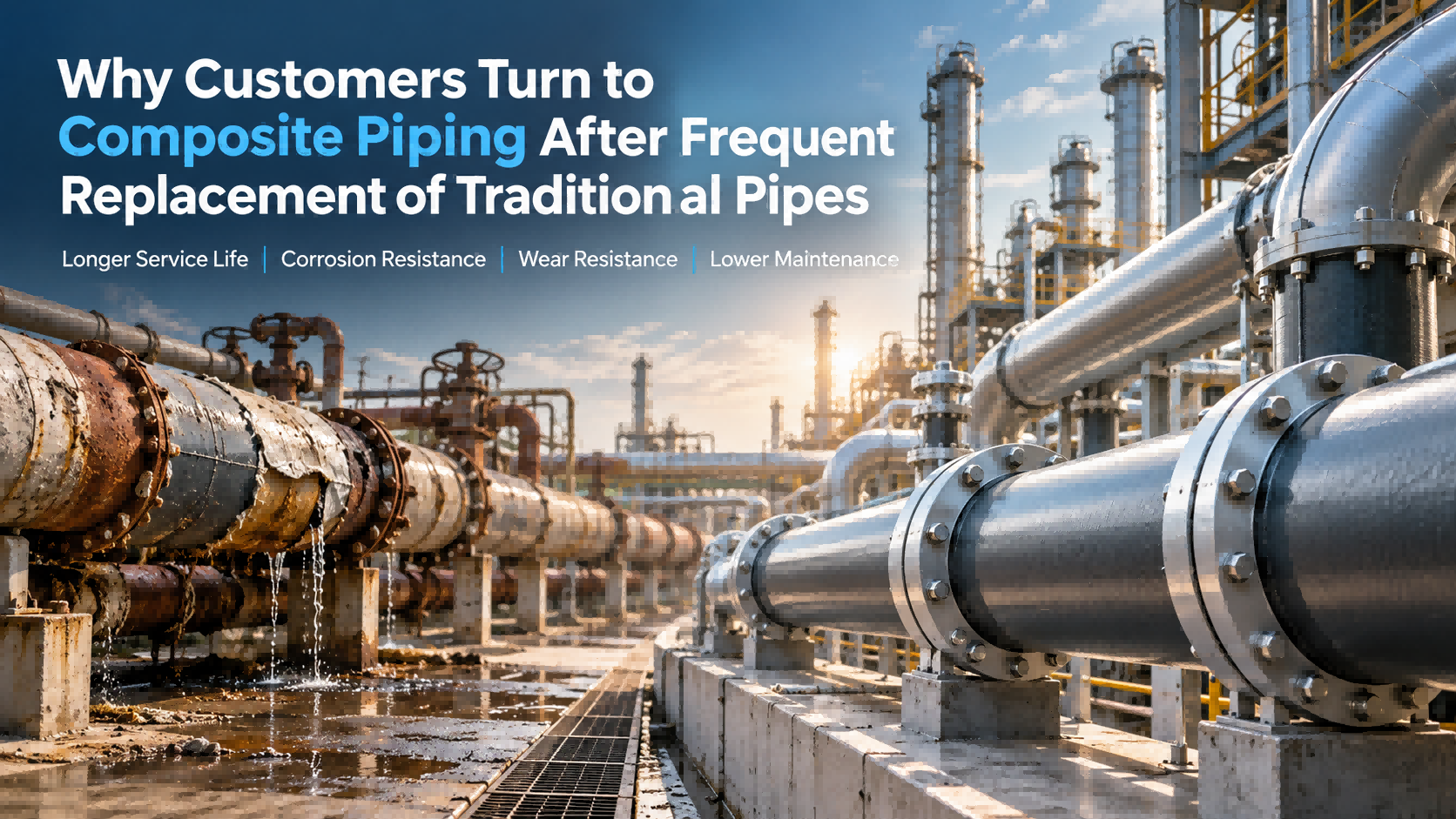
In chemical processing, oil and gas, mining, salt chemicals, soda ash, chlor-alkali, and industrial water treatment, pipelines are not always the most expensive equipment in a project.
However, after several years of operation, many companies discover that pipelines can become one of the most persistent sources of maintenance cost and operational instability.
Corrosion perforation, internal abrasion, lining delamination, flange leakage, low-temperature damage, repeated welding repairs, short-section replacement, and emergency shutdowns can gradually turn a seemingly ordinary piping system into a major maintenance burden.
When these problems keep recurring, the customer's priorities begin to change.
At the initial procurement stage, the main question may be:
“How much does the pipe cost per meter?”
After repeated repairs and replacements, the question becomes:
“How long can this piping system operate reliably?”
And eventually:
“Is there a solution that can reduce corrosion, abrasion, leakage, and maintenance frequency at the same time?”
This shift in thinking is one of the key reasons why more industrial users are reassessing traditional single-material piping systems and turning their attention to composite piping solutions such as steel-nylon composite pipe.
1. Material Upgrades Often Begin After the First Major Repair
During the construction of a new industrial project, piping materials are usually selected according to several factors:
-
Initial purchasing cost
-
Project budget
-
Engineering design practices
-
Previous operating experience
-
Local supply availability
-
Installation convenience
As a result, carbon steel, stainless steel, FRP, HDPE, rubber-lined steel pipe, and other lined piping systems all have their appropriate applications.
However, the real differences between materials become more obvious after the plant enters long-term operation.
For example, a pipeline transporting corrosive mother liquor, brine, high-salinity produced water, or abrasive slurry may gradually develop problems such as:
-
Localized wall thinning
-
Leakage near welded joints
-
Elbow erosion
-
Internal lining failure
-
Flange leakage
-
Surface blistering
-
Repeated welding repairs
-
Frequent replacement of pipe sections
At this point, the issue is no longer simply about maintenance.
It may indicate that:
The current piping material is fundamentally mismatched with the actual operating environment.
Many customers do not begin considering composite piping because of marketing claims about new materials.
They begin considering it because the maintenance frequency of their existing piping system has become unacceptable.
2. Why Does Frequent Pipe Replacement Become So Expensive?
Many purchasing departments focus mainly on the cost of new pipe.
Operations departments, however, must deal with a much larger group of hidden costs.
Pipe Cost Is Only Part of the Replacement Cost
Replacing an industrial pipeline may involve:
-
Removal of the old pipe
-
Transportation of new pipe
-
Lifting and handling
-
Welding
-
Corrosion protection
-
Removal and restoration of insulation
-
Scaffolding
-
Pipe support adjustment
-
Non-destructive testing
-
Pressure testing
-
Cleaning
-
Commissioning
-
Safety approvals
In chemical plants and oilfields, some areas also require strict hot-work procedures.
As a result, the total replacement cost of a seemingly inexpensive pipeline can be significantly higher than the purchase price of the pipe itself.
Production Downtime Can Cost More Than the Pipe
For continuous-process industrial facilities, leakage in a critical process pipeline may affect:
-
Production capacity
-
Continuous plant operation
-
Upstream and downstream processes
-
Raw material supply
-
Product delivery
-
Safety management
Therefore, companies should not evaluate piping only by its purchase price.
A more realistic model is:
Pipeline lifecycle cost
= Initial purchase + installation + maintenance + shutdown losses + replacement + safety management + repeated investment over the service life
Once this model is applied, some solutions that appear inexpensive at the beginning may no longer be economical over the long term.
3. Why Are Single-Material Pipes Increasingly Challenged by Complex Industrial Conditions?
Modern industrial transportation systems are becoming increasingly demanding.
A single pipeline may simultaneously face:
-
Corrosion
-
Abrasion
-
Internal pressure
-
Temperature fluctuations
-
Solid-particle erosion
-
High salinity
-
Acidic or alkaline media
-
H₂S
-
CO₂
-
Outdoor exposure
-
Equipment vibration
This means that focusing on only one material property is often no longer sufficient.
Carbon Steel: Strong, but Vulnerable to Internal Corrosion
One of the major advantages of steel pipe is its mechanical strength.
However, when steel is directly exposed to corrosive media, internal corrosion can become a major concern.
Typical examples include:
-
High-salinity water
-
Chemical mother liquor
-
Chloride-containing media
-
Certain acidic or alkaline solutions
-
Oilfield produced water
-
Fluids containing H₂S or CO₂
Carbon steel systems may therefore depend on:
-
Corrosion inhibitors
-
Internal coatings
-
Linings
-
Corrosion monitoring
-
Periodic inspection and maintenance
If these protection systems fail, the steel substrate may be directly exposed to the corrosive medium.
Stainless Steel: Corrosion Resistant, but Cost and Localized Corrosion Still Matter
304, 316L, and higher-grade stainless steels are widely used in industrial piping.
However, in environments involving high chloride concentrations, salinity, elevated temperatures, or certain chemical conditions, engineers still need to consider:
-
Pitting corrosion
-
Crevice corrosion
-
Stress corrosion cracking
-
Material grade selection
-
Weld-area corrosion risks
At the same time, using high-grade stainless steel for large-diameter or higher-pressure piping can significantly increase capital expenditure.
FRP: Corrosion Resistant, but Mechanical Performance Must Match the Application
FRP piping provides strong corrosion resistance in many industrial applications.
However, in environments involving heavy mechanical loads, impact, difficult installation conditions, or abrasive slurries, engineers may need to evaluate:
-
Laminate structure
-
Joint reliability
-
Impact resistance
-
Long-term fatigue behavior
-
Installation quality
No single material is suitable for every industrial service.
HDPE: Excellent for Many Water Applications, but Temperature and Rigidity Have Limits
HDPE provides strong corrosion resistance and is widely used in water transportation.
However, when industrial applications involve:
-
Higher temperatures
-
Large diameters
-
Higher pressures
-
Long-distance aboveground installation
-
Greater structural rigidity requirements
its suitability needs to be carefully evaluated.
4. Why Are Customers Moving Toward a “Composite Material” Approach?
The real value of composite piping is not simply that two materials are combined.
It represents a different engineering philosophy:
Instead of requiring one material to perform every function, different materials are assigned the functions they perform best.
This is also the fundamental design concept behind steel-nylon composite piping.
5. Steel-Nylon Composite Pipe: Steel for Strength, Nylon for Media Protection
Steel-nylon composite pipe can be understood as a piping system that combines structural strength with functional media protection.
The steel structure mainly provides:
-
Pressure-bearing capability
-
Rigidity
-
Mechanical strength
-
Overall structural stability
The nylon functional layer mainly provides:
-
Isolation from corrosive media
-
Reduced direct contact between process fluids and steel
-
Improved abrasion resistance
-
Better adaptability to demanding industrial transportation conditions
Compared with conventional designs where a single material must perform all functions, composite structures allow different engineering functions to be distributed between different materials.
This is one of the main reasons steel-nylon composite pipe is increasingly considered for industrial environments involving corrosion, abrasion, and pressure at the same time.
6. Corrosion Reduction Is Often the First Reason Customers Consider Composite Pipe
For many chemical and oilfield applications, internal corrosion is one of the major long-term risks associated with traditional steel piping.
This is especially true in systems transporting the following media.
High-Salinity Fluids
Examples include:
-
Oilfield produced water
-
Water injection fluids
-
Brine
-
Concentrated salt water
-
Salt chemical process fluids
Long-term exposure of steel to these media can accelerate corrosion.
Acidic and Alkaline Media
Chemical plants may transport:
-
NaOH
-
NaCl
-
Certain low-concentration acidic solutions
-
Process mother liquor
-
Chemical wastewater
Material chemical stability therefore becomes essential for long-term operation.
By separating the process medium from the steel structure with a nylon functional layer, steel-nylon composite pipe can reduce the risk associated with direct exposure of steel to corrosive fluids.
For continuous industrial service, this structural strength + corrosion-resistant inner layer approach can be more meaningful than simply increasing steel wall thickness.
7. The Second Reason: Corrosion Resistance Alone Is Not Enough
This is a challenge that some conventional anti-corrosion solutions may overlook.
In mining, phosphate chemicals, soda ash, salt chemicals, and certain oilfield applications, the transported medium is not always a clean liquid.
It may contain:
-
Mineral particles
-
Sand
-
Salt mud
-
Crystals
-
Suspended solids
-
Other abrasive particles
As these particles move through the pipeline at high velocity, they continuously erode the internal surface.
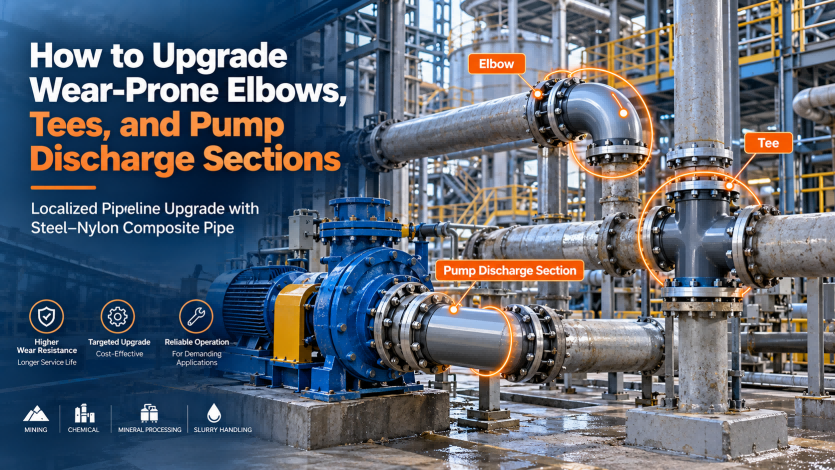
Wear is often more severe at:
-
Elbows
-
Tees
-
Reducers
-
Areas near valves
-
High-velocity sections
Therefore, corrosion resistance alone may not be sufficient.
Customers increasingly require:
Corrosion resistance + abrasion resistance.
Nylon materials have favorable wear-resistant characteristics, which makes steel-nylon composite structures particularly relevant for applications where corrosion and abrasion occur simultaneously.
8. The Third Reason: Pressure Capacity and Structural Reliability Still Matter
Some non-metallic materials provide excellent corrosion resistance.
However, industrial projects must also address another critical factor:
Pressure.
This is especially important in:
-
Oil and gas gathering systems
-
Water injection pipelines
-
Long-distance transmission lines
-
Pressurized chemical pipelines
-
Large-diameter industrial piping
A piping system must not only resist the transported medium.
It must also provide reliable structural support.
The value of steel-nylon composite pipe lies in combining:
Steel for structural strength and pressure resistance, with nylon for media protection.
This material configuration allows corrosion resistance, abrasion resistance, and pressure capability to be considered within the same piping system.
For demanding applications where conventional single-material solutions struggle to balance these requirements, this can be particularly valuable.
9. The Fourth Reason: Industrial Projects Are Paying More Attention to Connection Reliability
Many pipeline leaks do not begin in straight pipe sections.
They often occur at:
-
Joints
-
Welds
-
Flanges
-
Lining termination points
-
Field connection areas
Modern industrial piping design must therefore consider more than the pipe body itself.
It must consider:
The reliability of the entire transportation system.
For steel-nylon composite piping, we place particular emphasis on flange connection design and connection integrity.
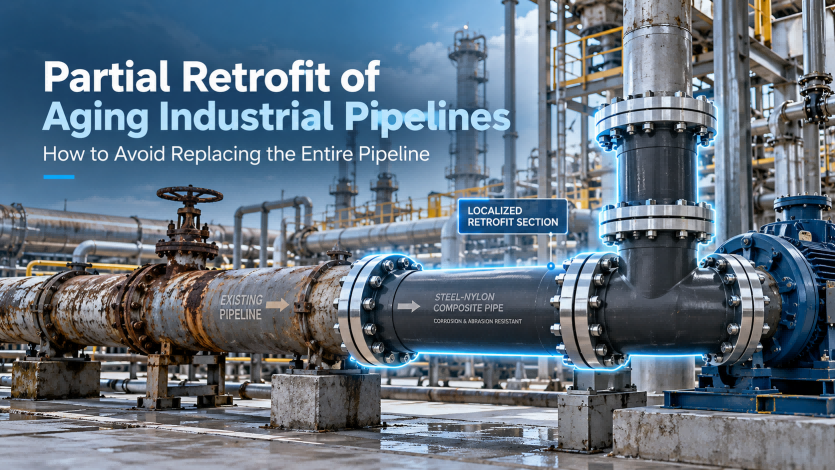
Depending on project requirements, flange-connected systems can reduce some field welding requirements.
This can be especially valuable in:
-
Chemical plant retrofits
-
Flammable or explosive areas
-
Aging plant upgrades
-
Facilities where long shutdowns are difficult
Customers therefore evaluate not only pipe service life, but also:
Installation safety, construction efficiency, and future maintenance convenience.
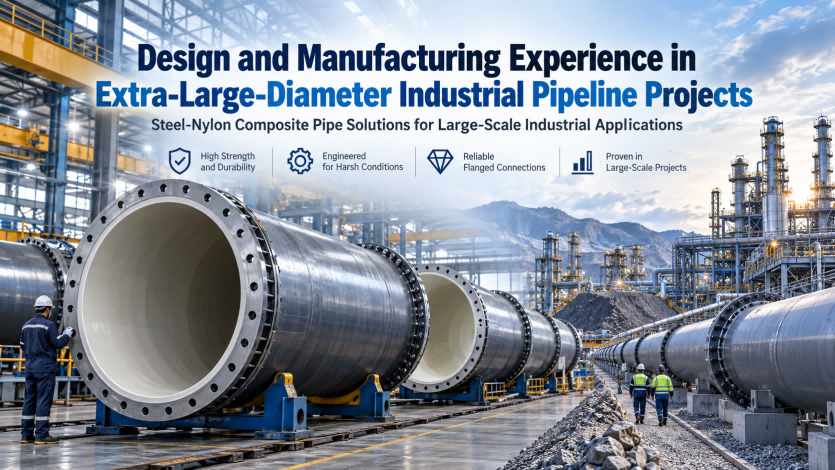
10. The Fifth Reason: Large-Diameter Piping Requires Both Structural and Material Engineering
As industrial facilities expand in scale, large-diameter piping systems are becoming increasingly common.
However, larger pipe diameters also create greater engineering challenges.
Designers may need to consider:
-
Ring stiffness
-
Pipe wall stability
-
Support spacing
-
External loads
-
Internal pressure
-
Temperature variation
-
Thermal expansion and contraction
-
Connection design
-
Transportation and installation
For this reason, large-diameter industrial piping cannot be evaluated solely according to corrosion resistance.
Structural reliability is equally important.
In the development and manufacture of steel-nylon composite pipe, we continue to focus on large-diameter structural stability.
Different diameters and pressure classes can be developed according to actual project requirements, while manufacturing capabilities continue to expand toward larger composite pipe sizes.
11. The Real Change Is a Shift in Maintenance Philosophy
Traditional pipeline maintenance often follows this pattern:
Problem occurs → Repair → Resume operation → Repair again
As the pipeline ages, the disadvantages of this approach become increasingly obvious.
Maintenance teams may discover that the same piping system requires repairs every year.
One section is repaired this year.
Another section fails the next year.
Eventually, maintenance can no longer solve the fundamental material problem.
Companies then begin adopting a different approach:
Moving from “repairing pipes” to “designing for service life.”
This means considering the following questions during material selection:
-
What is the corrosion mechanism?
-
What is the abrasion mechanism?
-
What service life is required?
-
How many shutdowns are acceptable?
-
What is the expected maintenance cost?
-
What does one complete pipeline replacement cost?
-
What is the total investment over the full lifecycle?
Once companies begin thinking this way, the value of composite piping becomes easier to understand.
12. From Purchase Price to Total Cost of Ownership
Consider two piping options.
Option A
Lower initial purchase cost, but requires:
-
Frequent repairs
-
Periodic corrosion protection
-
Multiple replacements
-
Repeated shutdowns
Option B
Potentially higher initial investment, but offers:
-
Lower maintenance frequency
-
Longer replacement intervals
-
Fewer shutdowns
-
Reduced corrosion exposure
If only initial purchase price is compared, Option A may appear cheaper.
But over 10 or even 20 years of operation, the result may be very different.
This is why more industrial customers are evaluating:
TCO — Total Cost of Ownership
For industrial piping, a more comprehensive cost model should include:
TCO = Pipe cost + installation cost + maintenance cost + corrosion protection cost + replacement cost + downtime losses + safety management cost
When these costs are considered together, the economic value of longer-life piping systems becomes much clearer.
13. Which Applications Should Reevaluate Composite Piping?
Composite pipe is not necessary for every industrial application.
Material selection should always be based on actual operating conditions.
However, if your piping system repeatedly experiences the following problems, it may be time to reevaluate the material solution.
1. Corrosion Is Progressing Too Quickly
Typical examples include:
-
Brine pipelines
-
High-salinity produced water
-
Chemical mother liquor
-
Acidic or alkaline fluids
-
Corrosive wastewater
If frequent wall thinning or perforation occurs, the compatibility between the material and the process medium should be reassessed.
2. Corrosion and Abrasion Occur at the Same Time
Typical examples include:
-
Mineral slurry
-
Salt mud
-
Chemical slurry
-
Wastewater containing solids
-
Produced fluids containing sand
In these conditions, solving corrosion alone may not be enough.
Abrasion resistance is equally important.
3. Elbows and Local Pipe Sections Require Frequent Replacement
If components such as:
-
Elbows
-
Tees
-
Reducers
-
High-velocity pipe sections
repeatedly fail due to erosion, the wear resistance of the piping system should be reconsidered.
4. Hot Work Is Difficult at the Installation Site
In chemical plants, oilfields, and continuous-production facilities, hot work may involve:
-
Permit procedures
-
Production shutdowns
-
Equipment isolation
-
Gas testing
-
Fire monitoring
Therefore, piping systems designed for prefabrication and flange connections can provide another pathway for project optimization.
5. Pipe Diameter Continues to Increase
DN500, DN800, DN1000, and even larger industrial piping systems place higher requirements on:
-
Material strength
-
Rigidity
-
Connection design
-
Long-term stability
Composite structures can provide greater flexibility in balancing these requirements.
14. Steel-Nylon Composite Pipe Is Not Only About the Pipe — It Is About Operation
At the end of the day, customers are not simply purchasing a pipe.
They are trying to achieve:
-
Lower leakage risk
-
Fewer repairs
-
Less downtime
-
Longer operating cycles
-
Safer transportation
-
More stable production
For this reason, the value of steel-nylon composite pipe should not be described simply as:
“A new type of pipe material.”
A more accurate description is:
An industrial transportation solution designed to address corrosion, abrasion, pressure, and long-term maintenance challenges together.
15. What Performance Areas Do We Focus on in Steel-Nylon Composite Pipe?
For demanding industrial applications, our product development and manufacturing focus on several key areas.
Corrosion Resistance
The nylon functional layer helps reduce direct contact between corrosive media and the steel structure.
Abrasion Resistance
Suitable for evaluating applications involving particles, slurry, and erosion-prone process fluids.
Pressure Capability
The steel structure provides mechanical support and pressure-bearing capability. Product design can be adapted according to project pressure, diameter, and operating conditions.
Large-Diameter Manufacturing
Designed to address the growing demand for large-diameter industrial transportation pipelines.
Flange Connections
Flange-based designs can improve installation and maintenance efficiency and may reduce some on-site hot-work requirements.
Long-Term Operation
Our design objective is not simply to ensure that a pipe passes factory inspection.
The more important question is how reliably the piping system will perform after it enters long-term industrial service.
16. Why Will Industrial Piping Competition Increasingly Focus on Service Life?
In the past, industrial piping projects often asked:
Which pipe has the lowest purchase price?
Increasingly, the more important question is:
Which piping system has the lowest lifecycle cost?
For large industrial companies:
The most expensive pipeline is not necessarily the one with the highest purchase price.
The truly expensive pipeline may be the one that:
-
Requires repairs every year
-
Frequently leaks
-
Causes repeated shutdowns
-
Must be replaced after only a few years
By contrast, a transportation system capable of stable long-term operation may create better economic value even if its initial investment is not the lowest.
17. From “Replacing Pipe” to “Redesigning the Transportation System”
When a customer has replaced the same type of conventional pipe several times, continuing with exactly the same material may not solve the underlying problem.
A better approach is to reassess the entire piping system.
Step 1: Analyze the Medium
Consider:
-
Chemical composition
-
pH
-
Solids content
-
Particle size
-
Chloride concentration
-
Salinity
-
H₂S
-
CO₂
Step 2: Analyze Operating Conditions
Consider:
-
Pressure
-
Temperature
-
Flow velocity
-
Pipe diameter
-
Transportation distance
Step 3: Analyze the Failure Location
Typical examples include:
-
Straight pipe abrasion
-
Elbow perforation
-
Weld corrosion
-
Flange leakage
-
Lining delamination
Step 4: Redesign the Material Structure
Based on the actual failure mechanism, determine whether the system needs improved:
-
Corrosion resistance
-
Abrasion resistance
-
Pressure capability
-
Connection reliability
or whether several of these issues must be solved at the same time.
Only then can a company truly move from:
“continuously repairing pipelines”
to:
“solving the pipeline problem.”
18. Conclusion: The Shift to Composite Pipe Is Really a Shift from Short-Term Purchasing to Long-Term Value
When traditional piping requires frequent replacement, the biggest change is not simply the material itself.
The customer's entire decision-making logic begins to change.
From:
Buying a lower-cost pipe
to:
Building a more reliable transportation system.
From:
Repairing leaks after they occur
to:
Reducing the probability of failure during the design stage.
From:
Comparing initial purchase prices
to:
Comparing total lifecycle costs.
This is one of the fundamental reasons why high-performance composite piping systems such as steel-nylon composite pipe are receiving greater attention from industrial users.
Steel provides strength and structural support.
Nylon provides corrosion and abrasion resistance.
By combining the advantages of both materials, steel-nylon composite piping provides another material option for demanding transportation applications in:
-
Chemical processing
-
Oil and gas fields
-
Mining
-
Salt chemical production
-
Soda ash plants
-
Chlor-alkali facilities
-
Other complex industrial environments
For companies that have repeatedly experienced the cycle of:
Corrosion → Leakage → Repair → Replacement → Leakage again
the most important question is no longer:
“Which pipe should we buy next?”
The more important question is:
“How can we prevent this pipeline from requiring frequent replacement again?”
That is where the real value of composite piping technology begins.
Looking for a Longer-Life Industrial Piping Solution?
If your existing pipeline is experiencing frequent corrosion, abrasion, leakage, or replacement, the first step should not simply be replacing it with the same material again.
Our steel-nylon composite piping solutions are designed for demanding industrial applications where corrosion resistance, abrasion resistance, pressure capability, and long service life must be considered together.
Typical applications include:
-
Chemical process pipelines
-
Oilfield gathering pipelines
-
Produced-water transportation
-
Water-injection systems
-
Mining slurry pipelines
-
Soda ash plants
-
Chlor-alkali plants
-
Salt chemical processing
-
Phosphate slurry transportation
-
Large-diameter industrial water pipelines
For a more accurate piping recommendation, provide the following operating parameters:
Medium, concentration, temperature, operating pressure, pipe diameter, flow velocity, and current pipeline failure mode.
Based on these conditions, a more suitable piping material and structural solution can be evaluated.
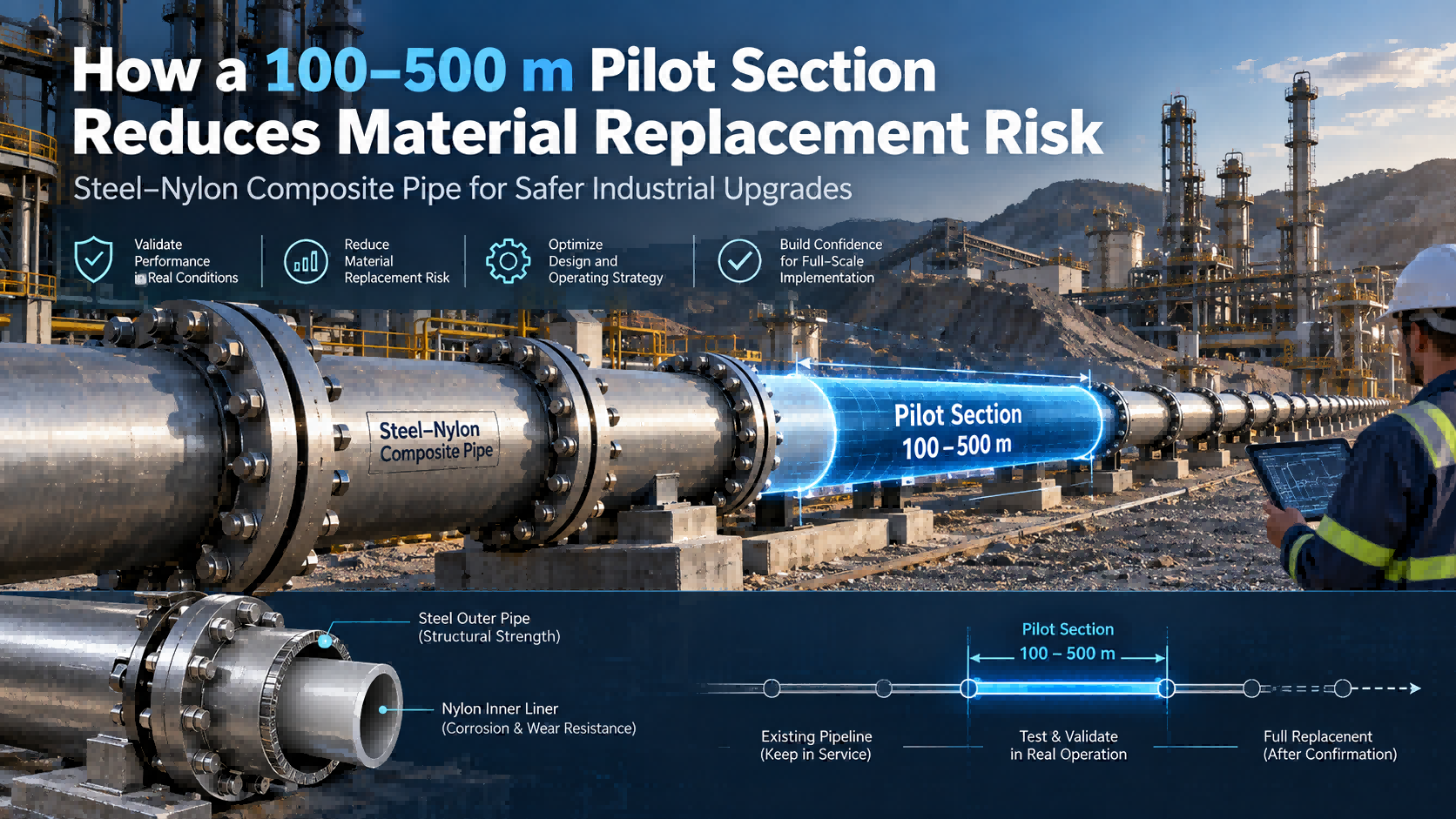
From Trial Section to Full Pipeline: How New Pipeline Materials Earn Customer Acceptance
Case Study: Chemical Mother Liquor Pipeline System Upgrade — How to Solve Corrosion, Abrasion, Leakage, and Frequent Maintenance at the Same Time