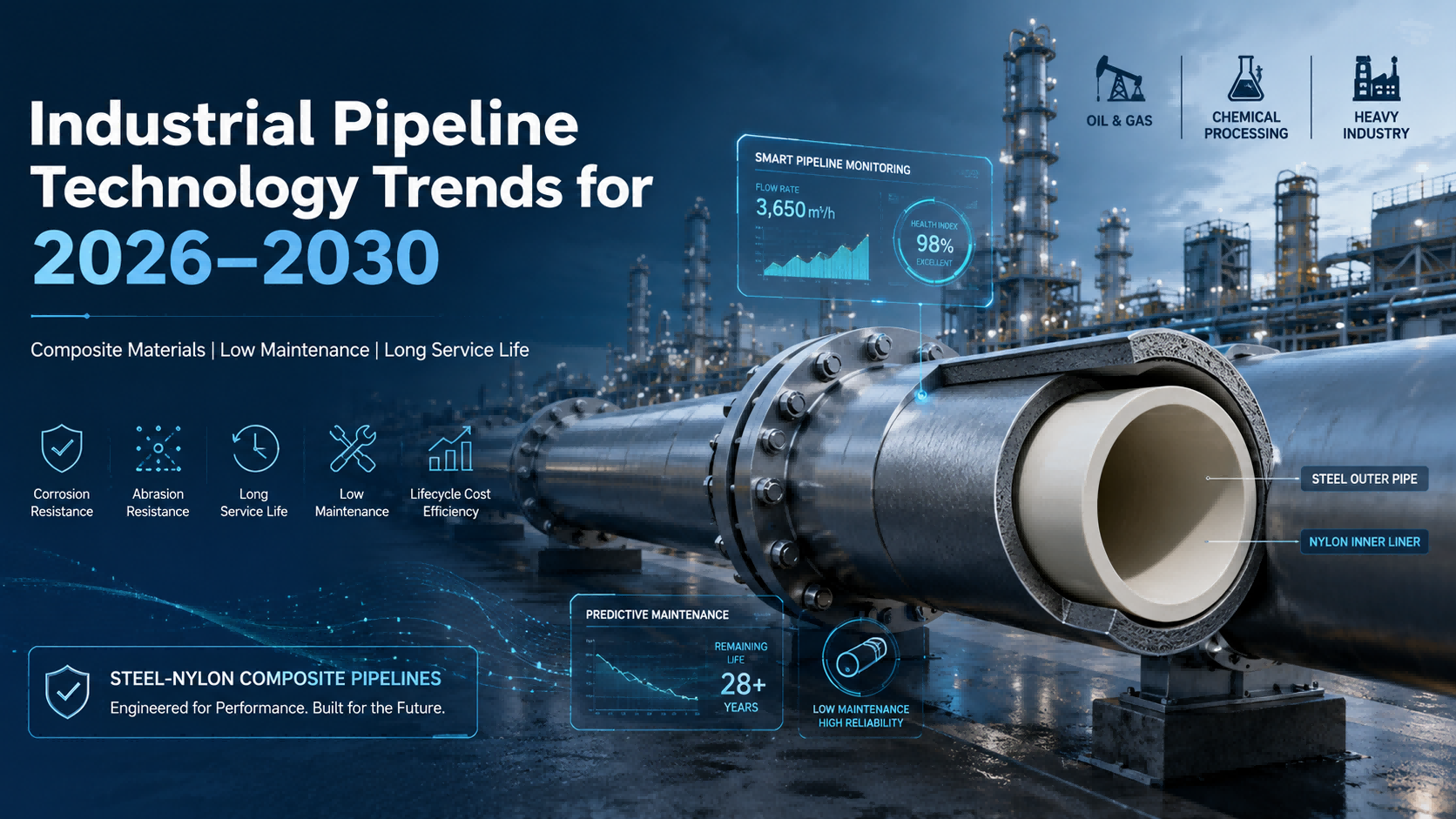
Why Industrial Companies Are Shifting Toward Longer-Lasting Pipeline Materials

“How much does this pipe cost per meter?”
But across industries such as chemicals, oil and gas, mining, power generation, salt chemicals, phosphate chemicals, and industrial water treatment, this purchasing logic is changing.
Today, the more important questions are becoming:
“How many times will this pipeline need to be replaced over the next 10 years?”
“How much could one corrosion-related leak cost in production downtime?”
“What is the total cost of installation, maintenance, spare parts, labor, and shutdowns?”
“Is there a pipeline material that can simultaneously address corrosion, wear, scaling, pressure, and maintenance challenges?”
This is why more industrial companies are moving away from pipelines selected primarily for a low initial purchase price and toward materials offering longer service life, lower maintenance frequency, and lower total lifecycle cost.
Under demanding corrosive and abrasive operating conditions, a pipeline is no longer just a simple transportation component.
It is increasingly becoming a critical part of industrial infrastructure that directly influences plant reliability, production continuity, and long-term operating costs.
1. The Most Expensive Part of an Industrial Pipeline Is Often Not the Pipe Itself
When selecting piping materials, it is easy to compare unit prices.
For example:
-
How much does carbon steel cost per ton?
-
How much does stainless steel pipe cost per meter?
-
How much does HDPE pipe cost per meter?
-
How much does FRP pipe cost?
-
How much does composite pipe cost?
However, this type of comparison has a major limitation:
The purchase price of an industrial pipeline is not the same as its true cost.
Over a service period of 10, 20, or even more years, the actual cost of a pipeline system usually includes:
Total Lifecycle Cost = Initial Cost + Installation + Maintenance + Shutdown Loss + Replacement + Disposal
In other words:
Total lifecycle cost includes initial procurement, installation, maintenance, production shutdowns, replacement, and end-of-life disposal.
For a conventional water supply system, a pipe leak may simply mean a repair.
But for a continuous industrial production plant, failure of a critical process pipeline can result in:
-
Plant load reduction
-
Partial production shutdown
-
Chemical leakage
-
Environmental risks
-
Cleaning and maintenance
-
Scaffolding installation
-
Pipe removal
-
Installation of replacement piping
-
Welding and hot-work permits
-
Pressure testing
-
Restart procedures
As a result, the total loss caused by one pipeline failure can be far greater than the original purchase price of the pipe.
Industrial companies are therefore increasingly recognizing a fundamental principle:
The cheapest pipe is not necessarily the lowest-cost pipe.
In many cases, the more economical solution is the pipe that can remain in service for a longer period without replacement.
2. Corrosion Is One of the Biggest Challenges to Industrial Pipeline Service Life
Industrial pipelines rarely transport “ideal” fluids.
In real industrial environments, pipelines may continuously carry or come into contact with:
-
High-salinity wastewater
-
Chloride ions
-
Alkaline solutions
-
Oilfield produced water
-
CO₂
-
H₂S
-
Salt slurry
-
Mineral slurry
-
Limestone slurry
-
Chemical mother liquor
-
High-solids fluids
-
Industrial circulating water
The key challenge is that:
High mechanical strength does not automatically mean high corrosion resistance.
Carbon Steel: High Strength, but Potentially High Long-Term Corrosion Costs
Carbon steel remains one of the most important industrial piping materials.
Its advantages include:
-
Mature manufacturing technology
-
High mechanical strength
-
Easy fabrication
-
Well-established supply chains
-
Relatively competitive initial cost
However, in corrosive environments, carbon steel may suffer from:
-
General corrosion
-
Localized corrosion
-
Pitting
-
Perforation
-
Rusting
-
Scaling
-
Progressive wall thinning
This can create a familiar maintenance cycle:
Inspection → Repair Welding → Partial Replacement → Re-Corrosion → Further Maintenance
Over time, this can become a typical industrial pipeline cost trap:
Low procurement cost, but continuously recurring maintenance expenses.
3. Stainless Steel Does Not Mean “Never Corrodes”
When carbon steel cannot meet the required service conditions, many companies consider upgrading to 304 stainless steel, 316L stainless steel, or even duplex stainless steel.
In many applications, this is a reasonable approach.
However, “stainless steel” does not mean “completely corrosion-proof.”
Particularly in environments containing:
-
Chlorides
-
High-salinity water
-
Certain acidic media
-
High-temperature corrosive fluids
-
CO₂ and H₂S
stainless steel may still experience:
-
Pitting corrosion
-
Crevice corrosion
-
Stress corrosion cracking
-
Weld-zone corrosion
At the same time, higher grades of stainless steel usually mean significantly higher material costs.
This is leading more engineers and procurement professionals to ask a different question:
Do we always need to solve corrosion by upgrading to a more expensive metal?
Or can the entire pipeline design concept be changed?
4. Why Composite Material Design Is Changing Industrial Pipeline Engineering
Traditional material selection often attempts to make one material perform every function.
The pipeline is expected to provide:
-
Pressure resistance
-
Mechanical strength
-
External load resistance
-
Corrosion resistance
-
Wear resistance
-
Temperature resistance
-
Long service life
In reality, it is difficult to find one material that performs optimally in every category while remaining economically competitive.
For this reason, modern industrial materials engineering increasingly follows a different principle:
Let Different Materials Perform Different Functions
For example:
Metal structures provide mechanical strength and pressure resistance.
High-performance polymers provide corrosion resistance, wear resistance, and isolation from the transported medium.
This is the fundamental engineering logic behind composite piping systems.
5. Why Steel-Nylon Composite Pipe Is Well Suited to Long-Life Industrial Piping
Steel-nylon composite pipe is not simply a steel pipe combined with a plastic pipe.
Its primary value comes from combining:
The Structural Strength of Steel + The Functional Performance of Nylon
This creates a piping system that balances mechanical rigidity with corrosion-resistant performance.
For many demanding industrial media, this combination provides an alternative engineering route to continuously upgrading the grade of metallic piping materials.
6. Advantage One: Reducing Corrosion Through Media Isolation
One of the biggest advantages of steel is its structural strength.
However, when steel is continuously exposed directly to corrosive fluids, its service life may be significantly reduced.
One important function of steel-nylon composite pipe is to:
Allow the corrosion-resistant nylon functional layer to contact the transported medium, while the steel structure primarily carries mechanical loads.
This design helps reduce direct chemical attack on the metallic structural component.
Where nylon demonstrates suitable chemical compatibility, steel-nylon composite piping may be applied to media such as:
-
Oilfield produced water
-
Salt chemical process fluids
-
Alkaline solutions
-
Industrial wastewater
-
Certain chemical mother liquors
-
Certain salt slurries and slurry media
It is particularly worth considering for applications where conventional carbon steel corrodes rapidly and requires frequent maintenance.
7. Advantage Two: Industrial Pipelines Need More Than Corrosion Resistance
Corrosion is not the only reason industrial pipelines fail.
In pipelines transporting mineral slurry, salt slurry, sand-containing wastewater, and high-solids media, another major failure mechanism is:
Erosive and Abrasive Wear
Solid particles continuously impact and rub against the inner wall of the pipe.
Over time, local wall thickness may decrease.
Elbows, tees, reducers, and high-velocity sections are particularly vulnerable to severe wear.
Therefore, in these operating environments, corrosion resistance alone is not enough.
The pipeline must provide both:
Corrosion Resistance + Wear Resistance
Nylon materials offer good wear-resistant characteristics, giving steel-nylon composite pipe potential advantages in operating conditions where corrosion and abrasion occur simultaneously.
This is one important difference compared with solutions based only on anti-corrosion coatings.
8. Advantage Three: Smooth Inner Walls Can Help Reduce Scaling
Many industrial companies face another problem that is often underestimated:
Scaling
As deposits accumulate inside a pipeline, the effective internal diameter becomes smaller.
This may result in:
-
Increased pressure loss
-
Reduced transport efficiency
-
Higher pump energy consumption
-
More frequent cleaning
-
Severe blockage in extreme cases
Steel-nylon composite pipes feature relatively smooth internal surfaces, which can help reduce the tendency of solids and scale-forming materials to adhere to the pipe wall.
For fluids that are prone to deposition and scaling, this can help maintain a more stable effective flow area over long-term operation.
From a lifecycle perspective:
The important question is not only whether the pipe leaks, but whether it can still maintain efficient flow after 10 years of operation.
9. Advantage Four: Pressure Capability for Industrial Applications
This is one of the limitations that some conventional polymer pipes may face in demanding industrial applications.
Industrial pipelines often require more than corrosion resistance. They may also need to handle:
-
Higher operating pressures
-
Large diameters
-
Long-distance transport
-
External mechanical loads
-
Pipe-rack support
-
Temperature fluctuations
Single-material polymer pipes may face design limitations in certain high-pressure, large-diameter, or elevated-temperature applications.
Steel-nylon composite pipe, by contrast, uses a steel structure to reinforce overall mechanical and pressure-bearing performance.
Our steel-nylon composite pipe systems can cover pressure classes from 1.0 to 4.0 MPa, together with large-diameter and ultra-large-diameter production capabilities.
This means the product is not simply an “anti-corrosion pipe.”
It is better understood as an industrial composite piping solution integrating:
Corrosion Resistance + Wear Resistance + Pressure Capability
10. Advantage Five: Large-Diameter Industrial Pipelines Increasingly Require a Balance of Rigidity and Flexibility
As pipeline diameter increases, engineering challenges become more complex.
Large-diameter industrial pipelines must consider:
-
Ring stiffness
-
Pipe self-weight
-
Support spacing
-
Thermal expansion
-
External loads
-
Transportation
-
Lifting
-
Joint reliability
For DN1000, DN1600, or even larger piping systems, it is no longer enough to evaluate only whether the material is corrosion resistant.
Structural stability is equally important.
By combining steel structures with nylon materials, steel-nylon composite pipe can achieve a balance between structural rigidity and functional performance.
Our manufacturing capabilities cover large-diameter industrial pipelines and include the production of special pipelines above DN2000 mm, providing additional material options for large-scale industrial water transport, chemical process pipelines, mining applications, and major infrastructure projects.
11. Advantage Six: Flanged Connections Can Reduce Installation Risks
Installation cost is also an important part of lifecycle cost.
Many conventional metallic pipeline systems require on-site:
-
Cutting
-
Beveling
-
Alignment
-
Welding
-
Non-destructive testing
-
Post-weld anti-corrosion treatment
In chemical plants, oilfields, and flammable or explosive operating environments:
Hot Work Is Itself a Risk
Hot work can require:
-
Permit approval
-
Safety supervision
-
Gas monitoring
-
Area isolation
-
Shutdown coordination
Steel-nylon composite pipes are mainly connected through flanged connections.
For many industrial projects, this can reduce on-site welding requirements and simplify installation as well as future local replacement.
Therefore, the value of long-life piping materials is not limited to material durability.
It can also include:
Simpler installation, easier maintenance, and lower project coordination costs.
12. Why Companies Are Increasingly Evaluating 10-Year TCO Instead of Purchase Price
Consider two pipeline options:
| Comparison | Option A | Option B |
|---|---|---|
| Initial procurement cost | Lower | Higher |
| Expected service cycle | Shorter | Longer |
| Replacements over 10 years | More | Fewer |
| Shutdown maintenance | More frequent | Less frequent |
| Labor costs | Higher | Lower |
| Spare parts requirements | Higher | Lower |
| 10-year total cost | Potentially higher | Potentially lower |
This is why modern industrial procurement increasingly focuses on:
TCO — Total Cost of Ownership
For example, if one pipeline system needs major replacement every few years, a 10-year period may include:
Initial Purchase
→ Maintenance
→ Production Shutdown
→ Removal
→ New Procurement
→ Reinstallation
→ Pressure Testing
→ Further Maintenance
By contrast, another piping material may have a higher initial purchase price but significantly reduce maintenance and replacement frequency.
Its 10-year total cost may therefore be lower.
13. Production Downtime Is Changing Industrial Material Purchasing Decisions
In the past, procurement departments often focused mainly on material cost.
Today, more companies involve:
-
Production departments
-
Equipment departments
-
Safety departments
-
Environmental departments
-
Maintenance teams
-
Finance teams
in pipeline material selection.
The reason is simple.
One of the Highest Costs in Modern Continuous Production Is Unplanned Downtime
In industries such as:
-
Petrochemicals
-
Chlor-alkali
-
Soda ash
-
Salt chemicals
-
Phosphate chemicals
-
Mining
-
Power generation
a leak in a critical pipeline may force an entire system to reduce output or shut down.
As a result, companies are increasingly willing to pay a reasonable premium for:
Reliability
rather than simply choosing:
Low Initial Price
14. Long-Life Pipelines Are Becoming an Investment in Production Reliability
If industrial pipelines are treated as ordinary consumable materials, procurement departments will naturally focus on the lowest purchase price.
But if pipelines are viewed as:
Infrastructure for Production Reliability
the decision-making process changes completely.
A high-performance industrial pipeline should help companies achieve:
-
Fewer leaks
-
Fewer shutdowns
-
Less maintenance
-
Longer maintenance intervals
-
More stable transport performance
-
Lower lifecycle costs
In this sense, “long service life” is not simply a material specification.
It represents:
Greater production continuity.
15. Why Steel-Nylon Composite Pipe Deserves a Place on the Industrial Material Selection List
Steel-nylon composite pipe is particularly worth evaluating when several of the following challenges occur at the same time.
Severe Corrosion
Traditional carbon steel suffers from corrosion, perforation, and leakage.
Corrosion Combined With Abrasion
The transported medium contains sand, salt crystals, mineral particles, or other solids.
Higher Operating Pressure
The project requires greater structural and pressure capability than some conventional non-metallic piping solutions can provide.
Large Pipe Diameter
The system must balance corrosion resistance with structural stability.
Difficult Maintenance Conditions
The pipeline is installed in a large processing plant, pipe rack, or continuous production area where shutdown maintenance is costly.
The Goal Is to Reduce Frequent Replacement
The company is more concerned about 10-year or longer-term economic performance than the lowest initial purchase price.
Under these conditions, steel-nylon composite pipe offers a different engineering approach compared with conventional single-material piping systems.
16. How Steel-Nylon Composite Pipe Compares With Common Industrial Pipe Materials
| Pipe Material | Main Advantages | Key Considerations |
|---|---|---|
| Carbon Steel | High strength, mature technology, relatively low cost | Corrosion, scaling, maintenance |
| 304/316L Stainless Steel | Good strength and corrosion resistance | Cost, pitting in certain media |
| HDPE/PE | Corrosion resistant, lightweight | Temperature, pressure, stiffness |
| FRP/GRP | Corrosion resistant, lightweight | Impact resistance, joining, long-term structural stability |
| Rubber-Lined Steel | Steel structure plus anti-corrosion lining | Lining wear, blistering, potential delamination |
| Steel-Nylon Composite Pipe | Corrosion resistant, wear resistant, pressure capable, available in large diameters | Engineering selection should consider media, temperature, and pressure |
This also highlights an important engineering principle:
There is no single “universal pipe material” suitable for every operating condition.
Professional pipeline material selection should consider:
Medium + Temperature + Pressure + Flow Velocity + Solids Content + Diameter + Installation Conditions + Design Life
17. The Future Competition in Industrial Pipelines Is Not Simply About “Who Is Cheaper”
Increasingly, industrial companies will no longer ask:
“Which pipe is the cheapest?”
Instead, they will ask:
“Which pipeline can keep our plant operating reliably for longer?”
This reflects a broader change in industrial procurement philosophy.
From:
Material Purchase Price
To:
Lifecycle Cost
From:
Repairing Failures After They Occur
To:
Reducing Failure Probability During the Design Stage
From:
Single Material Performance
To:
Overall System Reliability
18. Industrial Pipelines Are Becoming Long-Term Assets Rather Than Consumables
If an industrial pipeline requires major repair or replacement every three to five years, it effectively becomes a continuously consumed asset.
Modern industrial companies are increasingly looking for:
Install Once, Operate Longer.
In other words:
Install Once and Maintain Stable Operation for Longer
This is one of the main reasons long-life pipeline materials are receiving increasing attention in industrial projects.
By combining the structural strength of steel with the corrosion- and wear-resistant performance of nylon, steel-nylon composite pipe seeks to achieve a balance between:
-
Corrosion resistance
-
Wear resistance
-
Pressure capability
-
Large-diameter structural performance
-
Maintenance convenience
For oil and gas, chemical processing, salt chemicals, soda ash, chlor-alkali, mining, power generation, industrial water treatment, and large-scale water supply and drainage projects, companies facing repeated problems such as:
corrosion, abrasion, scaling, leakage, and frequent replacement
may benefit from reassessing the pipeline material itself rather than continuing to repeat the same maintenance cycle.
Conclusion: What Companies Are Really Investing In Is Longer Reliable Operating Time
Industrial companies are shifting toward longer-lasting pipeline materials not simply because they want a “higher-grade material.”
The real reasons are more fundamental:
Production shutdowns are becoming more expensive.
Labor is becoming more expensive.
Maintenance is becoming more expensive.
Safety and environmental requirements are becoming stricter.
Equipment reliability is becoming more important.
As a result, the future of industrial pipeline material selection will increasingly move away from:
Price Per Meter
and toward:
Cost Per Year of Reliable Service
For industrial pipelines facing corrosion, abrasion, higher pressure, large diameters, and frequent maintenance, steel-nylon composite pipe deserves to be considered as part of the material selection process.
Because a high-quality industrial pipeline solution should do more than simply transport fluid from one point to another.
It should help industrial companies achieve:
Less Maintenance. Fewer Shutdowns. Longer Service Life. Lower Lifecycle Cost.
Frequently Asked Questions
1. Why are industrial companies paying more attention to long-life pipelines?
Because the real cost of industrial pipelines includes much more than the initial purchase price. Installation, maintenance, shutdowns, replacement, labor, and lost production can all significantly increase total ownership costs. For continuous production facilities, reducing failures and replacement frequency can be more valuable than simply reducing initial material cost.
2. What are the main advantages of steel-nylon composite pipe?
Steel-nylon composite pipe combines the structural and pressure-bearing capabilities of steel with the corrosion resistance, wear resistance, and smooth internal surface of nylon. This allows it to address both mechanical and chemical challenges in demanding industrial applications.
3. Which industries can use steel-nylon composite pipe?
Depending on actual operating conditions, it can be used in oil and gas fields, chemical plants, soda ash production, chlor-alkali plants, salt chemicals, phosphate chemicals, mining, power generation, industrial water treatment, seawater desalination, and large municipal water supply and drainage projects.
4. Can steel-nylon composite pipe completely replace stainless steel?
No single piping material can completely replace another in every application. Material selection should always consider the transported medium, concentration, temperature, pressure, flow velocity, solids content, pipe diameter, and target service life. In certain corrosive and abrasive applications, steel-nylon composite pipe can be a valuable alternative to stainless steel.
5. How can companies determine whether a pipeline material is truly economical?
Do not compare only the price per meter. A more meaningful approach is to compare procurement, installation, maintenance, shutdown, replacement, and labor costs over 5, 10, or more years. This is known as Total Cost of Ownership (TCO).
Future Development Trends in Corrosion-Resistant Industrial Pipeline Technology
Global Industrial Piping Market Trends 2026: Why Corrosion-Resistant Composite Pipes Are Gaining Ground