Why Is Nylon So Wear Resistant? PA6 & Steel-Nylon Pipe Guide
Why Is Nylon So Wear-Resistant? A Deep Dive into Molecular Structure and Industrial Pipe Applications
In mining, chemical processing, industrial water circulation, tailings transportation, and municipal water supply and drainage systems, pipeline wear is one of the major factors affecting equipment lifespan, operational efficiency, and maintenance costs.
When transporting media containing sand, mineral particles, suspended solids, or other abrasive materials, conventional metal pipelines may experience internal surface wear, localized wall thinning, and the combined effects of corrosion and abrasion. Over time, these problems can lead to leakage, unexpected shutdowns, and premature pipeline replacement.
As a result, industrial pipeline material selection is evolving beyond mechanical strength alone. Engineers and procurement specialists are increasingly evaluating abrasion resistance, corrosion resistance, operational reliability, and total lifecycle costs.
Among various engineering plastics, Nylon 6 (Polyamide 6, PA6) has attracted considerable attention because of its excellent combination of wear resistance, toughness, fatigue resistance, and processing versatility.
However, an important question remains:
Why can nylon demonstrate excellent wear resistance in many applications even though it is not the hardest engineering material?
The answer lies not simply in hardness but in the relationship between molecular structure, energy absorption, surface friction behavior, and the mechanisms of material wear.
This article explores the scientific principles behind nylon's wear resistance and explains how steel-nylon composite pipes combine the functional properties of nylon with the mechanical strength of steel to create an advanced material option for industrial fluid transportation systems.
1. What Is Wear Resistance, and Why Does Higher Hardness Not Always Mean Better Performance?
Before understanding nylon's wear resistance, it is important to distinguish between two commonly confused concepts: hardness and wear resistance.
Hardness refers primarily to a material's resistance to localized indentation or deformation.
Wear resistance, however, describes a material's ability to resist material loss caused by friction, particle impact, or repeated mechanical contact.
This means that:
A material with higher hardness does not necessarily provide superior wear resistance under every operating condition.
Industrial pipelines are exposed to several common wear mechanisms.
-
Abrasive Wear: Solid particles slide or roll along the pipe surface, causing scratching, cutting, and material removal.
-
Erosive Wear: High-velocity particles strike the internal pipe wall, producing localized surface damage and material loss.
-
Fatigue Wear: Repeated contact stresses generate microcracks that may eventually cause surface material to separate.
-
Corrosion-Wear: Chemical corrosion and mechanical wear interact, potentially accelerating pipeline deterioration.
Consider a pipeline transporting sand-containing water.
The resulting wear depends not only on particle hardness but also on particle size, shape, velocity, impact angle, and the toughness of the pipe material.
For certain hard but relatively brittle materials, repeated particle impacts may initiate and propagate microscopic cracks.
Materials with suitable toughness and deformation capacity can absorb part of the impact energy through localized deformation, helping reduce material loss under specific conditions.
This interaction between different material properties is one of the main reasons nylon performs well in many wear-related applications.
2. Why Does Nylon 6 Have Excellent Wear Resistance? Five Scientific Principles
2.1 Hydrogen Bonding Between Molecular Chains Creates a Stable Internal Structure
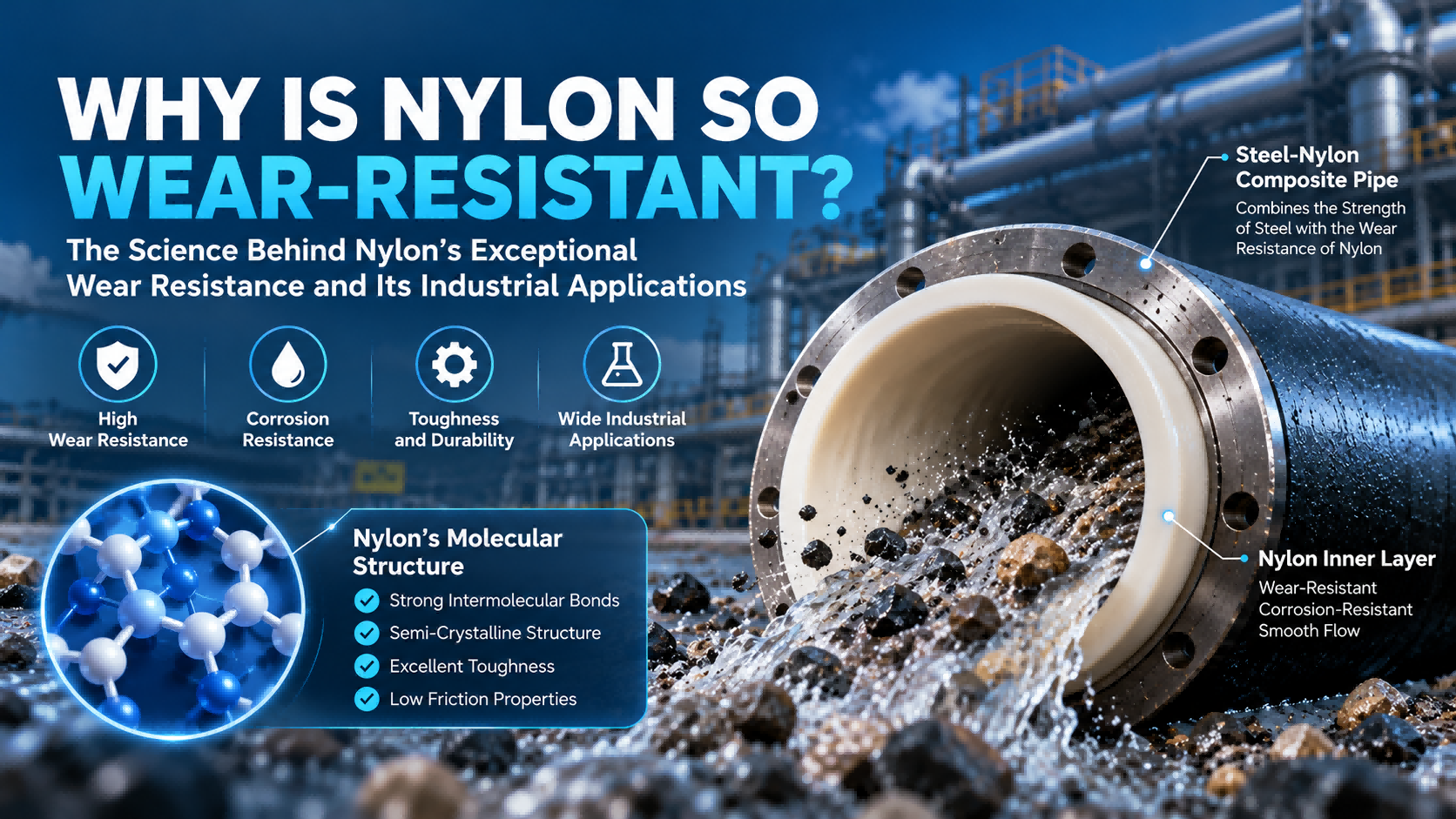
Nylon 6 is a semi-crystalline thermoplastic engineering polymer containing amide groups (–CONH–) within its molecular chains.
These amide groups allow hydrogen bonds to form between neighboring polymer chains.
Hydrogen bonding strengthens intermolecular interactions, contributing to nylon's mechanical strength, cohesion, and fatigue resistance.
From a microscopic perspective, Nylon 6 contains both crystalline and amorphous regions.
The crystalline regions contribute to structural stability and mechanical strength, while the amorphous regions participate in deformation and energy dissipation.
This semi-crystalline structure enables nylon to maintain a useful balance between strength and toughness.
During friction and particle contact, a material must resist localized damage while avoiding premature cracking caused by stress concentration.
Therefore, the wear resistance of Nylon 6 is not determined by a single hardness value. Instead, it results from the interaction between its intermolecular bonding and overall microstructure.
2.2 Good Toughness Helps Reduce Particle Impact Damage
Wear inside industrial pipelines is often more complicated than simple surface friction.
When fluids containing solid particles flow at high velocities, particles can repeatedly strike the internal pipe wall.
These impacts are particularly significant in elbows, tees, reducers, and other locations where the direction or velocity of fluid flow changes.
If a material lacks sufficient toughness, localized impacts may initiate cracks and gradually cause surface spalling.
Nylon 6 possesses useful toughness and deformation capability.
Under appropriate operating temperatures and loading conditions, its surface can absorb and distribute part of the impact energy through localized deformation.
This behavior may help reduce brittle damage under certain particle-impact conditions.
However, nylon cannot withstand every level of impact.
Extremely high particle velocities, unfavorable impact angles, or highly angular particles may still cause cutting, plowing, and fatigue-related wear.
Therefore, proper pipeline velocity control and elbow design are just as important as selecting a wear-resistant material.
2.3 Favorable Tribological Properties Help Reduce Surface Wear
Nylon 6 demonstrates favorable sliding friction characteristics under suitable operating conditions and against compatible counterface materials.
Compared with some untreated metallic contact surfaces, nylon can provide relatively low frictional resistance and good wear performance in certain applications.
This is one reason nylon is widely used in bushings, guide rails, sliding components, gears, and other mechanical parts involving repeated contact.
However, the coefficient of friction is not a fixed value determined solely by the material type.
It depends on multiple factors, including:
-
Contact pressure and sliding velocity;
-
Surface roughness;
-
Moisture content and conditioning of the material;
-
Operating temperature and lubrication;
-
Counterface material and surface conditions.
For industrial pipelines, a well-finished nylon inner surface may help reduce local flow resistance.
Nevertheless, the hydraulic friction resistance of fluid flowing through a pipe is not the same as the sliding friction coefficient between two solid materials.
Actual hydraulic performance must be evaluated using pipe diameter, internal roughness, flow rate, and fluid properties.
2.4 Good Fatigue Resistance Supports Long-Term Repeated Loading
Industrial pipelines are typically expected to operate continuously for many years.
During operation, pipe walls may experience pressure fluctuations, fluid pulsation, and repeated contact with transported particles.
Nylon 6 offers good fatigue resistance, making it suitable for consideration in applications involving repeated mechanical stresses.
At the microscopic level, fatigue damage generally progresses through several stages:
-
Formation of localized defects;
-
Initiation of microscopic cracks;
-
Progressive crack propagation;
-
Eventual separation of surface material.
Materials with an appropriate balance of toughness and structural stability may help slow certain fatigue-related damage mechanisms.
Consequently, nylon's wear resistance is relevant not only to short-term friction testing but also to its behavior under repeated loading over extended periods.
However, the actual service life of an industrial pipeline must be verified according to operating temperature, stress conditions, transported media, and experimental data.
It cannot be determined solely from the fatigue resistance of the base polymer.
2.5 Chemical Resistance Helps Reduce Corrosion-Wear Risks
In many industrial transportation systems, corrosion and wear occur simultaneously.
For example, when a metal pipeline transports a fluid containing corrosive substances, corrosion products may form on the internal surface.
As these products are removed by flowing particles or fluid, fresh metal becomes exposed.
This can create a repeating cycle in which corrosion and mechanical wear accelerate one another.
As a nonmetallic engineering material, Nylon 6 does not undergo the typical electrochemical rusting process associated with carbon steel.
In water-based solutions, oils, and certain industrial media compatible with PA6, a nylon inner layer can reduce direct contact between the transported fluid and the steel structure.
This offers potential advantages in applications where corrosion and mechanical wear coexist.
However, Nylon 6 is not resistant to every chemical environment.
Strong acids, certain chemical substances, and high-temperature aqueous environments can degrade its properties or cause hydrolysis.
Therefore, material compatibility must always be evaluated according to chemical concentration, temperature, and exposure duration.
3. Nylon 6 vs. Traditional Industrial Pipe Materials: How Do Their Wear-Resistance Properties Compare?
Industrial pipeline wear resistance depends on how well the selected material matches the actual operating conditions.
Different materials offer different advantages.
| Pipe Material | Main Advantages | Key Considerations |
|---|---|---|
| Carbon Steel Pipe | High mechanical strength and established structural performance | Susceptible to corrosion and abrasive wear |
| Stainless Steel Pipe | Good corrosion resistance in appropriate environments | Higher cost and potential corrosion risks in certain media |
| Nylon 6 (PA6) | Good toughness, tribological properties, and wear resistance | Moisture absorption, temperature limits, and chemical compatibility |
| UHMWPE Pipe | Excellent wear resistance and low-friction characteristics | Stiffness, thermal performance, and structural design limitations |
| Rubber-Lined Pipe | Effective in certain particle-impact applications | Temperature limits, aging, and lining reliability |
| Ceramic-Lined Pipe | High hardness and strong resistance to certain abrasive wear mechanisms | Brittleness, impact damage, and connection design |
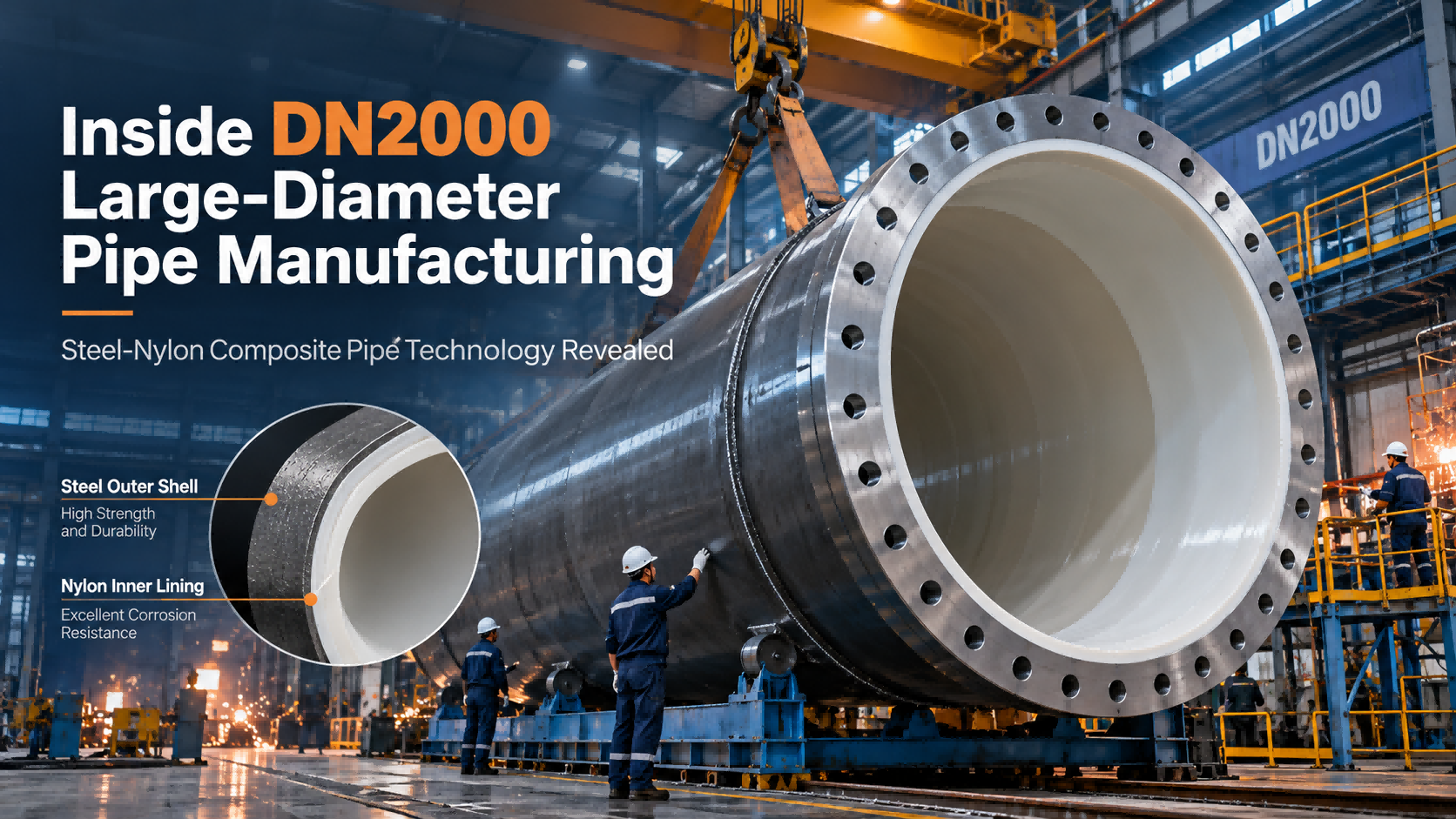
| Steel-Nylon Composite Pipe | Combines the structural strength of steel with the functional properties of nylon | Requires verification of composite interface integrity, temperature limits, and overall structural performance |
This comparison demonstrates that no single pipeline material is optimal under every operating condition.
For applications involving extremely high particle concentrations, severe erosion, or intense particle impact, specialized ceramic or other abrasion-resistant linings may provide better performance.
However, when a project requires a combination of mechanical strength, abrasion resistance, corrosion resistance, and structural reliability, steel-nylon composite pipes represent a valuable alternative for engineering evaluation.
4. Why Does Combining Nylon 6 with Steel Improve Overall Pipeline Performance?
A single material often cannot satisfy every requirement of a complex industrial pipeline system.
Although solid nylon offers favorable wear resistance, high-pressure and large-diameter applications require careful consideration of long-term creep, stiffness, thermal expansion, and dimensional stability.
Steel provides high mechanical strength and structural rigidity.
However, conventional steel pipe surfaces may experience corrosion and mechanical wear when exposed directly to corrosive or particle-containing fluids.
The fundamental design concept of steel-nylon composite pipes is to assign different functional responsibilities to steel and nylon according to their material strengths.
4.1 Steel Provides Mechanical Strength and Load-Bearing Capacity
In a properly designed steel-nylon composite pipe, the steel structure can carry the primary pressure and mechanical loads.
For large-diameter industrial pipelines, steel stiffness helps control deformation during installation and operation, including deformation caused by external mechanical loads.
This gives the composite structure potential advantages in demanding engineering environments.
However, actual pressure-bearing capacity must be calculated and verified according to steel grade, wall thickness, connection design, operating temperature, and applicable engineering standards.
4.2 Nylon 6 Provides Wear Resistance and Media Isolation
When the internal surface in contact with the transported medium is made from an appropriate Nylon 6 material, the pipeline can benefit from the polymer's wear-resistant characteristics and compatibility with selected fluids.
The nylon layer also reduces direct exposure of the steel structure to abrasive media.
In applications such as sand-containing water, certain mineral slurries, and industrial circulating water, this design may help address the combined effects of particle wear and steel corrosion.
However, lining thickness, surface quality, and long-term material behavior must match particle size, operating velocity, and chemical composition.
4.3 Composite Design Combines Structural Strength with Functional Performance
The value of steel-nylon composite pipe technology goes beyond simply combining two materials.
The key engineering challenge is:
How can the composite structure be designed so that steel carries structural loads while nylon delivers its functional advantages at the fluid-contact surface?
This division of functions can reduce the need for a single material to meet every performance requirement.
For pipeline designers, it provides additional opportunities to optimize structural and material performance.
5. Five Key Advantages of Our Steel-Nylon Composite Pipes
As a manufacturer specializing in steel-nylon composite pipes, we focus not only on the inherent properties of nylon but also on how these material characteristics can deliver practical value in industrial projects.
Advantage 1: Suitable for Complex Environments Involving Wear and Corrosion Risks
For pipelines exposed to both abrasive particles and corrosive media, simply increasing the thickness of a conventional steel pipe may not always be the most economical solution.
Using a Nylon 6 functional layer compatible with the transported medium can reduce direct exposure of the steel structure to the fluid.
Under suitable operating conditions, this may help minimize the combined effects of corrosion and mechanical wear.
Advantage 2: Complementary Performance of Steel Strength and Nylon Wear Resistance
The steel structure provides mechanical support, while the nylon layer contributes wear resistance and media isolation.
This composite approach is particularly relevant to projects requiring simultaneous consideration of internal pressure, structural rigidity, and fluid characteristics.
Compared with solutions that rely solely on increased wall thickness, composite pipe technology offers an alternative route to structural and functional optimization.
Advantage 3: Potential to Reduce Maintenance and Replacement Frequency
The true cost of industrial pipelines extends far beyond their initial purchase price.
For facilities requiring continuous operation, wear-related pipeline failures may result in:
-
Leakage repair expenses;
-
Unplanned production shutdowns;
-
Labor and replacement costs;
-
System inspection and recommissioning expenses.
When properly matched to operating conditions, a wear-resistant inner layer may delay abrasion-related pipeline deterioration and reduce certain maintenance requirements.
The actual benefits should be established through wear testing and operating records.
Advantage 4: Structural Design Can Be Optimized for Project Requirements
Industrial projects operate under widely varying conditions.
Transported media, working pressure, temperature, particle concentration, and installation environments can all influence composite pipe design.
A professional pipe manufacturer should evaluate these parameters when selecting the steel structure, nylon material, functional layer thickness, and connection system.
For large-diameter, long-distance, or complex pipeline networks, additional attention should be given to flange connections, thermal expansion, pipe supports, and localized wear risks.
Advantage 5: Potential to Improve Total Cost of Ownership
For industrial procurement specialists, the most important financial consideration is not necessarily the price per meter of pipe.
Instead, it is the total expenditure over the entire operating life of the pipeline system.
A basic Total Cost of Ownership (TCO) model is:
Pipeline TCO = Initial Purchase Cost + Installation Cost + Operating Energy Cost + Maintenance Cost + Replacement Cost + Downtime Losses
Steel-nylon composite pipes may have a different initial purchase price compared with conventional carbon steel pipes.
However, in applications involving difficult maintenance, significant wear risks, and strict continuous-production requirements, their overall economic performance deserves careful evaluation.
Whether they actually reduce TCO depends on project-specific pricing, expected service life, operating energy requirements, and maintenance strategies.
6. Which Industrial Applications Can Benefit from Nylon Wear-Resistant Pipes?
6.1 Mining and Tailings Transportation
Mining tailings and certain mineral slurries contain varying concentrations of solid particles.
During transportation, the pipeline may experience particle sliding, repeated impact, and localized turbulence.
Steel-nylon composite pipes incorporating a Nylon 6 functional layer can be considered for selected mineral slurry and tailings transportation projects.
Their suitability should be verified according to solids concentration, particle size distribution, mineral hardness, and flow velocity.
6.2 Chemical Processing Pipelines
Chemical processing environments may involve corrosive fluids, suspended solids, and continuous operation.
For process media compatible with PA6, steel-nylon composite pipes can combine structural load-bearing capabilities with the benefits of a polymer-based barrier layer.
They are particularly worth evaluating when both abrasion risk and corrosion control are important material selection criteria.
6.3 Industrial Cooling and Circulating Water Systems
Industrial circulating water may contain suspended particles, deposits, and water-quality components that influence metal corrosion.
Under appropriate operating conditions, a Nylon 6 inner layer can reduce direct contact between the circulating fluid and steel structure.
For continuously operating circulation networks, this composite design may be considered as part of a broader maintenance and lifecycle cost assessment.
6.4 Municipal Water Supply and Drainage Systems
Some municipal pipelines transport water containing sand, sediment, suspended solids, or other impurities.
Under suitable conditions, steel-nylon composite pipes can be evaluated as an alternative for water supply and drainage infrastructure.
For potable water applications, however, materials must comply with applicable local health, drinking-water contact, and engineering requirements.
Wear resistance alone does not establish suitability for drinking-water service.
6.5 Seawater and Coastal Industrial Transportation Systems
Salt-containing fluids can create significant corrosion challenges for conventional carbon steel pipelines.
In seawater transportation projects where temperature, pressure, and chemical conditions are compatible with PA6, a nylon functional layer may help isolate the steel structure from direct contact with the transported medium.
Long-term water absorption, dimensional changes, connection sealing, and external corrosion protection must also be considered.
7. Six Critical Factors That Determine the Wear Life of Nylon Pipelines
Although Nylon 6 offers favorable wear resistance, actual pipeline service life depends on much more than the material name.
7.1 Particle Hardness and Shape
Sharp, angular particles generally have a greater potential to cause localized cutting than smooth or rounded particles.
7.2 Fluid Velocity
Flow velocity influences the frequency and energy of particle contact with the pipe wall.
However, there is no universal fixed relationship between velocity and wear rate across all wear mechanisms.
7.3 Particle Concentration and Size
Solids concentration and particle size distribution influence wear behavior.
Interactions between particles may also affect the rate of material loss.
7.4 Operating Temperature
Temperature affects the modulus, toughness, long-term creep behavior, and chemical stability of PA6.
7.5 Moisture Absorption and Chemical Compatibility
PA6 absorbs moisture to varying degrees.
Long-term water exposure may change its dimensions and mechanical properties.
High temperatures or incompatible chemicals can also cause material aging or degradation.
7.6 Composite Interface and Pipeline Structure
For steel-nylon composite pipes, engineers must also consider the integrity of the interface between nylon and steel, differences in thermal expansion, and the reliability of end sealing and connections.
Therefore, the service life of a wear-resistant pipeline is determined by the combined effects of material properties, structural design, and actual operating conditions.
8. How Can the Wear Resistance of Steel-Nylon Composite Pipes Be Scientifically Verified?
For industrial buyers, EPC contractors, and engineering design institutes, material wear resistance must be supported by verifiable technical evidence.
Simply claiming that one pipe material has several times the wear resistance of conventional steel is generally insufficient for engineering selection.
8.1 Select Appropriate Wear Testing Methods
Different laboratory methods can be selected according to the expected wear mechanism.
Examples include:
-
ASTM G99: Used to evaluate sliding friction and wear characteristics.
-
ASTM G75: Can be used to evaluate slurry abrasivity and the relative wear response of materials under specified slurry conditions.
-
Application-Specific Slurry Circulation Tests: Used to compare internal pipe wear under test conditions that approximate the intended service environment.
Because different methods reproduce different physical wear mechanisms, laboratory results cannot automatically be translated into the service life of a complete industrial pipeline.
8.2 Focus on Measurable Wear Data
Engineering evaluations should obtain quantitative results whenever possible.
Relevant measurements may include:
-
Volume loss;
-
Mass loss;
-
Wear depth;
-
Wear rate over a defined test period.
Testing records should also document temperature, pressure, transported medium, particle characteristics, flow velocity, and testing duration.
Results from different materials are most meaningful when the testing conditions are identical or reasonably comparable.
8.3 Verify the Performance of the Complete Composite Pipe
Evaluating steel-nylon composite pipes requires more than testing isolated nylon specimens.
Depending on the intended application, the complete product should also be evaluated for:
-
Internal pressure resistance and sealing performance;
-
Reliability of the interface between the nylon layer and steel structure;
-
Thermal cycling performance and long-term dimensional stability;
-
Integrity of flanges, elbows, and other connections;
-
Long-term performance under representative operating media when necessary.
For major industrial projects, combining material testing, full-pipe validation, and field operating data provides a more comprehensive technical assessment.
9. Why Are Composite Materials Becoming More Important in Industrial Wear-Resistant Pipelines?
Industrial pipeline material development is increasingly shifting from optimizing individual properties toward combining multiple functional capabilities.
Traditional pipeline selection often focuses on mechanical strength, corrosion resistance, or initial material cost.
Modern engineering projects, however, place greater emphasis on achieving a balance between different performance requirements.
This is particularly important in continuous-production facilities where maintenance windows are limited and pipeline replacement is expensive.
Steel-nylon composite pipes reflect this broader materials-engineering approach.
Rather than replacing steel entirely with nylon or requiring steel to perform every function, composite design separates structural load-bearing requirements from the functional demands of the fluid-contact surface.
From an engineering materials perspective, this approach offers meaningful opportunities for further optimization.
As nylon modification technologies, composite manufacturing methods, interface engineering, and testing techniques continue to develop, steel-nylon composite pipes may find wider application in industrial environments with clearly defined performance requirements.
10. Frequently Asked Questions (FAQ)
Q1: Why Is Nylon 6 More Wear-Resistant Than Some Traditional Materials?
Nylon 6 benefits from intermolecular hydrogen bonding, its semi-crystalline structure, toughness, and favorable tribological behavior.
These characteristics enable good wear performance under specific friction and particle abrasion conditions.
However, this does not mean nylon is more wear-resistant than every traditional material under all conditions.
Q2: Which Has Better Wear Resistance, Nylon 6 or Nylon 66?
Both PA6 and PA66 offer good wear resistance.
However, they differ in crystallization behavior, moisture absorption, thermal properties, and mechanical characteristics.
Actual wear performance depends on material formulation, processing methods, and operating conditions.
Neither material can be considered universally superior based solely on its polymer designation.
Q3: Are Nylon Pipes Suitable for Transporting Sand-Containing Water?
Nylon 6 may be considered as an internal lining material for certain sand-containing water transportation systems.
However, particle size, hardness, concentration, velocity, and operating temperature must be evaluated.
For highly abrasive conditions, representative testing is recommended before final material selection.
Q4: What Are the Advantages of Steel-Nylon Composite Pipes Compared with Conventional Steel Pipes?
The main advantage of steel-nylon composite pipes is the complementary performance of their constituent materials.
The steel structure provides mechanical support and pressure-bearing capability.
The nylon functional layer can improve wear performance in suitable applications while reducing direct contact between the transported medium and the steel structure.
Q5: How Long Can Steel-Nylon Composite Pipes Last?
Actual service life depends on material formulation, composite manufacturing processes, transported media, operating pressure, temperature, and maintenance conditions.
Reliable service-life predictions require material testing, engineering calculations, and operating data from comparable applications.
A specific lifespan should not be assumed without adequate supporting evidence.
Conclusion: Nylon's Wear Resistance Comes from Molecular Structure, While the Value of Steel-Nylon Composite Pipes Comes from Material Synergy
Nylon 6 performs well in many industrial wear environments not because it has the highest hardness, but because its molecular structure, mechanical toughness, fatigue resistance, and tribological properties work together.
For industrial transportation systems, the goal is not simply to select the hardest available material.
Instead, engineers should identify a pipeline structure capable of maintaining reliable performance under actual operating conditions.
Steel-nylon composite pipes combine the mechanical load-bearing advantages of steel with the wear-resistant and media-isolation characteristics of Nylon 6.
This makes them a promising solution for evaluation in mining, chemical processing, industrial circulating water, and selected water supply and drainage applications.
A high-performance industrial pipeline requires more than structural strength. It must also provide appropriate wear resistance, corrosion resistance, and long-term reliability for the intended operating environment.
Looking for a Wear-Resistant Pipeline Solution for Your Industrial Project?
We specialize in the manufacturing and industrial application of steel-nylon composite pipes.
By combining steel structures with appropriately selected Nylon 6 materials, we aim to address demanding engineering requirements involving mechanical strength, abrasion resistance, corrosion resistance, and operational reliability.
If your project involves mining slurry transportation, industrial circulating water, chemical fluid transfer, or large-diameter industrial pipelines, we welcome the opportunity to discuss your technical requirements.
Share your pipeline diameter, operating pressure, transported medium, operating temperature, flow velocity, and particle concentration with our team.
We can help evaluate the suitability of steel-nylon composite pipes and discuss potential technical solutions for your application.
Steel Provides Structural Strength. Nylon Delivers Functional Performance. Together, They Enable Smarter and More Efficient Industrial Pipeline Design.