Why Low-Maintenance Piping Is Becoming a New Trend in Industrial Projects

“How much does this pipe cost per meter?”
However, in continuous-process industries such as oil and gas, chemicals, mining, power generation, salt chemicals, and wastewater treatment, this purchasing logic is rapidly changing.
Today, EPC contractors, plant owners, and asset management teams are increasingly asking different questions:
“How many times will this pipeline need to be repaired over the next 10 years?”
“How long will it take before corrosion or abrasion causes leakage?”
“How much would one unplanned shutdown cost?”
“What is the true lifecycle cost of the entire piping system?”
As a result, a new philosophy of industrial pipeline selection is emerging:
The most economical pipe is not necessarily the one with the lowest purchase price, but the one that requires less maintenance, operates more reliably, and delivers a lower total lifecycle cost.
This is why low-maintenance piping is becoming an increasingly important trend in industrial projects.
For applications involving corrosive fluids, abrasive slurries, oilfield produced fluids, brine, alkaline solutions, and other demanding industrial media, this trend is particularly significant.
1. Why Are Industrial Projects Paying More Attention to Low Maintenance?
Industrial pipelines do not operate independently.
They connect pumps, valves, storage tanks, reactors, heat exchangers, processing equipment, and sometimes entire production systems.
Therefore, even the failure of a relatively short section of pipe can affect an entire production line.
Traditional procurement often focuses mainly on:
-
Pipe price
-
Wall thickness
-
Pressure rating
-
Initial installation cost
Modern industrial projects, however, are increasingly focused on Total Cost of Ownership (TCO).
From a TCO perspective, the true cost of a piping system can be expressed as:
Total Pipeline Cost = Initial Purchase Cost + Installation Cost + Inspection Cost + Corrosion Protection Cost + Cleaning Cost + Repair Cost + Replacement Cost + Shutdown Losses
In highly corrosive, highly abrasive, or continuous-operation environments, the costs that occur after installation may greatly exceed the original purchase price of the pipe.
As a result, industrial pipeline procurement is gradually shifting from:
Low Initial Cost
to:
Low Lifecycle Cost
This is one of the fundamental reasons why low-maintenance piping is becoming a major industry trend.
2. The Most Expensive Part Is Often Not the Pipe—It Is the Shutdown
Consider a chemical plant where a section of pipeline carrying corrosive fluid begins to leak.
The company may face far more than the cost of replacing a few meters of pipe.
The maintenance process may involve:
Shutdown → Drainage → Cleaning → Inspection → Removal → Replacement → Installation → Pressure Testing → Restart
If the medium is corrosive, flammable, toxic, or otherwise hazardous, additional safety procedures and environmental controls may also be required.
Therefore, the real cost of a pipeline failure can include:
-
Maintenance labor
-
Lifting equipment
-
Spare parts
-
Replacement piping
-
Cleaning
-
Corrosion protection
-
Inspection
-
Safety management
-
Production losses caused by downtime
For continuous-process plants, downtime itself is a major cost.
This means that even if one pipe material is 20% cheaper initially, it may not be the more economical choice if it requires repeated repair or replacement during its service life.
That is why more procurement and engineering teams are paying attention to another important indicator:
Maintenance Frequency
In other words:
How many maintenance interventions will be required throughout the pipeline's lifecycle?
3. Why Do Industrial Pipelines Enter a “High-Maintenance Cycle”?
Many industrial plants have experienced the same pattern.
A new pipeline is installed and initially operates normally.
After several years, localized corrosion appears.
The pipe is repaired.
Later, another leak develops.
It is repaired again.
Then another section is replaced.
Eventually, the entire pipeline has to be replaced.
The fundamental problem is that:
Maintenance has not eliminated the root cause of pipeline failure.
For example, when carbon steel is used to transport corrosive media, repeated welding repairs will not stop corrosion if the operating environment remains unchanged.
Different materials may also have different failure mechanisms.
Stainless steel may be vulnerable to pitting, crevice corrosion, or stress corrosion cracking under certain conditions.
FRP piping may require close attention to structural damage, installation quality, and long-term interlaminar reliability under complex loading.
Rubber-lined or plastic-lined steel piping may face issues such as liner aging, blistering, delamination, or failure around joints and interfaces.
Conventional steel pipelines transporting particle-containing slurry may suffer from both corrosion and erosion.
If material selection does not fundamentally address these failure mechanisms, plants can become trapped in a repetitive cycle:
Leakage → Repair → Operation → Leakage Again
The real purpose of low-maintenance piping, therefore, is not simply to make repairs faster.
It is to:
Reduce the probability that repairs will be needed in the first place.
4. What Characteristics Should a Truly Low-Maintenance Pipeline Have?
“Low maintenance” is not a single material property.
It is the result of multiple performance characteristics working together.
To reduce maintenance over the long term, an industrial pipeline generally needs to address several issues simultaneously:
-
Corrosion
-
Abrasion
-
Connection reliability
-
Scaling
-
Mechanical strength
-
Environmental adaptability
This is why comparing only one material property often fails to reflect actual long-term pipeline performance.
For example, in corrosive slurry applications:
If a material is corrosion-resistant but lacks wear resistance, the protective layer may still be damaged by abrasion.
For high-pressure pipelines:
Corrosion resistance alone is not sufficient if the pipe lacks the structural strength required for the operating pressure.
For outdoor pipe racks:
In addition to internal chemical exposure, engineers may need to consider UV exposure, temperature variations, support spacing, and long-term mechanical loads.
Therefore, a truly low-maintenance industrial pipeline should ideally combine:
Corrosion Resistance + Wear Resistance + Mechanical Strength + Reliable Connections
This is also one of the reasons composite piping materials are attracting increasing attention.
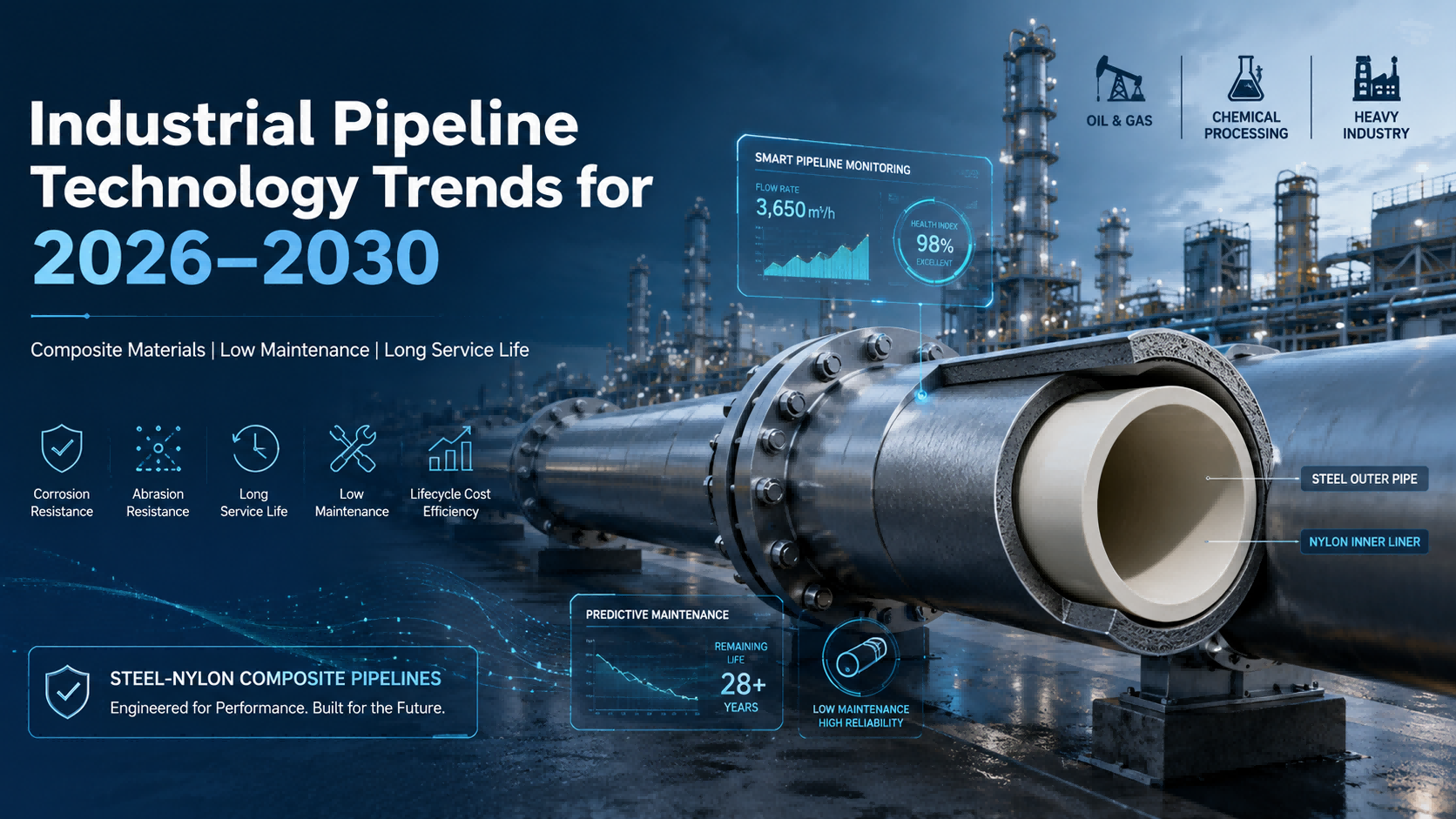
5. Why Is a Steel-Nylon Composite Structure Well Suited to Low-Maintenance Piping?
The design philosophy behind steel-nylon composite pipe is not simply to replace one conventional material with another.
Instead, it uses different materials to solve different engineering problems.
The basic concept can be summarized as:
Steel provides structural strength. Nylon manages contact with the process medium.
The steel structure provides:
-
Mechanical strength
-
Rigidity
-
Pressure-bearing capability
The nylon functional layer helps address:
-
Corrosion
-
Abrasion
-
Scaling and deposition
This design avoids requiring a single material to perform every function simultaneously.
For complex industrial operating conditions, this division of functions can provide a more practical engineering solution.
6. How Can Steel-Nylon Composite Pipe Reduce Maintenance Frequency?
6.1 Reducing Maintenance Caused by Internal Corrosion
Internal corrosion is one of the major causes of pipeline failure in applications involving:
-
Oilfield produced fluids
-
Brine
-
Industrial wastewater
-
Alkaline solutions
-
Certain chemical media
In steel-nylon composite pipe, the nylon functional layer separates the process medium from the steel structure, reducing direct exposure of the steel to corrosive fluids.
This is fundamentally different from the traditional approach of repairing carbon steel after corrosion has already occurred.
The objective is instead to:
Reduce corrosion from the material-design stage.
For continuous-operation systems, this can help reduce potential leak points, repair frequency, and the need for localized pipe replacement.
6.2 Managing Both Corrosion and Abrasion
Many industrial fluids are not simply clean liquids.
Examples include:
-
Mineral slurry
-
Tailings
-
Oilfield produced fluids containing sand
-
Flue gas desulfurization slurry
-
Industrial fluids containing suspended solids
These services can produce significant erosion and abrasion.
The difficulty is that:
Corrosion and wear may occur at the same time.
If a material is corrosion-resistant but not sufficiently wear-resistant, abrasion may eventually destroy the protective surface and expose the underlying material.
One of the advantages of a steel-nylon composite structure is that it combines the structural strength of steel with the corrosion- and wear-resistant properties of nylon.
This makes the system particularly relevant to combined corrosion-abrasion environments.
7. Reducing Welding Can Also Reduce Maintenance Risk
Large industrial piping systems normally contain many:
-
Elbows
-
Tees
-
Reducers
-
Valve connections
-
Equipment interfaces
These locations are often important areas for maintenance and inspection.
Our steel-nylon composite pipes use an integrally formed flange connection design, allowing pipe sections, elbows, tees, valves, and equipment to be connected through flanges.
The significance of this design goes beyond convenient installation.
It can also reduce the need for hot work on site.
Traditional welded piping systems may require:
-
Welding
-
Weld inspection
-
Repair of protective coatings
-
Hot-work permits and safety management
A flanged system enables a more modular piping configuration.
If a valve, elbow, or high-wear section needs to be replaced, the affected component can be removed locally without extensive cutting and rewelding.
Therefore:
Maintainability itself is an important part of low-maintenance design.
8. Reducing Scaling Can Further Lower Operating and Maintenance Costs
Not all pipeline maintenance is caused by leakage.
Scaling and deposition can also create significant maintenance requirements.
As deposits accumulate inside a pipe:
-
Effective internal diameter decreases
-
Flow resistance increases
-
Pumping energy consumption rises
-
Transport capacity decreases
Eventually, mechanical or chemical cleaning may become necessary.
Steel-nylon composite pipe has a relatively smooth internal surface. Under suitable operating conditions, this can help reduce the tendency for deposits to adhere to the pipe wall.
The benefits of low-maintenance piping therefore go beyond simply reducing leakage.
They may also include:
Less cleaning, more stable flow performance, and lower long-term hydraulic resistance.
9. Low Maintenance Does Not Mean Lower Structural Strength
This is an important concern for industrial users.
Many projects require higher corrosion resistance, but they cannot sacrifice:
-
Pressure capability
-
Structural rigidity
-
Large-diameter stability
-
Mechanical strength
This is another important advantage of the steel-nylon composite structure.
Depending on project requirements, our steel-nylon composite pipes can be designed for pressure classes of approximately 1.0–4.0 MPa and can cover applications from conventional industrial diameters to large-diameter piping systems.
The products can also be applied across a broad operating temperature range of approximately -36°C to 160°C, although final engineering selection should always consider the specific medium, concentration, pressure, temperature, and operating conditions.
This allows steel-nylon composite pipe to enter certain medium- and high-pressure, challenging-temperature, and large-diameter industrial applications that may be difficult for conventional thermoplastic piping.
In other words:
Low maintenance should not require sacrificing structural performance for corrosion resistance.
An effective solution should provide both:
Structural strength and long-term resistance to the process medium.
10. How Do the Maintenance Requirements of Different Pipe Materials Compare?
| Pipe Type | Long-Term Issues Requiring Attention | Typical Maintenance Focus |
|---|---|---|
| Carbon Steel Pipe | Corrosion, scaling, erosion | Corrosion protection, welding repair, localized replacement |
| 304/316L Stainless Steel Pipe | Pitting, crevice corrosion, specific-environment corrosion | Welds and localized corrosion monitoring |
| FRP Pipe | Structural damage, long-term mechanical reliability | Joints, supports, structural condition |
| Rubber-Lined Steel Pipe | Liner aging, blistering, delamination | Liner inspection and repair |
| Plastic-Lined Steel Pipe | Liner integrity, interface areas | Liner and pipe-end inspection |
| PE/HDPE Pipe | Temperature, pressure, creep, connection reliability | Fusion joints and deformation |
| Steel-Nylon Composite Pipe | Inspection intervals determined mainly by medium and operating conditions | Preventive condition inspection |
No single pipe material is suitable for every operating environment.
However, if a project must simultaneously handle:
Corrosion + Abrasion + Pressure + Temperature + Continuous Operation
then steel-nylon composite pipe should be considered as one of the candidate solutions.
11. After 10 Years, Which Pipe Is Actually Cheaper?
Consider two piping options.
Option A has a lower initial purchase price but requires repeated:
-
Corrosion protection
-
Repair
-
Welding
-
Cleaning
-
Localized replacement
over a 10-year period.
Option B has a somewhat higher initial investment but significantly lower maintenance requirements.
If only first-year CAPEX is considered:
Option A may appear cheaper.
But when 10-year TCO is calculated:
The result may be completely different.
Future industrial procurement should therefore compare more than:
$/m — Cost per Meter
It should increasingly consider:
$/year — Annualized Cost of Use
and potentially even:
Cost per Ton Transported — Lifecycle Cost per Ton of Fluid Transported
This provides a much more meaningful assessment of the economics of large industrial piping systems.
12. Why Is “Design Life” Becoming More Important Than Purchase Price?
Industrial projects are paying greater attention to long-term asset value.
This is particularly true in:
-
Oil and gas fields
-
Chemical complexes
-
Mining operations
-
Power plants
-
Municipal infrastructure
-
Large industrial parks
These projects often operate for many years or even decades.
If a piping system requires frequent maintenance, the impact extends far beyond direct repair expenses.
It can also increase:
-
Maintenance staffing requirements
-
Spare-parts inventory
-
Maintenance planning
-
Safety management requirements
-
Turnaround scheduling
-
Operational complexity
As a result, one of the major future trends in industrial pipeline procurement will be:
A shift from material purchasing to asset management.
The question will no longer simply be:
“Which pipe should we buy?”
Instead, engineering and procurement teams will increasingly ask:
“Which piping system will make this production line easier to manage over the next 10 years?”
13. Which Industrial Applications Benefit Most From Low-Maintenance Piping?
Low-maintenance piping is particularly valuable in projects where pipeline failure is expensive.
One example is oil and gas gathering and transportation systems.
When produced fluids contain combinations of:
-
Water
-
Salts
-
CO₂
-
H₂S
-
Solid particles
corrosion and erosion may become persistent operating challenges.
Another example is the salt chemical, chlor-alkali, soda ash, and general chemical industries.
High-salinity, high-alkalinity, and complex chemical media place continuous demands on piping materials.
Mining and slurry transport systems need to address:
-
Wear resistance
-
Pressure capability
-
Long-term structural strength
Power plant desulfurization and industrial wastewater systems may simultaneously face:
-
Corrosion
-
Abrasion
-
Scaling
All of these applications have one thing in common:
The cost of one maintenance event is much greater than the price of a few meters of replacement pipe.
These are precisely the applications where low-maintenance piping can create substantial economic value.
14. The Value of Steel-Nylon Composite Pipe Goes Beyond Corrosion Resistance
If steel-nylon composite pipe is viewed only as an anti-corrosion pipe, much of its engineering value is overlooked.
Its real design philosophy is:
Use steel to solve structural requirements, use nylon to manage the process medium, and use an integrated structure and flanged connections to improve long-term reliability and maintainability.
Its advantages therefore go beyond corrosion resistance.
Depending on operating conditions, potential benefits include:
-
Wear resistance
-
Reduced scaling tendency
-
Broad temperature adaptability
-
Suitability for medium- and high-pressure applications
-
Capability for large industrial diameters
-
Reduced on-site welding
Ultimately, these characteristics support one core objective:
Less Maintenance. Less Downtime. Lower Lifecycle Cost.
15. The Future of Industrial Piping Competition Will Shift From Material Price to TCO
The industrial piping market is undergoing an important transformation.
In the past:
Price drove purchasing decisions.
Today:
Performance + Service Life + Risk increasingly drive purchasing decisions.
In the future:
TCO will play an even greater role in purchasing decisions.
As industrial companies place more emphasis on asset reliability, production continuity, safety, and long-term return on investment, demand for low-maintenance piping systems is likely to continue growing.
This will be particularly important in highly corrosive, highly abrasive, and continuous-operation applications.
Piping systems capable of reducing:
-
Corrosion
-
Leakage
-
Scaling
-
Maintenance
-
Shutdowns
will become increasingly competitive.
This is also why steel-nylon composite piping deserves greater attention.
It is not simply intended to replace one traditional pipe material.
More importantly, it represents a different industrial piping philosophy:
Do not wait until the pipeline corrodes before repairing it.
Reduce the probability of future maintenance through better material selection from the beginning.
Conclusion: A Good Industrial Pipeline Should Allow the Maintenance Team to Almost “Forget It Exists”
For an industrial piping system, excellent performance does not mean attracting constant attention from maintenance personnel.
The ideal operating condition is the opposite:
Stable transportation.
Long-term operation.
Fewer leaks.
Less maintenance.
Less downtime.
From this perspective, “low maintenance” is not simply a product feature.
It represents a fundamental shift in industrial pipeline procurement from:
Purchase Price
to:
Lifecycle Value
For companies designing new projects—or those already struggling with corrosion, abrasion, scaling, leakage, and frequent pipe replacement—the better question may no longer be:
“Where can we find a cheaper pipe?”
Instead, the more important question is:
Which piping solution can truly reduce maintenance over the next 10 years?
That may be one of the most important questions in modern industrial pipeline selection.
For steel-nylon composite pipe selection in a specific project, engineering evaluation should consider the process medium, chemical concentration, temperature, design pressure, pipe diameter, flow velocity, solids content, installation environment, and expected service life in order to determine the most appropriate material structure and piping solution.
How Composite Materials Are Reshaping the Traditional Industrial Pipeline Market
Future Development Trends in Corrosion-Resistant Industrial Pipeline Technology