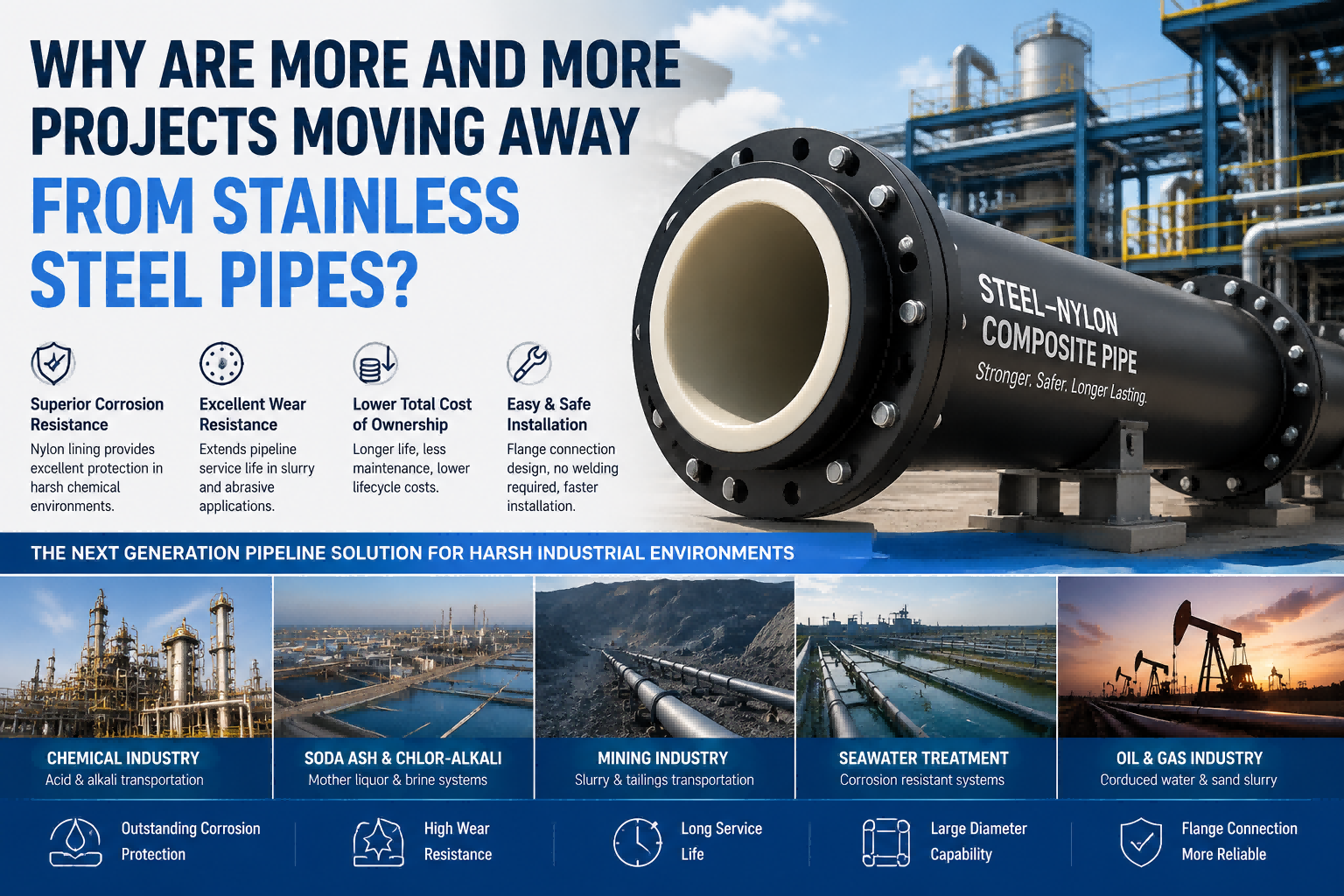
Why Are More and More Projects Moving Away from Stainless Steel Pipes?
How Steel-Nylon Composite Pipes Are Becoming a New Choice for Industrial Pipeline Systems
-
Chemical processing
-
Oil & gas
-
Mining
-
Power generation
-
Seawater treatment
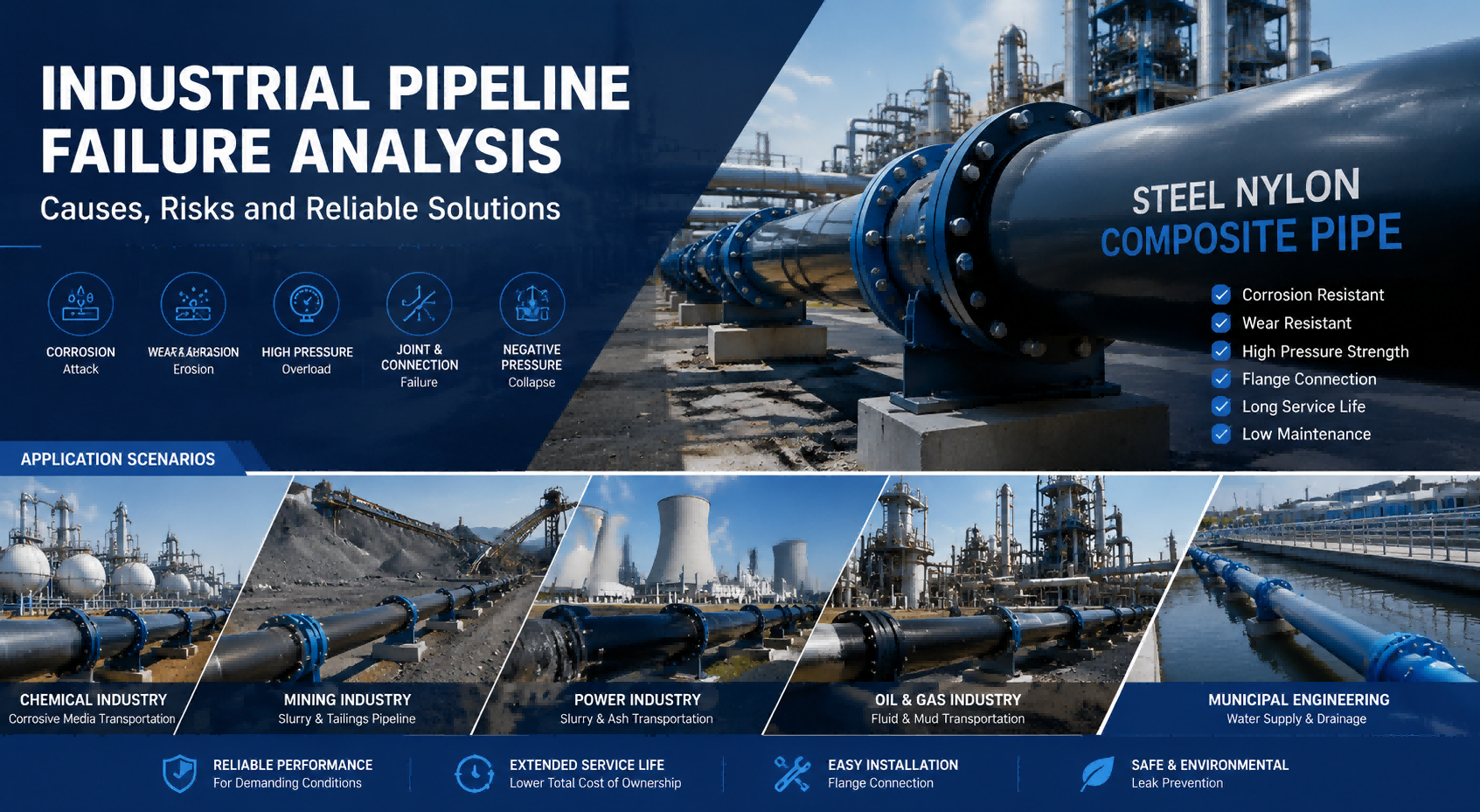
304 and 316L stainless steel pipes have been widely used as the preferred solution for corrosive fluid transportation.
However, with increasingly complex operating conditions, traditional stainless steel pipelines are facing new challenges:
-
Localized corrosion caused by aggressive chemical media;
-
Pitting corrosion in chloride environments;
-
High investment costs for large-diameter pipelines;
-
Long welding and installation processes;
-
Potential leakage risks at welded joints;
-
Increasing maintenance costs during long-term operation.
As a result, more and more engineering projects are shifting their focus from initial purchase price to Total Cost of Ownership (TCO).
Under this trend, Steel-Nylon Composite Pipes are emerging as an advanced alternative solution to traditional stainless steel pipelines.
1. Why Was Stainless Steel So Popular in Industrial Pipeline Applications?
Stainless steel has several recognized advantages.
1.1 Excellent Mechanical Strength
Stainless steel provides high tensile strength and structural rigidity, making it suitable for high-pressure pipeline systems.
1.2 Smooth Internal Surface
The relatively smooth inner surface reduces flow resistance and improves transportation efficiency.
1.3 Good Appearance and Cleanliness
For industries requiring high hygiene standards, such as food and pharmaceutical applications, stainless steel remains an excellent choice.
Therefore, for many years, engineers followed the concept:
“Highly corrosive environment = Stainless steel pipeline.”
However, industrial operating conditions have evolved.
2. The Biggest Challenge of Stainless Steel: Corrosion Resistance Is Not Absolute
Many engineers overlook one important fact:
The corrosion resistance of stainless steel depends heavily on the actual operating environment.
2.1 Chloride-Induced Pitting Corrosion
In industries such as:
-
Chlor-alkali production;
-
Salt chemical processing;
-
Seawater desalination;
-
Oilfield produced water transportation;
high concentrations of chloride ions can damage the passive layer of stainless steel.
Even 316L stainless steel, although more resistant than 304, can still suffer from:
-
Pitting corrosion;
-
Crevice corrosion;
-
Stress corrosion cracking.
For pipeline systems designed for 10–20 years of operation, these risks cannot be ignored.
2.2 Limitations in Strong Acid and Strong Alkali Applications
In applications involving:
-
High concentration sodium hydroxide (NaOH);
-
Hydrochloric acid;
-
Sulfuric acid;
-
Corrosive fluids containing solid particles;
stainless steel may experience:
-
Chemical corrosion;
-
Abrasion damage;
-
Weld area corrosion.
Especially in industries such as soda ash, chlor-alkali, and phosphate chemicals, pipelines must withstand not only corrosion but also continuous particle erosion.
This makes traditional stainless steel solutions increasingly challenging for long-term service.
3. High Cost: Large-Diameter Stainless Steel Pipelines Are Becoming Difficult to Justify
For industrial pipelines above DN300, stainless steel costs increase significantly.
The total investment includes:
-
High material cost;
-
Complex fabrication;
-
Welding expenses;
-
Installation costs;
-
Future maintenance expenses.
For large-diameter pipelines such as:
-
DN800;
-
DN1000;
-
DN1600;
-
DN2000;
full stainless steel systems can require extremely high investment.
Large industrial projects are therefore looking for:
“A pipeline material that provides stainless-steel-level performance with better lifecycle economics.”
4. Steel-Nylon Composite Pipe: Combining Steel Strength with Nylon Protection
Steel-Nylon Composite Pipe was developed to solve these challenges.
Its structure combines:
Outer steel pipe + inner reinforced nylon lining
The design provides:
-
Steel layer for pressure resistance and structural strength;
-
Nylon layer for corrosion protection and wear resistance.
It creates a new generation of pipeline technology:
“Metal strength combined with non-metal corrosion resistance.”
5. Key Advantages of Steel-Nylon Composite Pipes Compared with Stainless Steel Pipes
5.1 Superior Corrosion Protection
Reinforced nylon lining provides excellent chemical resistance.
It is suitable for transporting:
-
Acid and alkaline solutions;
-
Brine;
-
Mother liquor;
-
Mining slurry;
-
Industrial wastewater.
Unlike stainless steel, which relies on a passive oxide film for protection, nylon provides a physical barrier between the transported medium and the steel substrate.
This effectively prevents:
-
Pitting corrosion;
-
Crevice corrosion;
-
Weld corrosion.
5.2 Outstanding Wear Resistance for Severe Industrial Conditions
Many industrial pipelines fail not only because of corrosion, but because of:
Combined corrosion and abrasion.
Typical examples include:
-
Mine slurry pipelines;
-
Coal slurry transportation;
-
Salt mud pipelines;
-
Sand-containing oilfield wastewater.
Although stainless steel performs well against corrosion, long-term particle impact can still cause wall thinning.
Steel-Nylon Composite Pipes utilize the low-friction and wear-resistant properties of nylon to:
-
Reduce particle impact damage;
-
Minimize pipeline wear;
-
Extend maintenance intervals.
5.3 Advantages in Large-Diameter Pipeline Applications
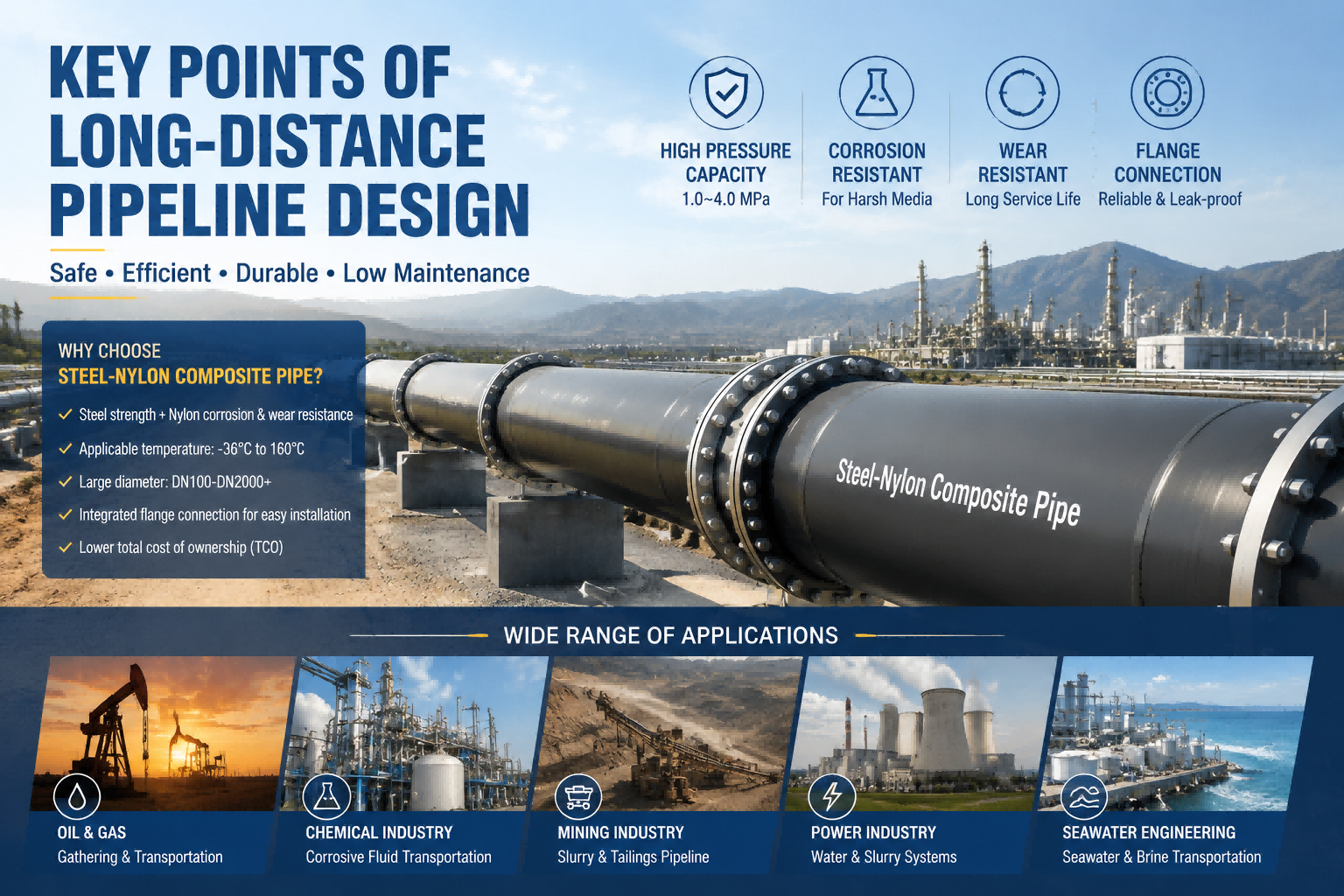
Steel-Nylon Composite Pipes can be manufactured in:
-
DN100–DN2000+ diameter range;
-
Pressure ratings from 1.0 MPa to 4.0 MPa.
They are especially suitable for:
-
Large chemical transportation systems;
-
Mining slurry pipelines;
-
Oil and gas gathering pipelines;
-
Industrial water circulation systems.
Compared with large-diameter stainless steel pipelines, they offer:
-
Lower weight;
-
Easier installation;
-
Better overall cost performance.
5.4 Integrated Flange Design for Faster and Safer Installation
Traditional stainless steel pipelines usually require:
-
Field cutting;
-
Welding;
-
Non-destructive testing;
-
Additional corrosion protection.
Welded areas often become potential weak points for:
-
Corrosion;
-
Leakage.
Steel-Nylon Composite Pipes feature:
Integrated forming technology with built-in flange connections.
Advantages include:
-
Reduced field welding work;
-
Lower installation difficulty;
-
Fewer leakage points;
-
Shorter construction time.
This makes them particularly suitable for:
-
Chemical plant upgrades;
-
Shutdown-limited projects;
-
Large pipeline replacement programs.
6. Total Cost of Ownership (TCO): The Key Factor in Future Pipeline Selection
Modern industrial projects no longer focus only on:
“Which pipe has the lowest initial purchase price?”
Instead, they evaluate:
“Which pipeline system provides the lowest cost over its entire service life?”
A lifecycle cost evaluation includes:
-
Initial investment;
-
Installation cost;
-
Maintenance frequency;
-
Downtime losses;
-
Replacement costs.
Steel-Nylon Composite Pipes help reduce lifecycle costs through:
-
Longer service life;
-
Reduced maintenance;
-
Fewer shutdowns;
-
Lower replacement frequency.
7. Proven Applications Across Multiple Industries
Steel-Nylon Composite Pipes have been successfully applied in many industrial sectors.
Oil & Gas Industry
Solving problems such as:
-
High water-content produced water corrosion;
-
Sand erosion;
-
Frequent pipeline replacement.
Soda Ash and Chlor-Alkali Industry
Handling:
-
Mother liquor transportation;
-
Brine systems;
-
Corrosive chemical media.
Mining Industry
Used for:
-
High-wear slurry transportation;
-
Tailings pipelines;
-
Mine backfill systems.
Power Industry
Applied in:
-
Flue gas desulfurization systems;
-
Circulating water pipelines.
8. The Future of Industrial Pipeline Materials: From Metal Protection to Composite Technology
The evolution of industrial pipelines has moved through several stages:
Carbon Steel → Rubber Lined Steel → Stainless Steel → Advanced Composite Pipeline Systems
The future direction is not simply replacing metal materials, but combining different material advantages.
Steel-Nylon Composite Pipes provide:
✅ Steel structural strength
✅ Nylon corrosion resistance
✅ Excellent wear resistance
✅ Large-diameter capability
✅ Integrated flange installation
✅ Long service life
They are becoming an increasingly attractive solution for chemical, energy, mining, and infrastructure projects.
Conclusion: Stainless Steel Is Not Wrong — Industrial Requirements Are Changing
Stainless steel remains an excellent material for many applications.
However, modern industrial environments require more than corrosion resistance alone.
Projects now demand:
-
Higher reliability;
-
Longer service life;
-
Lower lifecycle costs;
-
Faster installation.
Steel-Nylon Composite Pipes combine:
-
The strength of steel;
-
The chemical resistance of nylon;
-
Advanced composite technology;
to provide a next-generation pipeline solution for demanding industrial environments.
When the goal changes from:
“Buying a pipeline”
to:
“Building a reliable pipeline system that operates for decades,”
Steel-Nylon Composite Pipes demonstrate their true engineering value.
5 Most Overlooked Issues When Purchasing Industrial Pipelines: Why Low Purchase Prices May Lead to Higher Engineering Costs
Metal Pipe vs Non-Metal Pipe: Fundamental Differences and Why Steel-Nylon Composite Pipe Is the Future of Industrial Pipeline Systems